
AUTO-210 · Lesson 5 of 12 · 23 min
Electronic and air suspension
On a cold Tuesday morning a large luxury SUV is towed into the lot, sitting with its left rear corner well down over its tire. Its owner, Harold Kemp, a retired contractor who lives two streets from Bev Ostrowski, says it has been sinking overnight for a few weeks, always worse after a cold night, and that it usually rises again a minute or so after he starts it. This morning it did not rise, a message on the dash said the suspension was faulty, and the compressor under the vehicle ran until it shut itself off. Bev tells Kiran this one is a learning job: Marty will lead, and she will do the work.
This lesson covers suspensions controlled by electronics: adaptive and semi-active dampers, ride height sensors, and air suspension systems with their compressors, dryers, valves and air springs. It explains how they work, how they are put into a safe service mode, how their faults are found, why cold weather shows up leaks, and why so many of them need calibration after a repair.
Why electronic control
A passive suspension, with fixed springs and dampers, is always a compromise. Springs soft enough for a smooth ride let the body roll and pitch; dampers firm enough to control the body in a hard turn make the ride harsh on small bumps; and a vehicle set up for its empty weight sits low and handles poorly when it is loaded. Electronic control removes part of that compromise by changing the suspension's behavior while the vehicle moves, using sensors to measure what the body and wheels are doing and actuators to respond within milliseconds.
Three levels of control are common. Adaptive or semi-active dampers change how firm they are, but do not add energy; they cannot lift the vehicle, only resist its motion more or less. Self-leveling systems, using air springs or hydraulic struts, keep the ride height constant as the load changes and may let the driver raise or lower the vehicle. Fully active systems, still rare, use powerful actuators that can push the body up or pull it down, canceling roll and pitch almost entirely. Kiran will mostly see the first two.
Adaptive dampers
An adaptive damper has a valve inside it whose opening a control module can change. In the most common design, a solenoid valve varies the size of a bypass passage around the piston: a large opening lets oil through easily for a soft ride, and a small opening makes the damper firm. The module reads wheel and body accelerometers, the steering angle, the brake pressure and the vehicle speed, and adjusts each damper several hundred times a second. When the driver brakes hard, the front dampers firm up to resist dive; in a turn, the outside dampers firm up to resist roll; on a smooth highway, they all soften.
A second design, used on some performance cars and SUVs, fills the damper with magnetorheological fluid, oil carrying tiny iron particles. An electromagnet in the piston changes the fluid's thickness when current flows through its coil, so the damper's firmness can change almost instantly with no moving valve parts.
Adaptive dampers are checked like any other damper for leaks and damage, and electrically with a scan tool and a meter. A failed solenoid or an open circuit usually sets a trouble code and puts that damper into a default mode, which on most systems is firm, so the vehicle stays safe to drive. Their connectors sit in the wheel wells, where road salt and water attack them, so corrosion at the connector is a common fault. Replacement dampers must be the correct electronically controlled part; a conventional damper fitted in their place will set a fault and may disable other functions.
Ride height sensors
Most electronic suspensions, and many vehicles with automatic headlight leveling, measure the body's height with ride height sensors. A typical sensor is mounted on the body or subframe with a short lever and link connected to a control arm. As the arm moves, the lever turns a sensor inside the housing, usually a Hall-effect or magnetic angle sensor, and its output voltage changes. The module converts the voltage into a height using a calibration stored when the vehicle was built or after the last repair.
Because the module only knows the voltage, anything that moves the sensor, its lever or the arm it is attached to changes what the module thinks the height is. Replacing a sensor, a control arm, a spring or a strut, or even bending the sensor's link slightly, can leave the system leveling the vehicle to the wrong height. That is why the service information for most of these vehicles requires a ride height calibration with a scan tool after any such repair: the technician sets the vehicle at a measured height and tells the module that this is the reference.
# Ride height sensor: convert a voltage to a height using a two-point calibration
UNITS = "US"
low_v, low_h = 1.20, 16.5        # voltage and measured height at the low calibration point
high_v, high_h = 3.60, 21.3     # voltage and measured height at the high calibration point
def height(v):
    return low_h + (v - low_v) * (high_h - low_h) / (high_v - low_v)
for corner, v in [("left front", 2.47), ("right front", 2.45), ("left rear", 1.38), ("right rear", 2.41)]:
print(f"{corner:<12} {v:4.2f} V -> {height(v):6.1f} in")left front 2.47 V -> 19.0 in right front 2.45 V -> 19.0 in left rear 1.38 V -> 16.9 in right rear 2.41 V -> 18.9 in
The heights in the code are measured from the wheel center to the fender lip, illustrative values for Harold's SUV. The left rear reading agrees with what Kiran sees: that corner is about 2 in lower than the others, and lower still when it has sat overnight. The sensors are telling the truth; the air spring is not holding its air.
Air suspension systems
In an air suspension, each corner, or each rear corner on simpler systems, has an air spring instead of a coil spring. An air spring is a reinforced rubber bladder, often around a damper as an air strut, filled with compressed air. The air carries the load; raising the pressure raises the vehicle or lets it carry more weight at the same height.
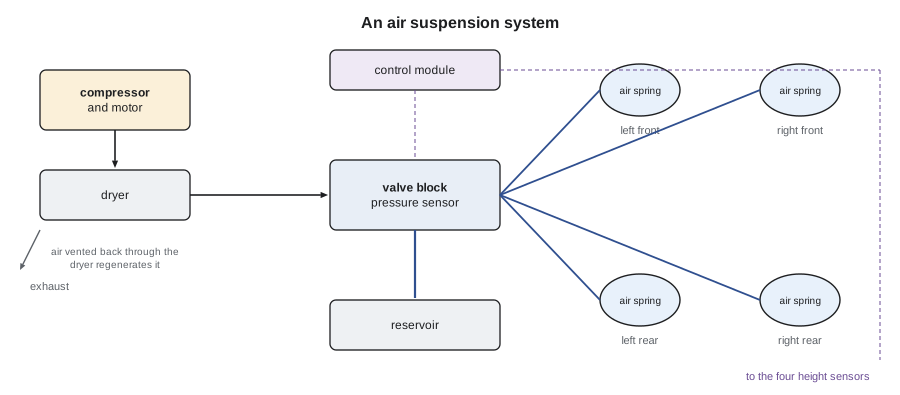
Here F is the load on the air spring, p is the gauge pressure inside it and A sub e is its effective area, the area over which the pressure effectively pushes; it depends on the bladder's shape and changes slightly as the spring compresses. Because the pressure can be changed, the spring's rate and the vehicle's height can be changed too. A full system has a compressor driven by an electric motor, a dryer that removes moisture from the air before it reaches the springs, a valve block with a solenoid valve for each spring, often a reservoir tank so that the vehicle can be raised quickly without running the compressor, pressure and temperature sensors, the ride height sensors and a control module.
# Air spring load from pressure and effective area
UNITS = "US"
area_cm2 = 95.0                        # effective area of one rear air spring, illustrative
for kpa in (550, 700, 850):
    load_n = kpa * 1000 * area_cm2 / 10000
    if UNITS == "metric":
        print(f"{kpa} kPa carries about {load_n / 9.81:5.0f} kg")
    else:
        print(f"{kpa * 0.145:3.0f} psi carries about {load_n / 4.448:5.0f} lb")
print("doubling the load at the same height needs about double the gauge pressure")80 psi carries about 1175 lb 102 psi carries about 1495 lb 123 psi carries about 1815 lb doubling the load at the same height needs about double the gauge pressure
When the system needs to raise a corner, it opens that spring's valve and either runs the compressor or draws air from the reservoir. When it lowers a corner, it opens the valve and an exhaust valve, and the air flows back through the dryer to the outside. That reverse flow carries away the moisture the dryer collected, regenerating it. A dryer that is saturated, because the system has been pumping air into a leak for weeks, lets water into the valves and springs, where it freezes in winter and corrodes the valves.
Service mode
An air suspension that is lifted on a hoist sees all four wheels drop. If the module is still active, it may try to correct the height by venting or filling the springs, and when the vehicle is lowered it may sit on its bump stops until the compressor catches up, or worse, a corner may move while someone is underneath. Every manufacturer gives a procedure to prevent this. Usually a scan tool or a menu in the vehicle puts the system into a service, jack or tire-change mode that suspends leveling; some systems need a fuse or relay removed. Before working on an air spring or line, the system is depressurized in the way the service information describes, because a line or fitting removed under pressure can blow out with great force. Air springs must never be inflated when they are not installed and restrained: a bladder that is not held by its mounts can burst.
Why leaks show up in the cold
Air contracts as it cools. A tightly sealed air spring that is filled to height in a warm garage loses pressure overnight in the cold, and the vehicle sinks a little even with no leak at all. The ideal gas law describes the effect: at a fixed volume, the absolute pressure is proportional to the absolute temperature. A small leak that loses only a little air on a mild night combines with the cold to drop a corner much further on a frigid one, and on a very cold night, the rubber of an old bladder stiffens and cracks where it folds over its piston, so the leak itself gets worse. That is why Harold's SUV is always worst on cold mornings.
In this relation the pressures are absolute pressures, gauge pressure plus atmospheric pressure, and the temperatures are absolute temperatures in kelvins, degrees Celsius plus 273.15. The code separates the part of Harold's overnight pressure loss caused by cooling from the part caused by a leak.
# Overnight pressure loss in an air spring: how much is temperature and how much is a leak?
UNITS = "US"
atm = 83                      # local atmospheric pressure, kPa (higher altitude, lower pressure)
p_evening, t_evening = 700, 12   # gauge kPa and air temperature C when parked
p_morning, t_morning = 455, -18  # gauge kPa and temperature C next morning
p_expected = (p_evening + atm) * (t_morning + 273.15) / (t_evening + 273.15) - atm
cooling_loss = p_evening - p_expected
leak_loss = p_expected - p_morning
if UNITS == "metric":
    print(f"expected from cooling alone: {p_expected:5.0f} kPa (loss {cooling_loss:4.0f} kPa)")
    print(f"actual: {p_morning} kPa, so about {leak_loss:4.0f} kPa was lost to a leak")
else:
    print(f"expected from cooling alone: {p_expected * 0.145:5.1f} psi (loss {cooling_loss * 0.145:4.1f} psi)")
print(f"actual: {p_morning * 0.145:5.1f} psi, so about {leak_loss * 0.145:4.1f} psi was lost to a leak")expected from cooling alone: 89.6 psi (loss 11.9 psi) actual: 66.0 psi, so about 23.6 psi was lost to a leak
Cooling alone explains only about a third of the overnight loss. The rest is a leak, and a real one.
Finding the fault
Marty starts with the scan tool. The module has stored codes for the compressor running too long and for the left rear corner failing to reach its target height, and it has a duty-cycle counter showing that the compressor has been running far more than normal for weeks. Compressors on these systems are not built to run continuously. They have thermal protection that shuts them down when they overheat, and a compressor that has been pumping into a leak for weeks is often worn out by the time the vehicle arrives. Replacing the compressor without fixing the leak only means the new one fails too.
Next comes the leak search. With the vehicle in service mode on the hoist, its springs supported and the system pressurized from the reservoir, Kiran sprays a soap solution over the left rear air spring, its fittings and the line to the valve block. A cluster of bubbles grows from the bladder where it rolls over its lower piston, in a fold that has cracked with age. The other springs and the valve block are dry. The left rear air strut is replaced with a new assembly, the system is refilled, and the compressor's current draw and run time are tested against the service information. The compressor is slow to fill the reservoir, so it is replaced too, along with its dryer. Finally the ride height is checked against specification at each corner, and because the strut and its height sensor link were disturbed, the ride height calibration is run with the scan tool.
# Compressor run time and duty cycle check (illustrative limits)
runs = [            # minutes of compressor running in each hour, from the module's log
    ("week 1", 2.0), ("week 2", 3.5), ("week 3", 6.0), ("week 4", 11.0),
]
limit = 4.0         # minutes per hour the compressor is designed for, illustrative
for week, minutes in runs:
    duty = minutes / 60 * 100
    flag = "normal" if minutes <= limit else "too high: look for a leak first"
print(f"{week}: {minutes:4.1f} min per hour, duty {duty:4.1f} %, {flag}")week 1: 2.0 min per hour, duty 3.3 %, normal week 2: 3.5 min per hour, duty 5.8 %, normal week 3: 6.0 min per hour, duty 10.0 %, too high: look for a leak first week 4: 11.0 min per hour, duty 18.3 %, too high: look for a leak first
Conversion kits and owner choices
Air suspension parts are expensive, and some owners ask for a conversion kit that replaces the air springs with coil springs and conventional dampers, with an electronic module that fools the vehicle's control module into thinking the system is still there. Kits are sold for many vehicles. The technician's job is to explain what the owner gives up: self-leveling with a load or trailer, the ability to raise the vehicle, and possibly functions that depend on the system, such as automatic headlight leveling. The owner decides, and the repair order records the decision. Harold chooses the original parts.
Electronic suspension and the rest of the vehicle
Electronic suspension is connected to other systems on the vehicle network. Some vehicles lower themselves at highway speed to reduce drag, kneel for easier loading, or tell the stability control system that the vehicle is loaded. Headlight leveling uses the same height sensors. Driver assistance cameras and radar, covered in AUTO-420, are aimed relative to the body, so a vehicle sitting at the wrong height sees the road at the wrong angle. All of this is why the final step of nearly every electronic suspension repair is a check of the ride height, a calibration if the service information calls for one, and a road test with the scan tool connected.
Worked problem
How much pressure does Harold's rear spring need with a trailer?
With the SUV empty, each rear air spring carries about 1,370 lb at 93 psi gauge pressure. Harold's camping trailer adds about 400 lb to each rear corner. Roughly what pressure holds the same height?
Show solution
- At the same height the effective area is about the same, so pressure is proportional to load.
- The new load is 1,370 + 400 = 1,770 lb.
- Pressure rises by 1,770 / 1,370 ≈ 1.29.
- 93 × 1.29 ≈ 120 psi.
Answer: About 120 psi. The system does this automatically, which is what a coil spring conversion gives up.
Common mistakes
MistakeLifting an air-suspended vehicle without putting the system into service mode.
InsteadUse the service or jack mode, or the procedure the manufacturer gives, before lifting.
MistakeReplacing a worn-out compressor without finding the leak.
InsteadFind and fix the leak first; a compressor that pumped into a leak will fail again.
MistakeInflating an air spring that is not installed.
InsteadAir springs must be restrained by their mounts before they are pressurized.
MistakeSkipping the ride height calibration after replacing a strut or sensor.
InsteadThe module only knows the sensor voltage; calibrate as the service information requires.
MistakeFitting a conventional damper in place of an adaptive one.
InsteadUse the correct electronically controlled part, or the system will set faults.
Summary and key terms
- Adaptive dampers change their firmness with a solenoid valve or magnetorheological fluid, controlled by a module.
- Ride height sensors turn arm movement into a voltage that the module converts to height using a stored calibration.
- An air spring's load is its pressure times its effective area.
- An air system includes a compressor, dryer, valve block, reservoir, sensors and module.
- Service mode, depressurizing and restraining air springs keep air suspension work safe.
- Cold nights lower air spring pressure and reveal leaks.
- Repairs usually end with a height check, a calibration and a road test.
- Adaptive damper
- A damper whose firmness a control module can change while the vehicle moves.
- Magnetorheological fluid
- A fluid whose thickness changes in a magnetic field.
- Ride height sensor
- A sensor that measures suspension position and reports it as a voltage.
- Air spring
- A rubber bladder filled with compressed air that carries a corner of the vehicle.
- Dryer
- A part that removes moisture from the air before it reaches the air springs.
- Service mode
- A setting that stops an air suspension from leveling while the vehicle is lifted or worked on.
- Ride height calibration
- A scan tool procedure that teaches the module the sensor readings at a known height.
Practice problems
Work each problem on paper first, then reveal the answer to check.
Why do adaptive dampers usually default to firm when they fail?
Show answer
Firm damping keeps the body controlled and the vehicle safe to drive.
An air spring with an effective area of 15 in² holds 90 psi. What load does it carry?
Show answer
90 × 15 = 1,350 lb.
Why must a ride height sensor be calibrated after a strut is replaced?
Show answer
Its lever or link may have moved, so the module would level the vehicle to the wrong height.
What is the first step before lifting an air-suspended vehicle?
Show answer
Put the system into service or jack mode as the service information describes.
Lesson quiz · 5 questions
Score 60% or more to complete this lesson.
Create a free account to save your progress, take quizzes and earn a certificate.