
AUTO-130 · Lesson 11 of 12 · 21 min
Regenerative braking and brake-by-wire
Two complaints arrive on the same January morning, after a week of −15 °F nights. Dr. Amara Singh says her electric car “doesn't slow down properly” when she lifts off the accelerator on the way to work, though it is fine by the afternoon. And Ines Moreau, picking up her hybrid after the front rotor job in Lesson 7, mentions that her rear pads have never been replaced in 116,000 miles and asks whether that is safe. Marty smiles. “Same answer to both,” he says. “The motor does the braking, until it can't.”
This lesson explains how hybrids and electric vehicles brake with their motors, how much energy they can recover, what limits it, and how the vehicle blends motor braking and friction braking so that the driver feels a consistent pedal. It explains the brake-by-wire systems that make blending possible, how they protect the driver if they fail, and the safety rules for servicing them.
A motor that works as a generator
An electric drive motor can work in both directions. When the battery supplies current, the motor turns the wheels. When the wheels turn the motor and the inverter controls it as a generator, it converts the vehicle's kinetic energy into electrical energy and sends it back to the battery. The generator resists being turned, which slows the vehicle. This is regenerative braking, often called regen. Instead of turning the vehicle's energy into heat in the rotors, as Lesson 1 described, it stores much of it for the next acceleration.
Not all the energy comes back. The motor, the inverter and the battery each lose some as heat, and the tires and air take their share during the stop. In round numbers, between half and two-thirds of the kinetic energy of a moderate stop ends up back in the battery as energy that can be used again. In city driving, with a stop every block or two, that recovered energy is a large part of why hybrids and electric vehicles use so little energy, and why their friction brakes do so little work.
# Energy recovered by regenerative braking in a stop, and over a day of city driving
UNITS = "US"
mass = 1690                       # kg, Dr. Singh's car with driver
v_kmh = 50
eff_motor_inverter = 0.90
eff_battery_in = 0.95
eff_battery_out = 0.95            # losses when the stored energy is used again
v = v_kmh / 3.6
ke = 0.5 * mass * v ** 2          # J
road_losses = 0.15                # share taken by tires and air during the stop
recovered = ke * (1 - road_losses) * eff_motor_inverter * eff_battery_in
usable = recovered * eff_battery_out
print(f"kinetic energy at {v_kmh if UNITS == 'metric' else round(v_kmh / 1.609)} {'km/h' if UNITS == 'metric' else 'mph'}: {ke / 1000:5.0f} kJ")
print(f"stored in the battery: {recovered / 1000:5.0f} kJ; usable again: {usable / 1000:5.0f} kJ ({usable / ke * 100:.0f} % of the kinetic energy)")
stops = 80
day_kwh = usable * stops / 3.6e6
print(f"{stops} such stops a day: about {day_kwh:.1f} kWh recovered, " + (f"about {day_kwh / 17 * 100:.0f} km of driving" if UNITS == "metric" else f"about {day_kwh / 0.274:.0f} miles of driving"))kinetic energy at 31 mph: 163 kJ stored in the battery: 118 kJ; usable again: 113 kJ (69 % of the kinetic energy) 80 such stops a day: about 2.5 kWh recovered, about 9 miles of driving
What limits regenerative braking
Regen cannot do every stop. Its braking force is limited in several ways, and in each case the friction brakes must make up the difference.
- Power. The motor and inverter can absorb only so much power, and the battery can accept only so much charging current. In a gentle stop the power is small, and regen can do all of it; in a hard stop from highway speed the power is many times larger, and the friction brakes must do most of the work.
- Speed. At very low speed the motor produces too little voltage to charge the battery effectively, so the last few miles per hour of every stop are usually done by the friction brakes, which also hold the vehicle still.
- Battery temperature. A cold battery cannot accept charging current quickly without damage, so the battery management system limits regen until the battery warms up. On a Denver winter morning, a car that has sat outside overnight may allow little or no regen for the first part of a drive, unless it was plugged in and preconditioned.
- Battery charge. A full battery has no room for more energy. After a full overnight charge, regen is limited until some charge has been used, which is why many owners set their daily charge limit below 100 percent.
- Driven axle. Regen works only through the wheels connected to a motor. A front-wheel-drive hybrid like Ines Moreau's can regenerate only through its front wheels, and in a hard stop the rear wheels' share must come from friction brakes in any case. Stability control can also limit regen on slippery roads, to keep the driven wheels from slipping.
# How a cold, fully charged battery changes the split between regen and friction brakes
UNITS = "US"
mass = 1690
def split(decel_g, speed_kmh, regen_limit_kw):
    force = mass * 9.81 * decel_g                 # N needed
    power = force * speed_kmh / 3.6 / 1000         # kW needed at that speed
    regen = min(power, regen_limit_kw)
    return power, regen, power - regen
cases = [("warm battery at 70 % charge", 60), ("cold battery, early morning", 15), ("cold and fully charged", 3)]
for name, limit in cases:
    p, r, f = split(0.15, 60, limit)               # a gentle 0.15 g lift-off slowdown at 60 km/h
    print(f"{name:<30} need {p:4.0f} kW: regen {r:4.0f} kW, friction {f:4.0f} kW ({f / p * 100:3.0f} % friction)")
print("the car makes up the difference so the deceleration stays the same in the normal driving mode,")
print("but in one-pedal mode it may simply slow less, and show a message that regen is limited")warm battery at 70 % charge need 41 kW: regen 41 kW, friction 0 kW ( 0 % friction) cold battery, early morning need 41 kW: regen 15 kW, friction 26 kW ( 64 % friction) cold and fully charged need 41 kW: regen 3 kW, friction 38 kW ( 93 % friction) the car makes up the difference so the deceleration stays the same in the normal driving mode, but in one-pedal mode it may simply slow less, and show a message that regen is limited
That is the answer to Dr. Singh's complaint. Her car is set to one-pedal driving, a mode in which lifting off the accelerator gives strong regen, enough to stop the car in most traffic without touching the brake pedal. On cold mornings, with a battery that has been charged to full overnight, the battery management system limits regen. Her car's design reduces the one-pedal slowdown and shows a message on the dash rather than secretly applying the friction brakes, so the car coasts further than she expects. Kiran checks the car's history for codes, finds none, and confirms with the scan tool that the battery temperature was 7 °F at the start of her drive this morning. She explains the behavior, shows Dr. Singh the message on the screen, and suggests scheduling departure preconditioning while the car is plugged in, which warms the battery before she leaves, and setting a lower daily charge limit.
Blending regen and friction
When the driver presses the brake pedal in a hybrid or electric vehicle, the driver is asking for a deceleration, not for a particular pressure in the calipers. The brake control module works out the deceleration requested from the pedal's travel and force sensors, asks the powertrain controller how much regen is available at that moment, uses as much regen as it can, and makes up the rest with friction braking. As the vehicle slows and regen falls away at low speed, the module smoothly raises the friction pressure, so the driver feels a steady deceleration throughout the stop. This is called blended braking, or brake blending.
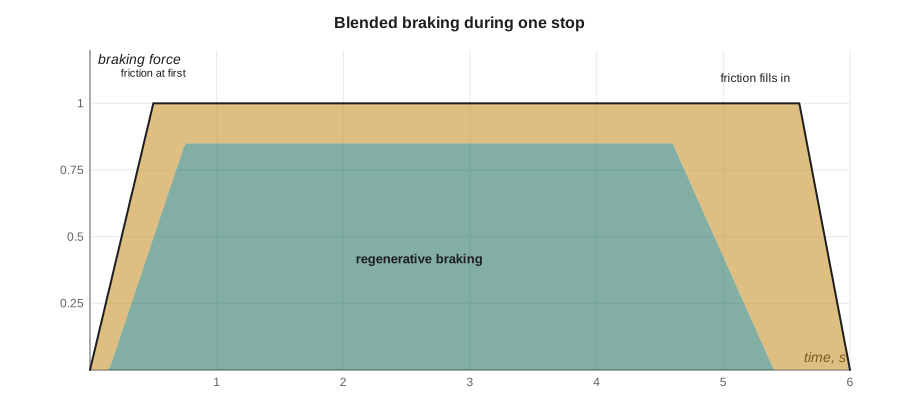
Good blending is hard to achieve, because the driver's foot is very sensitive to small changes in pedal feel and deceleration. That is why most blended systems separate the pedal from the calipers in normal operation. The driver pushes against a pedal feel simulator, a spring and damper that give a natural pedal, while the module makes the actual caliper pressure with an electric pump or motor-driven piston. Since the hydraulic pressure no longer comes directly from the driver's foot, the system is called brake-by-wire.
Because their friction brakes do so little of the work, hybrids and electric vehicles often go very far on one set of pads, which answers Ines Moreau's question: her rear pads may well be fine. But long pad life does not mean long life for the rest of the brakes. Pads, slides and rotors that rarely work are prone to corrosion, as Lesson 7 showed on Dr. Singh's car, and brake fluid absorbs water at the same rate in any vehicle. Kiran measures Ines's rear pads: they have more than half their material left and wear evenly, but one rear caliper's guide pins are stiff and its boots are dry. She services the slides, measures and records the rotors, and recommends a brake fluid flush, which is overdue by the schedule.
How brake-by-wire systems are built and how they fail safely
A typical integrated brake-by-wire system has a single unit on the firewall with the master cylinder, the pedal feel simulator, an electric pressure source, the valves for each wheel, pressure sensors and the control module. The pressure source may be a motor driving a plunger directly, or a pump that charges a high-pressure accumulator; either can build full braking pressure in a fraction of a second, which also makes the system ideal for stability control and automatic emergency braking. Pedal travel sensors, often two for redundancy, and pressure sensors tell the module what the driver wants and what the brakes are doing.
If the electric pressure source or the module fails, the system falls back to a direct hydraulic connection: valves that are open when not powered connect the driver's master cylinder straight to the calipers, and the simulator is shut off. The driver can still stop the vehicle with foot force alone, though the pedal feels harder and longer and regen and anti-lock control may be lost; warning lamps and messages tell the driver to have the system checked. Some designs also have a second, independent electronic path so that a single fault does not remove power assistance. The regulations that set stopping performance after a failure apply to these systems as to any other.
# Brake-by-wire fallback: pedal force needed for a moderate stop with and without the electric pressure source
UNITS = "US"
pedal_ratio = 3.0
mc_area_mm2 = 380             # small master cylinder used in fallback, illustrative
needed_mpa = 3.0              # line pressure for about 0.3 g in this car, illustrative
foot_no_power = needed_mpa * mc_area_mm2 / pedal_ratio      # N
foot_normal = 60                                             # N, typical with the system working (the simulator sets the feel)
for label, f in [("system working", foot_normal), ("fallback, no electric pressure", foot_no_power)]:
    if UNITS == "metric":
        print(f"{label:<32} about {f:4.0f} N of foot force")
    else:
        print(f"{label:<32} about {f * 0.2248:4.0f} lb of foot force")
print("the fallback still stops the car, but needs a much firmer push, so the driver is warned")system working about 13 lb of foot force fallback, no electric pressure about 85 lb of foot force the fallback still stops the car, but needs a much firmer push, so the driver is warned
Servicing hybrid and electric brakes safely
Brake work on hybrids and electric vehicles uses the same skills as on any vehicle, but it adds three kinds of hazard, and the service information always comes first.
- Unexpected brake application. Integrated systems may run self-tests and build pressure when a door opens, the driver's seat is occupied, or the vehicle is unlocked. Before working on calipers or lines, the system is put into its maintenance mode, or disabled in the way the manufacturer specifies, as Lessons 5 and 9 described.
- Stored hydraulic energy. Systems with high-pressure accumulators can hold enough pressure to spray fluid with great force. The procedure for depressurizing them is followed before any line is opened, and the system is bled with the scan tool procedure afterwards.
- High voltage. Ordinary pad, rotor and caliper work does not usually involve the high-voltage system, but cables and components with orange insulation may be near the brakes, and the vehicle may be able to move silently. The vehicle is shut down with the key or key fob away from it, as AUTO-110 explained. Any work that requires disconnecting the high-voltage system is done only by a qualified technician such as Marty, with the proper procedure and protective equipment.
Brake lamps need care on these vehicles too. Strong regen can slow a car as much as a light brake application without the driver touching the brake pedal, so the vehicle turns on its brake lamps when regen deceleration passes a set level, as the safety standards require. A driver complaint that the brake lamps flicker in one-pedal mode is usually normal operation, not a fault.
Worked problem
Two complaints, one answer
Write the explanations for Dr. Singh's and Ines Moreau's repair orders.
Show solution
- Dr. Singh: on cold mornings with a full charge, the battery cannot accept regen current, so the car limits regen and its one-pedal slowdown is weaker; the car shows a message when this happens. No fault was found. Preconditioning while plugged in and a lower daily charge limit will restore normal regen sooner.
- Ines Moreau: the hybrid's motor does most of the braking, so the rear pads wear very slowly; they have more than half their material left and wear evenly. One rear caliper's slides were stiff and were serviced. The brake fluid is overdue by the schedule and should be flushed.
- Both vehicles' friction brakes do little work, so their slides, rotors and fluid need regular inspection even when the pads look new.
Answer: Regen does most of the braking until temperature, charge, speed or power limits it; the friction brakes still need regular inspection and service.
Common mistakes
MistakeTreating weak cold-morning regen as a fault.
InsteadCheck the battery temperature and charge; limited regen is normal then.
MistakeAssuming long pad life means the brakes need no service.
InsteadInspect slides, rotors and fluid on schedule.
MistakeOpening brake lines on an accumulator system without depressurizing it.
InsteadFollow the depressurizing procedure first.
MistakeWorking on calipers of an integrated system without its maintenance mode.
InsteadDisable self-tests as the manufacturer specifies.
MistakeTreating brake lamps that light in one-pedal mode as a fault.
InsteadRegen above a set deceleration turns them on by design.
Summary and key terms
- Regenerative braking runs the drive motor as a generator, returning part of the kinetic energy to the battery.
- Regen is limited by power, low speed, battery temperature, battery charge and which axle is driven.
- Blended braking uses as much regen as possible and fills the rest with friction braking for a steady deceleration.
- Brake-by-wire separates the pedal from the calipers, with a pedal feel simulator and an electric pressure source.
- If the system fails, valves connect the master cylinder straight to the brakes, with a harder pedal.
- Service needs maintenance modes, depressurizing and high-voltage awareness.
- Regenerative braking
- Slowing the vehicle by running the drive motor as a generator to charge the battery.
- One-pedal driving
- A mode with strong regen when the driver lifts off the accelerator.
- Blended braking
- Combining regen and friction braking to give the deceleration the driver asks for.
- Brake-by-wire
- A system in which the brake pressure is produced electrically on command from pedal sensors.
- Pedal feel simulator
- A spring and damper unit that gives the pedal a natural feel in a brake-by-wire system.
- Hydraulic fallback
- The direct connection from the master cylinder to the brakes used if the electric system fails.
- Preconditioning
- Warming the battery and cabin from the charger before a drive.
Practice problems
Work each problem on paper first, then reveal the answer to check.
Name three conditions that limit regenerative braking.
Show answer
Low speed, a cold battery, a full battery, high power demand, or slippery roads.
Why do hybrid pads often last a very long time?
Show answer
Regen does most of the braking, so the friction brakes do little work.
What does a pedal feel simulator do?
Show answer
It gives the driver a natural pedal while the module makes the actual brake pressure.
What happens to the pedal if a brake-by-wire system loses its electric pressure source?
Show answer
It falls back to a direct hydraulic connection; the pedal is harder and longer but still stops the car.
Lesson quiz · 5 questions
Score 60% or more to complete this lesson.
Create a free account to save your progress, take quizzes and earn a certificate.