
ARCH-520 · Lesson 4 of 12 · 21 min
Project management
The co-op board chose Wren's firm, at least in the imagined world of the seminar, and in the fourth week Moss moves the story forward fourteen weeks. Schematic design was approved on time. Design development is under way, but the residents' second workshop produced a long list of requests, the mechanical engineer changed the heating system after a cost review, and the project architect was sick for two weeks. Wren has a feeling that the project is behind and over budget but cannot say by how much. Moss says that feeling is the moment most small firms discover project management, usually too late. This week the students learn the tools that would have told Wren exactly where she stood on week six.
Marisol Ortiz, the design-builder who visited in the first week, returns for the afternoon. In her company a project that runs late or over budget costs real money within days, because crews and subcontractors are waiting. She says architects who have worked in design-build manage their design schedules more tightly than most, because they have seen what a late drawing costs on site.
What a project manager does
A project manager in an architecture firm is responsible for delivering the project the client contracted for, on time, within the fee and to the firm's standard of quality. In a small firm the project manager is often also the project architect, who leads the design and technical work. In a larger firm the roles may be separate. Either way, the project manager plans the work, assembles and directs the team, coordinates the consultants, communicates with the client, tracks progress, manages changes and reports to the principal in charge. Moss tells the students that the job is less about control than about information: knowing at every moment what has been done, what remains, what it will cost and what decisions are needed from whom.
The work plan and the schedule
Every project begins with a work plan, which Wren already built for her proposal: the phases, the tasks in each, the hours by role and the deliverables. The project manager turns it into a schedule that shows when each task will start and finish, which tasks depend on others, when the client must make decisions and when approvals are expected. For a building like the co-op, the critical decisions include approval of the schematic design, the choice of structural and mechanical systems, the selection of exterior materials and the final layout of the suites. Each decision has a date, and each late decision pushes the drawings that depend on it.
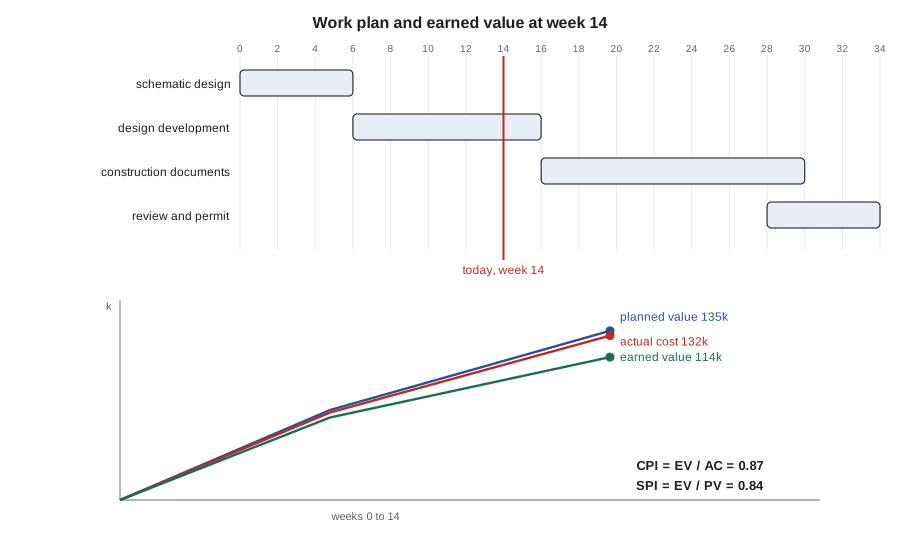
Moss recommends a simple schedule: phases and milestones on one page, updated every two weeks, shared with the client and consultants. Complex software is not needed for a project of this size, but the discipline of updating the schedule is. A schedule that was made for the proposal and never opened again is worse than none, because it gives everyone false comfort.
Tracking the budget with earned value
Most small firms track project budgets by comparing hours spent with hours budgeted. That comparison is useful but incomplete: a project that has spent half its hours may be fine if half the work is done, or in trouble if only a third is. Earned value management, a method developed for large engineering and defense projects and now used in many professions, adds the missing piece by comparing three numbers.
- Planned value: the budget for the work that was scheduled to be done by now.
- Earned value: the budget for the work that has actually been done, estimated as the share of each phase completed multiplied by that phase's budget.
- Actual cost: what has been spent so far, in hours multiplied by billing rates.
From these three numbers come two indexes. The cost performance index, earned value divided by actual cost, shows how efficiently the work is being done: below 1.0 means the firm is spending more than the budget allows for the work done. The schedule performance index, earned value divided by planned value, shows whether the work is on schedule: below 1.0 means the firm has done less than it planned. The estimate at completion, the total budget divided by the cost index, forecasts the final cost if the present efficiency continues.
# Earned value at the end of week 14 of design development (US dollars).
budget = {"schematic design": 77_000, "design development": 100_000, "construction documents": 148_000}
planned_done = {"schematic design": 1.00, "design development": 0.60, "construction documents": 0.05}
actual_done = {"schematic design": 1.00, "design development": 0.45, "construction documents": 0.00}
actual_cost = 139_800                  # staff time at billing rates booked to date
pv = sum(budget[p] * planned_done[p] for p in budget)     # planned value
ev = sum(budget[p] * actual_done[p] for p in budget)      # earned value
bac = sum(budget.values())                                # budget at completion
cpi, spi = ev / actual_cost, ev / pv
eac = bac / cpi                                           # estimate at completion if efficiency holds
print(f"planned value {pv:>10,.0f}   earned value {ev:>10,.0f}   actual cost {actual_cost:>10,.0f}")
print(f"cost performance index    {cpi:.2f}  (below 1.00 means over budget)")
print(f"schedule performance index {spi:.2f}  (below 1.00 means behind plan)")
print(f"estimate at completion {eac:,.0f} against a budget of {bac:,.0f}: {eac - bac:+,.0f}")
tcpi = (bac - ev) / (bac - actual_cost)                    # to-complete performance index
print(f"to finish on budget the remaining work must run at CPI {tcpi:.2f}")planned value 144,400 earned value 122,000 actual cost 139,800 cost performance index 0.87 (below 1.00 means over budget) schedule performance index 0.84 (below 1.00 means behind plan) estimate at completion 372,418 against a budget of 325,000: +47,418 to finish on budget the remaining work must run at CPI 1.10
The numbers confirm Wren's feeling and measure it. The project has earned about 122,000 dollars of value but spent about 139,800 dollars, a cost index of 0.87. It is also behind schedule, with a schedule index of 0.84. If the rest of the project runs at the same efficiency, it will cost about 47,000 dollars more than budgeted, a loss of most of the firm's expected profit. To finish on budget, the remaining work would have to run at a cost index of 1.10, better than the project has achieved so far, which Moss says rarely happens without a change in approach.
| Index | Formula | Wren's project | Meaning |
|---|---|---|---|
| Cost performance (CPI) | EV / AC | 0.87 | Spending 1.15 for every 1.00 of work earned |
| Schedule performance (SPI) | EV / PV | 0.84 | Has done 84% of the work planned by now |
| Estimate at completion (EAC) | BAC / CPI | about 15% over budget | Forecast final cost if efficiency holds |
| To-complete index (TCPI) | (BAC − EV) / (BAC − AC) | 1.10 | Efficiency needed on the rest to finish on budget |
Finding the cause
The indexes say that something is wrong but not what. Moss asks Wren to look at three questions. First, did the scope change? The residents' requests added two design options for the common room and a redesign of the suite bathrooms for wheelchair users. Some of this was within the scope Wren promised, because she offered resident workshops, but the second bathroom redesign followed a request the board had approved after the schematic design was signed off. Second, did the team change? The project architect's two-week absence meant that Wren, at a principal's rate, did work planned for the project architect. Third, was the estimate wrong? The mechanical change cost thirty hours of coordination that no one had foreseen.
Each cause has a different response. The approved change after sign-off is an additional service, and Wren should raise it with the board now, with a written estimate, rather than at the end of the project. The cost of the absence is real but cannot be recovered; the lesson is to plan backup for key roles. The mechanical coordination could have been avoided by a cost review earlier in schematic design, and the lesson goes into the firm's checklist. Moss notes that the hardest part is the conversation with the client, and that it is far easier at week fourteen than at week forty.
Managing change
Changes are a normal part of design, and clients have every right to change their minds. The project manager's job is to make the cost of each change visible before it is made. Moss teaches a simple change process. When the client asks for something that may be outside the agreed scope, the project manager acknowledges the request, checks it against the scope of services, estimates the hours and the effect on the schedule, and sends the client a short written note asking for approval before the work begins. Most clients appreciate this, because it lets them decide whether a change is worth its cost. The firms that suffer are those that say yes to everything in the meeting and send a large invoice months later.
Moss adds that the change process should follow the contract. AIA B101 requires the owner's authorization for additional services, and an architect who performs extra work without it may find the claim hard to support. A short email confirming the request, the estimate and the owner's approval is usually enough.
Meetings, decisions and records
Ortiz describes the meeting rhythm her company uses on every project: a short internal meeting every week to review progress and problems, a client meeting every two weeks during design with an agenda sent in advance, and a written record of every decision within two days. She says that the record is the most important part. Months later, when someone asks why the windows are a certain size, the answer is in the minutes, with the date and the name of the person who decided.
Moss adds three habits for project managers. First, keep a decision log: a single list of every decision the client has made, when and by whom, with references to the drawings. Second, keep an issues list of open questions, each with an owner and a date. Third, protect the team's time. A project manager who accepts every meeting request and every late client email at face value will find the team constantly interrupted, and productivity will fall. Agreeing on how and when the client and consultants will communicate, at the start of the project, prevents much of this.
The team and its workload
A project's performance depends on the people assigned to it. The project manager must make sure the team has the right mix of experience, that each person knows what is expected of them, and that no one is overloaded or idle. In a small firm, people work on several projects at once, and the project manager must negotiate their time with other project managers and the principals. Moss recommends a weekly staffing meeting where the firm's project managers review the next four weeks of work and resolve conflicts. She warns that the most common cause of late projects in small firms is not poor work but competing demands on the same few people.
Closing the project
A project is not finished when the building opens. The project manager should close out the contract, issue the final invoice, return any retainer as agreed, archive the drawings and records, and hold a short review with the team: what went well, what went wrong and what the firm will do differently. Ortiz says her company also visits each client a year after completion. The visits produce some of the firm's best design lessons and most of its repeat work.
Worked problem
Responding to an earned value report
At week 14 the cost index is 0.87, the schedule index 0.84 and the forecast overrun is about 15% of the fee budget. What should the project manager do this week?
Show solution
- List the causes: an approved change after sign-off, a key person's absence and an unforeseen coordination task.
- Prepare a written estimate for the approved change and ask the client to authorize it as an additional service.
- Re-plan the remaining phases: confirm the team, assign backup for key roles and agree the client's decision dates.
- Report the forecast and the plan to the principal in charge, with the expected recovery.
- Record the lessons in the firm's checklist: earlier cost review of mechanical systems and backup for key roles.
Answer: Act on each cause separately, seek authorization for the change now, re-plan the rest and record the lessons.
Exercise 4: a project control sheet
- Prepare a one-page schedule for a project with phases, milestones and client decisions.
- Calculate planned value, earned value, actual cost, CPI, SPI and the estimate at completion at a point of your choice.
- Write a change request for a client request that falls outside the scope.
- Set up a decision log and an issues list for the first month of the project.
Self-check
- Can I calculate and explain CPI and SPI?
- Do I know the difference between hours spent and value earned?
- Do I make the cost of each change visible before the work begins?
- Do I keep a written record of every decision?
Common mistakes
MistakeTracking only hours spent against hours budgeted.
InsteadEstimate the work completed and calculate earned value.
MistakeWaiting until the end of a phase to look at the budget.
InsteadReview earned value every two weeks.
MistakeDoing extra work without the client's written authorization.
InsteadEstimate each change and obtain approval before starting.
MistakeLetting the schedule from the proposal go out of date.
InsteadUpdate the schedule every two weeks and share it.
MistakeRelying on memory for client decisions.
InsteadKeep a decision log with dates and names.
Summary and key terms
- Project management is about information: what is done, what remains, what it costs and what decisions are needed.
- A simple schedule, updated and shared, is better than a detailed one that is never opened.
- Earned value compares planned value, earned value and actual cost to measure both cost and schedule performance.
- Each cause of an overrun needs its own response, and changes must be estimated and authorized before the work begins.
- Meetings, decision logs, issues lists and close-out reviews keep projects under control and teach the firm.
- Planned value
- The budget for the work scheduled to be done by a given date.
- Earned value
- The budget for the work actually completed by a given date.
- Cost performance index
- Earned value divided by actual cost.
- Schedule performance index
- Earned value divided by planned value.
- Decision log
- A record of every client decision with its date and the person who made it.
Practice problems
Work each problem on paper first, then reveal the answer to check.
A phase has a budget of 100,000. It is 40% complete and has cost 50,000. What are its earned value and cost index?
Show answer
Earned value 40,000; cost index 40,000 / 50,000 = 0.80.
If a project's budget at completion is 300,000 and its CPI is 0.90, what is the estimate at completion?
Show answer
300,000 / 0.90 = about 333,000.
Planned value is 120,000 and earned value is 108,000. What is the SPI, and what does it mean?
Show answer
0.90: the project has done 90% of the work it planned to do by now.
Why is the conversation about overruns easier early in a project?
Show answer
There is time to change the plan and the client can make informed decisions before costs are committed.
Name two habits that protect a team's productivity.
Show answer
Agreeing how and when the client communicates, and a weekly staffing meeting to resolve conflicts between projects.
Lesson quiz · 5 questions
Score 60% or more to complete this lesson.
Create a free account to save your progress, take quizzes and earn a certificate.