
ARCH-520 · Lesson 2 of 12 · 21 min
Marketing and winning work
In the second week Moss asks each student to name the first five clients their imagined firm would call. Wren lists three non-profit housing providers and two co-operatives. Callum names four architecture firms that might hire him for energy modeling and one school board. Ingrid lists a lake association, a family she knows who want a cabin, a church that needs an addition and two small businesses. Joon-ho says that his clients are the people who will rent his apartments, and that he has never met them. Moss says that the lists are the beginning of a marketing plan. Every firm, however talented, needs a steady flow of work, and no client hires a firm it has never heard of.
Rosa Delgado, the development director of Greenway Homes, joins the class for the morning. Greenway has hired architects for more than twenty projects, and she explains how it chooses them. She tells the students that marketing is not advertising. Architecture firms rarely buy advertisements. They win work through reputation, relationships and the proposals and interviews that turn an opportunity into a contract.
Marketing and business development
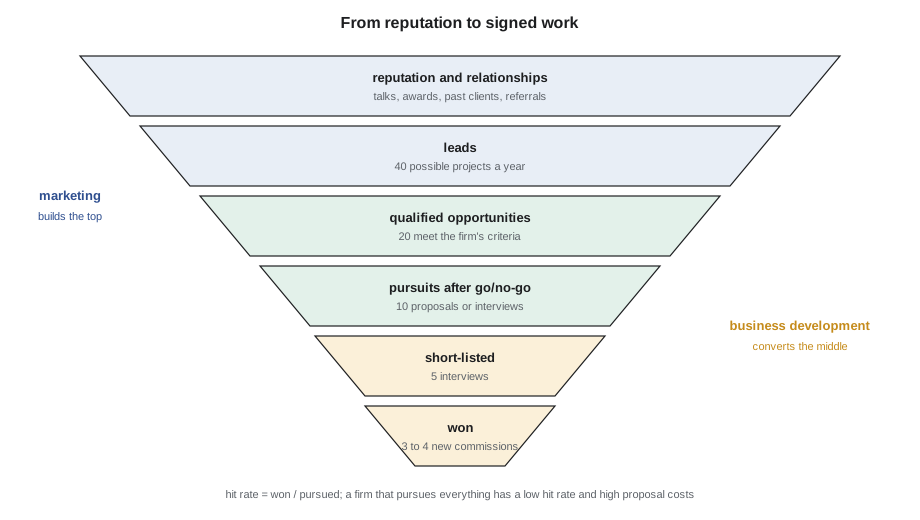
Moss distinguishes two activities. Marketing builds the firm's reputation and makes it known to the clients it wants: a clear position, a website and portfolio, published projects, awards, talks, articles, community involvement and the relationships its people build over years. Business development turns that reputation into signed work: finding opportunities, deciding which to pursue, writing proposals, preparing for interviews and negotiating contracts. In a small firm the same people do both, usually the principals. In a large firm there may be a marketing department, but the principals still lead the pursuits, because clients want to meet the people who will do the work.
The best source of new work is old work. Satisfied clients return and recommend the firm to others, and Delgado says that more than half of Greenway's architects are firms it has used before. A firm that does excellent work, communicates well and keeps to budgets and schedules is marketing every day. A firm that leaves one client unhappy may lose not only that client but the others who hear about it.
Positioning: what the firm stands for
A firm's position is a short answer to the question a client asks first: why should we hire you? Moss tells the students that a position must be specific, true and valuable to the client. 'We do good design' is none of these, because every firm says it. 'We design housing for non-profit owners that is easy to maintain, comfortable for seniors and built within public funding limits' is specific, can be proven by past work, and speaks to a client's real concerns. A position helps a small firm in two ways: clients looking for that expertise find it, and the firm knows which opportunities to pursue and which to decline.
Wren drafts her firm's position: Common Room Architects designs homes for people who are often designed for last, including seniors, families on modest incomes and people living with disabilities, for owners who must make every dollar of public funding count. Delgado likes it but asks for proof. A new firm has no portfolio of its own, she says, so the founders must show the projects they led at other firms, describe them honestly and name the firm that did the work. She has seen founders claim credit for buildings they worked on as junior staff, and it ended their chances with her organization.
Where work comes from
Moss lists the main sources of work for a small practice.
- Repeat and referred clients: the most valuable source, built by good work and good service.
- Relationships: developers, contractors, engineers, other architects, municipal staff and community leaders who know the firm and recommend it.
- Public procurement: requests for qualifications or proposals from governments, school boards, universities and health authorities, usually advertised on public bidding sites.
- Competitions: open or invited design competitions, which can launch a reputation but cost a great deal of unpaid effort.
- Teaming: joining a larger firm as a consultant or partner, which lets a small firm work on projects it could not win alone.
- Direct outreach: approaching owners who are likely to build, such as housing providers with growing waiting lists or businesses expanding their premises.
For public work, the method of selection matters. Federal agencies in the United States must select architects and engineers on qualifications under the Brooks Act of 1972, negotiating the fee with the highest-ranked firm, and many states and cities have similar laws for their own projects. Other public owners weigh price as well as qualifications. Moss tells the students to read each request carefully: how much weight is given to price, what the evaluation criteria are and what the owner expects to receive. A request that weighs price at half the score is a different kind of opportunity from one that negotiates the fee after selecting the best-qualified firm.
Go or no-go
No firm can pursue every opportunity. Proposals cost time: a small public proposal may take forty hours of principal and staff time, a large one several hundred, and an interview more. A firm that pursues everything spreads itself thin, writes weak proposals and wins little. Moss teaches a go/no-go decision made before any proposal is started. The firm scores each opportunity against weighted criteria: how well the project fits the firm's expertise and position, how strong its relationship with the client is, its realistic chance of winning, the likely fee and profit, and whether it has the people to do the work if it wins. Opportunities below a threshold are declined politely, sometimes with a note to the client that keeps the relationship warm.
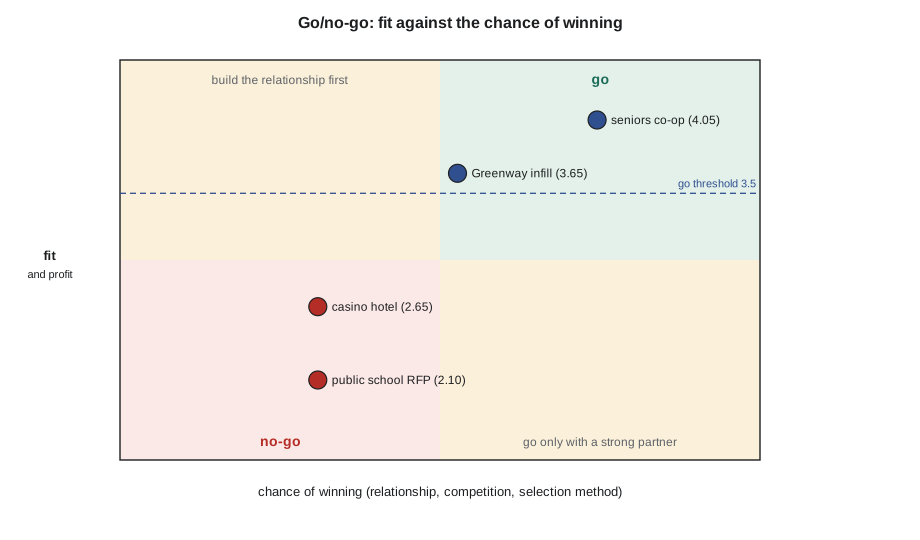
Wren applies the method to four opportunities her firm might see in its first year: a 24-home seniors co-operative whose board knows her, a casino hotel expansion with a large fee, a 12-home infill project for Greenway Homes, and a public school advertised by open request for proposals. The code below scores each, estimates its chance of winning from the relationship and competition, and calculates a weighted pipeline: the sum of each fee multiplied by its chance of winning.
# Go/no-go scoring and a weighted pipeline for a small housing studio (US dollars).
criteria = {"fit with our expertise": 0.25, "relationship with the client": 0.20, "chance of winning": 0.20,
            "fee and profit": 0.20, "capacity to staff it": 0.15}
pursuits = {  # name: scores 1-5 in the order above, fee, proposal cost
    "senior co-op, 24 homes": ([5, 4, 4, 3, 4], 330_000, 10_000),
    "casino hotel expansion": ([3, 2, 2, 4, 2], 1_550_000, 41_000),
    "Greenway Homes infill, 12 homes": ([4, 5, 3, 3, 3], 205_000, 5_000),
    "public school, open RFP": ([2, 1, 2, 2, 4], 940_000, 28_000),
}
GO = 3.5
print(f"{'pursuit':34}{'score':>6}{'decision':>9}{'win odds':>9}{'weighted fee':>13}")
total = 0
for name, (scores, fee, cost) in pursuits.items():
    score = sum(w * s for w, s in zip(criteria.values(), scores))
    odds = 0.10 + 0.12 * (scores[2] - 1)        # chance of winning from the third score
    weighted = odds * fee
    decision = "go" if score >= GO else "no-go"
    if decision == "go":
        total += weighted
    print(f"{name:34}{score:>6.2f}{decision:>9}{odds:>9.0%}{weighted:>13,.0f}")
spent = sum(c for s, f, c in pursuits.values() if sum(w * x for w, x in zip(criteria.values(), s)) >= GO)
print(f"weighted pipeline of the go pursuits: {total:,.0f}")
print(f"proposal cost of the go pursuits: {spent:,.0f} ({spent / total:.0%} of the weighted fees)")pursuit score decision win odds weighted fee senior co-op, 24 homes 4.05 go 46% 151,800 casino hotel expansion 2.65 no-go 22% 341,000 Greenway Homes infill, 12 homes 3.65 go 34% 69,700 public school, open RFP 2.10 no-go 22% 206,800 weighted pipeline of the go pursuits: 221,500 proposal cost of the go pursuits: 15,000 (7% of the weighted fees)
The casino hotel has the largest fee and the largest weighted value, but it scores poorly on fit, relationship and capacity, and a three-person firm that won it might not be able to staff it. The open school request scores lowest: Wren has no school experience, does not know the board and expects a dozen competitors. Both are no-go. The two housing projects pass the threshold, and together they are worth a weighted pipeline of about 221,500 dollars for proposal costs of about 7% of that amount. Delgado nods: a firm that chases the casino because the fee is large will often lose it, and meanwhile write a weak proposal for the work it could have won.
Moss adds that the hit rate, the share of pursuits a firm wins, is one of the most useful numbers a firm can track. A firm that wins one in ten is probably pursuing the wrong work or presenting itself poorly. A firm that wins one in two may be too cautious and missing opportunities. A healthy small firm often wins between a quarter and a third of what it pursues, with a much higher rate among repeat clients.
The proposal and the interview
A proposal is written for the client, not for the firm. Delgado says she reads the first page and the team page first, and decides within minutes whether a firm understands her project. The best proposals restate the client's goals in the client's words, show that the firm has thought about this project rather than projects in general, name the people who will actually do the work and show their relevant experience, explain the approach and schedule clearly, and answer every question in the request in the order asked. The worst are glossy brochures with generic text and pictures of buildings unlike the one the client wants.
If the firm is short-listed, the interview decides. Clients choose people they trust. Delgado watches how the team listens, whether they answer the question asked, whether the junior members speak, and whether the principal will really be involved. Moss advises the students to rehearse, to bring the people who will do the work, to ask the client questions, and to leave time for discussion rather than filling every minute with slides. After every pursuit, won or lost, the firm should ask the client for a debriefing. Most public owners will give one, and the lessons are worth more than any marketing consultant.
| Activity | Typical effort for a small firm | What it builds |
|---|---|---|
| Website and portfolio | A few days a year to keep current | Credibility when a client looks the firm up |
| Talks, articles, awards | One or two a year per principal | Reputation in the profession and the community |
| Relationship meetings | Several a month | Referrals and early knowledge of projects |
| Proposals | 40 to 200 hours each | Signed work, if chosen well |
| Debriefings after pursuits | An hour each | Better proposals and stronger relationships |
A marketing budget
Moss asks how much a firm should spend on marketing. Firms commonly spend a small share of their net revenue on it, often in the range of 2 to 5%, most of it as the time of principals and staff on proposals and relationships rather than as cash. For a small firm with a net revenue of half a million dollars, that is perhaps twenty to thirty thousand dollars a year, much of it in hours. She tells the students to plan the time explicitly, because marketing that is done only when there is nothing else to do is never done when the firm is busy, and that is when it matters most: the work won this year is the work that keeps the firm going next year.
Worked problem
Deciding on a pursuit
A municipal client invites Wren's firm to submit qualifications for a 60-home affordable housing building. The firm has three people and has never led a project of that size. What should it do?
Show solution
- Score the opportunity: excellent fit, a moderate relationship, low chance of winning alone, a good fee, and too little capacity.
- Recognize that the score is held down by size and capacity rather than by fit.
- Look for a teaming partner: a larger firm with experience of buildings that size, with Wren's firm leading the housing design and community engagement.
- Agree the roles, fee split and credit in writing before the submission.
- Submit jointly, and ask for a debriefing whatever the result.
Answer: Pursue it as a team with a larger firm, with the roles and fee split agreed in advance.
Exercise 2: a marketing plan
- Write your firm's position in two sentences that are specific, true and valuable to clients.
- List the ten clients or referral sources you would contact in the first three months, and how.
- Score three real opportunities from public bidding sites using the go/no-go criteria.
- Draft the first page of a proposal for the one that scores highest.
Self-check
- Can I distinguish marketing from business development?
- Is my firm's position specific, true and valuable?
- Do I decide go or no-go before starting a proposal?
- Do I know my likely hit rate and how to improve it?
Common mistakes
MistakePursuing every opportunity because any work seems better than none.
InsteadScore each opportunity and decline the ones the firm is unlikely to win or cannot staff.
MistakeWriting proposals about the firm instead of about the client's project.
InsteadRestate the client's goals and show how the team will meet them.
MistakeClaiming credit for work done as junior staff at another firm.
InsteadDescribe your role honestly and name the firm that did the work.
MistakeSending a different team to the interview from the one that will do the work.
InsteadBring the people the client will work with.
MistakeMarketing only when the firm runs short of work.
InsteadPlan marketing time every month, especially when busy.
Summary and key terms
- Marketing builds reputation; business development turns it into signed work.
- Repeat and referred clients are the most valuable source of work.
- A clear position helps clients find the firm and helps the firm choose its pursuits.
- A go/no-go decision before every proposal protects the firm's time and raises its hit rate.
- Proposals and interviews should be about the client's project and the people who will do the work.
- Position
- A specific, true statement of what the firm offers and for whom.
- Go/no-go
- A decision, made before a proposal is started, on whether to pursue an opportunity.
- Hit rate
- The share of pursued opportunities that the firm wins.
- Weighted pipeline
- The sum of potential fees multiplied by the chance of winning each one.
- Teaming
- Pursuing a project jointly with another firm.
Practice problems
Work each problem on paper first, then reveal the answer to check.
A pursuit has a fee of 400,000 dollars and a 25% chance of winning. What is its weighted value?
Show answer
100,000 dollars.
Why did the casino hotel score below the threshold despite its large fee?
Show answer
Poor fit, no relationship, a low chance of winning and too little capacity to staff it.
What does a hit rate of one in ten suggest?
Show answer
The firm is probably pursuing the wrong work or presenting itself poorly.
Why should a firm ask for a debriefing after losing?
Show answer
To learn how the client evaluated the proposals and improve future pursuits, and to keep the relationship.
What makes a firm's position useful?
Show answer
It is specific, true and valuable to the clients the firm wants.
Lesson quiz · 5 questions
Score 60% or more to complete this lesson.
Create a free account to save your progress, take quizzes and earn a certificate.