
ARCH-520 · Lesson 3 of 12 · 21 min
Proposals and fees
Wren's go/no-go scoring sent her firm after the seniors co-operative, and in the third week the board of the co-op asks for a proposal. The project is a four-story building of 24 homes with a common room, a garden and a small clinic office, with an estimated construction cost of 8.4 million dollars. Moss uses it as the case for the week. In Professional Practice the students learned the methods of charging and calculated a fee from the effort required. Now they will write a complete proposal, build the fee from a work plan the firm could actually manage, and decide what price to put in front of the client and why.
What the client is buying
Moss reminds the class that the fee is the last page of the proposal, not the first. Before a client looks at the price, it wants to know whether the firm understands the project, has done similar work, will put experienced people on it and has a realistic plan. A proposal that wins on those points can often command a fair fee. A proposal that does not will lose even with the lowest price, or worse, win with a fee too low to do the work properly.
The co-op's request is two pages long, written by volunteers on the board. It asks for the firm's experience with seniors housing, its approach to involving residents in design, its team, its schedule and its fee. It does not say how the fee will be weighed. Wren calls the board chair, a retired teacher, to ask. He tells her that the board will interview three firms and choose the one it trusts most, then negotiate the fee if necessary. Moss says that the call was the most valuable hour of the proposal: Wren now knows that trust and resident involvement matter more than price, and she has begun a relationship.
The structure of a proposal
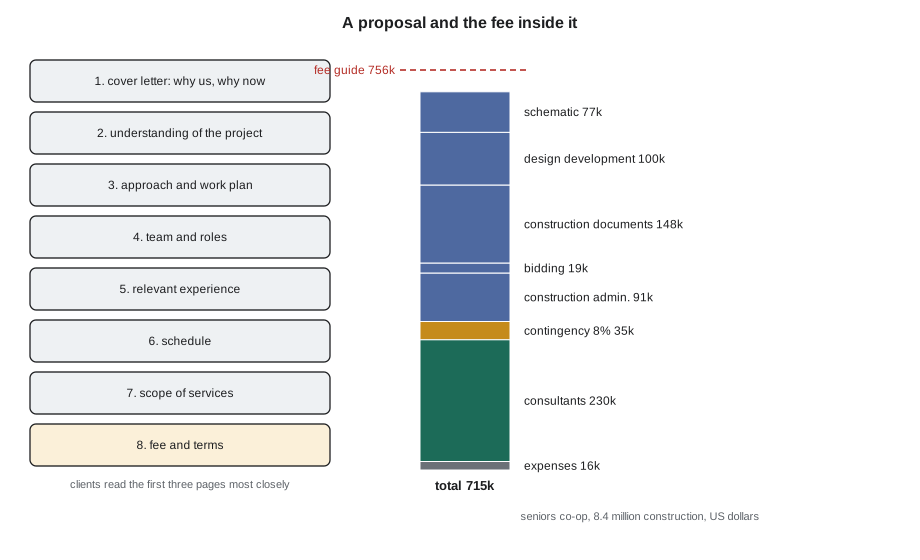
Moss shows the structure she recommends for a proposal of this size.
- A cover letter of one page that says why the firm wants this project, what it understands about the client's goals and what makes its team the right choice.
- An understanding of the project: the site, the budget, the funding, the residents, the schedule, and the two or three issues that will decide success, written in the client's terms.
- The approach and work plan: how the firm will move from programming through design, approvals and construction, including how residents will be involved.
- The team: who will lead, who will do the work and which consultants will join, with short, relevant biographies.
- Relevant experience: three or four projects, described honestly, with the founders' roles and the firms that did the work.
- The schedule: the phases, the key decisions the client must make and the approvals that will set the pace.
- The scope of services: what is included and, just as important, what is not.
- The fee and terms: the amount, how it is divided by phase, how expenses and additional services are handled, and the payment terms.
Building the fee from the work plan
The fee should come from the work the firm will actually do. Moss asks Wren to estimate, phase by phase, how many hours each kind of person will spend: a principal, a project architect, a designer and a technologist. Each role has a billing rate that covers its salary, benefits, a share of overhead and a profit. Multiplying hours by rates and adding them up gives the cost of the architect's own work. To that the firm adds a contingency for scope the client has not yet decided, the fees of the consultants it will engage and its reimbursable expenses. The result is then checked against a fee guide or a share of construction cost, as the students learned in Professional Practice.
# Fee build-up for the seniors co-op (US dollars): hours by phase and role, then checks.
rates = {"principal": 225, "project architect": 160, "designer": 120, "technologist": 110}
hours = {  # phase: hours by role in the order above
    "schematic design":         (90, 160, 220, 40),
    "design development":       (70, 220, 260, 160),
    "construction documents":   (60, 300, 240, 520),
    "bidding":                 (16, 60, 20, 30),
    "construction administration": (80, 330, 60, 120),
}
consultants = 230_000          # structural, mechanical, electrical, civil, landscape
reimbursables = 16_000
contingency = 0.08            # for scope the client has not yet decided
construction = 8_400_000
work = 0
print(f"{'phase':30}{'hours':>7}{'fee':>11}{'share':>7}")
rows = []
for phase, h in hours.items():
    fee = sum(x * r for x, r in zip(h, rates.values()))
    rows.append((phase, sum(h), fee)); work += fee
for phase, hrs, fee in rows:
    print(f"{phase:30}{hrs:>7,}{fee:>11,.0f}{fee / work:>7.0%}")
own = work * (1 + contingency)
total = own + consultants + reimbursables
print(f"architect's work {work:,.0f}; with {contingency:.0%} contingency {own:,.0f}")
print(f"total fee proposal {total:,.0f} = {total / construction:.2%} of construction")
pct_guide = 0.09 * construction
print(f"check against a fee guide of {0.09:.1%}: {pct_guide:,.0f}  (difference {total / pct_guide - 1:+.1%})")
avg_rate = work / sum(r[1] for r in rows)
print(f"average billing rate {avg_rate:.0f} per hour over {sum(r[1] for r in rows):,} hours")phase hours fee share schematic design 510 76,650 18% design development 710 99,750 23% construction documents 1,120 147,500 34% bidding 126 18,900 4% construction administration 590 91,200 21% architect's work 434,000; with 8% contingency 468,720 total fee proposal 714,720 = 8.51% of construction check against a fee guide of 9.0%: 756,000 (difference -5.5%) average billing rate 142 per hour over 3,056 hours
The bottom-up fee comes to about 715,000 dollars, or 8.5% of construction, against a fee guide figure of 756,000 dollars. Wren is surprised. In Professional Practice the bottom-up estimate for the Stanfield conversion came out above the guide, and the class learned to negotiate scope. Here it comes out below. Moss asks what the difference means.
There are two readings, she says. The first is that Wren's estimate is too optimistic: she has never led a project of this size, and first estimates by new principals are almost always low. Moss reviews the hours. Construction administration, at 590 hours for a construction period of about fourteen months, is thin; a weekly site meeting alone would consume most of it. The second reading is that the firm is efficient, perhaps because it has designed similar buildings before, and the guide reflects the effort of an average firm. Either way, Moss tells her, the guide figure is not money the firm should give away. If the estimate is sound, the difference is the reward for efficiency and expertise; if it is not, it is the margin that will save the project.
Wren revises the plan. She adds 120 hours of construction administration, a resident workshop at each design phase, and a post-occupancy visit a year after completion. The revised fee comes close to the guide, and every hour now corresponds to a service she can describe to the board.
Pricing strategies
Moss explains that price is a strategic decision as well as an arithmetic one. A firm can price at cost plus a fair profit, which is the default. It can price below cost to win a strategic first project, which is sometimes wise for a new firm but dangerous as a habit, because clients remember the first fee and expect the next one to match. It can price for value, charging what the service is worth to the client rather than what it costs the firm. Value pricing works when the firm's expertise saves the client money or risk that the client can see: a specialist who can solve a heritage problem that would otherwise delay a project by a year may charge far more than the hours suggest.
She also warns against three traps. The first is the fee that wins but cannot be delivered, which leads to cut corners, late drawings and an unhappy client. The second is the vague scope, which turns every client request into an argument about whether it is included. The third is the open-ended hourly fee without a maximum, which leaves the client anxious and the firm unable to plan. A good fee proposal is specific about what is included, states the assumptions it rests on, names what would count as additional services and how they would be priced, and sets out a schedule of payments that keeps the firm's cash flowing.
| Strategy | When it suits | Risk |
|---|---|---|
| Cost plus fair profit | Most projects | Leaves value on the table when the firm is unusually efficient |
| Low entry price | A strategic first project with a repeat client | Sets an expectation for future fees |
| Value pricing | Expertise that saves the client visible time, money or risk | Requires trust and clear evidence of value |
| Hourly with a maximum | Uncertain scope, early studies | The maximum must be realistic |
| Fixed fee per deliverable | Repeat services such as feasibility studies | Scope must be tightly defined |
Scope, exclusions and additional services
Moss spends an hour on the scope of services, because most fee disputes begin there. The co-op's request mentions 'full architectural services', which means different things to different people. Wren's proposal lists what she will do in each phase, the number of design options she will present, the number of resident workshops, the drawings and specifications she will produce, the number of site visits during construction and the post-occupancy visit. It then lists what is excluded: furniture selection, a rezoning application if one is needed, environmental site assessment, detailed cost estimating by a professional estimator, and services after the warranty year.
For each exclusion she says whether the firm could provide it as an additional service and how it would be priced. Moss reminds the students that AIA B101 distinguishes basic from supplemental and additional services, and that the client must authorize additional services before they are performed. A proposal that aligns its scope with the contract form the client will sign saves a great deal of negotiation later.
Payment terms
The fee is only useful if it is paid on time. Wren proposes monthly invoices in proportion to the work completed in each phase, payable within thirty days, with interest on overdue amounts. Moss adds two suggestions. The first is a modest retainer at signing, which the co-op will apply against the final invoice; it gives a new firm cash before its first invoice is paid and shows the client's commitment. The second is to ask how the co-op's funding flows. Non-profit housing providers often receive government funding in stages, tied to milestones such as a funding agreement, a building permit or the start of construction, and their ability to pay the architect may depend on reaching those milestones. Wren's proposal links her largest invoices to the stages when the co-op will have money.
Presenting the fee
At the interview, the board asks why Wren's fee is higher than one of the other firms'. Moss rehearses the answer with her. Wren does not apologize or offer a discount. She explains what the fee includes that the board asked for: resident workshops, a full construction administration service and the post-occupancy visit. She asks which of those services the board would like to reduce if the fee must come down. The chair says none, and the board accepts the fee. Moss says this is the usual outcome when a fee is clearly linked to services the client values. Clients who negotiate on price alone, without discussing scope, are telling the firm something about how the project will go.
Worked problem
Revising a low estimate
A first estimate for a project produces a fee of 7.6% of construction against a guide of 8.5%. Construction administration is estimated at 590 hours for a fourteen-month construction period. What should the principal do?
Show solution
- Check each phase against experience: weekly site meetings for 60 weeks at three hours each, with travel and minutes, already take about 180 hours.
- Add the reviews of shop drawings, answers to contractor questions, change orders, payment certificates and deficiency inspections.
- Revise construction administration upward, here by 120 hours, and check the other phases the same way.
- Compare the revised fee with the guide; if the estimate is still lower, decide whether to keep the difference as a reward for efficiency.
- Write the assumptions into the proposal so that a longer construction period becomes an additional service.
Answer: Test the estimate against the real effort of each phase, revise it, and price the remaining difference deliberately.
Exercise 3: a complete proposal
- Write a proposal of no more than eight pages for a real or imagined project, following the structure in this lesson.
- Build the fee from hours by phase and role, add contingency, consultants and expenses, and check it against a guide.
- List five exclusions and how you would price each as an additional service.
- Propose payment terms that match the client's funding and protect your cash flow.
Self-check
- Does my proposal show that I understand this client and this project?
- Is my fee built from a work plan I could actually deliver?
- Have I defined what is included and excluded?
- Can I explain my fee without apologizing or discounting?
Common mistakes
MistakeStarting with the fee before understanding the project.
InsteadTalk to the client and write the understanding first.
MistakeAccepting a first estimate without testing it.
InsteadCheck every phase against the real effort it requires.
MistakeGiving away the difference between an efficient estimate and the market rate.
InsteadKeep it as the reward for efficiency or as a margin for risk.
MistakeWriting 'full services' without defining them.
InsteadList what is included, what is excluded and how extras are priced.
MistakeDiscounting the fee when a client asks.
InsteadDiscuss which services the client would remove to reach a lower fee.
Summary and key terms
- A proposal should show understanding, experience, team and plan before it shows the fee.
- The fee should be built from a realistic work plan and checked against guides and experience.
- Price is a strategic choice: cost plus profit, low entry, value pricing or capped hourly fees each suit different situations.
- A clear scope of services with exclusions prevents most fee disputes.
- Payment terms should match the client's funding and keep the firm's cash flowing.
- Work plan
- An estimate of the hours each role will spend in each phase of a project.
- Contingency
- An allowance in a fee for scope that is not yet defined.
- Value pricing
- Charging according to the value of a service to the client rather than its cost to the firm.
- Retainer
- A payment at signing that is applied against a later invoice.
- Exclusion
- A service stated in a proposal as not included in the fee.
Practice problems
Work each problem on paper first, then reveal the answer to check.
A firm's work plan totals 3,000 hours at an average rate of 140. With an 8% contingency, what is the architect's own fee?
Show answer
3,000 × 140 = 420,000; with 8% contingency, 453,600.
Why did Moss tell Wren not to give away the difference below the fee guide?
Show answer
Because it is either the reward for efficiency or the margin that will protect the project if the estimate proves low.
Name three exclusions that housing proposals often list.
Show answer
Any three of: furniture selection, rezoning, environmental site assessment, professional cost estimating, services after the warranty period.
Why link invoices to a non-profit client's funding milestones?
Show answer
Because the client can pay only when its funding arrives, and the firm's cash flow depends on being paid.
What should a principal do when a client asks for a lower fee?
Show answer
Ask which services the client would like to remove, rather than discounting the same scope.
Lesson quiz · 5 questions
Score 60% or more to complete this lesson.
Create a free account to save your progress, take quizzes and earn a certificate.