
ARCH-410 · Lesson 9 of 12 · 21 min
Running an office
In the ninth week the students meet the person Eberle calls the most important architect in the firm who is not an architect. Hannah Moss, Eberle's partner, trained as an architect but has spent the last fifteen years running the business side of Eberle Moss: finances, contracts, staffing, technology, insurance and the lease. She opens a spreadsheet on the conference room screen and says that design firms fail far more often from poor management than from poor design. A firm can do beautiful work and still run out of cash, lose its best people or take on a project that bankrupts it. This week the students set up an imaginary practice of their own, and Moss will show them the numbers that decide whether it survives.
Forms of practice
An architecture practice can take several legal forms. A sole proprietorship is one architect in business alone; it is simple to set up, but the architect is personally liable for the firm's debts. A partnership is two or more people in business together, sharing profits and, in a general partnership, sharing personal liability for the firm's debts. A corporation is a separate legal person that can own property, sign contracts and employ staff; its shareholders are generally not personally liable for its debts, although architects remain personally responsible for their own professional negligence. Many jurisdictions also allow limited liability partnerships or companies that combine features of both.
State law controls which forms may practice architecture. In Minnesota a firm that offers architectural services must have a licensed architect in responsible charge of that work, must use a name that does not mislead the public, and must register with the board as the rules require. Most states allow corporations, limited liability companies and partnerships to practice, but the rules on ownership differ: some require that a majority of owners or directors be licensed architects, while others allow broader ownership as long as a licensed architect is in responsible charge. Firms that work in several states must meet the rules of each. Moss tells the students to check these rules before forming a company with partners who are not architects.
How an office makes money
Moss explains the arithmetic that every partner must understand. An architecture firm sells the time of its people. Its revenue comes from fees, and its largest cost is salaries. The difference between them pays for everything else, from rent and software to insurance and the partners' income. Three numbers describe how well a firm turns time into money.
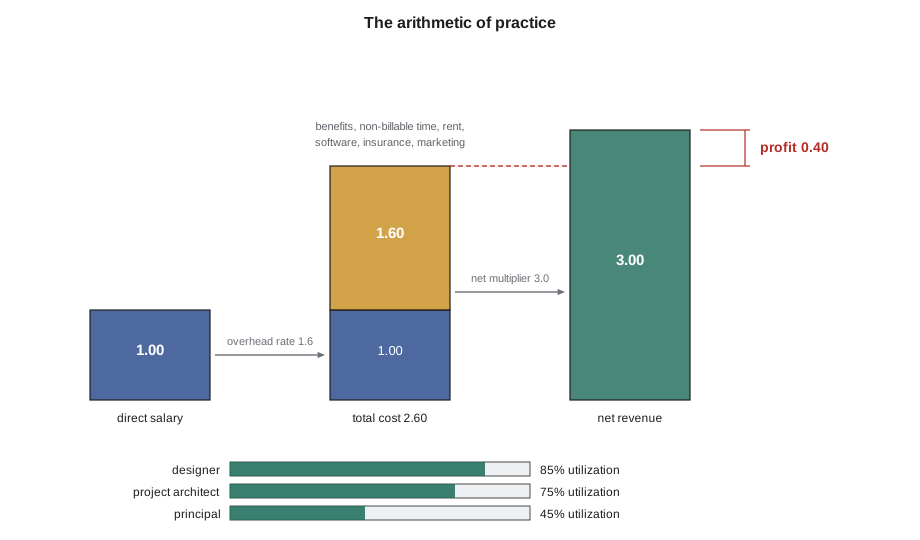
The first is utilization, the share of the staff's paid hours that are spent on billable project work. Nobody is billable all the time: people spend time on proposals, training, administration, holidays and illness. A designer might be 85% billable, a project architect 75%, a principal 50% or less. A firm whose utilization falls is paying for time it cannot recover from clients. The second is the net multiplier, the ratio of the firm's net revenue, its fees minus the cost of consultants and reimbursable expenses, to the direct cost of the salaries spent on projects. A net multiplier of 3.0 means that each dollar of direct salary brings in three dollars of net revenue. The third is the overhead rate, the ratio of the firm's indirect costs, including the salaries of time that is not billable, benefits, rent, software, insurance and marketing, to direct salary. Profit is what is left: if the multiplier is 3.0 and the overhead rate is 1.6, each dollar of direct salary costs 2.6 dollars in total and earns 3.0, leaving a profit of 40 cents.
# A year in the life of a small firm (US dollars).
staff = [  # role, salary, utilization (billable share of paid hours)
    ("principal", 150_000, 0.45), ("principal", 145_000, 0.50), ("project architect", 102_000, 0.75),
    ("architect", 86_000, 0.80), ("designer", 66_000, 0.85), ("designer", 63_000, 0.85),
    ("technical staff", 72_000, 0.85), ("office manager", 60_000, 0.0),
]
benefits_rate = 0.25
other_overhead = 330_000          # rent, software, insurance, marketing, equipment, professional fees
net_revenue = 1_420_000           # fees after consultants and reimbursables
salaries = sum(s for _, s, _ in staff)
direct = sum(s * u for _, s, u in staff)
indirect_salary = salaries - direct
overhead = indirect_salary + salaries * benefits_rate + other_overhead
mult = net_revenue / direct
oh_rate = overhead / direct
profit = net_revenue - direct - overhead
print(f"total salaries     {salaries:>11,.0f}")
print(f"direct salary      {direct:>11,.0f}   utilization {direct / salaries:.0%}")
print(f"overhead           {overhead:>11,.0f}   overhead rate {oh_rate:.2f}")
print(f"net revenue        {net_revenue:>11,.0f}   net multiplier {mult:.2f}")
print(f"profit             {profit:>11,.0f}   {profit / net_revenue:.1%} of net revenue")
print(f"break-even multiplier {1 + oh_rate:.2f}")total salaries 744,000 direct salary 456,150 utilization 61% overhead 803,850 overhead rate 1.76 net revenue 1,420,000 net multiplier 3.11 profit 160,000 11.3% of net revenue break-even multiplier 2.76
The imaginary firm has eight people and about 1.42 million dollars of net revenue. Its overall utilization is 61%, because the two principals and the office manager spend much of their time on work that clients do not pay for directly. Its overhead rate is 1.76, so it breaks even at a net multiplier of about 2.76, and its actual multiplier of 3.11 leaves a profit of about 160,000 dollars, or 11% of net revenue. The AIA's 2024 firm survey reported that US firms averaged a profit of 13.2% of net billings in 2023, with net billings of about 143,000 dollars per employee, so the imaginary firm is close to typical. Moss says that it is a healthy small firm, but a fragile one: if utilization fell by five points or one large project ended without a replacement, most of the profit would disappear.
Cash is not profit
A profitable firm can still fail if it runs out of cash. Architects pay salaries every two weeks and rent every month, but clients pay invoices weeks or months after the work is done. The gap between the two is the firm's working capital, and it grows when the firm grows, when clients pay slowly and when projects are front-loaded with effort. Moss tracks three things every week: the cash in the bank, the invoices outstanding and how long they have been outstanding, and the work in progress that has not yet been invoiced. A firm with a large amount of unbilled work and slow-paying clients can be rich on paper and unable to make payroll.
# Accounts receivable aging and the cash it ties up.
invoices = [  # client, amount, days outstanding
    ("Greenway Homes", 84_000, 22), ("school board", 126_000, 48), ("church committee", 18_500, 95),
    ("private developer", 61_000, 67), ("municipal parks", 39_000, 14),
]
buckets = {"0-30": 0, "31-60": 0, "61-90": 0, "over 90": 0}
for _, amt, d in invoices:
    key = "0-30" if d <= 30 else "31-60" if d <= 60 else "61-90" if d <= 90 else "over 90"
    buckets[key] += amt
total = sum(buckets.values())
for k, v in buckets.items():
    print(f"{k:>8} days {v:>9,}  {v / total:5.0%}")
weighted = sum(a * d for _, a, d in invoices) / total
print(f"total outstanding {total:,}  average age {weighted:.0f} days")
monthly_payroll = 62_000
print(f"outstanding invoices cover {total / monthly_payroll:.1f} months of payroll")0-30 days 123,000 37% 31-60 days 126,000 38% 61-90 days 61,000 19% over 90 days 18,500 6% total outstanding 328,500 average age 43 days outstanding invoices cover 5.3 months of payroll
The aging report shows that the firm is owed about 329,000 dollars, more than five months of payroll, and that the average invoice, weighted by amount, is about 43 days old. The church committee's invoice is more than ninety days old, and the developer's is more than sixty. Moss's rules are to invoice promptly at the end of each month, to call any client whose invoice reaches forty-five days, to use the contract's interest and suspension provisions when needed, and to keep a line of credit for the gaps that remain. She also asks for a retainer from new clients, a modest advance credited against the final invoice, which protects the firm against clients who never pay at all.
People, technology and the office
Most of a firm's value walks out of the door every evening, and Moss spends more time on people than on money. Hiring well, paying fairly, giving staff a range of work and a path to licensure, and making time for mentoring keep good people. Employment law sets minimums for wages, overtime, holidays and termination, and the firm must follow them. Moss says that the profession's long habit of unpaid overtime is both unfair and bad business, because tired people make the mistakes that lead to claims. Eberle Moss records every hour worked, pays overtime or gives time off in lieu, and treats a project that requires constant overtime as a project that was badly priced or badly planned.
Technology is the firm's second-largest cost after people. Software subscriptions for modeling, documentation, rendering, project management and accounting cost thousands of dollars per person each year, and hardware, servers and backup add more. Cyber security has become a serious concern: design firms hold drawings, client data and bank details, and ransomware attacks have shut down firms for weeks. Moss insists on multi-factor sign-in, regular backups stored off site, training for staff and cyber insurance. Artificial intelligence tools are changing how firms produce drawings, renderings and documents, and the AIA's 2024 survey found that about a third of US firms were already using them in daily work; Moss says that the firm's policy requires a person to check any machine-generated work before it leaves the office, because the seal still belongs to an architect.
Planning the business
Every firm needs a plan, even a simple one. Moss's plan for Eberle Moss covers the kinds of work the firm wants, the clients it will pursue, the staff it will need, the revenue it expects and the profit it will reinvest. It is revised each year. The firm watches a few indicators monthly: backlog, the value of signed work not yet done, measured in months of revenue; utilization by person; the net multiplier by project; cash and receivables. A backlog of less than three months is a warning; more than a year means the firm may need to hire. A project whose multiplier falls below break-even is reviewed to see whether the fee was too low, the scope grew or the team was inefficient.
| Indicator | What it measures | Signal to act |
|---|---|---|
| Utilization | Share of paid hours that are billable | Falling several points below plan |
| Net multiplier | Net revenue per dollar of direct salary | Below the break-even multiplier on a project |
| Overhead rate | Indirect costs per dollar of direct salary | Rising faster than revenue |
| Backlog | Signed work not yet done, in months of revenue | Under three months |
| Receivables age | Average days invoices are outstanding | Over sixty days |
| Profit | Net revenue less all costs | Below the amount needed for reinvestment and partners' risk |
Ownership and succession
Firms outlive their founders only if someone plans for it. Moss and Eberle have been preparing for years to transfer ownership to the next generation of leaders, and they describe the choices. A firm can be sold to its employees over time, merged into a larger firm, sold to an outside buyer or closed when the founders retire. Each choice has implications for clients, staff, insurance and the firm's name. An architect who is offered shares in a firm should understand how they are valued, how they will be paid for, what happens if the architect leaves, and what liabilities come with them. Moss says the most common mistake is to start too late: a transition takes five to ten years, and founders who wait until they are ready to retire often have no one ready to take over.
Worked problem
Diagnosing a loss on a project
A library renovation was expected to earn a net multiplier of 3.0, but at the end of construction documents it is running at 2.3, below the firm's break-even. What should the project manager do?
Show solution
- Compare hours spent with the estimate by phase and staff category to find where the overrun occurred.
- Check whether the client asked for changes that were not authorized as additional services.
- Check whether the team composition changed, for example a senior architect doing work planned for an intern.
- Seek payment for any unauthorized changes that were genuinely outside the scope, and authorize future ones properly.
- Plan the remaining phases tightly, and record the lessons for the next fee proposal.
Answer: Find the cause of the overrun, recover what the contract allows, and improve the next estimate.
Exercise 9: a business plan
- Write a one-page business plan for a three-person firm: the work you will do, your clients, your fees and your costs.
- Calculate the firm's break-even multiplier and the utilization it needs to make a 10% profit.
- List the insurance, software and legal steps needed before the firm takes its first project.
- Describe how you would handle a client whose invoices are ninety days overdue.
Self-check
- Do I understand utilization, net multiplier, overhead rate and break-even?
- Can I explain why a profitable firm can run out of cash?
- Do I know the rules on firm ownership and registration where I intend to practice?
- Do I know what indicators to watch each month?
Common mistakes
MistakeConfusing profit with cash.
InsteadTrack cash, receivables and unbilled work every week.
MistakeIgnoring non-billable time.
InsteadMeasure utilization by person and plan for proposals, training and administration.
MistakeRelying on unpaid overtime to finish projects.
InsteadRecord and pay overtime, and treat chronic overtime as a sign of poor pricing or planning.
MistakeForming a firm without checking the regulatory rules.
InsteadConfirm ownership, registration, insurance and naming requirements before starting.
MistakeLeaving succession until retirement.
InsteadPlan ownership transitions years in advance.
Summary and key terms
- Firms can be sole proprietorships, partnerships or corporations, subject to the regulator's rules on ownership and responsibility.
- A firm sells time: utilization, net multiplier and overhead rate determine whether it makes a profit.
- Profit is not cash; receivables and unbilled work must be managed weekly.
- People are the firm's greatest asset and largest cost; fair pay, mentoring and recorded hours protect both staff and clients.
- Monthly indicators and a simple business plan help a firm survive, grow and pass to the next generation.
- Utilization
- The share of paid hours spent on billable project work.
- Net multiplier
- Net revenue divided by direct project salary.
- Overhead rate
- Indirect costs divided by direct project salary.
- Backlog
- The value of signed work not yet done, often expressed in months of revenue.
- Accounts receivable
- Money invoiced to clients but not yet received.
Practice problems
Work each problem on paper first, then reveal the answer to check.
If a firm's overhead rate is 1.7, what net multiplier does it need to break even?
Show answer
2.7: each dollar of direct salary costs 1.0 plus 1.7 of overhead.
Why is a principal's utilization usually much lower than a designer's?
Show answer
Principals spend much of their time on management, marketing, proposals and mentoring, which clients do not pay for directly.
Name three ways to reduce the cash tied up in receivables.
Show answer
Any three of: invoice promptly, follow up on old invoices, charge interest, use suspension provisions, ask for retainers, keep a line of credit.
Why should overtime be recorded and paid?
Show answer
It is required by employment law in many cases, it is fair, and tired staff make the mistakes that lead to claims.
What does a backlog of under three months suggest?
Show answer
The firm may soon run short of work and should pursue new projects urgently.
Lesson quiz · 5 questions
Score 60% or more to complete this lesson.
Create a free account to save your progress, take quizzes and earn a certificate.