
ARCH-410 · Lesson 12 of 12 · 22 min
Career paths
The last week of the course is about the students themselves. Eberle has asked each of them to bring the timeline they drew in the third week, revised with everything they have learned since, and to present it to a small panel: Eberle, Hannah Moss, Rosa Delgado from Greenway Homes and Adaeze Nwosu. The presentations are the final assignment of the course, and the panel's job is to ask the kind of questions that a future employer, partner or client would ask. Before the presentations begin, Eberle spends the morning on the range of careers that an architecture education opens, because the four students, like most of their classmates, imagine only one.
The traditional path
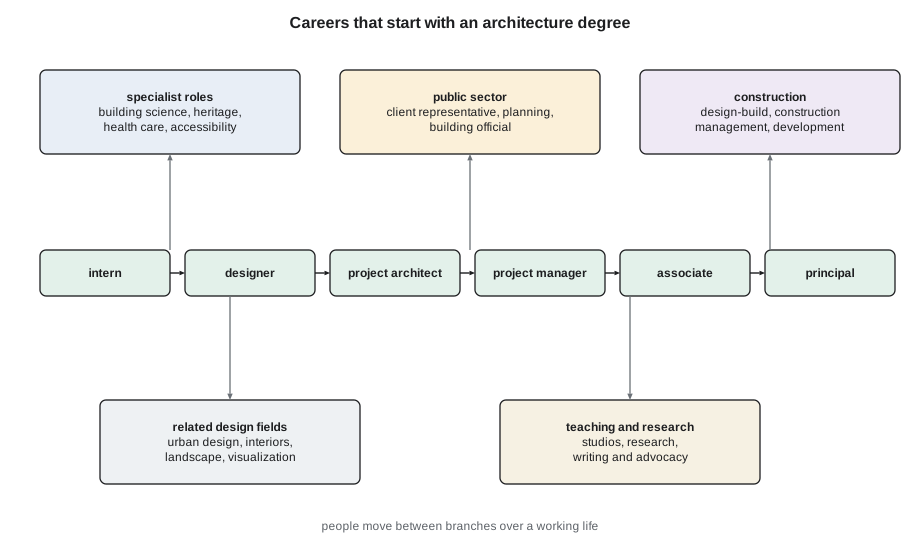
The path that most students imagine begins in a firm as an intern, moves through the roles of designer, project architect and project manager, and ends as an associate, principal or partner. Along the way the architect becomes licensed, takes responsibility for larger and more complex projects, learns to manage teams and clients, and eventually helps to run the firm. This path remains the core of the profession, and many architects follow it happily for their whole careers. Eberle followed it himself. He says that its rewards are the satisfaction of seeing buildings built, the variety of problems, the company of talented colleagues and the slow accumulation of judgment that makes a senior architect valuable.
Within the traditional path there are many variations. Some architects specialize by building type, becoming experts in health care, schools, laboratories, housing or heritage. Some specialize by role: design leadership, technical leadership in building science and documentation, project management or contract administration. Some move between large firms, with their resources and complex projects, and small firms, with their breadth of responsibility and closeness to clients. Some start their own practices early and grow them; others never want to. Eberle says that there is no correct order, but that every move should add something: a new kind of project, a new responsibility or a new skill.
Paths beside and beyond practice
Many people with architecture degrees work outside conventional firms, and some of the most influential architects of the last century spent much of their careers in other roles. Nwosu lists some of them. In the public sector, architects work for cities, provinces and states, and national governments as client representatives who commission and manage public buildings, as heritage and planning staff, as building officials and code consultants, and as policy advisers on housing and infrastructure. Delgado is an example of a career on the client side: she trained in architecture, worked in a firm for six years and moved to a housing provider, where her design knowledge makes her a better client.
In construction and development, architects work for design-build firms, construction managers and developers, where they manage design, cost and schedule from the other side of the table. Specialists in building science, accessibility, sustainability, lighting, acoustics, fire and code consulting, and computational design often trained as architects and found that a narrower focus suited them. Others work in related design fields: urban design, landscape, interiors, exhibitions, set design, product design, visualization and software. Some teach and do research, which in architecture often combines with practice. Some write, curate and advocate. Nwosu says that the education is broad enough to support all of these, and that people who move into them often keep their licenses, because the title and the knowledge behind it carry weight.
| Path | What the work involves | License needed? |
|---|---|---|
| Firm practice | Design, documentation and contract administration; leading teams and clients | Yes, to take professional responsibility and use the title |
| Public sector client | Commissioning and managing public buildings; standards; procurement | Often preferred, sometimes required |
| Building official or code consultant | Reviewing designs for code compliance; advising on complex cases | Varies; specialized certification may be required |
| Developer or design-build | Managing design, cost and schedule for an owner or builder | Not always, but valuable |
| Specialist consultant | Building science, heritage, accessibility, sustainability, computational design | Often held; may need other credentials |
| Teaching and research | Teaching studios and courses; research; practice on the side | Often held; required for some courses |
| Related design fields | Urban design, interiors, landscape, exhibitions, visualization | Usually not, but other licenses may apply |
Starting a practice
Some of the students will start their own practices, and Moss returns for half an hour to give them a checklist. First, become licensed and gain enough experience to take responsibility for the work you intend to do. Second, decide what kind of practice you want, for whom, and how you will find your first clients; most new firms begin with a small number of clients the founders already know. Third, set up the business: the legal form, registration with the board and the state, a bank account, accounting, a standard contract, a fee method, professional liability and other insurance, software and a place to work. Fourth, make a cash plan for the first two years, because income will be uneven and slow at first. Fifth, find advisers: an accountant, a lawyer, an insurance broker and a few experienced architects who will answer questions.
Moss warns against two common mistakes. The first is to start a firm without enough money to survive the first year, which leads founders to accept bad projects and low fees out of desperation. The second is to try to do everything alone. A small firm that collaborates with others, shares an office, joins with another firm on a large project or hires a part-time bookkeeper can do far more than one that does not. She also points out that starting small is not a lesser path. Many of the best buildings in both countries were designed by firms of fewer than ten people, and small firms make up the great majority of architecture practices.
# Compare career options against personal priorities (weights sum to 1.0).
priorities = {"design leadership": 0.30, "pay": 0.20, "licensure support": 0.20,
              "work-life balance": 0.15, "range of experience": 0.15}
options = {  # scores 1 to 5 from interviews and research
    "large firm, health care":   {"design leadership": 2, "pay": 4, "licensure support": 5, "work-life balance": 3, "range of experience": 3},
    "small firm, housing":       {"design leadership": 4, "pay": 3, "licensure support": 3, "work-life balance": 4, "range of experience": 5},
    "public client, county":     {"design leadership": 2, "pay": 4, "licensure support": 2, "work-life balance": 5, "range of experience": 3},
    "design-build contractor":   {"design leadership": 3, "pay": 5, "licensure support": 2, "work-life balance": 3, "range of experience": 4},
}
ranked = sorted(options, key=lambda o: -sum(priorities[k] * options[o][k] for k in priorities))
for o in ranked:
    score = sum(priorities[k] * options[o][k] for k in priorities)
    weakest = min(priorities, key=lambda k: options[o][k])
    print(f"{score:4.2f}  {o:<26} weakest: {weakest}")
# sensitivity: what if licensure support matters twice as much?
p2 = dict(priorities); p2["licensure support"] *= 2
s = sum(p2.values()); p2 = {k: v / s for k, v in p2.items()}
print("top choice if licensure matters more:", max(options, key=lambda o: sum(p2[k] * options[o][k] for k in p2)))3.75 small firm, housing weakest: pay 3.35 design-build contractor weakest: licensure support 3.30 large firm, health care weakest: design leadership 3.00 public client, county weakest: design leadership top choice if licensure matters more: small firm, housing
The scores in the sketch are Wren's, from interviews with architects at each kind of organization. The small housing firm comes first, mainly because it offers design leadership and a wide range of experience, and it stays first even if support for licensure counts twice as much. Eberle says that the tool is useful not because it decides but because it makes the student name her priorities and notice the weakest point of each option. Wren's weakest point at the small firm is pay, and she now knows to ask about it, and about how the firm supports interns through the internship and examination, before she accepts an offer.
The four presentations
The presentations take the afternoon. Wren presents first. She plans to join a small firm that designs housing for non-profit clients, record her experience from the first week, write the examination within three years and become an associate within eight. The panel asks how she will get experience in contract administration in a firm that size, and she answers that she has already asked the firm to let her join its project architect on site visits. Moss asks what she will do if the firm cannot pay her overtime, and Wren says she will ask about it in the interview, as the course taught her.
Callum wants to travel for a year first, working in an office abroad. The panel does not try to talk him out of it. Nwosu tells him that experience outside the country may count toward his internship if it is supervised by a licensed architect, and that he should check the rules before he leaves so that the year is not lost. Delgado asks what he hopes to learn that he could not learn at home, and Callum says that he wants to see how housing is built in a country that builds it differently. Eberle says that is a good answer.
Ingrid plans to spend two years with a design-build company before moving to a firm, because she wants to understand cost and construction from the builder's side. Moss points out that her experience there will count toward some areas of the internship but not others, and that she should find a mentor outside the company who is a licensed architect. Delgado says that the architects she trusts most on cost are the ones who have worked for builders.
Joon-ho is the most uncertain. He may move to another country where his family lives, and he wants to know whether his education will be recognized there. The panel spends the most time with him, looking up the mutual recognition agreements, the assessment of education and the experience rules in the country he is considering. Eberle tells him that uncertainty is normal at this stage, that the education he has is recognized in many places, and that the professional habits the course has tried to teach, from reading contracts to recording decisions, travel well.
Sustaining a career
Eberle ends the course with the part of a career that schools rarely discuss: keeping it going for forty years. A license must be renewed and continuing education completed. Knowledge must be renewed too, because codes, materials, technology and the expectations of clients change faster than most architects expect. The architects who last, he says, are the ones who keep learning deliberately, who move between kinds of work when they feel stale, who teach and mentor, who take part in the profession through committees and associations, and who protect their health by refusing to treat exhaustion as a badge of honor.
He also asks them to remember why the profession is regulated at all. The stamp on the table, the binder of contracts and the insurance policy all exist because people who will never meet the architect trust them with their safety, their money and their daily lives. A career in architecture is a long series of chances to deserve that trust. Some of the chances are dramatic, like refusing to remove a required stair. Most are quiet, like writing down a decision, returning a call, crediting a colleague or telling a client the truth about a cost estimate. The profession, he says, is the sum of those quiet choices.
Worked problem
Choosing between two offers
A graduate has two offers: a large firm with a structured internship program, paid examination fees and a salary of 66,000 dollars, and a small firm with broad responsibility from the start, no formal program and a salary of 60,000 dollars. How should the graduate decide?
Show solution
- List personal priorities and weight them honestly: design responsibility, pay, licensure support, balance and range of experience.
- Ask each firm specific questions: how overtime is recorded and paid, who will supervise and mentor, how experience in contract administration and management is gained, and whether examination fees are paid.
- Score each option against the priorities, and note the weakest point of each.
- Consider the next five years, not only the first: which option leads more reliably to licensure and to the kind of work wanted?
- Decide, and ask the chosen firm to put the important commitments, such as mentoring and examination support, in the offer letter.
Answer: Name your priorities, ask specific questions, compare the options and get key commitments in writing.
Exercise 12: a professional practice plan
- Revise the timeline you drew in the third week to show your path to licensure, the kinds of experience you need and the dates you expect to reach each milestone.
- Identify three kinds of organization where you might work in the next five years and score them against your priorities.
- List the questions you will ask every future employer about pay, overtime, mentoring and licensure.
- Present your plan to a panel of classmates acting as employer, partner, client and mentor, and revise it after their questions.
Self-check
- Do I know the range of careers that an architecture education opens?
- Do I know what my license will allow me to do on each path?
- Do I have a plan for the next five years, and do I know its weakest point?
- Do I know how I will keep learning after licensure?
Common mistakes
MistakeImagining only one career path.
InsteadExplore practice, the public sector, construction, specialist consulting, related design fields, teaching and research.
MistakeAccepting the first offer without asking questions.
InsteadAsk about pay, overtime, mentoring, range of experience and licensure support.
MistakeLeaving the path to licensure to chance.
InsteadPlan experience, find a mentor early and take the examination when eligible.
MistakeStarting a practice without money or advisers.
InsteadPlan cash for two years and find an accountant, lawyer, broker and experienced mentors.
MistakeTreating learning as finished at licensure.
InsteadKeep learning deliberately throughout a career, and teach others.
Summary and key terms
- The traditional path runs from intern to principal, with many variations by building type, role and firm size.
- Architects also work as public clients, building officials, developers, design-builders, specialists, educators, researchers and in related design fields.
- Starting a practice requires licensure, a business set-up, insurance, a cash plan and advisers.
- A career plan should name priorities, compare options, ask specific questions and plan the path to licensure.
- A long career depends on continued learning, mentoring, participation in the profession and the quiet choices that earn the public's trust.
- Associate
- A senior employee recognized by a firm with greater responsibility, often a step toward ownership.
- Principal
- An owner or senior leader of a firm who takes responsibility for its work and business.
- Client representative
- An architect who works for an owner, commissioning and managing design and construction.
- Specialist consultant
- A professional who advises design teams in a focused area such as building science, heritage or accessibility.
- Professional practice plan
- A personal plan for gaining experience, licensure and the kind of work one wants over the next several years.
Practice problems
Work each problem on paper first, then reveal the answer to check.
Name four career paths outside conventional firm practice.
Show answer
Any four of: public client, building official or code consultant, developer, design-build or construction management, specialist consultant, teaching and research, related design fields, writing and advocacy.
Why might an architect working for a developer keep their license?
Show answer
The title and knowledge carry weight, allow them to take professional responsibility if needed, and keep options open.
Name three steps in setting up a small practice.
Show answer
Any three of: licensure and experience; deciding the kind of practice and clients; legal form and registration; contracts, fees and insurance; a cash plan; advisers.
What questions should a graduate ask a future employer?
Show answer
How overtime is recorded and paid, who will mentor and supervise, how a range of experience is provided, whether examination fees are paid, and what the salary range is.
Why does Eberle call the profession 'the sum of quiet choices'?
Show answer
Because the public's trust is earned less by dramatic decisions than by everyday honesty, care and communication.
Lesson quiz · 5 questions
Score 60% or more to complete this lesson.
Create a free account to save your progress, take quizzes and earn a certificate.