
ARCH-410 · Lesson 4 of 12 · 22 min
Ethics and professional conduct
Eberle starts the fourth week with a story rather than a rule. Early in his career, he says, he worked on a small apartment building for a developer who wanted to save money on the fire separations between units. The developer did not ask him to break the code. He asked him to interpret it generously, to accept a cheaper assembly whose test report was for a slightly different wall, and to stop raising questions that the building official had not raised. The project was small, the developer was a repeat client and Eberle's employer needed the work. Eberle refused, his employer backed him, and the firm lost the developer's next project. He tells the story not because it ends well but because it was not dramatic. Most ethical problems in practice, he says, arrive quietly, as a small request from someone you would like to please.
Ethics, conduct and law
The students begin by sorting three ideas that are often confused. The law sets the minimum: an architect who breaks the building code, the practice act or a contract can be fined, disciplined or sued. Rules of professional conduct, issued by the regulator, are binding on everyone who holds a license and go further than the general law, for example by requiring architects to disclose conflicts of interest or to seal only work they supervised. Codes of ethics, issued by professional associations, are binding on their members and often contain both enforceable rules and aspirational standards that describe the kind of architect the profession hopes its members will be. Ethics in the wider sense is the habit of asking what is right when none of these documents gives a clear answer, which happens more often than most people expect.
In Minnesota the conduct of licensed architects is governed by the statute and by the board's rules of professional conduct, which the board enforces through its complaints process. NCARB publishes model rules of conduct that many states, including Minnesota, have drawn on. The AIA publishes its Code of Ethics and Professional Conduct for its members; the current edition is dated 2026. It is organized in six canons: general obligations, and obligations to the public, to the client, to the profession, to colleagues and to the environment. Within each canon, ethical standards describe goals and rules of conduct set out mandatory requirements. The AIA's National Ethics Council hears complaints against members and can admonish, censure, suspend or terminate membership, but it cannot touch a license; only the board can do that.
The four sets of obligations
Almost every code organizes the architect's duties around the same groups of people, and Eberle uses them as the structure for the week. The first and highest duty is to the public. An architect must design buildings that protect the health, safety and welfare of the people who use them and who live near them, must follow the building codes and laws that apply, and must not knowingly approve work that endangers people. When a client's wishes conflict with public safety, public safety wins. Most codes say that if an architect's professional judgment is overruled in a way that threatens public safety, the architect must tell the client of the consequences and, if necessary, report the matter to the authorities.
The second duty is to the client. An architect must act competently, perform the services they have agreed to provide, keep the client informed, keep the client's information confidential, and avoid conflicts between the client's interests and their own. They must not make promises they cannot keep, such as guaranteeing a construction cost or a schedule that depends on others. They must be honest about their qualifications and about mistakes. When an architect acts as an impartial interpreter of the construction contract, as they do when they certify payments or decide disputes between owner and contractor, they must be fair to both sides even though the owner pays their fee.
The third duty is to the profession: to uphold its standards, to avoid conduct that brings it into disrepute, to report serious misconduct by others, to support the education of interns and students, and to be truthful in advertising and in claims about one's work. The fourth is to colleagues: to give credit to others for their work, to avoid taking a commission that another architect already holds without telling them, to treat employees and collaborators fairly, and to avoid harassment and discrimination. The AIA's code adds a canon on the environment, which asks architects to promote sustainable design and to discuss the environmental effects of project decisions with clients; other codes include similar duties in their sections on the public.
Conflicts of interest
Conflicts of interest deserve their own section because they are common and often invisible to the people involved. A conflict exists when an architect's personal or financial interest, or a duty to someone else, could influence their professional judgment for a client. Eberle gives examples. An architect who owns shares in a window manufacturer specifies its windows on a project. An architect who designs a building for one client is approached by the neighboring owner who wants to oppose it. An architect's spouse runs the construction company that bids on the firm's project. A supplier offers the firm's staff tickets to a hockey game the week before the specification is finalized.
Codes do not forbid all of these. They require disclosure: the architect must tell the client about the interest, in writing, and proceed only with the client's agreement, and in some cases must step aside entirely. Gifts that could reasonably be seen as influencing judgment must be refused. Eberle Moss has a written policy that staff may accept a modest lunch at a product presentation but no gifts, trips or tickets from anyone whose product the firm might specify or whose bid the firm might evaluate. He says that the test he uses is simple: would I be comfortable if the client read about this in the newspaper?
Competence and honesty
An architect may undertake only work they are competent to do, either personally or with consultants who have the competence. This sounds obvious, but it is tested in practice whenever a firm that designs houses is offered a laboratory, or a firm that designs offices is offered a hospital. The ethical course is to decline, to bring in a consultant or partner with the right experience, or to learn enough in time and tell the client honestly what the firm has and has not done before. Misrepresenting experience in a proposal, for example by showing a building designed by a partner's former firm as if it were the firm's own work, is a breach of most codes and a common ground for complaint.
Honesty also covers mistakes. Every architect makes them, and the question is what happens next. Most codes require an architect to tell the client promptly about an error that affects the project, and insurers generally agree that early disclosure, combined with prompt notice to the insurer, leads to better outcomes than hiding the problem and hoping it goes unnoticed. Lesson 8 explains how this works with insurance. Eberle's rule is that the person who finds a mistake tells the project architect the same day, without fear of blame, and the project architect tells the client within the week with a proposal for fixing it.
| Situation | Duty engaged | Reasonable response |
|---|---|---|
| Client asks to omit sprinklers that the code requires | Public safety | Explain the requirement in writing; decline to issue drawings that omit them |
| The architect's brother-in-law bids on the project | Conflict of interest | Disclose to the client in writing; take no part in evaluating the bids |
| A supplier offers the project team a weekend at a lodge | Conflict of interest, profession | Decline; record the offer |
| A proposal could show a building designed by a former employer | Honesty, colleagues | Show it only with clear credit and a description of the person's actual role |
| A detail in issued drawings will leak | Honesty to the client | Tell the client promptly with a fix; notify the insurer |
| A firm is asked to design a type of building it has never done | Competence | Partner with an experienced firm or consultant, or decline; be honest about experience |
Harassment, fairness and the workplace
Recent revisions of professional codes have given more attention to how architects treat each other. Harassment, bullying and discrimination in offices and on job sites are now explicitly prohibited in most codes, along with retaliation against people who report them. The profession has also confronted long hours, unpaid overtime and unpaid internships, which affect the health of young architects and limit who can afford to enter the field. Some regulators and associations now say plainly that unpaid internships are not acceptable, and labor laws generally require that interns doing productive work be paid. Eberle says that a firm's ethics are visible in its timesheets as well as in its drawings, and that the students should ask any future employer how overtime is recorded and paid.
Working through a dilemma
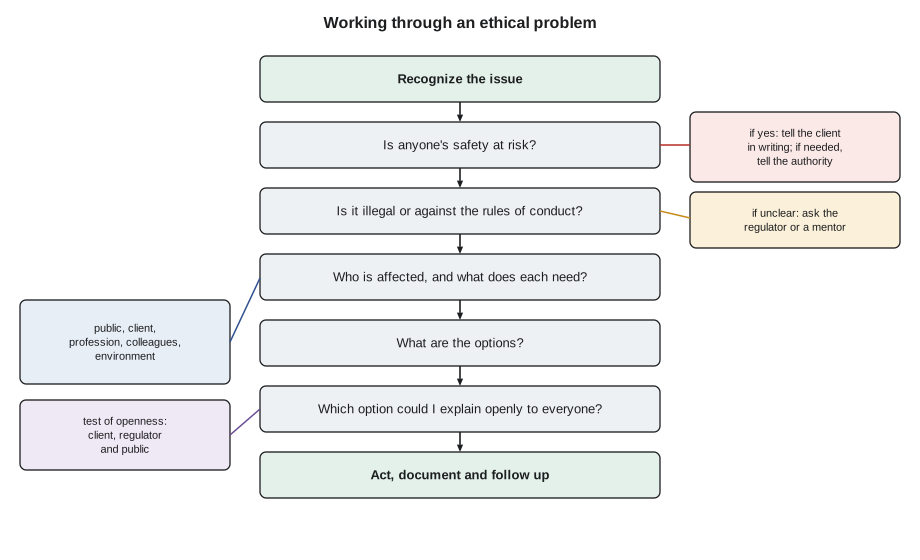
The hardest cases are the ones in which two duties pull in different directions. A client asks the architect to keep a design confidential, but the design affects a neighbor's property and the neighbor asks a direct question. An employee reports that a senior partner has been sealing drawings he did not review. A contractor offers to save the client money with a substitution that meets the code but not the performance the architect specified. The codes give guidance, but they cannot decide every case, and the flowchart in the figure is one way to think it through: recognize the issue, check safety and the rules, identify the people affected and what each needs, list the options, and choose the one you could explain openly to all of them. Then act, document what you did and why, and follow up.
# Score options for an ethical dilemma against the duties in a professional code.
# Scores: 2 fully meets the duty, 1 partly, 0 does not, -2 breaches it.
duties = ["public safety", "client", "profession", "colleagues", "law and rules"]
options = {
    "issue drawings as the client asks": [-2, 2, -2, 0, -2],
    "refuse and resign from the project": [2, -2, 1, 0, 2],
    "explain risks in writing, offer a code-compliant alternative": [2, 1, 2, 1, 2],
    "issue drawings with a private note to file": [-2, 1, -2, 0, -2],
}
weights = [3, 1, 1, 1, 2]
for name, row in options.items():
    breach = any(s == -2 for s in row[:1] + row[4:])
    score = sum(w * s for w, s in zip(weights, row))
    flag = "  (breaches safety or law)" if breach else ""
    print(f"{score:4d}  {name}{flag}")
best = max(options, key=lambda k: sum(w * s for w, s in zip(weights, options[k])))
print("most defensible:", best)-10 issue drawings as the client asks (breaches safety or law) 9 refuse and resign from the project 14 explain risks in writing, offer a code-compliant alternative -11 issue drawings with a private note to file (breaches safety or law) most defensible: explain risks in writing, offer a code-compliant alternative
Eberle is careful about the code, as every instructor in the school has been about scoring tools. The numbers do not decide anything, and an option that breaches public safety or the law is excluded however well it scores elsewhere. The value of the exercise is that it forces the students to name the duties involved and to look for an option that meets more of them than the obvious choices do. In the example, the best option is neither to give in nor to walk away but to explain the risks in writing and offer a compliant alternative, which is what Eberle did all those years ago with the developer.
Worked problem
A request to soften a code requirement
Late in design, the client for a three-story office building asks the project architect to reduce the number of exit stairs from two to one to gain lettable space, arguing that the building official will probably not notice. What should the architect do?
Show solution
- Recognize the issue: the request affects public safety and would require the architect to issue drawings that breach the building code.
- Check the rules: the code requires two exits for this building; the architect's duty to the public and the rules of conduct forbid knowingly issuing non-compliant drawings.
- Identify the people affected: future occupants, the client, the building official, the firm and the architect personally.
- List the options: refuse outright; explain in writing and offer alternatives that recover space legally, such as a more compact stair, a scissor stair where permitted, or relocating mechanical space.
- Act: send the client a letter explaining the requirement, the consequences and the alternatives; record the conversation; decline to issue drawings with one stair if the client insists.
Answer: Explain the requirement and the alternatives in writing, and do not issue non-compliant drawings.
Exercise 4: an ethics casebook
- Write a one-page case describing an ethical problem you have seen or heard of in practice or school, with the names removed.
- Identify the duties engaged, the people affected and at least three possible responses.
- Choose a response and explain how you would document it.
- Compare your case with a classmate's and look for the rule of conduct that applies to each.
Self-check
- Can I name the four groups to whom an architect owes duties?
- Do I know the difference between a rule of conduct and an aspirational standard?
- Do I know what to do if a client's wishes conflict with public safety?
- Would I recognize a conflict of interest and know how to disclose it?
Common mistakes
MistakeTreating ethics as a matter of personal opinion.
InsteadUse the codes of conduct and ethics, which set out shared and enforceable duties.
MistakeGiving the client's wishes priority over public safety.
InsteadPublic safety comes first; explain consequences in writing and do not issue non-compliant work.
MistakeKeeping quiet about a conflict of interest because it feels minor.
InsteadDisclose it in writing and let the client decide, or step aside.
MistakeHiding a mistake in the hope that it goes unnoticed.
InsteadTell the client promptly with a solution, and notify the insurer.
MistakeAccepting gifts from suppliers whose products you specify.
InsteadDecline gifts that could reasonably be seen as influencing your judgment.
Summary and key terms
- Law sets the minimum; the regulator's rules of conduct bind all licensees; association codes bind members and add aspirational standards.
- In Minnesota the board's rules of conduct bind licensees; the AIA's 2026 code, with six canons, binds AIA members.
- Architects owe duties to the public, clients, the profession and colleagues, and increasingly to the environment; public safety comes first.
- Conflicts of interest must be disclosed in writing, and gifts that could influence judgment must be refused.
- Competence, honesty about experience and prompt disclosure of mistakes protect clients and the architect alike.
- Rule of conduct
- A mandatory requirement whose breach can lead to discipline.
- Ethical standard
- An aspirational goal that describes the conduct a profession hopes its members will show.
- Conflict of interest
- A situation in which an architect's own interests or other duties could influence their professional judgment for a client.
- Impartiality
- The duty to interpret a construction contract fairly between owner and contractor, even though the owner pays the architect.
- Disclosure
- Telling the client in writing about an interest, relationship or mistake so that they can make an informed decision.
Practice problems
Work each problem on paper first, then reveal the answer to check.
Which duty takes priority when a client's wishes conflict with public safety?
Show answer
The duty to the public: the architect must not issue work that endangers people and must explain the consequences to the client.
What must an architect do about a conflict of interest?
Show answer
Disclose it to the client in writing and proceed only with the client's agreement, or step aside if the conflict is serious.
Why is misrepresenting another firm's building as one's own an ethical breach?
Show answer
It is dishonest to clients and unfair to colleagues, and it misleads the client about the firm's competence.
When the architect certifies a contractor's payment, whose interests must they consider?
Show answer
Both the owner's and the contractor's: the architect must interpret the contract impartially.
What is the test of openness?
Show answer
Asking whether you could explain your choice openly to everyone it affects, including the client, the regulator and the public.
Lesson quiz · 5 questions
Score 60% or more to complete this lesson.
Create a free account to save your progress, take quizzes and earn a certificate.