
APT-340 · Lesson 8 of 12 · 28 min
Review: electrical and EV parts
▶ Video coming soon A video version of this lesson is on the way.
The seventh session was the one Teodor had been dreading. He had sold batteries and alternators for fifteen years, but the department's first hybrid parts had arrived only last year, and the Marlo EV's first deliveries were planned for December. Imani started with a confession of her own. "When the Vela Hybrid came in, I had to learn this too," she said. "The good news is that the exam asks about the same things the counter does: ratings, compatibility, safe handling and the rules for returns."
On the P2 test, electrical topics appear in at least two vehicle systems subareas, electrical/electronic and battery, starting and charging, with two or three questions each, and hybrid and electric vehicle parts are increasingly part of the electrical questions. APT-310 covered the whole area.
Electrical basics for the counter
A parts technician doesn't diagnose circuits, but needs enough electrical knowledge to talk to technicians and choose parts. A circuit needs a power source, a load, conductors and a path back to the source, usually through the vehicle's body and frame as ground. Voltage is electrical pressure in volts, current is the flow in amperes, and resistance in ohms opposes the flow. They are related by Ohm's law, and power in watts is voltage times current.
Worked problem
Current through a headlamp circuit
A 55-watt halogen headlamp bulb runs on a 12-volt circuit. About how much current does it draw?
Show solution
- Rearrange P = V × I: I = P ÷ V.
- I = 55 ÷ 12 = 4.6 amperes.
Answer: About 4.6 amperes. The circuit's fuse is rated above the normal current, so a fuse that keeps blowing means a fault, not a fuse that is too small. Replacing it with a larger fuse is never the answer.
Fuses are sold by type (mini, standard and maxi blade fuses, cartridge fuses, fusible links) and by rating, with color codes on blade fuses. Relays, connectors, pigtails and terminals are sold by the maker's part number, because connectors that look similar often have different locks, seals and pin layouts.
Batteries: types, ratings and testing
The 12-volt battery is still the most common electrical part sold. Exam questions focus on types, ratings and testing:
- Types: flooded lead-acid, enhanced flooded (EFB) for basic start-stop systems, and absorbent glass mat (AGM) for vehicles with demanding start-stop systems and high electrical loads. A vehicle that came with AGM must get AGM.
- Cold cranking amps (CCA): the current a battery can deliver at 0 °F for 30 seconds while staying above 7.2 volts. The main rating for starting in cold weather.
- Reserve capacity (RC): the minutes a battery can deliver 25 amperes before falling to 10.5 volts, at 80 °F.
- Ampere-hours (Ah): capacity over a 20-hour discharge.
- Group size: the case dimensions, terminal type and terminal positions, such as H7, also called 94R.
A replacement should match the group size and type and meet or exceed the original CCA. Many newer vehicles, including the Vela, need battery registration after replacement, so the charging system knows the battery is new; skipping it can shorten the new battery's life.
Testing starts with a charged battery. A conductance tester gives an estimate of the battery's CCA against its rating. A load test applies a load of half the CCA rating for 15 seconds; a good battery stays at or above about 9.6 volts at around 70 °F. The open-circuit voltage of a rested battery gives its state of charge: about 12.6 volts fully charged, about 12.4 at three-quarters and about 12.2 at half (typical values for a flooded battery).
Worked problem
Load testing a battery
A charged battery is rated at 760 CCA. What load should be applied, for how long, and what voltage should it hold?
Show solution
- Load = half the CCA rating = 760 ÷ 2 = 380 amperes.
- Duration: 15 seconds.
- Minimum voltage: about 9.6 volts at room temperature, lower in the cold.
Answer: 380 amperes for 15 seconds, holding at least about 9.6 volts. In APT-310's Saturday case, the conductance tester showed 412 CCA, about 54 percent of the 760 rating, and the battery was replaced.
Worked problem
A pro-rated warranty claim
A battery bought for 230 dollars has an 84-month warranty with 36 months of free replacement and pro-rating after that. It fails at 50 months. Using the common method of price times unused share of the warranty, what credit is given?
Show solution
- Months left: 84 − 50 = 34.
- Credit = 230 × 34 ÷ 84 = 93.10 dollars.
- The customer pays 230 − 93.10 = 136.90 dollars plus tax for a new battery at the same price.
Answer: 93.10 dollars of credit. Each battery maker sets its own terms and method, and the store applies them exactly.
Starters, alternators and lighting
Starters and alternators are mostly sold remanufactured, with a core charge (a sample 75 dollars on an alternator at Linmore). Two things go wrong at the counter: the wrong output rating and a rejected core. APT-310's example was a 2017 Arden whose cold-weather package (option CW3) used a 150-ampere alternator in place of the standard 120-ampere unit. Same engine, same year, different part. A core is rejected if it is broken, missing parts or the wrong unit.
Bulbs are sold by standard numbers: H7 and H11 halogen headlamp bulbs, 7443 and 3157 for signal and tail lamps. The exam may ask about LED replacement bulbs for halogen headlamps.
NHTSA's interpretation of February 2024 confirmed that FMVSS 108 doesn't allow LED replacement bulbs in headlamps designed for halogen bulbs, because the headlamp is certified with a specific light source and an LED bulb scatters light into the eyes of oncoming drivers. Linmore doesn't sell LED bulbs as replacements for halogen headlamp bulbs.
Sensors, modules and programmed parts
Modern vehicles have dozens of electronic modules and many more sensors. The counter rules APT-310 taught are:
- Identify by VIN and part number. Modules that look the same may have different software or hardware versions.
- Protect against static. Electronic modules arrive in static-shielding bags and should be handled at the counter only in the bag, ideally with grounding, because a static discharge too small to feel can damage them.
- Programming and coding. Many modules must be programmed or coded to the vehicle with the maker's tools after installation, and some are VIN-locked once programmed, so a used module from another vehicle may not work.
- Security-related parts such as keys, fobs and immobilizer modules are released only to verified owners and to technicians registered as Vehicle Security Professionals through NASTF, which lets independent locksmiths and shops obtain security information.
Returns follow from this. Opened static-shielding packaging, installed parts, programmed or coded parts and parts ordered by VIN are not returnable. A defect goes through warranty with a diagnosis.
Hybrid and electric vehicle components
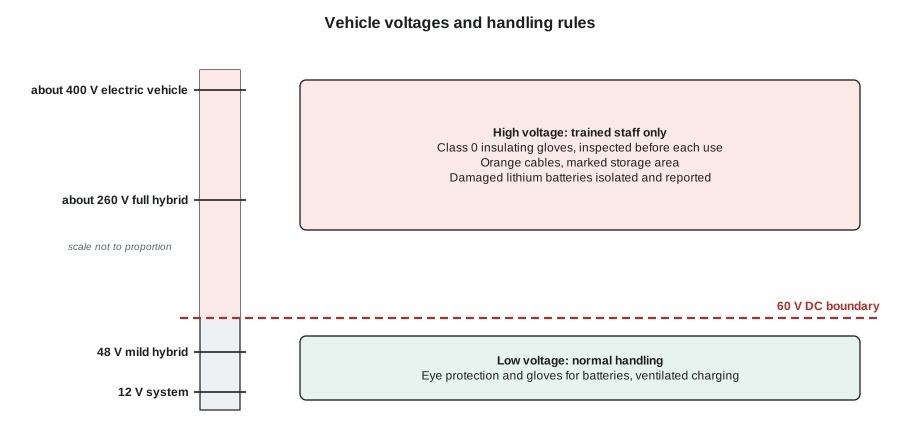
Tessaro's lineup gives three levels of electrification, which is a good way to remember the differences:
- Mild hybrid: the Arden MH4 uses a 48-volt system with a belt-driven starter-generator that assists the engine and restarts it smoothly; it can't drive the car on electricity alone.
- Full hybrid: the Vela Hybrid uses a power-split system with two motor-generators and a lithium-ion battery of about 260 volts under the rear seat. It can drive short distances on electricity and still has a small 12-volt AGM battery in the trunk for the vehicle's normal electrical system.
- Battery electric vehicle: the 2027 Marlo EV uses a pack of about 400 volts and 75 kWh, with an 11-kilowatt onboard charger and an SAE J3400 charging inlet. First deliveries are planned for early December 2026.
Worked problem
Energy in the Marlo pack
The Marlo pack has 108 cells in series at a nominal 3.7 volts, each with a capacity of 188 ampere-hours. What are the pack voltage and energy, and roughly how long would a full charge take on the 11 kW onboard charger?
Show solution
- Pack voltage = 108 × 3.7 = 399.6 volts, about 400.
- Energy = 399.6 × 188 = 75,125 watt-hours, about 75.1 kWh.
- Charge time from empty ≈ 75.1 ÷ 11 = 6.8 hours, plus charging losses.
Answer: About 400 volts and 75 kWh, and roughly 7 to 8 hours on a Level 2 home charger that can supply the full 11 kW. Real times depend on the charger, the starting charge and losses.
Charging equipment and accessories
EV charging comes in three levels: Level 1 from an ordinary household outlet, slow but useful overnight; Level 2 from a 240-volt circuit, the usual home and workplace charger; and DC fast charging at public stations, which bypasses the onboard charger. A home charger is a continuous load, so its circuit must be rated at 125 percent of the charger's current.
Worked problem
Sizing a home charger circuit
Tessaro's home charger draws 48 amperes. What circuit rating does it need?
Show solution
- Continuous load rule: circuit rating ≥ 1.25 × charger current.
- 1.25 × 48 = 60 amperes.
Answer: A 60-ampere circuit.
In Ohio, a charger installation is electrical work under the local building department's permit and inspection rules, done to Article 625 of the National Electrical Code, with listed equipment. The parts counter sells the charger and points the customer to a licensed electrician; it doesn't advise on the wiring.
Handling high-voltage parts safely
The line between low and high voltage in vehicles is usually drawn at 60 volts DC. Anything above it, such as the Vela Hybrid's 260-volt battery or the Marlo's 400-volt pack, is handled only by trained people with the right protective equipment. High-voltage cables are orange. The rules APT-310 set out for the parts department are:
- Only trained staff handle high-voltage components, and nobody opens a high-voltage battery or component in the parts department.
- Class 0 insulating gloves, rated for 1,000 volts AC and 1,500 volts DC, are inspected before each use and retested every six months. Linmore's went into service on October 15, 2026, with a retest due by April 15, 2027.
- High-voltage batteries are stored in a marked area, away from heat, sparks and other stock, in their shipping containers, and are moved with suitable equipment because of their weight, about 990 lb for the Marlo pack.
- Damaged, swollen, leaking or hot lithium batteries are isolated outdoors or in a designated area, reported, and shipped only under the special rules for damaged lithium batteries.
Putting it together
Imani ended with five quick scenarios from APT-310's case review and asked Teodor to answer each in one sentence. A customer wants an LED bulb for a halogen headlamp: decline and explain why. A shop wants to return a programmed body control module that didn't fix the fault: not returnable, offer warranty diagnosis if defective. A 48-volt mild hybrid battery arrives in a crushed carton: treat it as possibly damaged, isolate it and report it. A trailer customer needs a powered converter: confirm the wiring and the vehicle's towing package. A customer asks if any electrician can install a home charger: only a licensed one, with the required permit or notification. Teodor got all five, and Talia said that it sounded like he had been selling EV parts for years.
Electronic parts returns and warranty
APT-310 gave the department a decision sequence for electronic returns that is worth memorizing, because exam questions describe the situations it covers. Is the part defective? If yes, it goes through warranty with a diagnosis. If no, has it been installed, programmed or coded? If yes, it is not returnable. If no, was it ordered by VIN or as a special order? If yes, it is not returnable, or returnable only under the special-order terms. If no, is the static-shielding bag or seal opened? If yes, it is not returnable unless it was defective on arrival and a test confirms it. Only an unopened stock part, within the return period, with proof of purchase and saleable packaging, is returned normally.
The reason behind each rule is what the exam rewards. An installed or programmed part has been changed and may be tied to one vehicle. An opened static-sensitive part may have been damaged without any visible sign. A VIN-ordered part may fit no other vehicle. Explaining the reason to the customer, as Imani did with the sensor in lesson 12, turns a refusal into good service.
Teodor noticed that most of the electrical rules came back to the same two ideas: match the part exactly, and protect people and parts from energy they can't see. Imani said that was a good summary of the whole electrical area of the exam.
Common mistakes
MistakeFitting a larger fuse because one keeps blowing.
InsteadFind the fault; never exceed the circuit's specified fuse rating.
MistakeReplacing an AGM battery with a flooded battery.
InsteadMatch the original type, group size and at least the original CCA, and register the battery if required.
MistakeSelling LED bulbs for halogen headlamps.
InsteadSell the specified halogen bulb; LED replacements are not legal in halogen headlamps.
MistakeAccepting a returned module in an opened static bag.
InsteadOpened, installed, programmed or VIN-ordered electronic parts are not returnable; defects go to warranty.
MistakeLetting anyone move a high-voltage battery.
InsteadOnly trained staff with the right equipment handle parts above 60 volts DC.
Summary and key terms
- Ohm's law (V = I × R) and P = V × I explain currents and fuse ratings.
- Batteries are matched by type, group size and CCA; load tests use half the CCA for 15 seconds.
- Alternators and starters vary by output and option; LED bulbs are not legal replacements in halogen headlamps.
- Modules are identified by VIN, protected from static and often programmed or VIN-locked.
- Above 60 volts DC, parts are handled only by trained staff with Class 0 gloves and marked storage.
- Cold cranking amps (CCA)
- The current a battery delivers for 30 seconds at 0 °F while staying above 7.2 volts.
- Reserve capacity
- The minutes a battery can supply 25 amperes before falling to 10.5 volts.
- AGM battery
- An absorbent glass mat lead-acid battery used in many start-stop vehicles.
- Battery registration
- Telling the vehicle's system that a new battery has been fitted.
- Continuous load
- A load that runs for long periods, such as an EV charger; its circuit is sized at 125 percent of the current.
- Class 0 gloves
- Insulating gloves rated for 1,000 volts AC and 1,500 volts DC.
Practice problems
Work each problem on paper first, then reveal the answer to check.
A 60-watt load runs on 12 volts. What current does it draw?
Show answer
60 ÷ 12 = 5 amperes.
What load is used to test a 650 CCA battery?
Show answer
325 amperes for 15 seconds.
A rested battery reads 12.4 volts. About what is its state of charge?
Show answer
About three-quarters charged (a typical value).
A charger draws 32 amperes continuously. What circuit rating is needed?
Show answer
1.25 × 32 = 40 amperes.
What color are high-voltage cables on hybrids and EVs?
Show answer
Orange.
Lesson quiz · 5 questions
Score 60% or more to complete this lesson.
Create a free account to save your progress, take quizzes and earn a certificate.