
APT-340 · Lesson 2 of 12 · 21 min
Review: safety and warehouse operations
▶ Video coming soon A video version of this lesson is on the way.
For the first review session, Imani didn't open a book. She walked Teodor and Talia through the parts department with a clipboard, the same route the joint health and safety committee walks once a month, and asked them to point out every hazard and every control they could see. Teodor found twenty-two in half an hour. Talia found twenty-six, because she had taken the APT-110 safety course only two months earlier and the checklists were still fresh. "That's the point," Imani said. "Safety questions on the exam aren't hard. They're easy to get wrong when you've stopped seeing the hazards."
On the P2 test, safety, hazardous materials and the day-to-day running of the department fall mostly under general operations, 10 scored questions, and safe handling comes up again in questions about specific parts such as batteries and airbags. This lesson reviews both.
Hazards and controls
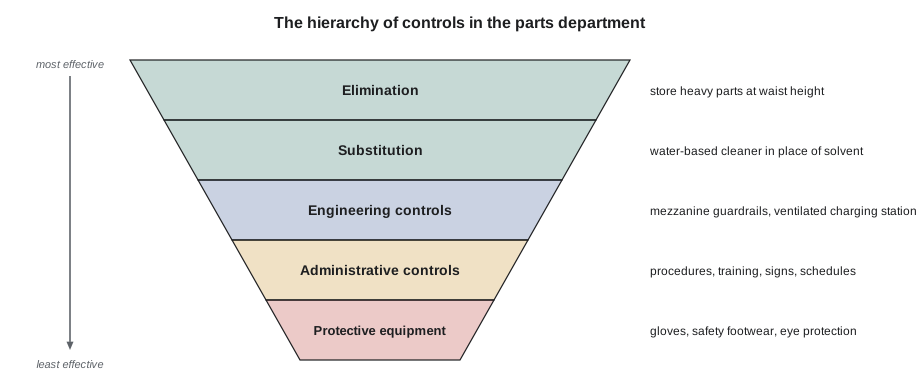
A hazard is anything that could cause harm: a heavy box on a high shelf, a wet floor, an open battery, a forklift backing out of an aisle. The risk is how likely the harm is and how bad it would be. Every safety program starts by finding hazards and then choosing controls, and the controls follow an order of preference called the hierarchy of controls:
- Elimination: remove the hazard entirely, such as storing heavy parts at waist height so nobody lifts them from the floor or from overhead.
- Substitution: replace it with something less hazardous, such as a water-based cleaner in place of a solvent.
- Engineering controls: change the workplace, such as guardrails on the mezzanine, a battery charging station with ventilation, or a dock leveler.
- Administrative controls: change how work is done, with procedures, training, signs and schedules.
- Personal protective equipment: gloves, safety footwear, eye protection and high-visibility vests, used as the last line of defense.
Exam questions about controls usually ask which is most effective. The answer is the one highest on the list that would actually work. Personal protective equipment matters, but it protects only the person wearing it and only when it is worn correctly, so it is never the best first answer when an engineering or elimination control is available.
In the United States, the Occupational Safety and Health Act requires employers to provide a workplace free from recognized serious hazards, and OSHA's general industry standards in 29 CFR 1910 cover warehouses, powered industrial trucks, walking surfaces and hazard communication. Workers have the right to be trained in a language they understand, to see records of injuries and hazards, and to report hazards without retaliation. In situations of imminent danger, where there is no time to get the hazard fixed through normal channels, a worker may refuse the task after asking the employer to correct the hazard.
Lifting, ladders and material handling
Most injuries in a parts department aren't dramatic. They are back strains, cuts, crushed fingers and falls from small heights. APT-110 covered the habits that prevent them:
- Plan the lift. Check the weight on the label or by tipping a corner. Clear the path and the landing spot. Get help or use a cart, dolly or lift table for anything heavy, awkward or long.
- Lift close and straight. Keep the load close to the body, bend at the knees and hips rather than the waist, keep the back in its natural curve, and turn with the feet rather than twisting.
- Know the guide weight. The NIOSH lifting equation uses a load constant of 51 lb for an ideal lift: close to the body, at waist height, without twisting, done occasionally. Any less ideal lift reduces the recommended weight, sometimes by more than half.
- Use ladders correctly. Use a stepladder fully opened and locked, never stand on the top cap or the top step, and keep three points of contact while climbing. Rolling warehouse ladders lock when someone stands on them. An extension ladder is set at about one unit out for every four units up and extends about 3 ft above a landing.
- Never climb racking. Shelving and pallet racks are not ladders, and a rack that is overloaded or damaged can collapse.
Racking has its own rules. Each bay has a load rating, usually on a sign at the end of the aisle, and the heaviest items belong on the lowest levels. Damaged uprights or beams are reported and unloaded at once, and pallets are stored square on the beams with nothing overhanging the aisle. A gap of about 18 in is kept below sprinkler heads so water can reach a fire.
Forklifts and powered equipment
OSHA's powered industrial truck standard, 29 CFR 1910.178, requires every operator to be trained and evaluated on the type of truck they drive, and re-evaluated at least every three years, or sooner after an accident, a near miss or a change in equipment. Linmore's operators are trained by an outside trainer, Delphine Ashworth of Steelport Lift Truck Training, and the dealership keeps the training records.
Every shift starts with a pre-use inspection: tires, forks, chains, mast, hydraulic leaks, horn, lights, brakes, steering, seat belt and the data plate. A truck with a defect is tagged out and not used until it is repaired.
The data plate gives the truck's rated capacity at a stated load center, the distance from the face of the forks to the load's center of gravity. A long or deep load moves the center of gravity forward and reduces the safe capacity. A forklift tips forward when the load's leverage over the front axle exceeds the truck's counterweight, and it tips sideways most easily when turning with the load raised.
Worked problem
Why a long load reduces capacity
A forklift's plate shows 5,000 lb at a 24 in load center. A crated bumper assembly puts its center of gravity 36 in from the fork face. Using the rough proportion rule, about what can the truck safely carry?
Show solution
- Rough rule: capacity × rated load center ÷ actual load center.
- 5,000 × 24 ÷ 36 = 3,333 lb.
Answer: About 3,330 lb, a third less than the plate figure. The rule only shows the size of the effect; the real capacity for a non-standard load comes from the manufacturer's capacity information for that truck and attachment.
Pedestrians are the other half of forklift safety. Linmore marks walkways in the warehouse, uses mirrors at blind corners, and requires operators to sound the horn at intersections and to travel in reverse when a load blocks their view. Pallet jacks and order pickers have the same basic rules: inspection, training and attention to people nearby.
Hazard communication and hazardous materials
Parts departments handle many hazardous products: brake cleaner, paints, adhesives, fuel additives, refrigerants, batteries and airbag modules. OSHA's Hazard Communication Standard, aligned with the Globally Harmonized System (GHS) and updated in 2024, requires manufacturers and importers to label hazardous chemicals and provide a safety data sheet (SDS), and requires employers to train workers and keep SDSs readily accessible.
- Supplier labels show the product identifier, hazard pictograms, a signal word (Danger or Warning), hazard statements, precautionary statements and the supplier's details.
- Workplace labels are needed on secondary containers, such as brake cleaner poured into a spray bottle, unless the person who filled it uses it all at once.
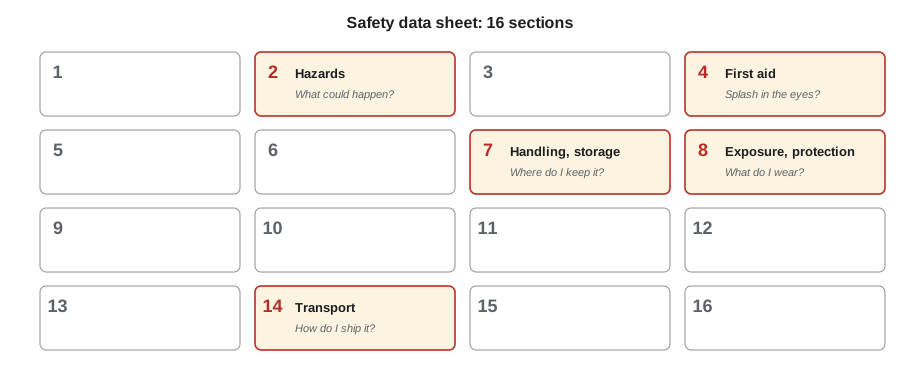
- Safety data sheets have 16 sections in a standard order. Section 2 gives hazards, section 4 first aid, section 7 handling and storage, section 8 exposure controls and protective equipment, and section 14 transport information.
Exam questions in this area often ask where to find information. If the question asks what protective equipment to wear with a product, the answer is section 8 of the SDS. If it asks how to treat a splash in the eyes, section 4. If it asks how to ship it, section 14, along with the transport rules reviewed in lesson 6.
Batteries, fluids and other hazardous parts
Some parts are hazards in themselves, and APT-110 and APT-310 set out how to handle them:
- Lead-acid batteries contain sulfuric acid and give off hydrogen while charging. Store them upright, carry them with a carrier or by the case, wear eye protection and gloves, charge them only in a ventilated area away from sparks, and keep an eyewash station and spill kit nearby. A cracked or leaking battery goes into an acid-resistant container.
- Lithium-ion batteries, from small key fob cells to high-voltage packs, can overheat and burn if damaged. Damaged or recalled lithium batteries are isolated, not stacked, and shipped only under the special rules for damaged batteries.
- Airbag modules and seat belt pretensioners contain small explosive charges. Store them in their original packaging, face up, away from heat and electrical sources, and never carry them by the wires or with the deployment side toward your body.
- Used fluids and parts: used oil, coolant, filters and refrigerant are collected for recycling under environmental rules. Cores and returns may still contain fluid and must be drained or bagged.
- High-voltage components from hybrids and electric vehicles are handled only by people trained for them, as lesson 8 reviews.
Housekeeping, fire and emergencies
Good housekeeping prevents many accidents: aisles clear, spills cleaned at once, cardboard flattened and removed, pallets returned, and nothing stored in front of exits, electrical panels, extinguishers or eyewash stations. Fire safety follows the same logic.
- Fire classes: A for ordinary combustibles such as cardboard and wood, B for flammable liquids and gases, C for energized electrical equipment, D for combustible metals and K for cooking oils. Most warehouse extinguishers are rated ABC.
- Using an extinguisher: pull the pin, aim at the base of the fire, squeeze the handle and sweep side to side. Only fight a small fire with a clear exit behind you; otherwise, leave and raise the alarm.
- Emergency procedures: know the exits, the alarm, the assembly point and who takes the head count. Linmore's fire drill on October 21 happened on stock order day, with seven pallets on the receiving floor, which is exactly why drills are run on busy days.
Tools, equipment and organizing work
General operations also covers the tools a parts specialist uses and how the day's work is organized. The tools range from measuring instruments, such as calipers, micrometers, thread gauges and battery testers, to the parts system, scanners, label printers and the phone. Organizing work means planning the day, setting priorities when everything is urgent, keeping records and following up. These are rarely tested as facts. They are tested as situations: a question describes three jobs arriving at once and asks which to do first.
Imani's rule for priorities was the one Rolf had taught her years before: safety first, then the vehicle in the service bay or the machine that is down, then the customer at the counter, then the phone, then everything else. An exam question that offers a safety problem as one of the options almost always wants it dealt with first.
Communication and mentoring
The test also expects professional communication: clear speech, accurate written records, respect in the workplace and the ability to show a new employee a task. A good method for teaching a task is to explain it, demonstrate it, let the learner try it, and give feedback.
Teodor laughed when Imani read the mentoring steps aloud. "That's what you're doing with me," he said. "Explain, demonstrate, let me try and tell me what I got wrong." Imani agreed, and set him his first task: to teach Talia how the department's battery charging station worked, step by step, before the next session.
Personal protective equipment in the parts department
Even as the last line of defense, protective equipment matters, and exam questions ask which equipment fits which job. Safety footwear protects against dropped parts and is standard in the warehouse. Cut-resistant gloves protect against sheet metal, glass and sharp edges when unpacking body parts and exhaust components. Chemical-resistant gloves and eye protection are worn when handling batteries, fluids and cleaners, chosen from section 8 of the product's safety data sheet. Hearing protection is needed near loud equipment, and high-visibility vests in the receiving area and on the dock when trucks and forklifts are moving.
Equipment only works if it fits, is in good condition and is worn. Damaged gloves are replaced, not taped. Safety glasses are worn with the side shields in place. And protective equipment is the employer's responsibility to provide and the worker's to use and look after.
Reporting incidents and near misses
Every injury, however small, is reported to the supervisor and recorded. So are near misses, events that could have caused an injury but didn't, such as a carton falling from a shelf into an empty aisle. Near misses are the cheapest warnings a department gets, and investigating them prevents the next injury.
Common mistakes
MistakeChoosing personal protective equipment as the best control.
InsteadChoose the highest workable control in the hierarchy; PPE is the last line of defense.
MistakeUsing a shelf or rack as a ladder.
InsteadUse a proper ladder or rolling stair and keep three points of contact.
MistakeIgnoring the load center when lifting a long crate.
InsteadCheck the load center and the manufacturer's capacity information; a long load reduces capacity.
MistakeLooking for first aid information in section 8 of the SDS.
InsteadFirst aid is section 4; section 8 is exposure controls and protective equipment.
MistakeCharging batteries in a closed corner of the warehouse.
InsteadCharge in a ventilated area away from sparks, with eye protection and an eyewash station nearby.
Summary and key terms
- Controls follow the hierarchy: elimination, substitution, engineering, administrative, then personal protective equipment.
- OSHA requires a workplace free of recognized serious hazards and protects workers who report them.
- Forklift operators are trained, evaluated and re-evaluated at least every three years.
- Hazard Communication requires labels, 16-section SDSs and training.
- Batteries, airbag modules, lithium cells and high-voltage parts each have their own handling rules.
- Hazard
- Anything that could cause harm.
- Hierarchy of controls
- The order of preference for controls: elimination, substitution, engineering, administrative, personal protective equipment.
- Load center
- The distance from the fork face to the load's center of gravity, used in the truck's rated capacity.
- Safety data sheet (SDS)
- A 16-section document with hazard, handling, protection, first aid and transport information for a product.
- Pre-use inspection
- The check of a forklift or other powered equipment before it is used each shift.
- Class C fire
- A fire involving energized electrical equipment.
Practice problems
Work each problem on paper first, then reveal the answer to check.
A spill of brake fluid in an aisle. Which SDS section gives clean-up guidance?
Show answer
Section 6, accidental release measures.
Name the five levels of the hierarchy of controls, most effective first.
Show answer
Elimination, substitution, engineering controls, administrative controls, personal protective equipment.
An extension ladder reaches a landing 12 ft up. About how far from the wall should its foot be?
Show answer
One quarter of the height: about 3 ft.
What fire class is a burning parts system terminal still plugged in?
Show answer
Class C, energized electrical equipment.
An airbag module must be carried to the receiving area. How should it be held?
Show answer
By the housing, with the deployment side away from the body, never by the wires.
Lesson quiz · 5 questions
Score 60% or more to complete this lesson.
Create a free account to save your progress, take quizzes and earn a certificate.