
APT-340 · Lesson 6 of 12 · 25 min
Review: receiving and shipping
▶ Video coming soon A video version of this lesson is on the way.
For the fifth session, Imani asked Sasha Esparza, the warehouse lead, to teach it. Sasha agreed on one condition: that it happen on the receiving dock, not in the training room. She set out a pallet she had built for the purpose, a mix of rotors, filters, a battery, a crated bumper cover and a carton with a damaged corner, with a packing slip that contained three deliberate errors. Teodor found two. Talia found all three, and then found a fourth that Sasha hadn't planted: a battery carton stacked on its side.
On the P2 test, receiving and shipping questions appear mostly under general operations and inventory management, and hazardous materials shipping comes up in questions about batteries and airbag modules. APT-220 covered the whole area, including the federal hazardous materials rules in 49 CFR enforced by the Department of Transportation (DOT).
The flow of parts through the warehouse
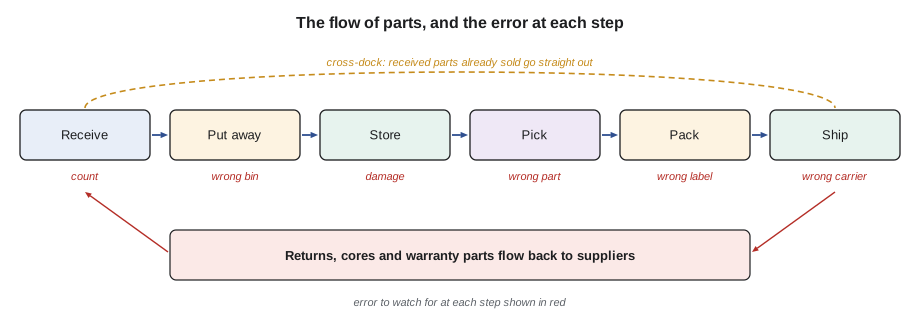
Parts move through a warehouse in a standard sequence, and most errors happen at the hand-offs between steps:
- Receiving: unload, count, check and record what arrived.
- Put-away: move parts to their bin locations, or straight to the customer or service shop if they are already sold (cross-docking).
- Storage: keep parts safe, findable and in the right conditions.
- Picking: pull parts for orders, usually from a pick list or a scanner.
- Packing and shipping: pack, label, document and send parts out by van, courier or freight.
- Reverse logistics: handle returns, cores and warranty parts going back to suppliers.
Receiving and checking shipments
Receiving is where the department finds out whether it got what it paid for. APT-220 set out Sasha's routine:
- Before signing: count the pieces (pallets and cartons) against the carrier's delivery receipt or bill of lading, and look for damage: crushed corners, wet cartons, broken shrink-wrap, leaking fluid.
- Note exceptions on the carrier's copy before signing: "2 cartons crushed" or "1 pallet short". A clean signature tells the carrier everything arrived in good order and weakens any claim.
- Check contents against the packing slip and the order: part numbers, quantities and the condition of each item.
- Receive into the system, so stock is available for sale and the invoice can be matched.
- Deal with exceptions the same day: short, damaged, wrong or extra parts.
The order of these steps matters. An exam question about a damaged shipment usually wants the damage noted on the delivery receipt before signing, not discovered afterwards.
Damaged, short and wrong shipments
Exceptions come in a few types, and each has its own process:
- Visible damage: note it on the delivery receipt, photograph it, keep the packaging and file a claim with the carrier.
- Concealed damage: damage found when the carton is opened, after a clean signature. Report it to the carrier as soon as possible, keep the packaging and photographs, and file the claim.
- Shortages: parts listed on the packing slip but not in the shipment. Check whether they were back-ordered or shipped separately before claiming.
- Wrong parts: report them to the supplier for a return authorization and replacement.
The terms of sale decide who claims. Under FOB destination, the seller owns the goods until delivery and files the carrier claim; under FOB origin (or shipping point), the buyer owns them once they leave the seller and files the claim itself.
In the United States, the Carmack Amendment makes interstate carriers liable for loss and damage, with at least nine months to file a written claim and two years from a denial to sue.
Worked problem
A shipment with exceptions
A Torvale distributor's freight shipment arrives with a crushed corner on one pallet. The delivery receipt is noted. On checking, one rotor is cracked, four rotors invoiced at 61.75 dollars each are missing, and two boxes of pads are the wrong part number. What value is short, and what does each exception need?
Show solution
- Shortage: 4 × 61.75 = 247.00 dollars.
- Cracked rotor: visible damage, already noted, photographed and claimed with the carrier.
- Shortage: checked against the packing slip, then reported to the distributor.
- Wrong pads: return authorization from the distributor and replacement.
Answer: 247.00 dollars short, plus a damage claim and a wrong-part return. In APT-220's real case on October 19, the terms were FOB destination, so the distributor handled the carrier claim, and everything was recovered in ten days.
Put-away and storage
Put-away decides whether the part can be found again. A part put in the wrong bin is lost to the system until someone finds it by accident. Sasha's rules were to scan or check the location label for every put-away, put fast movers nearest the counter, keep heavy parts low, store long parts horizontally on cantilever racks, and keep sensitive parts in the right conditions: batteries upright, electronic modules in their static-shielding packaging, rubber parts away from heat and sunlight, and fluids away from extreme cold.
Two storage principles come up on exams. First in, first out (FIFO) means older stock is sold first, which matters for parts with a shelf life, such as batteries, adhesives and some rubber parts. Fixed locations give each part a permanent bin; random locations put stock wherever there is space and rely on the system to track it. Most dealer parts departments use fixed locations, with overflow locations for large orders.
Picking and packing
Accurate picking depends on reading the pick list carefully, scanning or checking each part number and quantity, and putting the picked parts in a tote or bin labeled with the order. Linmore's target for order accuracy is 99.5 percent; in September the department shipped 378 of 380 orders without error.
Packing protects parts and the people who handle them. Use a box that fits, fill empty space, put heavy items at the bottom, protect fragile items such as lamps and glass, seal cartons well, and put the label on the largest flat side. Parts with fluids are drained or bagged, and anything hazardous is packed and marked under the transport rules.
Couriers often charge by dimensional weight for light, bulky parcels, so packing in an oversized box costs money.
Worked problem
Dimensional weight
A bumper cover is packed in a box 24 in × 16 in × 16 in that weighs 26 lb. The courier's divisor is 139 cubic inches per pound. What weight is billed?
Show solution
- Volume = 24 × 16 × 16 = 6,144 cubic inches.
- Dimensional weight = 6,144 ÷ 139 = 44.2 lb.
- The courier bills the greater of actual (26 lb) and dimensional weight.
Answer: About 44.2 lb, which couriers round up to 45 lb. A smaller box would cut the cost.
Shipping methods and carriers
A parts department ships by several methods, chosen by speed, size and cost: its own delivery van for local wholesale customers, couriers for parcels, less-than-truckload (LTL) freight for pallets, and truckload or specialized carriers for very large items. Linmore's van runs at 10 a.m. and 2 p.m., with order cut-offs at 9:30 and 1:30, and a courier, Brackenly Express, picks up daily at about 4:30.
Shipping hazardous materials
Many parts are hazardous materials under the DOT rules: lead-acid batteries, lithium batteries, airbag modules and seat belt pretensioners, aerosols, flammable paints and fuel additives. Every hazmat employee who prepares, packs, marks or ships them must be trained within 90 days of starting the job and retrained at least every three years, and the employer keeps the training records. The shipper must classify the goods, pack them in approved packaging, and apply the right marks, labels and documents.
- UN numbers identify the product: UN2794 for wet lead-acid batteries, UN3268 for airbag modules and pretensioners, UN3480 for lithium-ion batteries shipped alone and UN3481 for lithium-ion batteries packed with or in equipment.
- Limited quantities of some products, such as small aerosols, can ship with simpler marking, up to a gross weight of 66 lb per package.
- Placards are needed on the vehicle above set amounts, generally 1,001 lb or more of hazardous materials for many classes.
- Damaged lithium batteries follow special, stricter packaging rules and can't go by air.
The safe exam answer on hazardous shipments is almost always to check the safety data sheet's transport section and the regulations, use the right packaging and documents, and let only trained, certified staff prepare the shipment.
Cores, returns and reverse logistics
Parts going back to suppliers need as much care as parts coming in, because each one is money owed to the department. Returns need a return authorization and the original packaging; cores need to be clean, drained, complete and packed so they aren't damaged further in transit; warranty parts are tagged with the claim number and kept until the supplier says what to do with them.
Worked problem
A core statement
The core statement for November lists 18 cores returned at a core value of 45 dollars each. The supplier accepts 16 and rejects 2 as damaged. What credit is received, and how much was lost?
Show solution
- Credit claimed: 18 × 45 = 810 dollars.
- Credit received: 16 × 45 = 720 dollars.
- Lost: 2 × 45 = 90 dollars.
Answer: 720 dollars received and 90 dollars lost. After Sasha tightened core inspection at the counter, rejections fell to about 1 in 40.
Barcodes, layout and delivery
Scanners and barcodes reduce errors at every step: receiving, put-away, picking and shipping. A UPC or EAN barcode includes a check digit, like the VIN, so a misread is caught. Warehouse layout matters too. When Sasha re-slotted the warehouse on October 31, moving the packing bench beside the van lane and about 120 fast-moving wholesale parts closer to it, each of about 160 daily picks became about 59 ft shorter, saving about 40 minutes of walking a day.
Delivery drivers represent the department to its customers. Gideon Achebe's van route covers about nine stops a run, and the department's rules are simple: check every delivery against its paperwork, get a signature, bring back cores and returns with their paperwork, and drive safely.
Ohio's hands-free law, in force since April 2023, makes using a hand-held phone while driving an offense.
Running a receiving dock for a day
APT-220 ended with a full receiving day on October 21, the department's weekly stock order day. Seven pallets and nine cartons arrived at 8:40, with 140 order lines. By 2:30, 131 of the lines were put away, and two problem lines had been dealt with: one short, one wrong part. The lessons Sasha drew from it are the ones to bring into the exam:
- Plan the space: clear the receiving area before the truck arrives, and move the core pallet out of the way.
- Work in order: pieces and damage first, then contents, then the system, then put-away.
- Separate exceptions: put problem items on a marked shelf with a note, so they don't get mixed into stock.
- Put away the urgent first: parts already sold to customers and the shop go out first, by cross-docking.
- Close the day: every line received, every exception reported, and the receiving area clear for the next delivery.
On that day the department also ran its fire drill, with seven pallets on the floor, which showed that the receiving area's exit had to stay clear even on the busiest day of the week.
Warehouse layout and efficiency
A warehouse layout decides how far people walk. Fast-moving parts belong closest to where they are picked and packed, slow-moving parts farther away, and heavy parts low and near the dock. Re-slotting, moving parts to new locations as their sales change, is part of normal warehouse management. When Sasha re-slotted on October 31, she measured the result: about 160 picks a day each saved about 59 ft, about 40 minutes of walking a day, enough to absorb a busy morning without overtime.
Barcodes and tracking
Barcodes carry the part number, and on many labels a quantity or serial number, in a form a scanner reads without error. When the department scans at every step, the system knows where each part is: received, in a bin, picked, packed or shipped. Couriers add tracking numbers, so a customer can be told exactly where a parcel is. The exam may ask why scanning reduces errors; the answer is that it replaces reading and typing, which are where most mistakes are made, with a check that the right item is in the right place.
A UPC code has 12 digits and the last is a check digit, calculated from the others like the VIN's. If a label is damaged and a digit is misread, the check digit no longer matches and the scanner rejects it. That is why a parts technician who types a code by hand from a damaged label should check the result against the part description before using it.
Common mistakes
MistakeSigning the delivery receipt before counting and checking.
InsteadCount pieces and inspect for damage first, and note exceptions on the receipt before signing.
MistakeThrowing away the packaging of a damaged shipment.
InsteadKeep packaging and photographs until the claim is settled.
MistakePacking a light part in an oversized box.
InsteadUse a box that fits; dimensional weight pricing charges for space.
MistakeLetting any staff member pack a battery or airbag shipment.
InsteadOnly trained, certified staff prepare hazardous materials shipments.
MistakeSending cores back dirty or undrained.
InsteadClean, drain and pack cores so the supplier accepts them.
Summary and key terms
- Parts flow from receiving through put-away, storage, picking and packing to shipping, with returns flowing back.
- Count and inspect before signing, and note exceptions on the delivery receipt.
- Visible damage, concealed damage, shortages and wrong parts each have their own process; terms of sale decide who claims.
- Couriers bill the greater of actual and dimensional weight.
- Hazardous materials shipments need trained hazmat employees, correct UN numbers, packaging, marks and documents.
- Bill of lading
- A carrier's document listing the goods shipped and the terms of carriage.
- Concealed damage
- Damage found after delivery when a carton is opened.
- FOB destination
- Terms under which the seller owns the goods until they are delivered.
- Cross-docking
- Moving received parts straight to shipping or the customer without storing them.
- Dimensional weight
- A parcel's billed weight based on its size.
- UN number
- A four-digit number identifying a dangerous product for transport.
Practice problems
Work each problem on paper first, then reveal the answer to check.
A box is 20 × 16 × 12 in and weighs 18 lb. With a divisor of 139, what is the dimensional weight?
Show answer
3,840 ÷ 139 = 27.6 lb, rounded up to 28 lb, which is billed.
A shipment is 3 cartons short, each worth 84.20 dollars. What value is missing?
Show answer
3 × 84.20 = 252.60 dollars.
What UN number covers airbag modules?
Show answer
UN3268.
Under FOB origin terms, who files the carrier claim for damage in transit?
Show answer
The buyer, who owned the goods once they left the seller.
Twelve cores at 75 dollars are returned and 1 is rejected. What credit is received?
Show answer
11 × 75 = 825 dollars.
Lesson quiz · 5 questions
Score 60% or more to complete this lesson.
Create a free account to save your progress, take quizzes and earn a certificate.