
APP-220 · Lesson 7 of 12 · 24 min
Electric dryers: heaters and controls
▶ Video coming soon A video version of this lesson is on the way.
The third laundry night, on Wednesday, November 11, was about dryers. Harriet had a 2015 electric dryer from Quarrington's yard on the bench with its front panel and drum out, and the parts laid in a row along the edge: the heater housing with its coil, the high-limit thermostat and thermal cutoff clipped to it, the cycling thermostat and thermal fuse from the blower housing, the motor with its blower wheel, the idler pulley and the belt. "A dryer is a fan, a heater, a drum and four ways of stopping the heater from starting a fire," she said. "If you learn what each of those four does, you can fix almost every electric dryer that comes in."
This lesson covers the electric dryer: how air moves through it, how the drum is driven and supported, how the heater works and how the dryer's thermostats and fuses control it and protect it. It finishes with the logic of a no-heat call and one of Dee's case files in which the dryer was not the problem at all. APP-120 covered the dryer's 240 V circuit and how to test elements; lesson 8 covers gas dryers, lesson 9 venting and lesson 10 moisture sensing.
How air moves through a dryer
A dryer works by heating air, passing it through the tumbling clothes to pick up moisture, and blowing the warm, damp air outside. The blower, a wheel on one end of the drive motor shaft, pulls air through the dryer. Room air enters through openings in the cabinet, passes over the heater, enters the drum, picks up moisture from the clothes, leaves the drum through the lint filter, passes through the blower and goes out the exhaust duct. Because the blower pulls the air, the drum is under a slight negative pressure. Anything that restricts the airflow, from a full lint filter to a crushed vent outside, reduces the amount of air carrying moisture away and makes the heater's air hotter.
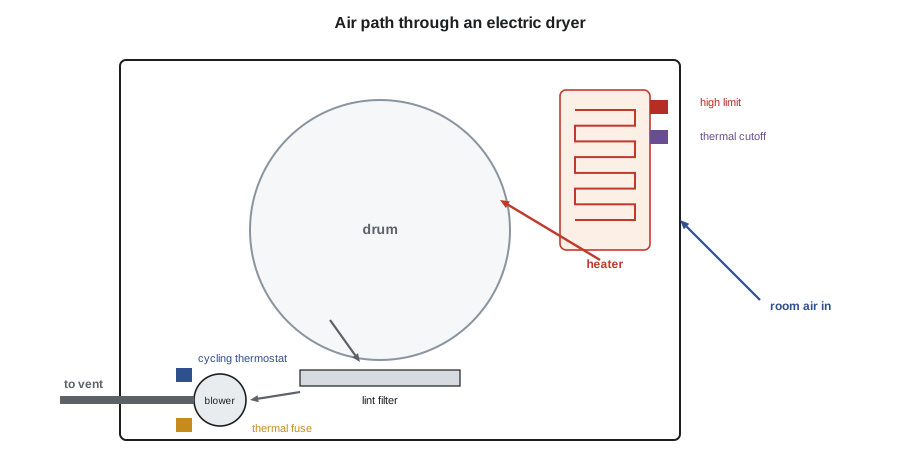
This airflow is the single most important thing about a dryer. A dryer with good airflow dries a normal load in about 40 to 60 minutes with its heater cycling on and off. A dryer with poor airflow runs its heater for short bursts, cycling off on its thermostat because the air is too hot, while the clothes stay damp because too little air passes through them. The customer reports that it takes two or three cycles to dry, or that the outside of the dryer is unusually hot. Lesson 9 covers venting in detail; this lesson notes where restricted airflow shows up in the controls.
The drum and its drive
In most North American electric dryers, one motor turns both the blower and the drum. The blower wheel is on one end of the motor shaft. A long flat or multi-rib belt runs from a small pulley on the other end around the whole drum, held tight by a spring-loaded idler pulley. The drum is carried at the back on two rollers or on a rear bearing, and at the front on plastic glides or rollers on the front bulkhead. Felt seals at the front and rear of the drum keep air from bypassing the clothes.
Wear in these parts gives familiar noises. A thumping on each drum revolution usually means flat spots on the rollers. A squeal points to a dry idler pulley or roller axle. A scraping points to worn front glides, letting the drum rub on the bulkhead. A broken belt stops the drum while the motor runs, and many dryers have a belt switch on the idler arm that shuts the motor off when the belt breaks. Drum support parts are often sold as a kit with rollers, idler and belt, and replacing them together is usually worth it on a dryer over about ten years old.
The heater
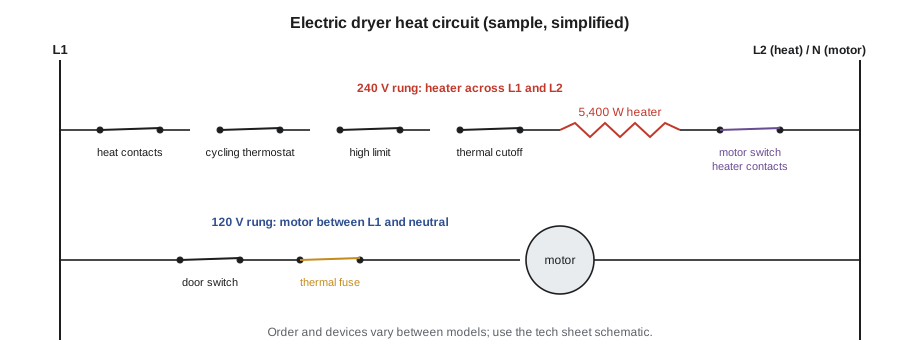
An electric dryer's heater is a coil of resistance wire, usually nichrome, strung on ceramic insulators in a metal housing. Most full-size dryers in North America use a heater rated about 5,000 to 5,600 W at 240 V. The coil is connected across the two hot legs of the dryer's 240 V supply, so it sees the full 240 V, while the motor, timer and lights run on 120 V between one leg and neutral, as APP-120 explained. A coil fails by breaking open, often at a spot where it has sagged and touched the housing, and a broken coil reads OL.
Worked problem
Heater resistance and current
A dryer heater is rated 5,400 W at 240 V. What should it read, what current does it draw, and what does it put out on a 208 V supply in an apartment building?
Show solution
- Resistance: R = V² ÷ P = 240² ÷ 5,400 = 57,600 ÷ 5,400 = 10.7 Ω.
- Current at 240 V: I = P ÷ V = 5,400 ÷ 240 = 22.5 A.
- Power at 208 V with the same resistance: P = V² ÷ R = 208² ÷ 10.7 = 43,264 ÷ 10.7 = 4,040 W.
- That is 4,040 ÷ 5,400 = 0.75, or about three-quarters of the rated power.
Answer: About 10.7 Ω and 22.5 A on 240 V. On a 208 V supply the same heater gives about 4,040 W, so drying takes noticeably longer, which is normal for that supply and not a fault.
Because the heater draws over 20 A, the dryer needs a dedicated 30 A, 240 V branch circuit, and the connections at the dryer's terminal block must be tight. A loose terminal heats, burns the block and the cord end, and can fail open, leaving a dryer with no heat. APP-120 described three-wire and four-wire connections and the bonding strap; always check the terminal block on any no-heat call.
The cycling thermostat
The cycling thermostat, also called the operating thermostat, controls the drying temperature. It is a bimetal disc thermostat mounted on the blower housing or exhaust duct inside the dryer, where it senses the temperature of the air leaving the drum. When the exhaust air reaches its opening temperature, typically somewhere around 135 to 160 °F depending on the heat setting, it opens and switches off the heater; as the air cools, it closes again. The heater therefore cycles on and off through the load. Many dryers select the temperature setting by switching a small bias heater next to the cycling thermostat on or off: the bias heater warms the thermostat a little, so it opens at a lower air temperature for a low-heat setting.
On dryers with electronic controls, an exhaust thermistor usually replaces the cycling thermostat, and the board switches the heater through a relay to hold the selected temperature. The thermistor is tested like any other, against the tech sheet's table; many read about 10 kΩ at 77 °F. A cycling thermostat that has failed open gives no heat. One that has failed closed lets the heater run until the high limit opens, and the dryer overheats.
The high limit, thermal cutoff and thermal fuse
Three more devices protect against overheating, and their names vary between makers. The high-limit thermostat is a resettable bimetal thermostat mounted on the heater housing. It opens if the air at the heater gets far too hot, typically somewhere around 250 °F, which happens when airflow is badly restricted, and closes again when it cools. It is a safety device, not a control; in a dryer with good airflow it should never open. A high limit that cycles is a warning that airflow is restricted.
The thermal cutoff, on many dryers, is a one-time device on the heater housing, wired in series with the heater, that blows if the heater housing overheats, usually because the cycling thermostat has failed closed or airflow is blocked. The thermal fuse, on many dryers, is a one-time device on the blower housing or exhaust duct, typically rated somewhere around 195 °F, that blows if the exhaust air gets too hot. On many models a blown thermal fuse stops the whole dryer, motor included; on others it only cuts the heater. A blown thermal fuse or cutoff is never the fault in itself. It has done its job: something made the dryer overheat, almost always restricted airflow, and the cause must be found and fixed before the dryer is returned to service.
| Device | Where it is | Type | Job | What its failure or opening tells you |
|---|---|---|---|---|
| Cycling thermostat or thermistor | Blower housing or exhaust | Resettable bimetal, or sensor | Controls drying temperature | Open: no heat. Closed: overheating. |
| High-limit thermostat | Heater housing | Resettable bimetal | Opens if heater air is far too hot | Cycling means restricted airflow |
| Thermal cutoff | Heater housing (many models) | One-time | Opens if heater housing overheats | Failed cycling thermostat or blocked airflow |
| Thermal fuse | Blower housing or exhaust (many models) | One-time | Opens if exhaust air overheats | Restricted vent or lint filter |
Some makers sell the thermal cutoff and the high limit together as a kit, because if the cutoff blew, the high limit has probably been through many heating cycles too. Replace a blown one-time device with the exact rated part from the maker. Never bridge a thermal fuse or cutoff with a wire, even to test whether the heater works; that removes the last protection against a lint fire.
Motor, centrifugal switch and the heat circuit
The dryer motor is usually a 120 V split-phase induction motor with a centrifugal switch, which APP-120 covered. That switch does two jobs. It disconnects the start winding once the motor is up to speed, and a second set of its contacts closes the heater circuit. The heater therefore cannot come on until the motor, and so the blower, is turning. A dryer whose motor centrifugal switch has failed in the heater circuit runs and tumbles but never heats, and its heater, thermostats and fuses all test good. The motor's heater contacts are tested with the motor running, by checking for the heater circuit's voltage across them, or with the motor removed by operating the switch by hand.
The door switch stops the motor when the door opens, and on most dryers a start switch or start relay starts it. A dryer that hums but will not turn has an open start winding, a failed start switch or a seized drum, roller or blower; a sock or a piece of lint mat caught in the blower wheel is a common cause.
Diagnosing a dryer that runs but does not heat
A no-heat call follows a short path. First check the supply: with the dryer plugged in and running, the voltage across the two hot legs at the terminal block should be about 240 V, or 208 V in many apartments, and each leg to neutral about 120 V. Then check the lint filter and the vent, because restricted airflow is behind most blown fuses. Then, with the dryer unplugged, check the heater circuit in series: terminal block, heater, high limit, thermal cutoff if fitted, cycling thermostat or relay, thermal fuse if it is in the heater circuit, and the motor's heater contacts. The schematic on the tech sheet shows the order. An open device in that chain is the fault, and if it is a fuse or cutoff, the reason it opened is the real fault.
Worked problem
A dryer with 120 V where there should be 240 V
On Friday, October 9, Dee went to Hollis Yarrow's 2018 electric dryer in Old North Columbus, which tumbled normally but gave no heat. At the receptacle, with the dryer unplugged, she read 121 V from the left leg to neutral, 0 V from the right leg to neutral and no steady reading across the two legs. The heater read 10.6 Ω and every thermostat and fuse in the heater circuit read closed. What was wrong, and whose job was the repair?
Show solution
- The motor runs on one leg and neutral, so it works with only the left leg present.
- The heater needs both legs. With the right leg dead, there is no 240 V for it.
- A right leg with no voltage to neutral cannot be supplying the dryer, so the readings across the legs mean nothing.
- The heater circuit inside the dryer tested good, and the readings at the receptacle put the missing leg upstream of the dryer: in the receptacle, the house wiring or the breaker.
Answer: The dryer had lost one leg of its supply. Dee checked the dryer's cord and terminal block, which were tight and undamaged, and found the customer's double-pole breaker had one side that would not stay on. Faults in the breaker, panel or branch circuit are work for a licensed electrician, so Dee explained that, charged the service call and left a written note of her readings for the electrician.
This case is a good example of why the supply is checked first. Every part inside the dryer was good, and an hour spent testing them would have found nothing. Three voltage readings at the receptacle pointed straight to the house circuit.
Common mistakes
MistakeReplacing a blown thermal fuse and leaving.
InsteadFind and fix the cause, usually the vent or lint filter, before returning the dryer to service.
MistakeBridging a thermal fuse or cutoff to test the heater.
InsteadNever bypass a safety device; test each device with the meter instead.
MistakeSkipping the supply check on a no-heat call.
InsteadMeasure each leg to neutral and across the legs at the terminal block first.
MistakeCalling slow drying on 208 V a fault.
InsteadA 240 V heater gives about three-quarters of its power on 208 V.
MistakeOverlooking the motor's heater contacts.
InsteadIf everything else tests good, check the centrifugal switch's heater circuit.
MistakeRepairing the customer's breaker or panel.
InsteadThat is work for a licensed electrician; leave the readings in writing.
Summary and key terms
- The blower pulls room air over the heater, through the drum and lint filter, and out the vent.
- Restricted airflow makes the heater cycle in short bursts, lengthens drying and causes overheating.
- One motor turns both the blower and the drum belt; rollers, glides and idlers wear and make noise.
- A typical 5,400 W, 240 V heater reads about 10.7 Ω and draws 22.5 A; on 208 V it gives about 4,040 W.
- The cycling thermostat or exhaust thermistor controls temperature; the high limit, cutoff and fuse protect against overheating.
- A blown one-time device has done its job; find the cause.
- The heater only works when the motor's centrifugal switch closes its heater contacts.
- On a no-heat call, check the supply, the airflow, then the heater circuit in series.
- Blower wheel
- The fan on the dryer motor shaft that pulls air through the dryer.
- Idler pulley
- The spring-loaded pulley that keeps the dryer drum belt tight.
- Heater element
- The coil of resistance wire that heats the air in an electric dryer.
- Cycling thermostat
- The thermostat that switches the heater on and off to control drying temperature.
- Bias heater
- A small heater beside the cycling thermostat that lowers its opening temperature for low heat.
- High-limit thermostat
- A resettable thermostat on the heater housing that opens if the heater air gets far too hot.
- Thermal cutoff
- A one-time protective device on the heater housing of many dryers.
- Thermal fuse
- A one-time protective device on the blower housing or exhaust of many dryers.
Practice problems
Work each problem on paper first, then reveal the answer to check.
Why does a dryer with a restricted vent take longer to dry?
Show answer
Less air carries moisture away, and the heater cycles off early because the air gets too hot.
A 5,400 W, 240 V heater reads OL. What has happened?
Show answer
The coil has broken open.
What does a blown thermal fuse tell you?
Show answer
The dryer overheated, usually because of restricted airflow, which must be fixed.
Why can a dryer tumble but not heat with every heater-circuit part testing good?
Show answer
The motor's centrifugal switch heater contacts may have failed, or a supply leg may be missing.
A dryer receptacle reads 120 V from one leg to neutral and 0 V from the other. Where is the fault?
Show answer
In the house supply: the breaker, wiring or receptacle.
Lesson quiz · 5 questions
Score 60% or more to complete this lesson.
Create a free account to save your progress, take quizzes and earn a certificate.