
APP-220 · Lesson 4 of 12 · 27 min
Water valves, pumps and level sensing
▶ Video coming soon A video version of this lesson is on the way.
On the shop bench beside the two washers, Harriet laid out the water path of the front-loader in the order the water travels: the inlet valve with its two hoses still attached, the dispenser drawer and its housing, the clear pressure hose and the pressure sensor from the top of the cabinet, and the drain pump with its filter and the gray corrugated drain hose. "Water comes in, goes through the soap, sits in the tub while the washer measures it, and goes out through the pump," she said. "Half the washer calls you will ever get are somewhere along this line."
This lesson follows water through a washer. It covers inlet valves and screens, water supply pressure and temperature mixing, the dispenser, the three ways a washer measures how much water it holds, drain pumps and filters, and the drain connection to the house, which is where many complaints that look like washer faults really start. APP-110 covered the water supply connection and drain basics; this lesson builds on it.
Inlet valves
The inlet valve is a set of solenoid valves, one for each water inlet and often more, in a single body at the back of the cabinet. A typical washer valve has a hot and a cold inlet and two to four solenoids, so the board can send cold water to the detergent compartment, hot or cold to the main wash, and cold to the softener compartment, by opening different coils in combination. Each solenoid lifts a plunger off a rubber diaphragm, and the water pressure behind the diaphragm then opens it. Because the valve relies on water pressure to open fully, very low supply pressure can leave it opening only partly, which makes for slow fills.
Most washer inlet valve coils are 120 V AC. Their resistance is typically somewhere from about 500 Ω to 1,500 Ω, with the exact value on the tech sheet; an open coil reads OL. Testing a valve follows the same logic as any load. With the board commanding a fill in service mode, check whether 120 V reaches the coil. If it does and no water flows, with the taps open and supply pressure good, the valve has failed, either electrically or mechanically. If no voltage reaches it, look at the board and the wiring. A valve that does not shut off completely lets water dribble into the tub when the washer is off, and the tub may slowly fill even with the washer unplugged. That is always the valve, never the board, because a valve with no power should be closed.
Each inlet has a fine screen to catch grit and scale, and many valves have a flow washer that limits the flow rate. Clogged screens are a common cause of slow fills and of fill codes, especially after municipal water main work stirs up sediment or in hard-water homes. Turn off the taps and remove the hoses to inspect them, and clean or replace them. New hoses are a good recommendation on any service call where the old rubber hoses are more than about five years old or show bulges; a burst inlet hose can flood a house. Braided stainless hoses and an automatic shut-off valve or leak detector are worth mentioning to the customer.
Worked problem
A slow fill
A front-load washer's main wash fill should take about 4.8 gal, and its inlet valve is rated for about 2.1 gpm at normal supply pressure. Kiran times a fill and finds it takes 6 minutes. What flow is the valve actually passing, and what should he check?
Show solution
- Expected fill time: 4.8 ÷ 2.1 = 2.3 minutes.
- Actual flow: 4.8 ÷ 6 = 0.8 gpm.
- That is 0.8 ÷ 2.1 = 0.38, or under 40 in 100 of the rated flow.
- Check that both taps are fully open, then the inlet screens, then the supply pressure, before suspecting the valve.
Answer: The valve is passing less than half its rated flow. Clogged screens or a part-closed tap are much likelier than a failed valve.
Supply pressure and temperature
Washers are designed for normal household water pressure, typically about 20 to 120 psi, with the exact range in the installation instructions. Below the minimum, the valve may not open fully. A pressure gauge on a hose bib or washer tap gives a quick reading. In a home with a well, the pressure cycles between the pump's cut-in and cut-out pressures, and a slow fill may happen only when the pressure tank is near its low point.
Many washers measure the temperature of the incoming water with a thermistor in the valve or the tub and blend hot and cold by switching the hot and cold coils on and off, so that a warm wash really is warm. Customers who complain that the warm or hot cycle runs cold may have a water heater set low, a long pipe run that delivers cold water at the start of each fill, or hot and cold hoses connected the wrong way round. Some washers display a temperature error when the hoses are reversed. Front-load washers with an internal heater warm the water in the tub when the household supply is not hot enough; that heater and its thermistor are tested like any other element and sensor.
The dispenser
The detergent drawer on a front-loader, or the dispenser cups on a top-loader, receives water from the inlet valve through separate channels. When the board opens the detergent coil, water flushes the detergent compartment and carries the detergent into the tub; later, the softener coil flushes the softener compartment through a siphon cap so that the softener is released only in the final rinse. Dispensers clog with dried powder and softener residue, which can leave detergent in the drawer or let softener drip in early, causing stains. They also leak when they are blocked, because water backs up and overflows the drawer housing. Cleaning the drawer and the housing above it is often the whole repair.
Measuring the water level
A washer must know how much water it holds, both to fill to the right level and, for safety, to make sure it does not overfill and does not spin or unlock with water in the tub. Three methods are in common use, and many washers combine two of them.
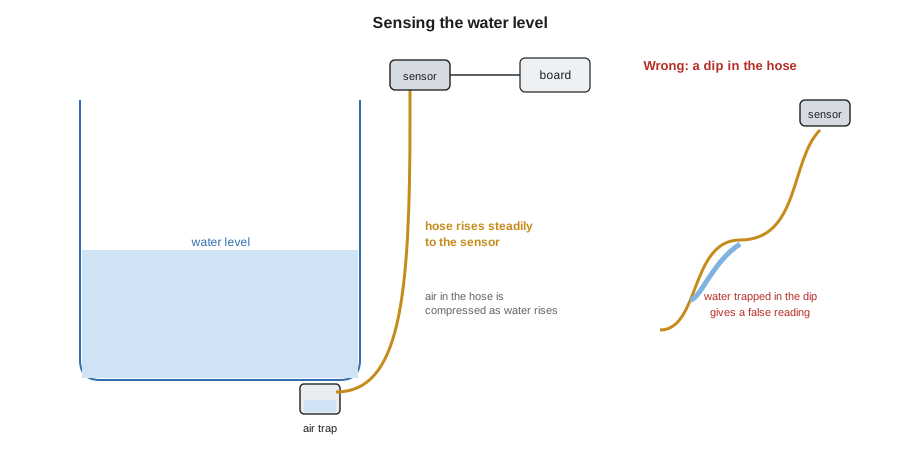
The pressure switch is the oldest. A small air chamber, or air trap, at the bottom of the tub connects through a thin hose to a diaphragm switch high on the cabinet. As water rises in the tub, it compresses the air in the chamber and hose, and at a set pressure the diaphragm snaps the switch from its empty to its full position. Older top-loaders have an adjustable pressure switch linked to the water level knob. Some washers have a second, higher-pressure switch for overflow protection.
The analog pressure sensor is the same idea with electronics. The hose connects to a sensor that converts the air pressure into a signal the board reads continuously. On many washers the sensor's output is a frequency that changes with pressure; on others it is a voltage. The tech sheet gives the values for empty and for various levels, and the service mode usually displays the level the board sees. Because the board knows the level at every moment, it can also detect slow drains, leaks and excess foam, which raises the pressure reading without adding water.
The flow meter counts the water as it enters. A small turbine in the inlet path spins as water passes, and a magnet and sensor produce pulses the board counts. A flow meter lets the board add a measured volume of water regardless of supply pressure. Washers with flow meters still use a pressure sensor for safety and for sensing the level in the tub.
| Method | How it works | Common faults |
|---|---|---|
| Pressure switch | Air trapped in a hose snaps a diaphragm switch at a set pressure | Leaking or kinked hose, clogged air trap, failed switch |
| Analog pressure sensor | A sensor converts air pressure to a frequency or voltage the board reads | Same hose problems; failed sensor; board misreading |
| Flow meter | A turbine in the inlet path produces pulses counted by the board | Debris in the turbine, failed sensor |
The commonest level-sensing fault is not the switch or sensor but the hose. A pressure hose that has slipped off its fitting, cracked, kinked or filled with water or detergent sludge cannot transmit the pressure, and the washer overfills, underfills or shows a pressure code. Blowing gently through the hose to clear it, checking the air trap at the tub for sludge, and checking that the hose runs uphill all the way to the sensor without a dip where water can sit, fixes many level complaints. Never blow into a pressure switch or sensor itself; it is sensitive.
Worked problem
Reading a flow meter
A washer's tech sheet says its flow meter produces about 1,510 pulses per gallon. In service mode the board reports 7,200 pulses for a fill. How much water came in, and does it match the 4.8 gal the main wash should use?
Show solution
- Volume: 7,200 ÷ 1,510 = 4.8 gal.
- That matches the expected 4.8 gal for the main wash.
Answer: The board measured the right amount. If the tub still looks low, the water may be leaking out or draining by siphon during the fill, which the drain section explains.
Drain pumps
Most current washers drain with a small electric pump. On front-loaders and most HE top-loaders it is a separate pump with a permanent-magnet synchronous motor, usually 120 V AC, mounted low at the front or back of the cabinet. Its coil resistance is often in the range of about 10 to 20 Ω, but check the tech sheet for the value. The impeller has a little play when turned by hand, which is normal; it may start in either direction. Older belt-drive top-loaders drive their pump from the motor through the belt. Some washers have a second pump that recirculates water over the load.
A washer that will not drain has a blockage more often than a failed pump. Socks, coins, hair ties, bra underwire and sludge collect in the pump inlet or the drain hose. Front-load washers and some top-loaders have a drain pump filter, also called a coin trap, behind a small door at the bottom front of the cabinet, with a short emergency drain hose beside it. Cleaning that filter is the customer's job in the use and care guide, but many customers never do it, and a clogged filter gives slow drains, drain codes, odor and wet clothes. When opening the filter on a washer that has not drained, put towels down and a shallow pan in front; a front-loader can hold 4 to 5 gal of water behind the door.
To test a drain pump, command a drain in service mode and listen. A pump that hums but moves no water is blocked or has a broken impeller. A pump that is silent may be getting no voltage, may have an open coil, or may have a thermal protector that has tripped from running against a blockage. Measure voltage at the pump during the command, then its coil resistance with the washer unplugged.
Worked problem
A front-loader that would not drain
On Thursday, October 1, Dee went to Ines Coutinho's 2020 front-load washer in Westerville, which stopped with a drain code and the drum half full. In service mode the pump hummed but the level on the display did not fall. Dee drained the water through the emergency hose into a pan, about 4.2 gal, and opened the filter. It held a quarter, three hair elastics and a mat of lint. With the filter cleaned, the pump coil read 14 Ω, against 12 to 18 Ω on the tech sheet, and a commanded drain emptied a fresh 4.2 gal fill in 40 seconds. What was the pump's draining rate, and what was the fault?
Show solution
- Draining rate: 4.2 gal in 40 s = 4.2 ÷ 40 × 60 = 6.3 gpm.
- A pump that hums with a good coil and drains at about 6.3 gpm once cleared is working.
- The fault was the clogged filter blocking the pump inlet.
Answer: A clogged drain filter. Dee showed Ms. Coutinho where the filter was and how to empty it, and suggested a mesh bag for small items. The call was the service call only.
The drain connection
A washer's drain hose usually discharges into a standpipe, a laundry tub or a dedicated drain box. The plumbing code and the washer's installation instructions set the height of the standpipe and the hose end, and the hose must be held loosely in the standpipe, not sealed into it. If the hose is pushed too far down the pipe or sealed with tape, or if the hose end is below the water level in the washer, the washer can siphon: water runs out of the tub by gravity while it fills. The washer then fills and fills, never reaching level, or drains during the wash. The fix is in the installation, not the washer.
A standpipe that is too short or too narrow, or a house drain that is partly blocked, overflows when the pump runs, leaving water on the floor beside the washer that the customer blames on the washer. Watch the standpipe during a drain: if water rises to the top, the house drain is the problem and the customer needs a plumber. A washer installed below the drain, for example in a basement with an overhead drain line, needs a pump and a check valve or a laundry tray pump, as its instructions describe.
A drain hose also needs to be secured so that the force of the pump cannot throw it out of the standpipe. A hose that has jumped out during a drain, leaving a floor full of water, is a common and avoidable flood. Penfold technicians use the hose's own clip or a strap to hold it to the standpipe at the right depth.
Common mistakes
MistakeReplacing a valve without checking the screens and taps.
InsteadCheck the taps are open and the screens clean first.
MistakeBlaming the board for a tub that fills while the washer is off.
InsteadA valve that leaks with no power is a failed valve.
MistakeBlowing into a pressure sensor.
InsteadClear the hose and air trap, but never blow into the sensor itself.
MistakeCondemning a pump that hums.
InsteadClear the filter and inlet; a humming pump is usually blocked.
MistakeSealing the drain hose into the standpipe.
InsteadHold it loosely at the specified depth so the washer cannot siphon.
MistakeOpening a full front-load filter without a pan.
InsteadDrain through the emergency hose into a pan first, with towels down.
Summary and key terms
- The inlet valve has several 120 V coils that route hot and cold water to the tub and dispenser.
- Clogged screens and closed taps cause more slow fills than failed valves.
- A tub that fills with the washer off has a leaking valve.
- Level is sensed by a pressure switch, an analog pressure sensor or a flow meter; hose faults are the commonest problem.
- Drain pumps are usually 120 V synchronous pumps; a humming pump is usually blocked.
- Front-load drain filters must be cleaned regularly; drain into a pan first.
- A drain hose sealed into the standpipe or set too low siphons; overflow at the standpipe is a house drain problem.
- Inlet valve
- The solenoid valve assembly that controls water flow into a washer.
- Inlet screen
- The fine mesh in each valve inlet that traps grit and scale.
- Air trap
- The chamber at the bottom of a washer tub that traps air for level sensing.
- Pressure switch
- A diaphragm switch that changes state when the water reaches a set level.
- Analog pressure sensor
- A sensor that reports the water level to the board continuously.
- Flow meter
- A turbine sensor that counts the water entering a washer.
- Drain pump filter
- The filter at the pump inlet of a front-loader that catches coins and debris.
- Siphoning
- Water running out of a washer by gravity through a drain hose set too low or sealed in.
Practice problems
Work each problem on paper first, then reveal the answer to check.
A washer slowly fills while unplugged. What has failed?
Show answer
The inlet valve, which is not closing fully.
Why does a dip in the pressure hose cause trouble?
Show answer
Water trapped in the dip gives the sensor a false reading.
A drain pump hums but does not drain. What is the likeliest cause?
Show answer
A blockage at the filter or pump inlet.
A washer keeps filling and never reaches level. What should you check at the drain?
Show answer
Whether the drain hose is too low or sealed in, letting the washer siphon.
Water overflows the standpipe during a drain. Whose problem is it?
Show answer
The house drain's; it needs a plumber.
Lesson quiz · 5 questions
Score 60% or more to complete this lesson.
Create a free account to save your progress, take quizzes and earn a certificate.