
AI-460 · Lesson 1 of 12 · 25 min
What responsible AI means
AI systems now help decide who gets a loan, a job interview, a medical follow-up, a social benefit or extra police attention. They write text that millions of people read, generate images, and recommend what people watch and buy. When these systems work well they can be faster, more consistent and sometimes fairer than the processes they replace. When they fail, they can deny opportunities to entire groups, expose private information, spread stereotypes, or make decisions nobody can explain or challenge. Responsible AI is the discipline of building, evaluating and deploying AI systems so that they are fair, protect privacy, are transparent and accountable, and remain under meaningful human oversight. This course focuses on the technical side of that discipline: measuring and reducing bias, protecting privacy with mathematical guarantees, documenting and explaining systems, and auditing them in practice. The legal and policy context is covered in AI-440; here we build the tools engineers and data scientists use every day.
Kinds of harm
A useful first step is to name the harms an AI system might cause. Researchers commonly distinguish:
- Allocative harms: a system withholds or allocates resources or opportunities unfairly, such as loans, jobs, housing, healthcare or bail.
- Quality-of-service harms: a system works less well for some people, for example speech recognition that makes more errors for certain accents, or face detection that fails more often for darker skin tones.
- Representational harms: a system reinforces stereotypes, demeans groups or erases them, for example image generators that depict doctors only as men or translation systems that assign gender stereotypically.
- Privacy harms: a system exposes or infers sensitive information, enables surveillance, or memorizes and reproduces personal data.
- Harms of opacity and lack of recourse: people cannot understand why a decision was made or how to contest it.
- Safety and societal harms: physical danger, misinformation, manipulation, environmental costs and concentration of power.
Different systems raise different mixes of harm. A credit model raises allocative and transparency concerns; a chatbot raises representational, privacy and safety concerns; a face recognition system raises quality-of-service and surveillance concerns.
Principles and practices
Many organizations and governments have published AI principles. Despite differences in wording, they converge on a handful of themes: fairness and non-discrimination, privacy and data protection, transparency and explainability, accountability, safety and robustness, and human oversight. Principles alone change little; what matters is turning them into practices with measurable criteria, assigned responsibilities and evidence. Frameworks such as the NIST AI Risk Management Framework and the ISO/IEC 42001 management system standard (AI-440) provide structures for doing so, and much of this course provides the technical measurements those frameworks require.
Responsible AI across the life cycle
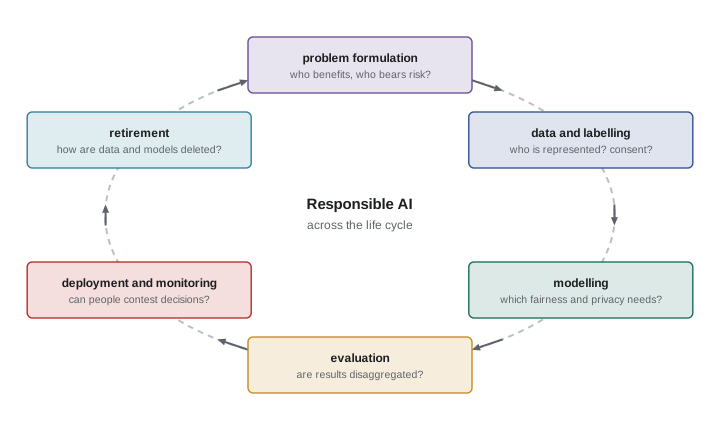
Responsible AI is not a final check before launch; it runs through the whole life cycle:
- Problem formulation: is AI appropriate here? Who benefits, who bears risk, and what outcome is actually being predicted?
- Data: where did the data come from, who is represented, how were labels created, and was consent obtained?
- Modeling: which fairness and privacy properties are needed, and how will trade-offs be handled?
- Evaluation: are results disaggregated by relevant groups, tested on realistic conditions, and stress-tested for failures?
- Deployment: how will humans use the outputs, can affected people contest decisions, and is the system monitored?
- Retirement: how are models and data decommissioned?
Many of the most serious failures originate in problem formulation, for example predicting healthcare costs as a proxy for healthcare needs, which embeds unequal access to care into the target (Lesson 2).
Disaggregated evaluation
The single most important practical habit in responsible AI is disaggregated evaluation: reporting performance and outcomes separately for relevant groups, instead of only overall averages. An overall accuracy of 95 % can hide 99 % accuracy for one group and 80 % for another. The groups that matter depend on the context and the law: often protected characteristics such as sex, race or ethnicity, age and disability, but also language, region, device type or intersections of several attributes.
import numpy as np
# Auditing a loan approval model: outcomes and error rates by group
rng = np.random.default_rng(1)
n = 10_000
group = rng.choice(["A", "B"], n, p=[0.7, 0.3])
repaid = rng.random(n) < np.where(group == "A", 0.80, 0.72)      # true outcome if approved
score = 0.55 * repaid + rng.normal(0.30, 0.18, n) - 0.06 * (group == "B")
approved = score > 0.55

print("group  share  approval  repay_rate  TPR    FPR    precision")
for g in ("A", "B"):
    m = group == g
    tp = np.sum(approved & repaid & m); fp = np.sum(approved & ~repaid & m)
    fn = np.sum(~approved & repaid & m); tn = np.sum(~approved & ~repaid & m)
    print(f"{g:5s}  {m.mean():5.2f}  {approved[m].mean():8.2f}  {repaid[m].mean():10.2f}  "
          f"{tp / (tp + fn):.2f}   {fp / (fp + tn):.2f}   {tp / (tp + fp):.2f}")
ratio = approved[group == "B"].mean() / approved[group == "A"].mean()
print(f"approval rate ratio B/A = {ratio:.2f} (the four-fifths rule flags values below 0.80)")group share approval repay_rate TPR FPR precision A 0.70 0.78 0.80 0.96 0.07 0.98 B 0.30 0.66 0.72 0.91 0.04 0.98 approval rate ratio B/A = 0.85 (the four-fifths rule flags values below 0.80)
The audit reveals several things that an overall accuracy figure would hide. Group B is approved less often than group A (66 % against 78 %), partly because its true repayment rate is lower in this simulation, but also because the score systematically penalizes group B: its true positive rate is lower (91 % against 96 %), so creditworthy applicants in group B are rejected more often. Precision is the same for both groups. The ratio of approval rates, 0.85, passes the "four-fifths" screening rule used in US employment discrimination practice, yet the model still treats creditworthy members of group B worse. Which of these numbers matters most depends on the definition of fairness chosen, which is the subject of Lessons 3 and 4.
Who decides what is fair?
Fairness is not purely a technical property. Choosing which groups to compare, which outcomes count as harms, and which trade-offs are acceptable involves values, law and the perspectives of affected people. Engineers can measure, illuminate trade-offs and implement choices, but decisions about what is acceptable should involve domain experts, legal and ethics advisers, and, wherever possible, representatives of the communities affected. Participatory approaches, such as consulting community groups during design and testing, often reveal harms that developers would not anticipate.
Data about sensitive attributes
Measuring fairness requires knowing which group each person belongs to, but collecting sensitive attributes raises its own privacy and legal issues. Some laws restrict collecting or using attributes such as race or religion; some organizations avoid collecting them to reduce discrimination risk. Yet without them, bias cannot be measured. Practical approaches include collecting attributes voluntarily and separately from decision systems with strict access controls, using them only for auditing, estimating group membership statistically for aggregate analysis (with care, since such estimates carry their own errors), and working with trusted third parties. "Fairness through unawareness", simply removing sensitive attributes from the model, does not prevent discrimination, because other features act as proxies (Lesson 2).
In the United States, laws such as the Civil Rights Act, the Equal Credit Opportunity Act and the Fair Housing Act prohibit discrimination in specific domains, with disparate impact doctrine applying in several of them; rules on collecting protected attributes vary, for example lenders generally may not ask about race for most credit, while mortgage lenders must collect it for monitoring under HMDA.
The rest of this course
The course moves from fairness to privacy to transparency and governance. Lessons 2 to 6 cover sources of bias, fairness definitions and their conflicts, mitigation techniques, and fairness in generative models. Lessons 7 to 10 cover privacy: re-identification and anonymization, differential privacy, privacy-preserving machine learning including federated learning, and attacks that extract information from models. Lessons 11 and 12 cover documentation and explanation, audits and governance, and a capstone project. Each lesson includes code that measures or implements the ideas, because responsible AI claims must be backed by evidence.
Worked problem
Framing a responsible AI review
A hospital plans a model to flag patients for a care management program with limited places. List the first questions a responsible AI review should ask.
Show solution
- Purpose: what outcome does the hospital want, better health outcomes, fewer readmissions or lower costs, and is the model's target aligned with that purpose?
- Harms: who could be wrongly excluded, and what are the consequences of false negatives versus false positives?
- Data: are all patient groups represented, and do historical records reflect unequal access to care?
- Fairness: which groups must be compared, and which metric (for example equal true positive rates among patients who truly need care) fits the purpose?
- Use and oversight: will clinicians review flags, can patients be added manually, and how will outcomes be monitored after deployment?
Answer: The review starts with purpose, harms, data provenance, fairness criteria and human oversight before any modeling choices are made.
Roles and accountability
Accountability means that identifiable people are responsible for an AI system's behavior and its consequences. In practice, responsible AI programs assign roles: a system owner who is accountable for the system in production, developers and data scientists who build and test it, a risk or compliance function that reviews high-risk systems, and an escalation path for incidents. Each high-risk system should have a documented purpose, a named owner, records of the evaluations performed, and a process for affected people to raise concerns. Without these, harms tend to fall into gaps between teams: the data team assumes the model team checked for bias, the model team assumes the business owner approved the trade-offs, and nobody monitors outcomes after launch.
Accountability also extends to suppliers. Many organizations deploy models they did not build, such as a vendor's hiring screen or a general-purpose language model accessed through an API. Using a third-party model does not transfer responsibility for its effects. Deployers should ask vendors for documentation of training data, evaluation results by group, known limitations and update practices, and should run their own tests on data that reflects their users, because a model that performed well in the vendor's benchmark may behave differently on a new population.
Values in tension
Responsible AI values sometimes conflict. Measuring fairness requires sensitive data, which raises privacy risk. Adding privacy protections such as differential privacy adds noise that can fall hardest on small groups, reducing accuracy for exactly the people fairness audits aim to protect. Explanations that make a model transparent can reveal information that helps people game it or that leaks training data. Strict human review improves oversight but can be slow, costly and subject to its own biases, and reviewers often defer to the model, a pattern called automation bias. Recognizing these tensions is part of the work: good practice makes the trade-offs explicit, records the reasoning, and revisits it as evidence accumulates rather than pretending a single metric settles every question.
A practical way to manage these tensions is a written impact assessment completed before development and updated before deployment. It describes the system's purpose and context, the people affected, foreseeable harms and their severity, the fairness and privacy measures chosen, the residual risks accepted and who accepted them. Impact assessments are required in some settings, such as certain public sector systems, and they are good practice everywhere, because they force teams to answer the questions in this lesson in writing and give later auditors a baseline to compare against.
Common mistakes
MistakeReporting only overall accuracy.
InsteadDisaggregate results by relevant groups and intersections.
MistakeTreating responsible AI as a final launch check.
InsteadAddress it at every life cycle stage.
MistakeAssuming removing sensitive attributes ensures fairness.
InsteadMeasure outcomes; proxies can still discriminate.
MistakeLetting engineers alone decide what is fair.
InsteadInvolve domain experts, legal advice and affected communities.
MistakePublishing principles without practices.
InsteadTurn principles into measurable criteria, owners and evidence.
Summary and key terms
- Responsible AI aims for fair, private, transparent, accountable and overseen systems.
- Harms include allocative, quality-of-service, representational, privacy, opacity and safety harms.
- Principles converge on common themes but must become measurable practices.
- Responsibility runs through problem formulation, data, modeling, evaluation, deployment and retirement.
- Disaggregated evaluation reveals disparities that averages hide.
- Fairness choices involve values and affected people, not only engineers.
- Measuring fairness requires careful handling of sensitive attributes.
- Responsible AI
- Building and deploying AI that is fair, private, transparent and accountable.
- Allocative harm
- Unfair distribution of resources or opportunities.
- Quality-of-service harm
- A system working worse for some groups.
- Representational harm
- Reinforcing stereotypes or demeaning groups.
- Disaggregated evaluation
- Reporting metrics separately for groups.
- True positive rate
- The share of actual positives correctly identified.
- Four-fifths rule
- A screening rule flagging selection rate ratios below 0.8.
- Fairness through unawareness
- Removing sensitive attributes from inputs.
- Proxy
- A feature correlated with a sensitive attribute.
- Participatory design
- Involving affected people in designing systems.
Practice problems
Work each problem on paper first, then reveal the answer to check.
Name four kinds of AI harm.
Show answer
Allocative, quality-of-service, representational, privacy, opacity, safety.
Give an example of a quality-of-service harm.
Show answer
Speech recognition with more errors for certain accents.
What common themes appear in AI principles?
Show answer
Fairness, privacy, transparency, accountability, safety, human oversight.
Why is problem formulation critical?
Show answer
Choosing the wrong target can embed bias, as with cost as a proxy for need.
What is disaggregated evaluation?
Show answer
Reporting metrics separately for relevant groups.
In the audit, what was group B's TPR compared with A's?
Show answer
0.91 versus 0.96.
Compute the four-fifths ratio for selection rates of 30 % and 45 %.
Show answer
0.67, which is flagged.
Why does removing sensitive attributes not guarantee fairness?
Show answer
Other features act as proxies.
Name two ways to measure fairness while limiting privacy risk.
Show answer
Voluntary collection kept separate, use only for audits, trusted third parties.
Who should be involved in deciding fairness criteria?
Show answer
Domain experts, legal and ethics advisers, affected communities.
Lesson quiz · 5 questions
Score 60% or more to complete this lesson.
Create a free account to save your progress, take quizzes and earn a certificate.