
AERO-320 · Lesson 2 of 12 · 24 min
Isentropic flow
Most of the flow around the Swift 900 is isentropic: it is adiabatic, because there is no time for heat to flow in or out of a moving parcel of air, and it is reversible, because viscous effects are confined to thin boundary layers and wakes. Outside those layers and away from shock waves, every parcel of air keeps its entropy. That single fact turns the full equations of compressible flow into a handful of algebraic relations between the Mach number and the pressure, temperature and density. Kenji Watanabe asks Arjun to build a small program that reproduces the standard isentropic flow tables, because the group will use those relations every day, from the air data system to the engine inlet.
Stagnation conditions
Lesson 1 introduced the stagnation temperature \(T_0\), the temperature air would reach if brought to rest adiabatically. Dividing the energy equation \(c_pT + \tfrac{1}{2}V^2 = c_pT_0\) by \(c_pT\) and using \(c_p = \gamma R/(\gamma - 1)\) and \(a^2 = \gamma R T\) gives the stagnation temperature ratio as a function of Mach number alone.
If the deceleration is also reversible, it is isentropic, and the isentropic power laws of Lesson 1 give the stagnation pressure and density. The stagnation pressure \(p_0\) is the pressure an ideal pitot tube would read in subsonic flow, and the stagnation density \(\rho_0\) is the density in its mouth.
These ratios are the backbone of compressible aerodynamics. At Mach 0.3 the stagnation pressure is only 6.4 percent above the static pressure. At Mach 0.8 it is 52 percent above it, at Mach 2 nearly eight times, and at Mach 3 almost 37 times. The steep growth explains why supersonic wind tunnels need very high supply pressures, and why the pressures on the nose of a fast aircraft are so large.
The stagnation quantities can be defined at every point in any flow, even one that is never actually brought to rest: they are the values the gas would have if it were. In an isentropic flow they are the same everywhere, so they act as reference values. A wind tunnel with a settling chamber at 300 kPa and 290 K has \(p_0 = 300\ \text{kPa}\) and \(T_0 = 290\ \text{K}\) everywhere in its isentropic nozzle and test section. Across a shock the stagnation temperature stays the same, but the stagnation pressure falls, and that fall is a direct measure of the entropy produced.
Sonic reference conditions
A second set of reference values is the sonic condition, marked with an asterisk: the state the gas would have if it were accelerated or decelerated isentropically to exactly Mach 1. Setting \(M = 1\) in the ratios gives \(T^*/T_0 = 2/(\gamma + 1) = 0.8333\) and \(p^*/p_0 = 0.5283\) for air. The second number is especially important: air flowing from a reservoir reaches the speed of sound when the pressure has fallen to just under 53 percent of the reservoir pressure. Any nozzle whose exit pressure is lower than that can be choked, a condition examined in Lesson 6.
Area and velocity: the reversal at Mach 1
For quasi-one-dimensional flow in a duct whose area changes slowly, continuity says \(\rho V A\) is constant. Differentiating, and using the momentum equation \(dp = -\rho V\,dV\) together with \(dp = a^2\,d\rho\), leads to the area-velocity relation.
This short equation contains one of the most important ideas in gas dynamics. Below Mach 1, the bracket is negative, so a narrowing duct accelerates the flow, as everyday experience suggests. Above Mach 1, the bracket is positive, so a narrowing duct decelerates the flow and a widening duct accelerates it. The reason is density: in supersonic flow the density falls faster than the velocity rises, so the stream tube must widen to carry the same mass flow. At exactly Mach 1 the area change must be zero, which means sonic flow can occur only at a throat, a minimum area. To accelerate a gas from rest to supersonic speed, the duct must converge to a throat and then diverge. This is the converging-diverging nozzle invented for steam turbines by Gustaf de Laval in the 1880s, and it is used in every rocket engine and supersonic wind tunnel.
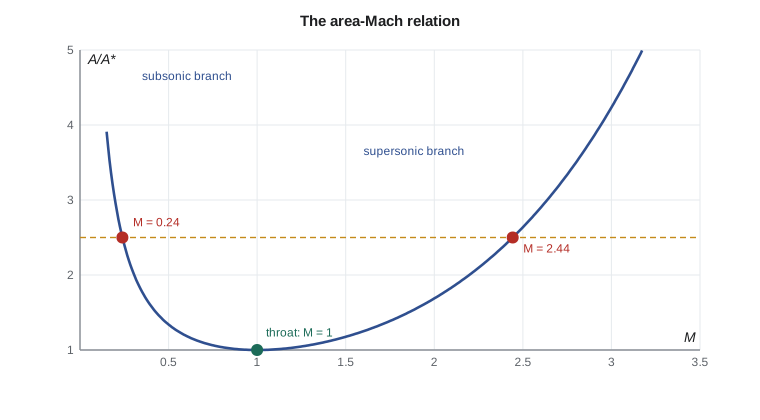
The area-Mach relation
Integrating the area-velocity relation for isentropic flow of a perfect gas gives the ratio of the local area to the sonic throat area \(A^*\), the area at which the flow would just reach Mach 1. The result depends only on Mach number.
The relation is easy to evaluate forward: given the Mach number, find the area ratio. Design usually needs the inverse: given the area of a nozzle station, find the Mach number. There is no closed form for the inverse, and every area ratio above 1 has two solutions, one subsonic and one supersonic. Which one occurs depends on the pressures at the two ends of the duct, as Lesson 6 shows. Arjun's program solves the inverse by Newton's method, starting on the requested branch and stepping toward the root using a numerical derivative. For an area ratio of 2.5 it finds Mach 0.240 and Mach 2.443 in a few iterations.
# Isentropic flow: stagnation ratios and the area-Mach relation solved by Newton's method
import math
G = 1.4
def T0_T(M): return 1 + (G - 1) / 2 * M * M
def p0_p(M): return T0_T(M) ** (G / (G - 1))
def A_Astar(M): return (1 / M) * ((2 / (G + 1)) * T0_T(M)) ** ((G + 1) / (2 * (G - 1)))
def mach_from_area(ratio, supersonic):
    M = 2.2 if supersonic else 0.3          # start on the wanted branch
    for _ in range(50):
        f = A_Astar(M) - ratio
        d = (A_Astar(M + 1e-6) - A_Astar(M - 1e-6)) / 2e-6
        M_new = M - f / d
        M = max(M_new, 1.0001) if supersonic else min(max(M_new, 1e-4), 0.9999)
        if abs(f) < 1e-12: break
    return M
print(" M     T0/T    p0/p    rho0/rho  A/A*")
for M in (0.3, 0.8, 1.0, 1.5, 2.0, 3.0):
    print(f"{M:4.1f} {T0_T(M):7.4f} {p0_p(M):8.4f} {T0_T(M) ** (1 / (G - 1)):8.4f} {A_Astar(M):7.4f}")
# the two answers for one area ratio
for ratio in (1.5, 2.5):
    print(f"\nA/A* = {ratio}: subsonic M = {mach_from_area(ratio, False):.4f}, supersonic M = {mach_from_area(ratio, True):.4f}")
# ram temperature and total pressure at the cruise point: M 0.80 at 12 500 m
T = 216.65; p = 22632 * math.exp(-1500 / (287.05 * T / 9.80665))   # ISA at 12 500 m
print(f"\ncruise: T0 = {T * T0_T(0.8):.1f} K (rise {T * (T0_T(0.8) - 1):.1f} K), p0 = {p * p0_p(0.8):.0f} Pa (p = {p:.0f} Pa)")
# engine face: the inlet slows the air from M 0.80 to M 0.50 at the fan face
A_fan = 0.385                                   # fan face area, m2 (study value)
A_capture = A_fan * A_Astar(0.80) / A_Astar(0.50)
print(f"capture area for M 0.50 at the fan: {A_capture:.3f} m2 (fan face {A_fan} m2)")M T0/T p0/p rho0/rho A/A* 0.3 1.0180 1.0644 1.0456 2.0351 0.8 1.1280 1.5243 1.3514 1.0382 1.0 1.2000 1.8929 1.5774 1.0000 1.5 1.4500 3.6710 2.5317 1.1762 2.0 1.8000 7.8244 4.3469 1.6875 3.0 2.8000 36.7327 13.1188 4.2346 A/A* = 1.5: subsonic M = 0.4303, supersonic M = 1.8541 A/A* = 2.5: subsonic M = 0.2395, supersonic M = 2.4428 cruise: T0 = 244.4 K (rise 27.7 K), p0 = 27232 Pa (p = 17865 Pa) capture area for M 0.50 at the fan: 0.298 m2 (fan face 0.385 m2)
Air data: measuring Mach number
The air data computer of the Swift 900 measures the total pressure from a pitot probe and the static pressure from flush ports on the fuselage. In subsonic flight the probe brings the air to rest almost isentropically, so the stagnation pressure ratio can be inverted to give the Mach number directly.
The true airspeed then needs the temperature. A probe on the fuselage measures the total air temperature, which is close to \(T_0\) because the air is brought nearly to rest in the probe. The computer divides by the stagnation temperature ratio to obtain the static temperature, then the speed of sound, then the true airspeed. Real probes do not quite recover the full stagnation temperature: a recovery factor of about 0.95 to 1.0 is applied, determined by calibration. The method fails above Mach 1, because a pitot probe in supersonic flow has a shock in front of it. Lesson 3 gives the correct formula for that case.
The program shows that at the cruise point, Mach 0.80 at 12,500 m, the ambient air is at 216.65 K and 17.9 kPa, while the stagnation temperature is 244.4 K and the stagnation pressure 27.2 kPa. The 28 K ram temperature rise is not small. It warms the leading edges, it reduces the ice threat slightly, and it must be accounted for in the cooling of avionics that use ram air. The ram pressure rise of over 9 kPa is what the engine inlet and the cabin ventilation system can use.
The engine inlet as an isentropic diffuser
A turbofan's fan works best when the air reaches it at about Mach 0.5 to 0.6, much slower than the Mach 0.8 flight speed. The inlet must slow the air with as little loss of stagnation pressure as possible, because every percent of pressure lost costs roughly a percent of thrust. In subsonic flight much of this deceleration happens ahead of the inlet: the stream tube that enters the engine at cruise is smaller than the inlet opening, and it widens as it approaches, slowing the air without any wall friction. The area-Mach relation gives the required capture area. If the fan face has an area of 0.385 m² and the air must arrive at Mach 0.50, the free-stream tube that feeds it at Mach 0.80 has an area of only 0.298 m². The inlet lip, designed for low speed and take-off, is larger still, so at cruise the air spills around the lip, and the shape of the outer cowl must be designed so that the spilled air does not form a shock.
This is a good example of a compressible-flow idea that has no incompressible counterpart. In incompressible flow the capture area would be set simply by the ratio of speeds, 0.50 to 0.80, giving 0.241 m². The compressible answer is 24 percent larger, because the air is denser at the fan face than in the free stream. An inlet sized with incompressible thinking would be too small for the engine.
Where isentropic flow breaks down
The isentropic relations fail in three places. Inside boundary layers, friction generates entropy, and the stagnation pressure falls toward the wall. Across shock waves the change is sudden and irreversible, and the next lesson gives the relations that replace the isentropic ones. Where heat is added, as in a combustor, the entropy rises and Lesson 8 applies. Outside those regions the isentropic relations are extremely accurate, and they are used even in computational fluid dynamics as checks on the far field and on boundary conditions.
Worked problem
Supply pressure for a Mach 2.5 test
A wind tunnel test section must have a static pressure of 20 kPa at Mach 2.5. What stagnation pressure does the settling chamber need, and what is the nozzle area ratio?
Show solution
- \(p_0/p = (1 + 0.2\times 6.25)^{3.5} = 2.25^{3.5} = 17.09\), so \(p_0 = 342\ \text{kPa}\).
- \(A/A^* = (1/2.5)[(2/2.4)(2.25)]^{3} = 0.4\times 1.875^3 = 2.637\).
Answer: A supply of about 342 kPa and a test section 2.64 times the throat area. Losses in the real tunnel mean a somewhat higher supply pressure is needed in practice.
Worked problem
Mach number from the air data system
At cruise the Swift 900's probes read a total pressure of 26.9 kPa and a static pressure of 17.9 kPa. Find the Mach number.
Show solution
- \(p_0/p = 1.503\), so \((p_0/p)^{0.2857} = 1.1235\).
- \(M = \sqrt{5\times 0.1235} = 0.786\).
Answer: Mach 0.786, slightly below the planned Mach 0.80. The crew would see this on the Mach meter and could increase thrust.
Common mistakes
MistakeUsing the subsonic pitot formula in supersonic flow.
InsteadA shock forms ahead of the probe. Use the Rayleigh pitot formula of Lesson 3.
MistakeAssuming a narrowing duct always speeds the flow up.
InsteadIn supersonic flow a narrowing duct slows the flow down.
MistakePicking the wrong branch of the area-Mach relation.
InsteadEvery area ratio above 1 has a subsonic and a supersonic solution. The pressures at the ends of the duct decide which occurs.
MistakeTreating the stagnation pressure as constant through a shock.
InsteadStagnation temperature is constant; stagnation pressure falls.
Summary and key terms
- In isentropic flow the temperature, pressure and density ratios to their stagnation values depend only on the Mach number.
- The sonic reference state has T*/T₀ = 0.833 and p*/p₀ = 0.528 for air.
- The area-velocity relation shows that a converging duct accelerates subsonic flow but decelerates supersonic flow, so sonic flow can occur only at a throat.
- The area-Mach relation gives two Mach numbers for every area ratio and is inverted numerically.
- Air data systems use the isentropic pressure ratio to find Mach number in subsonic flight, and inlets use the area-Mach relation to size the captured stream tube.
- Isentropic flow
- Flow that is both adiabatic and reversible, with constant entropy.
- Stagnation pressure
- The pressure reached if the flow is brought to rest isentropically.
- Sonic throat area
- The area A* at which the flow would just reach Mach 1 isentropically.
- Area-Mach relation
- The isentropic relation between A/A* and Mach number.
- Converging-diverging nozzle
- A duct that narrows to a throat and then widens, used to produce supersonic flow.
- Total air temperature
- The temperature measured by a probe that brings the air nearly to rest.
- Capture area
- The free-stream area of the stream tube that enters an inlet.
Practice problems
Work each problem on paper first, then reveal the answer to check.
Find T₀/T, p₀/p and A/A* at Mach 1.5.
Show answer
1.450, 3.671 and 1.176.
What is the static pressure at the throat of a nozzle supplied at 500 kPa when it is choked?
Show answer
0.5283 × 500 = 264 kPa.
Using the program, find the two Mach numbers for A/A* = 1.5.
Show answer
0.430 and 1.854.
Explain in one sentence why a supersonic flow slows down in a converging duct.
Show answer
Its density rises faster than its velocity falls, so the mass flow can pass a smaller area only at lower speed.
A total air temperature probe reads 260 K at Mach 0.75. Assuming full recovery, what is the static temperature?
Show answer
T = 260/1.1125 = 233.7 K.
Why must the inlet capture area be found with the area-Mach relation rather than the speed ratio alone?
Show answer
Because the density at the fan face is higher than in the free stream, so the stream tube is wider than the incompressible estimate.
Lesson quiz · 5 questions
Score 60% or more to complete this lesson.
Create a free account to save your progress, take quizzes and earn a certificate.