
AERO-320 · Lesson 11 of 12 · 24 min
Supersonic airfoils and wings
The third model in the the 10 by 10 campaign is a thin research wing with a 5 percent thick diamond section, part of NASA's work on wings for future supersonic airliners. The models are simple on purpose: sharp edges and straight faces make the flow easy to calculate, so the measurements can check the theory and the computer methods that will later be used on realistic shapes. Arjun's task before the test is to predict the lift and drag of the section at Mach 2 two ways, by linear supersonic theory and by exact shock-expansion theory, and to explain why a supersonic wing looks so different from the Swift 900's.
Supersonic linear theory
Lesson 9 showed that the linearized small-perturbation equation is hyperbolic when \(M_\infty > 1\). Writing \(\lambda = \sqrt{M_\infty^2 - 1}\), it becomes \(\lambda^2\phi_{xx} - \phi_{yy} = 0\), the wave equation. Its general solution consists of disturbances that travel along the two families of Mach lines, \(x - \lambda y\) and \(x + \lambda y\) constant. Above a thin airfoil, only the waves running downstream and away from the surface are physical, because the zone of silence ahead of the body receives nothing. That simple fact makes supersonic thin-airfoil theory much easier than the subsonic theory of AERO-300.
On each surface the perturbation velocity is proportional to the local slope, and linearizing the pressure coefficient gives the result first obtained by Jakob Ackeret in 1925: the pressure coefficient at any point on a thin surface depends only on the local inclination of that surface to the free stream, not on the shape elsewhere.
Here \(\theta\) is positive where the surface faces into the flow, compressing it, and negative where it faces away, expanding it. Unlike subsonic flow, where a bump on the front of a wing changes the pressure everywhere, supersonic flow over a thin surface is local: each piece of surface feels only the free stream, through the Mach waves it sends out.
Lift and wave drag of a thin section
Integrating Ackeret's pressure over a thin section gives its lift and drag. Split the section's surface slopes into three parts: the angle of attack, the camber and the thickness. The lift depends only on the angle of attack. Camber and thickness produce no lift at all in linear supersonic theory, unlike the subsonic case where camber is the main source of lift at zero incidence.
The drag is wave drag: in inviscid supersonic flow, unlike subsonic flow, every lifting or thick body has drag even with no viscosity, because energy is carried away by the waves. The drag has three parts. The first, proportional to \(\alpha^2\), is wave drag due to lift. The other two are wave drag due to camber and to thickness, each proportional to the mean square of the corresponding surface slope. Camber therefore adds drag without adding lift, so supersonic sections have little or no camber. Thickness adds drag in proportion to the square of the thickness ratio, so supersonic sections are thin, typically 3 to 5 percent. For a double-wedge section of thickness ratio \(t/c\), the surface slope is \(\pm t/c\) on each face, and the thickness term is simply \((t/c)^2\).
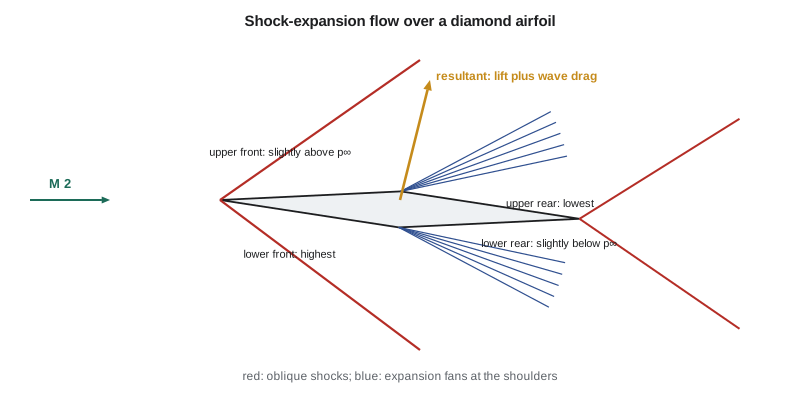
Shock-expansion theory
For a section with straight faces, an exact two-dimensional solution is available whenever the shocks are attached. At the leading edge the flow passes through an oblique shock or an expansion fan, depending on whether the first face turns into or away from the flow. At each corner further along, it turns through another shock or fan. On each face the pressure is uniform. Lessons 4 and 5 give the state after each turn, so the pressures on all four faces of a diamond can be computed exactly, and the lift and drag follow by resolving the face forces. This is shock-expansion theory. It neglects only the weak interactions between the waves from different corners, which do not reach the surface of a simple diamond.
# Supersonic airfoils: linear (Ackeret) theory against shock-expansion theory for a diamond section
import math
G = 1.4
def theta_of(beta, M):
    return math.atan(2 / math.tan(beta) * (M**2 * math.sin(beta)**2 - 1) / (M**2 * (G + math.cos(2 * beta)) + 2))
def oblique(M, th):                         # weak shock: returns M2 and p2/p1
    lo, hi = math.asin(1 / M), math.radians(64)
    for _ in range(80):
        mid = (lo + hi) / 2
        if theta_of(mid, M) > th: hi = mid
        else: lo = mid
    b = (lo + hi) / 2; Mn1 = M * math.sin(b)
    Mn2 = math.sqrt((1 + (G - 1) / 2 * Mn1**2) / (G * Mn1**2 - (G - 1) / 2))
    return Mn2 / math.sin(b - th), 1 + 2 * G / (G + 1) * (Mn1**2 - 1)
def nu(M):
    k = math.sqrt((G + 1) / (G - 1))
    return k * math.atan(math.sqrt((M * M - 1) / k**2)) - math.atan(math.sqrt(M * M - 1))
def expand(M, th):                          # Prandtl-Meyer: returns M2 and p2/p1
    target, lo, hi = nu(M) + th, M, 20.0
    for _ in range(80):
        mid = (lo + hi) / 2
        if nu(mid) < target: lo = mid
        else: hi = mid
    M2 = (lo + hi) / 2
    r = lambda m: (1 + (G - 1) / 2 * m * m) ** (G / (G - 1))
    return M2, r(M) / r(M2)
def turn(M, th):                            # positive th compresses, negative expands
    return oblique(M, th) if th > 0 else expand(M, -th)
def diamond(M, tc, a_deg):                  # symmetric double wedge, chord 1
    e, a = math.atan(tc), math.radians(a_deg)
    pressures = []                          # p/p_inf on the four faces: upper front, upper rear, lower front, lower rear
    for sign in (+1, -1):                   # upper surface then lower
        M1, p1 = turn(M, e - sign * a)
        M2, p2 = turn(M1, -2 * e); pressures += [p1, p1 * p2]
    uf, ur, lf, lr = pressures
    q = 0.5 * G * M * M                     # dynamic pressure divided by p_inf
    h = 0.5 / math.cos(e)                   # face length
    Fn = h * ((lf - uf) * math.cos(e) + (lr - ur) * math.cos(e))
    Fa = h * ((uf - ur) * math.sin(e) + (lf - lr) * math.sin(e))
    L = Fn * math.cos(a) - Fa * math.sin(a); D = Fn * math.sin(a) + Fa * math.cos(a)
    return L / q, D / q
M, tc = 2.0, 0.05
b = math.sqrt(M * M - 1)
print(" alpha  cl Ackeret  cl shock-exp  cd Ackeret  cd shock-exp")
for a in (0, 2, 4, 6):
    ar = math.radians(a)
    cl_lin = 4 * ar / b
    cd_lin = 4 * (ar**2 + tc**2) / b        # double wedge: mean square slope (t/c)^2
    cl_se, cd_se = diamond(M, tc, a)
    print(f"{a:5d} {cl_lin:10.4f} {cl_se:12.4f} {cd_lin:11.5f} {cd_se:12.5f}")
# lift-to-drag ratio of the section at 4 deg, and a flat plate for comparison
cl, cd = diamond(M, tc, 4)
print(f"\nL/D at 4 deg: diamond {cl / cd:.1f}, flat plate {1 / math.radians(4):.1f} (wave drag only)")
# leading edge sweep needed for a subsonic leading edge at M 1.6 (inside the Mach cone)
for M in (1.4, 1.6, 2.0):
    mu = math.degrees(math.asin(1 / M))
print(f"M {M}: Mach angle {mu:.1f} deg, leading edge subsonic if swept more than {90 - mu:.1f} deg") alpha cl Ackeret cl shock-exp cd Ackeret cd shock-exp
0 0.0000 0.0000 0.00577 0.00578
2 0.0806 0.0810 0.00859 0.00863
4 0.1612 0.1622 0.01703 0.01721
6 0.2418 0.2440 0.03110 0.03161
L/D at 4 deg: diamond 9.4, flat plate 14.3 (wave drag only)
M 1.4: Mach angle 45.6 deg, leading edge subsonic if swept more than 44.4 deg
M 1.6: Mach angle 38.7 deg, leading edge subsonic if swept more than 51.3 deg
M 2.0: Mach angle 30.0 deg, leading edge subsonic if swept more than 60.0 degWhat the comparison shows
For the 5 percent diamond at Mach 2, linear theory and shock-expansion theory agree remarkably well. At zero incidence both give a wave drag coefficient of about 0.0058. At 4 degrees, linear theory gives a lift coefficient of 0.161 against 0.162 from shock-expansion theory, and a drag coefficient of 0.0170 against 0.0172. The differences grow with incidence, reaching about 1 percent in lift and 2 percent in drag at 6 degrees, because the shock on the lower front face becomes stronger and the linear approximation of its pressure becomes less accurate. For thin sections at modest incidence, Ackeret's theory is perfectly adequate for preliminary design.
The lift-to-drag ratio is the real story. At 4 degrees the diamond section achieves about 9.4, before any skin friction is added. A flat plate, with no thickness at all, would achieve 14.3 at the same angle, limited only by wave drag due to lift. The thickness drag of even a 5 percent section costs a third of the lift-to-drag ratio. Adding skin friction lowers the realistic figures further, and supersonic airliners have achieved cruise lift-to-drag ratios of only about 7 to 8, compared with 15 to 20 for subsonic jets. That is the fundamental reason supersonic flight costs so much fuel.
Supersonic wings: subsonic and supersonic leading edges
Real wings are three-dimensional, and their behavior at supersonic speed depends on the relation between the sweep of the leading edge and the Mach cone. If the leading edge is swept behind the Mach lines from its apex, so that the component of the free stream normal to it is subsonic, the leading edge is called subsonic. The flow then wraps around it much as in subsonic flight, a rounded leading edge carries suction, and the drag due to lift is reduced. If the leading edge lies ahead of the Mach lines, it is supersonic, the flow cannot wrap round it, and the leading edge must be sharp to avoid a strong detached shock.
At Mach 1.6, a leading edge swept more than 51 degrees is subsonic; at Mach 2, it needs more than 60 degrees. This is why supersonic transports have highly swept delta or ogival wings. Concorde's slender ogee delta kept its leading edge subsonic at Mach 2 and generated much of its low-speed lift from the leading-edge vortices that form on such wings at high incidence. Studies of quiet supersonic airliners, including the NASA work that motivates the research wing, combine high sweep with long, slender fuselages shaped to soften the sonic boom.
Wave drag of complete aircraft
At supersonic speed the wave drag of a complete aircraft is closely tied to its volume distribution, as in the transonic area rule, but now the relevant areas are the cross sections cut by planes inclined at the Mach angle rather than by planes normal to the axis. Supersonic area ruling, and its extension to wave drag due to lift, were developed by Robert T. Jones and others in the 1950s and remain central to supersonic aircraft design. For a given volume and length, the body with least wave drag is a slender, smoothly pointed shape, the Sears-Haack body. Real aircraft approximate it: long, slender fuselages, thin wings blended into them, and engines placed where their volume does least harm.
Why the Swift 900 wing could never be used supersonically
The contrast with the Swift 900's wing is complete. A transonic wing has a thick, cambered, rounded supercritical section, designed to manage a pocket of supersonic flow within an otherwise subsonic field, and moderate sweep. A supersonic wing has a thin, nearly symmetric section with sharp or slightly rounded edges, high sweep and low aspect ratio. The supersonic wing would give the Swift 900 poor low-speed lift and long runways; the transonic wing would give a supersonic aircraft enormous wave drag. That incompatibility is why no aircraft is efficient at both speeds, and why supersonic aircraft rely heavily on high-lift devices, high approach speeds or variable geometry.
Worked problem
Lift and drag by linear theory at Mach 1.6
Find the lift and wave drag coefficients of a 4 percent diamond section at 3 degrees and Mach 1.6.
Show solution
- \(\lambda = \sqrt{2.56 - 1} = 1.249\), \(\alpha = 0.05236\ \text{rad}\).
- \(c_l = 4\times 0.05236/1.249 = 0.168\).
- \(c_d = (4/1.249)(0.05236^2 + 0.04^2) = 3.203\times 0.004342 = 0.0139\).
Answer: A lift-to-drag ratio of about 12, before skin friction.
Worked problem
Pressure on one face of a flat plate
A flat plate at 5 degrees is placed in a Mach 2.5 stream at 20 kPa. Estimate the pressure on its lower surface by linear theory.
Show solution
- \(\lambda = \sqrt{6.25 - 1} = 2.291\), \(\theta = 0.0873\ \text{rad}\).
- \(C_p = 2\times 0.0873/2.291 = 0.0762\).
- \(q = 0.5\times 1.4\times 20{,}000\times 6.25 = 87{,}500\ \text{Pa}\), so \(p = 20{,}000 + 0.0762\times 87{,}500 = 26.7\ \text{kPa}\).
Answer: About 26.7 kPa; shock-expansion theory gives a value within about 2 percent.
Common mistakes
MistakeExpecting camber to produce lift in supersonic linear theory.
InsteadOnly angle of attack produces lift; camber adds wave drag.
MistakeUsing subsonic thick, rounded sections on a supersonic wing.
InsteadSupersonic sections are thin and sharp-edged unless the leading edge is subsonic.
MistakeForgetting that wave drag exists without viscosity.
InsteadSupersonic waves carry energy away, so inviscid flow still has drag.
MistakeCalling a leading edge subsonic simply because the aircraft is near Mach 1.
InsteadThe test compares the sweep with 90 degrees minus the Mach angle.
Summary and key terms
- In supersonic flow the linearized potential equation is hyperbolic, and Ackeret's theory gives a pressure coefficient proportional to the local surface slope.
- Lift depends only on angle of attack, while wave drag comes from lift, camber and thickness, each proportional to a mean square slope.
- Shock-expansion theory gives exact results for straight-faced sections and agrees closely with linear theory for thin sections.
- Wave drag limits supersonic lift-to-drag ratios.
- Leading edges swept behind the Mach cone are subsonic and can carry suction, so supersonic aircraft use highly swept, thin wings and slender, area-ruled bodies.
- Ackeret theory
- Linear supersonic thin-airfoil theory, C_p = 2θ/√(M² − 1).
- Wave drag due to lift
- The part of supersonic wave drag proportional to the square of the angle of attack.
- Double-wedge section
- A symmetric diamond-shaped supersonic airfoil with straight faces.
- Shock-expansion theory
- Exact two-dimensional analysis using oblique shocks and Prandtl-Meyer expansions at each corner.
- Subsonic leading edge
- A leading edge swept behind the Mach cone, so the normal flow is subsonic.
- Supersonic area rule
- The relation between supersonic wave drag and areas cut by Mach-angle planes.
- Sears-Haack body
- The body of revolution with minimum supersonic wave drag for given length and volume.
Practice problems
Work each problem on paper first, then reveal the answer to check.
From the program, what is the wave drag coefficient of the diamond at zero lift?
Show answer
About 0.0058.
Find c_l for a flat plate at 2° and Mach 3.
Show answer
4 × 0.0349/2.828 = 0.049.
How does the thickness drag change if t/c is halved?
Show answer
It falls to a quarter.
Using the program, at what sweep is the leading edge subsonic at Mach 1.4?
Show answer
More than 44.4°.
Why are supersonic sections nearly uncambered?
Show answer
Camber adds wave drag without adding lift in linear theory.
Change the program to t/c = 0.03. What is L/D at 4°?
Show answer
About 12, closer to the flat-plate value because the thickness drag is much smaller.
Lesson quiz · 5 questions
Score 60% or more to complete this lesson.
Create a free account to save your progress, take quizzes and earn a certificate.