
AERO-320 · Lesson 12 of 12 · 25 min
Hypersonic flow introduction
The last model in the campaign is the most unusual: a small-scale model of a blunt cargo-return capsule, 2.5 m in diameter at full scale, from a NASA study of returning experiments and samples from low Earth orbit. the 10 by 10 cannot reach the Mach numbers the capsule meets during entry, which exceed Mach 20, but it can measure the capsule's stability and drag at the supersonic end of its descent, before the parachutes open. Kenji Watanabe uses the test to introduce hypersonic flow, the regime above roughly Mach 5, where the methods of the previous lessons begin to fail and new physics dominates. This lesson is introductory: it gives the main ideas and the simple methods engineers use for first estimates, and it points to the specialist courses and tools needed for real design.
What makes a flow hypersonic
There is no sharp boundary at Mach 5. Hypersonic flow is defined by the appearance of several effects that grow with Mach number until they control the flow. The first is that shocks lie very close to the body. Lesson 4 showed that the wave angle on a wedge approaches the deflection angle as the Mach number rises; at Mach 20 the shock on a 10-degree wedge sits only a few degrees off the surface, and the thin region between them, the shock layer, contains all the disturbed flow. The second is the entropy layer: around a blunt nose the shock is strongly curved, so streamlines passing near the nose cross a nearly normal shock and gain much more entropy than those farther out, leaving a layer of hot, low-density gas wrapped around the body.
The third effect is viscous interaction. At high Mach numbers the boundary layer is very thick, because the gas within it is hot and its viscosity high and its density low. The thick boundary layer displaces the outer flow, changing the shock shape and the surface pressure, which in turn changes the boundary layer. The fourth, and most important for re-entry vehicles, is high-temperature chemistry. The temperature behind a strong shock rises so high that the molecules of air vibrate, dissociate and, at entry speeds, ionize. The perfect-gas relations used throughout this course stop applying. The fifth is low density: at the altitudes where entry heating peaks, the air is so thin that, for small vehicles or sharp edges, the molecular mean free path approaches the body size, and the continuum assumption fails.
Newtonian theory
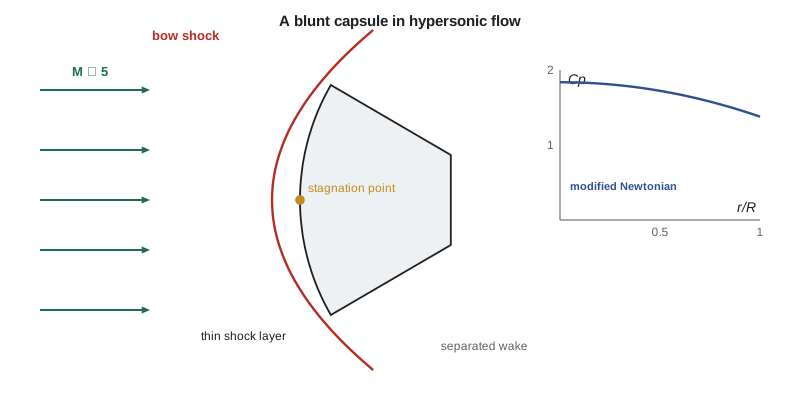
In the seventeenth century Isaac Newton imagined a fluid as a stream of particles that strike a surface, lose their normal momentum and then slide along it. The idea gives a very poor model of subsonic flow, but at hypersonic speed, where the shock layer is thin and the flow behind the shock runs almost parallel to the surface, it becomes surprisingly good. Applying momentum conservation to particles striking a surface inclined at angle \(\theta\) to the flow gives the Newtonian pressure coefficient.
Lester Lees proposed in the 1950s that the constant 2 be replaced by the pressure coefficient at the stagnation point behind a normal shock, \(C_{p,\text{max}}\), giving modified Newtonian theory. That value follows from the Rayleigh pitot formula of Lesson 3. It is 1.66 at Mach 2, 1.81 at Mach 5 and approaches 1.84 for air at very high Mach numbers. Modified Newtonian theory predicts the pressure on blunt bodies to within a few percent over most of their faces, and it is still used for first estimates of the aerodynamics of capsules and the windward surfaces of lifting entry vehicles.
Newtonian theory has one other striking prediction. Surfaces that face away from the flow, in the shadow of the body, have \(C_p = 0\): they receive no impacts. Real leeward pressures are slightly below the free-stream value, so the pressure coefficient is small and negative, but compared with the windward pressures they are negligible. The aerodynamics of a hypersonic body is dominated by its windward surfaces.
Mach number independence
As the Mach number rises, the pressure coefficient and the shock shape around a body approach limits that no longer depend on the Mach number. The program shows the stagnation pressure coefficient changing by less than 2 percent between Mach 5 and Mach 50. This Mach number independence principle, demonstrated by Oswatitsch, means that the force coefficients of a blunt capsule measured at Mach 8 or 10 in a tunnel can be applied, with modest corrections, at much higher flight Mach numbers. It is one reason the capsule test in the 10 by 10 at the tunnel's top Mach number still gives useful data for the entry phase, although the high-temperature effects that also matter in flight cannot be reproduced.
# Hypersonic flow: Newtonian pressure, capsule drag and stagnation-point heating
import math
G = 1.4
def cp_max(M):                              # stagnation-point Cp behind a normal shock (modified Newtonian)
    p02_p1 = ((G + 1)**2 * M**2 / (4 * G * M**2 - 2 * (G - 1))) ** (G / (G - 1)) * (1 - G + 2 * G * M**2) / (G + 1)
    return (p02_p1 - 1) / (0.5 * G * M * M)
print(" M     Cp,max   (Newtonian value is 2)")
for M in (2, 5, 10, 20, 50):
    print(f"{M:3d} {cp_max(M):9.4f}")
# sphere-cone or spherical-segment capsule heat shield: integrate modified Newtonian Cp over the face
def capsule_cd(Rn_over_D, M):              # spherical cap of nose radius Rn, base diameter D, zero angle of attack
    cpm, D = cp_max(M), 1.0
    Rn = Rn_over_D * D; phi_max = math.asin(0.5 * D / Rn)   # half-angle of the cap
    n, drag = 400, 0.0
    for i in range(n):
        phi = (i + 0.5) / n * phi_max
        r = Rn * math.sin(phi)              # radius of the ring
        dA = 2 * math.pi * r * Rn * (phi_max / n)
        theta = math.pi / 2 - phi           # local surface inclination to the flow
        drag += cpm * math.sin(theta) ** 2 * dA * math.cos(phi)
    return drag / (math.pi * D * D / 4)
for k in (0.5, 1.0, 1.2, 2.0):
    print(f"cap with Rn/D = {k}: CD = {capsule_cd(k, 20):.3f}")
# Sutton-Graves stagnation-point convective heating for air: q = k sqrt(rho / Rn) V^3
k_sg = 1.7415e-4                            # SI units, W/m2 with rho in kg/m3, Rn in m, V in m/s
Rn = 3.0                                    # nose radius of a 2.5 m cargo capsule (blunt), m
for h, rho, V in ((80e3, 1.85e-5, 7400), (70e3, 8.3e-5, 7000), (60e3, 3.1e-4, 6000), (50e3, 1.03e-3, 4200)):
    q = k_sg * math.sqrt(rho / Rn) * V**3
    print(f"altitude {h / 1e3:3.0f} km  V {V} m/s  heating {q / 1e4:6.1f} W/cm2")
# why blunt: heating falls with the square root of nose radius
print(f"nose radius 0.3 m instead of 3.0 m: heating {math.sqrt(10):.2f} times higher")
# calorically perfect stagnation temperature (unrealistic at entry speeds)
T, M = 220.0, 25.0
print(f"perfect-gas T0 at M {M:.0f}: {T * (1 + (G - 1) / 2 * M * M):.0f} K (real air dissociates and stays far cooler)")M Cp,max (Newtonian value is 2) 2 1.6573 5 1.8088 10 1.8317 20 1.8374 50 1.8391 cap with Rn/D = 0.5: CD = 0.919 cap with Rn/D = 1.0: CD = 1.608 cap with Rn/D = 1.2: CD = 1.678 cap with Rn/D = 2.0: CD = 1.780 altitude 80 km V 7400 m/s heating 17.5 W/cm2 altitude 70 km V 7000 m/s heating 31.4 W/cm2 altitude 60 km V 6000 m/s heating 38.2 W/cm2 altitude 50 km V 4200 m/s heating 23.9 W/cm2 nose radius 0.3 m instead of 3.0 m: heating 3.16 times higher perfect-gas T0 at M 25: 27720 K (real air dissociates and stays far cooler)
Why entry vehicles are blunt
The capsule's heat shield is a shallow spherical cap, with a nose radius of about 1.2 times its diameter. Integrating modified Newtonian pressure over such a cap at Mach 20 gives a drag coefficient of about 1.68, close to the values measured on capsules of this shape. A hemisphere, with a nose radius half the diameter, gives only 0.92. The blunter face produces more drag, which slows the capsule higher in the atmosphere, where the air is thinner. More importantly, it reduces the heating.
H. Julian Allen and Alfred Eggers at the NACA showed in the early 1950s that the convective heating at the stagnation point of a body varies inversely with the square root of its nose radius, and that a blunt body pushes most of the energy of entry into the air through its strong bow shock rather than into the vehicle. Their blunt-body principle overturned the intuition that a re-entry vehicle should be sharp and streamlined, and every crewed capsule since has followed it. The program uses the Sutton-Graves correlation, a simple form of the stagnation-point heating law, with a constant for air.
Along a representative entry the heating rises from about 18 W/cm² at 80 km to a peak near 38 W/cm² around 60 km, then falls as the capsule slows. A nose radius of 0.3 m instead of 3.0 m would raise the heating by a factor of 3.2. These are the convective heating rates; at the higher speeds of entry from the Moon or beyond, radiation from the extremely hot shock layer adds substantially to them. Heat shields absorb the energy by ablation, in which the surface material chars and erodes, carrying heat away, or, on reusable vehicles, by tiles and blankets that radiate most of the heat back to space.
High-temperature gas effects
The program's last line shows the problem with perfect-gas theory at entry speeds. At Mach 25 in air at 220 K, the perfect-gas stagnation temperature would be almost 28,000 K. Real air never gets that hot. Above about 800 K, energy goes into molecular vibration and the specific heats rise; above about 2,500 K, oxygen dissociates into atoms; above about 4,000 K, nitrogen dissociates; above about 9,000 K, the atoms begin to ionize. Each of these reactions absorbs energy, so the actual temperature behind the shock of an entering capsule is roughly 6,000 to 11,000 K, depending on speed and altitude. The effective value of \(\gamma\) falls toward 1.1 to 1.2, the shock stands closer to the body, and the density ratio across it rises well above the perfect-gas limit of 6.
The chemical reactions also take time. At high altitude, where collisions are rare, the gas behind the shock may not reach chemical equilibrium before it passes the vehicle, and nonequilibrium flow must be computed. The ionized gas around the capsule blocks radio signals for several minutes, the familiar communications blackout of entry. Surface catalysis, in which atoms recombine on the heat shield and release their energy there, can raise the heating noticeably. These effects are the domain of hypersonic aerothermodynamics, and they are why real entry vehicles are designed with specialized computational tools, arc-jet tests and flight data rather than the methods of this course.
Testing hypersonic flows
No single ground facility reproduces hypersonic flight. Conventional hypersonic wind tunnels heat their air to avoid liquefaction and reach Mach 6 to 10 or more, matching the Mach number but not the flight temperatures. Shock tunnels and expansion tubes use the strong shock from a sudden release of very high-pressure gas to produce flows with flight-like enthalpy for a few milliseconds. Arc-jet facilities heat a gas stream with an electric arc for minutes, reproducing the heating environment of a heat shield sample, though not the full aerodynamic flow. Engineers combine data from several facility types with computation and, ultimately, flight tests, to assemble a picture of the full flight environment.
Looking back over the course
This course has moved from the speed of sound to the edge of space. The isentropic relations, normal and oblique shocks and Prandtl-Meyer expansions are the building blocks of every supersonic and hypersonic calculation. Quasi-one-dimensional nozzle theory, with Fanno and Rayleigh flows, governs engines, tunnels and ducts. Linearized theory corrects subsonic results for compressibility and gives the lift and drag of thin supersonic wings. Transonic flow, the hardest regime to predict, is where the Swift 900 and almost every jet transport fly, and its design relies on correlations such as the Korn equation, on supercritical sections and on careful attention to buffet. The Swift 900 team will now take those choices into AERO-440, where computational fluid dynamics refines the wing and confirms the drag rise, and into AERO-340, where the engines that need those inlets and nozzles are designed.
Worked problem
Drag of the capsule at Mach 4
In the 10 by 10 at Mach 4 the capsule model has a heat shield with \(R_n/D = 1.2\). Using modified Newtonian theory, estimate its drag coefficient.
Show solution
- \(C_{p,\text{max}}\) at Mach 4 is about 1.79 (from the Rayleigh pitot formula).
- The Newtonian drag coefficient scales with \(C_{p,\text{max}}\): \(1.678\times 1.79/1.837 = 1.64\).
Answer: About 1.64, slightly below the Mach 20 value because the stagnation pressure coefficient is smaller at Mach 4. Measured values on similar capsules at that Mach number are close, though the wake and shoulder flow add small differences.
Worked problem
Effect of nose radius on heating
A designer considers reducing the capsule's nose radius from 3.0 m to 2.0 m to save mass. By how much does the peak convective heating rise?
Show solution
- \(\dot q \propto R_n^{-1/2}\), so the ratio is \(\sqrt{3.0/2.0} = 1.22\).
Answer: About 22 percent more heating, from about 38 to 47 W/cm² at the peak in the program's representative entry. The heat shield would need to be thicker, which would offset much of the mass saved.
Common mistakes
MistakeApplying perfect-gas shock relations at entry speeds.
InsteadDissociation and ionization absorb energy; real shock-layer temperatures are far lower than perfect-gas predictions.
MistakeAssuming a sharp nose reduces entry heating.
InsteadStagnation heating varies as one over the square root of nose radius, so blunt bodies heat less.
MistakeUsing the classical Newtonian constant 2 for blunt-body pressures.
InsteadModified Newtonian theory uses C_p,max, about 1.84 for air at high Mach number.
MistakeExpecting a single wind tunnel to reproduce hypersonic flight.
InsteadMach number, enthalpy and Reynolds number are matched by different facilities.
Summary and key terms
- Hypersonic flow, above roughly Mach 5, has thin shock layers, entropy layers around blunt noses, strong viscous interaction, high-temperature chemistry and, at high altitude, low-density effects.
- Newtonian theory gives C_p = 2 sin²θ, and modified Newtonian theory with C_p,max from the normal-shock stagnation value predicts blunt-body pressures well.
- Force coefficients become nearly independent of Mach number at high Mach numbers.
- Entry vehicles are blunt because stagnation heating falls with the square root of nose radius and a strong bow shock deposits energy in the air.
- Real air dissociates and ionizes, so perfect-gas theory overestimates temperatures, and testing needs several types of facility.
- Hypersonic flow
- Flow, roughly above Mach 5, dominated by thin shock layers and high-temperature effects.
- Shock layer
- The thin region between a hypersonic shock and the body.
- Entropy layer
- The layer of high-entropy gas near a blunt body from the strongly curved shock.
- Newtonian theory
- The impact model C_p = 2 sin²θ for hypersonic surface pressure.
- Modified Newtonian theory
- Newtonian theory with the constant replaced by the stagnation pressure coefficient.
- Mach number independence
- The tendency of hypersonic force coefficients and shock shapes to stop changing with Mach number.
- Blunt-body principle
- The finding that blunt entry vehicles heat less because heating falls with nose radius.
Practice problems
Work each problem on paper first, then reveal the answer to check.
Find the Newtonian C_p on a surface inclined at 30° to a hypersonic stream.
Show answer
2 sin²30° = 0.5 (modified: about 0.46).
From the program, what is C_p,max at Mach 10?
Show answer
1.832.
Using the program, how does the drag coefficient change from R_n/D = 1.0 to 2.0?
Show answer
From about 1.61 to 1.78.
By what factor does stagnation heating change if speed rises by 10 percent at the same density?
Show answer
1.1³ = 1.33.
Why does the radio blackout occur during entry?
Show answer
The shock layer is hot enough to ionize the air, and the ionized gas blocks radio signals.
Name two types of facility used to test hypersonic heating.
Show answer
Shock tunnels or expansion tubes, and arc-jet facilities.
Lesson quiz · 5 questions
Score 60% or more to complete this lesson.
Create a free account to save your progress, take quizzes and earn a certificate.