
AERO-220 · Lesson 4 of 12 · 21 min
Propeller and jet aircraft characteristics
Lesson 3 described what the Tern needs. This lesson describes what its propulsion system can supply, and how that differs between propeller aircraft and jets. The airline's evaluation team is comparing the Tern with a used 76-seat regional jet for some of its longer routes, so Arjun prepares a side-by-side explanation. The difference in how the two produce thrust explains almost every difference in how they should be flown: their best speeds, their best altitudes, and how their performance changes with height.
Power available and thrust available
Performance comes from comparing what is required with what is available. For a propeller aircraft, the engine or motor delivers shaft power \(P_{shaft}\) to the propeller, and the propeller converts it into thrust power with an efficiency \(\eta_p\). The thrust power available is \(\eta_p P_{shaft}\), and the thrust available is that power divided by the true airspeed. For a jet, the engine produces thrust directly, and its thrust power is thrust times speed.
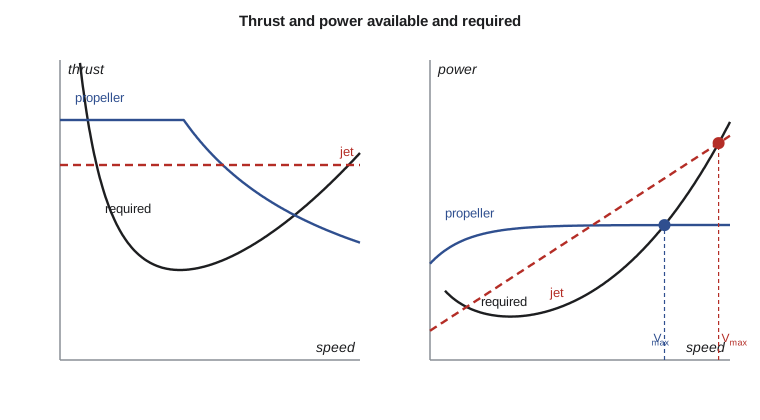
The two idealizations, constant power for propeller aircraft and constant thrust for jets, are only approximations, but they capture the essential difference. A propeller aircraft's thrust falls with speed, because the same power spread over a higher speed gives less force. A jet's thrust changes much more slowly with speed. On a graph of thrust against speed, the propeller aircraft's available thrust looks like a falling hyperbola and the jet's looks like a nearly flat line; on a graph of power against speed, the propeller aircraft's line is nearly flat and the jet's rises steadily.
How propellers work and why their efficiency changes
A propeller is a rotating wing. Each blade section meets the air at a combination of the forward speed and its own rotational speed, and produces lift that has a forward component, the thrust. Propeller efficiency, the ratio of thrust power to shaft power, depends mainly on the advance ratio \(J = V/(nD)\), where \(n\) is the rotational speed in revolutions per second and \(D\) the diameter. At zero forward speed the efficiency is zero by definition, because no thrust power is produced, though the propeller still makes a large static thrust. As speed rises, efficiency climbs to a peak of about 0.80 to 0.88 for a well-designed variable-pitch propeller, then falls as the blades reach their pitch limits and their tips approach the speed of sound.
Variable-pitch, constant-speed propellers keep the efficiency near its peak over a wide speed range by changing blade angle as speed changes. The Tern's propellers are of this type, and they can also feather and reverse. Momentum theory gives a useful upper bound: an ideal propeller accelerating a stream of air has a propulsive efficiency of \(2/(1 + V_j/V)\), where \(V_j\) is the speed of the air behind it. Large propellers, which accelerate a lot of air by a small amount, are therefore efficient. That same principle explains why high-bypass turbofans are more efficient than early turbojets, as a later section shows.
Engines, motors and altitude
Different power sources behave differently with altitude. A normally aspirated piston engine loses power roughly in proportion to air density, because each intake stroke takes in less air. A turbocharged piston engine holds its sea-level power up to a critical altitude. A turboprop engine, a gas turbine driving a propeller through a gearbox, loses power with altitude too, though less sharply on cold days; its power is often flat-rated, held to a fixed value up to a certain temperature or height by design. Electric motors are different: their power does not depend on air density at all, only on the electrical power fed to them and on cooling, which does get harder in thin air.
| Power source | Power with altitude | Fuel or energy measure | Typical use |
|---|---|---|---|
| Piston engine | Falls with density unless turbocharged | Specific fuel consumption, kg/kWh | Light aircraft |
| Turboprop | Falls with altitude, often flat-rated | Specific fuel consumption, kg/kWh | Commuters, regional aircraft |
| Electric motor | Independent of air density; limited by supply and cooling | Battery energy, kWh | Small aircraft, drones, hybrids |
| Turbofan | Thrust falls with density and somewhat with Mach | Thrust-specific fuel consumption, kg/(N·h) | Regional jets, airliners |
| Hybrid-electric (Tern) | Motors constant; generator falls with altitude | Fuel plus battery energy | Commuters on short routes |
The Tern's hybrid layout puts these effects together. Its two 450 kW electric motors are rated for continuous power regardless of height, with a five-minute 600 kW contingency rating each. The power they can draw comes from two sources: the turbine generator, which produces about 800 kW at sea level falling to about 700 kW at 3000 m, and the 600 kg battery pack, which can supply up to 600 kW for a few minutes. After motor and inverter losses, the generator alone delivers about 665 kW of shaft power at 3000 m. That figure, not the motor rating, sets the Tern's maximum continuous cruise speed.
# Maximum level speed: the Tern (power-producing) and a regional jet (thrust-producing)
import math
g = 9.81
def isa_rho(h):
    T = 288.15 - 0.0065 * min(h, 11000)
    p = 101325 * (T / 288.15) ** 5.2559
    if h > 11000:
        p *= math.exp(-g * (h - 11000) / (287.05 * 216.65))
    return p / (287.05 * T), math.sqrt(1.4 * 287.05 * T)
def bisect(f, a, b):
    for _ in range(60):
        c = (a + b) / 2
        if f(a) * f(c) <= 0: b = c
        else: a = c
    return (a + b) / 2
# Tern: shaft power from the motors, propeller efficiency rises with speed
S, CD0, k, m = 28.0, 0.028, 0.039, 6500.0
def eta(V): return 0.84 * (1 - math.exp(-V / 30))          # simple fit to propeller data
def P_req(V, rho):
    q = 0.5 * rho * V**2; CL = m * g / (q * S)
    return q * S * (CD0 + k * CL**2) * V
rho, a = isa_rho(3000)
for label, Pshaft in (("generator only, 665 kW", 665e3), ("generator + battery, 900 kW", 900e3)):
    Vmax = bisect(lambda V: eta(V) * Pshaft - P_req(V, rho), 60, 200)
    print(f"Tern at 3000 m, {label}: V_max = {Vmax*3.6:.0f} km/h ({Vmax/0.5144:.0f} kt), eta = {eta(Vmax):.2f}")
# Regional jet: thrust lapses with density and Mach; wave drag above M_crit (Lock's rule)
mj, Sj, CD0j, kj, T_sl, Mcr, Mmo = 38000.0, 72.0, 0.020, 0.042, 2 * 60e3, 0.72, 0.82
def jet_drag(M, rho, a):
    V = M * a; q = 0.5 * rho * V**2; CL = mj * g / (q * Sj)
    cdw = 20 * (M - Mcr)**4 if M > Mcr else 0.0
    return q * Sj * (CD0j + kj * CL**2 + cdw)
def jet_thrust(M, rho):
    return 0.80 * T_sl * (rho / 1.225) ** 0.75 * (1 - 0.35 * M)   # maximum cruise rating
for h in (6000, 9000, 11000):
    rho, a = isa_rho(h)
    Mmax = bisect(lambda M: jet_thrust(M, rho) - jet_drag(M, rho, a), 0.5, 1.0)
    D78 = jet_drag(0.78, rho, a)
print(f"Jet at {h} m: thrust-limited M_max = {Mmax:.3f} (limited in service to M_MO {Mmo}); drag at M0.78 = {D78/1000:.1f} kN")Tern at 3000 m, generator only, 665 kW: V_max = 382 km/h (206 kt), eta = 0.82 Tern at 3000 m, generator + battery, 900 kW: V_max = 438 km/h (236 kt), eta = 0.83 Jet at 6000 m: thrust-limited M_max = 0.836 (limited in service to M_MO 0.82); drag at M0.78 = 33.3 kN Jet at 9000 m: thrust-limited M_max = 0.845 (limited in service to M_MO 0.82); drag at M0.78 = 25.3 kN Jet at 11000 m: thrust-limited M_max = 0.844 (limited in service to M_MO 0.82); drag at M0.78 = 22.5 kN
Maximum speed
Maximum level speed is where the power available equals the power required, at the high-speed crossing of the two curves. The program finds it for the Tern at 3000 m: 382 km/h(206 kt) on generator power alone, almost exactly the airline's chosen cruise speed, and 438 km/h with the battery boosting the motors to their full continuous rating. The battery cannot sustain that for long, so the useful maximum cruise speed is the generator-limited one. A lower-speed crossing also exists on the back side of the power curve, but for most aircraft it lies below the stall and has no practical meaning.
For the jet, maximum speed is where thrust available equals drag. The program's simple model gives a thrust-limited maximum near Mach 0.84 at 9000 to 11,000 m, but in service the jet may not exceed its maximum operating Mach number \(M_{MO}\) of 0.82, a structural and handling limit set at certification. Jets therefore normally cruise below their thrust-limited speed, and their maximum speed in practice is a limit, not a performance capability.
Worked problem
Maximum speed check with constant power
Assume the Tern's propeller efficiency stays at 0.82 near cruise. With 665 kW of shaft power at 3000 m (\(\rho = 0.909\)), the power available is \(0.82 \times 665 = 545\ \text{kW}\). Check whether 380 km/h is achievable at 6500 kg, using the polar from Lesson 2.
Show solution
- From Lesson 2, the drag at 380 km/h, 3000 m and 6500 kg is about 5094 N.
- Power required: \(P_R = 5094 \times 105.6 = 538\ \text{kW}\).
- Power available is 545 kW, just above 538 kW, so 380 km/h is achievable with a margin of about 7 kW.
- At 6200 kg later in the flight, the power required falls to 527 kW, so the margin grows to about 18 kW.
Answer: The airline's requested cruise speed sits right at the generator's limit early in the flight. Arjun recommends quoting 375 km/h as the guaranteed cruise speed at maximum weight, with 380 km/h available once fuel has burned off, rather than promising a number the aircraft can only just reach on a standard day. On a hot day, when the generator produces less power, the margin would disappear.
Jets: thrust, Mach number and fuel
A turbofan engine produces thrust by accelerating two streams of air: a core stream that passes through the compressor, combustor and turbine, and a bypass stream moved by the large fan. The bypass ratio, the mass flow in the bypass stream divided by that in the core, ranges from about 5 for regional jets to above 10 for the newest airliner engines. Higher bypass ratios accelerate more air by less, which raises propulsive efficiency, exactly as for a large propeller. Their thrust falls faster with forward speed than a pure turbojet's, but they use much less fuel per unit of thrust.
Jet fuel use is described by the thrust-specific fuel consumption \(c_T\), the mass of fuel burned per unit of thrust per unit of time, typically quoted in kilograms per newton per hour or pounds per pound-force per hour. A modern regional jet engine at cruise has a TSFC of about 0.06 kg/(N·h)(about 0.6 lb/(lbf·h)). Thrust falls with altitude roughly in proportion to \(\sigma^{0.75}\), but drag at the minimum-drag point does not change with altitude, so jets climb high to fly faster through thinner air for the same thrust and fuel flow.
Above about Mach 0.7, compressibility becomes important. As the aircraft approaches its critical Mach number, local airflow over the wing reaches the speed of sound, and shock waves form. Above the drag-divergence Mach number, wave drag rises steeply. A simple empirical rule, often credited to the British aerodynamicist C. N. H. Lock, models the wave drag as \(20(M - M_{cr})^4\) above the critical Mach number. Swept, thin, supercritical wings push the critical Mach number up, which is why jet airliners cruise near Mach 0.78 to 0.85 and why their wings look so different from the Tern's straight, high-aspect-ratio wing.
Comparing the two aircraft
Arjun's side-by-side comparison for the airline shows why the two aircraft occupy different niches. The regional jet flies about twice as fast and three times as high, carries eight times as many passengers and burns much more fuel per trip. Per seat-kilometer it is competitive on long, busy routes, but on short, thin routes to smaller communities it burns fuel climbing to an altitude where it spends little time, and its runway needs exclude many airports. The Tern is slower but uses far less energy per trip on those routes, and it can use short and gravel runways.
| Characteristic | Tern (hybrid-electric commuter) | 76-seat regional jet |
|---|---|---|
| Typical cruise | 380 km/h at 3000 m(205 kt at 10,000 ft) | Mach 0.78 at 11,000 m(about 450 kt at 36,000 ft) |
| Power or thrust | 2 × 450 kW motors; 700 kW generator at 3000 m | 2 × 60 kN take-off thrust |
| Thrust with speed | Falls roughly as 1/V | Nearly constant, slight fall |
| Best altitude | Low to medium, set by generator and propeller | High, near the tropopause |
| Best range speed | Near minimum-drag speed | About 1.32 × minimum-drag speed |
| Maximum L/D | 15.2 | About 17 |
Common mistakes
MistakeAssuming propeller thrust is constant with speed.
InsteadFor constant shaft power, propeller thrust falls roughly as 1/V; it is limited by static thrust at very low speed.
MistakeAssuming electric motors lose power with altitude like piston engines.
InsteadElectric motor power is independent of air density; the electrical supply and cooling set its limits.
MistakeQuoting the thrust-limited maximum speed of a jet as its operating speed.
InsteadJets are limited in service by M_MO and V_MO, usually below the thrust-limited speed.
MistakeUsing specific fuel consumption for jets.
InsteadJets use thrust-specific fuel consumption; propeller aircraft use power-specific fuel consumption.
MistakePromising a cruise speed exactly at the power limit.
InsteadAllow for hot days, weight and degradation; quote speeds with a margin.
Summary and key terms
- Propeller aircraft produce shaft power: P_A = η_p P_shaft and T_A = η_p P_shaft/V.
- Jets produce thrust that changes slowly with speed; their power available rises with speed.
- Propeller efficiency depends on the advance ratio and peaks near 0.8 to 0.88 for variable-pitch propellers.
- Piston and turbine power fall with altitude; electric motor power does not, though its supply may.
- Maximum level speed is where power available equals power required; jets are limited in service by M_MO.
- Jet fuel flow is c_T × T; wave drag above the critical Mach number limits jet cruise speed.
- Power available
- The thrust power the propulsion system can supply at a given speed and altitude.
- Propeller efficiency
- The ratio of the propeller's thrust power to the shaft power driving it.
- Advance ratio
- Forward speed divided by the product of propeller rotational speed and diameter.
- Flat rating
- Limiting an engine to a fixed power up to a set temperature or altitude, below its thermodynamic maximum.
- Bypass ratio
- In a turbofan, the mass flow of air through the fan bypass divided by that through the core.
- Thrust-specific fuel consumption
- Fuel mass flow per unit of thrust.
- Critical Mach number
- The flight Mach number at which local flow somewhere on the aircraft first reaches the speed of sound.
- Maximum operating Mach number
- The certified Mach number limit that may not be exceeded in normal operation.
Practice problems
Work each problem on paper first, then reveal the answer to check.
A propeller of efficiency 0.80 receives 500 kW of shaft power at 100 m/s. Find the thrust.
Show answer
T = 0.80 × 500 000/100 = 4000 N.
A propeller of 2.6 m diameter turns at 1200 rpm with the aircraft at 90 m/s. Find the advance ratio.
Show answer
n = 20 rev/s; J = 90/(20 × 2.6) = 1.73.
A turbofan has a sea-level maximum cruise thrust of 40 kN. Estimate its thrust where σ = 0.30.
Show answer
40 × 0.30^0.75 = 40 × 0.405 = 16.2 kN.
A jet cruising at 25 kN of thrust has c_T = 0.06 kg/(N·h). Find its fuel flow.
Show answer
0.06 × 25 000 = 1500 kg/h.
Why do high-bypass turbofans use less fuel than turbojets?
Show answer
They accelerate a larger mass of air by a smaller amount, raising propulsive efficiency.
In the program, reduce the generator shaft power to 600 kW for a hot day. What is the Tern's maximum speed at 3000 m?
Show answer
About 362 km/h.
Lesson quiz · 5 questions
Score 60% or more to complete this lesson.
Create a free account to save your progress, take quizzes and earn a certificate.