
AERO-220 · Lesson 1 of 12 · 28 min
Forces in steady flight
In AERO-200, Arjun Mehta answered a sales director's questions about the Tern with quick estimates. The airline that asked them, a regional carrier serving Denver and communities across western Kansas and Colorado, has now sent a formal request for proposal. It wants guaranteed numbers: block times, fuel and energy per trip, take-off and landing distances on short and partly gravel runways, climb with one motor failed on a hot day, and how much payload the aircraft can carry over each route. Élise Fournier, the chief engineer at Prairiewind Aerospace, has made Arjun the performance engineer for the bid, with Priya Raman checking his numbers. This course follows his work, one question at a time, and it starts where every performance calculation starts: with the forces on the aircraft and the equations that balance them.
Performance is the study of how an aircraft moves as a whole: how fast, how high, how far and how long it can fly, and how much runway it needs. Unlike stability and control, which ask how the aircraft rotates about its center of gravity, performance treats the aircraft as a point mass acted on by a handful of forces. That simplification is what makes the subject so powerful. With four forces, two equations and a good drag polar, an engineer can predict most of the numbers an airline cares about before the first part is made.
The four forces and the flight path
Four forces act on an aircraft in flight. Lift acts perpendicular to the flight path, which is the direction of the aircraft's velocity through the air. Drag acts along the flight path, opposite to the motion. Thrust acts along the engine or propeller axis, which for performance work is usually assumed to line up with the flight path. Weight acts vertically downward through the center of gravity. The angle between the flight path and the horizontal is the flight path angle \(\gamma\), positive in a climb and negative in a descent.
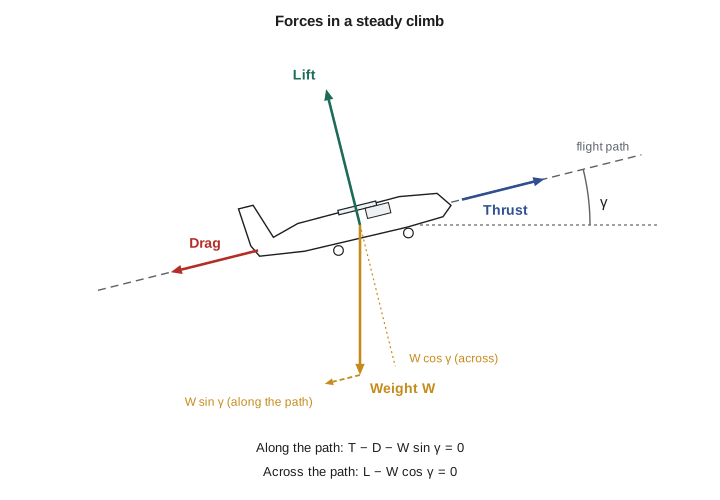
Because lift and drag are defined relative to the flight path, the weight must be split into components. Along the path, the component \(W\sin\gamma\) pulls the aircraft back in a climb and pushes it forward in a descent. Perpendicular to the path, the component \(W\cos\gamma\) must be balanced by lift. Newton's second law, applied along and perpendicular to the path, gives the two equations of motion that underlie the whole course.
The first equation says that the aircraft speeds up when thrust exceeds the sum of drag and the backward pull of gravity. The second says that the flight path curves upward when lift exceeds the component of weight perpendicular to the path, and downward when it falls short. A pilot who pulls back on the control column increases the angle of attack, which increases lift; the flight path curves upward and the aircraft starts to climb.
What steady flight means
Most of performance analysis deals with steady flight, in which the speed and flight path angle are constant, so both left-hand sides are zero. The equations then become simple balances. For steady level flight, \(\gamma = 0\), so lift equals weight and thrust equals drag. For a steady climb or descent, lift is a little less than the weight, and thrust must cover both the drag and the climb component of weight.
Real flight is rarely perfectly steady. The aircraft gets lighter as it burns fuel, the air temperature changes with height, and gusts disturb it constantly. Steady-flight analysis still works because these changes are slow compared with the aircraft's response. A cruise lasting two hours can be treated as a sequence of steady states, each with a slightly lower weight. When changes are fast, such as during the take-off run or a pull-up, the full equations with acceleration must be used, and later lessons do exactly that.
Climb angles for transport aircraft are small, usually under 10 degrees. For angles that small, \(\cos\gamma\) is very close to 1 (0.985 at 10 degrees) and \(\sin\gamma\) is very close to \(\gamma\) in radians. Engineers therefore often use the small-angle forms \(L \approx W\) and \(\gamma \approx (T - D)/W\) for climbs and descents. The error is under 2 percent for lift at 10 degrees, which is smaller than the uncertainty in most drag estimates.
Worked problem
Forces on the Tern in a steady climb
The Tern weighs 6500 kg and climbs steadily at 200 km/h on a flight path of 5 degrees. Its drag at that speed and weight is 5.6 kN. Find the lift and the thrust required.
Show solution
- Weight: \(W = 6500 \times 9.81 = 63\,765\ \text{N}\).
- Lift: \(L = W\cos\gamma = 63\,765 \times \cos 5^\circ = 63\,522\ \text{N}\), about 0.4 percent less than the weight.
- Climb component of weight: \(W\sin\gamma = 63\,765 \times 0.0872 = 5558\ \text{N}\).
- Thrust required: \(T = D + W\sin\gamma = 5600 + 5558 = 11\,158\ \text{N}\), about 11.2 kN.
Answer: Climbing at 5 degrees roughly doubles the thrust needed compared with level flight at the same speed, because the climb component of weight is about as large as the drag. The lift barely changes. This is why climb performance depends so strongly on the thrust or power the propulsion system can deliver, a point Lesson 5 develops.
Lift and the lift coefficient
Lift depends on the dynamic pressure \(q = \tfrac{1}{2}\rho V^2\), the wing reference area \(S\) and the lift coefficient \(C_L\), which captures the effect of the angle of attack, the wing shape and the flap setting. In steady level flight, lift equals weight, so the lift coefficient the aircraft needs is set by its weight, wing area, air density and speed. This one relation, rearranged, is the most used equation in performance work.
The ratio \(W/S\) is the wing loading. A high wing loading means a small wing for the weight, which reduces drag in cruise but needs higher speeds or more lift coefficient at take-off and landing. The Tern's wing loading is 6500 × 9.81 / 28 = 2277 N/m², about 47.6 lb/ft², typical of a modern commuter turboprop. As the aircraft slows, the required lift coefficient rises with the inverse square of speed until it reaches the wing's maximum lift coefficient \(C_{L,max}\). The speed at that point is the stall speed.
Stall speed rises with the square root of weight, falls with the square root of \(C_{L,max}\), and rises with altitude as density falls. That last effect is why stall speeds, approach speeds and lift-off speeds are usually quoted as indicated or calibrated airspeeds: in those terms they stay nearly constant with altitude, as the next section explains.
Airspeeds: indicated, calibrated, equivalent and true
An aircraft's airspeed indicator does not measure speed directly. It measures the difference between the total pressure in a pitot tube facing the airflow and the static pressure from ports on the side of the fuselage. That difference depends on both speed and air density, so the indicator is calibrated to show the correct speed only at sea level in the standard atmosphere. Several different airspeeds follow from this, and performance engineers must keep them straight.
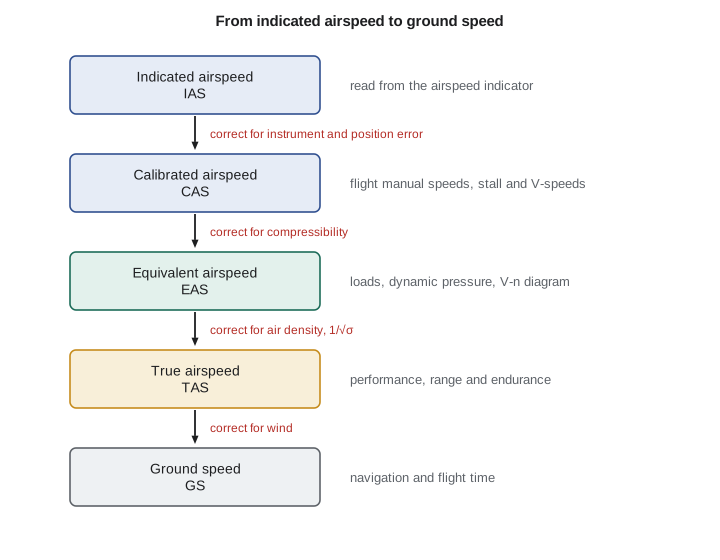
Indicated airspeed (IAS) is what the dial shows. Calibrated airspeed (CAS) corrects IAS for instrument error and position error, the small error caused by the static ports not sensing exactly the free-stream pressure. Equivalent airspeed (EAS) corrects CAS for the compressibility of air, a correction that is small below about 300 km/h(160 kt) and low altitude but grows at high speed and height. True airspeed (TAS) is the actual speed of the aircraft relative to the air mass. Ground speed is TAS corrected for wind.
Equivalent airspeed is the speed at sea level that would give the same dynamic pressure as the true speed at altitude. Because aerodynamic forces depend on dynamic pressure, the aircraft stalls at the same equivalent airspeed at every altitude, for a given weight and configuration. That is why pilots can use one indicated stall speed and one indicated approach speed whatever the airport elevation: the dial reads close to EAS at low speed. True airspeed, by contrast, rises with altitude for the same indicated speed, so an aircraft landing at a high airport touches down faster over the ground and needs more runway.
# Airspeeds and the lift coefficient the Tern needs at different speeds and heights
import math
g, R, gamma = 9.81, 287.05, 1.4
def isa(h):                      # troposphere only: temperature (K), pressure (Pa), density (kg/m3)
    T = 288.15 - 0.0065 * h
    p = 101325 * (T / 288.15) ** 5.2559
    return T, p, p / (R * T)
m, S = 6500.0, 28.0
W = m * g
rho0 = 1.225
print(" h (m)  TAS (km/h)  EAS (km/h)  Mach    q (Pa)   C_L")
for h in (0, 1500, 3000, 4500):
    T, p, rho = isa(h)
    V = 380 / 3.6                       # true airspeed held at 380 km/h
    eas = V * math.sqrt(rho / rho0)     # equivalent airspeed
    a = math.sqrt(gamma * R * T)
    q = 0.5 * rho * V**2
    CL = W / (q * S)
    print(f"{h:6d} {V*3.6:10.0f} {eas*3.6:11.0f} {V/a:7.3f} {q:9.0f} {CL:6.3f}")
# Lift coefficient needed at sea level across the speed range, and the speed for a given C_L
for kmh in (180, 220, 260, 300):
    q = 0.5 * rho0 * (kmh / 3.6) ** 2
    print(f"Sea level, {kmh} km/h: C_L = {W/(q*S):.2f}")
CLmax = 1.6
Vs = math.sqrt(2 * W / (rho0 * S * CLmax))
print(f"Clean stall speed at sea level (C_L,max {CLmax}): {Vs*3.6:.0f} km/h = {Vs/0.5144:.0f} kt") h (m) TAS (km/h) EAS (km/h) Mach q (Pa) C_L
0 380 380 0.310 6825 0.334
1500 380 353 0.316 5895 0.386
3000 380 327 0.321 5065 0.450
4500 380 303 0.327 4327 0.526
Sea level, 180 km/h: C_L = 1.49
Sea level, 220 km/h: C_L = 1.00
Sea level, 260 km/h: C_L = 0.71
Sea level, 300 km/h: C_L = 0.54
Clean stall speed at sea level (C_L,max 1.6): 174 km/h = 94 ktThe program shows a pattern that runs through the whole course. Holding the same true airspeed while climbing lowers the dynamic pressure, so the lift coefficient must rise to keep supporting the weight. At 4500 m the Tern needs a lift coefficient of 0.53 at 380 km/h, compared with 0.33 at sea level. Since induced drag grows with the square of the lift coefficient, the balance between parasite and induced drag shifts with altitude, and the best cruise altitude depends on that balance and on what the propulsion system can deliver.
Units in aircraft performance
Aircraft performance uses a mixture of units, and the mixture differs by audience. Engineering calculations are best done in SI units: newtons, kilograms, meters, seconds and watts. Aviation itself, in both Canada and the United States, uses feet for altitude, knots for airspeed, nautical miles for distance and feet per minute for climb rate, following international practice. Fuel is usually quoted in kilograms or pounds, and engine power in kilowatts or shaft horsepower. A performance engineer must convert fluently and check every number for units.
| Quantity | SI unit | Aviation unit | Conversion |
|---|---|---|---|
| Altitude | m | ft | 1 ft = 0.3048 m |
| Airspeed | m/s or km/h | kt (knot) | 1 kt = 0.5144 m/s = 1.852 km/h |
| Distance | km | NM (nautical mile) | 1 NM = 1.852 km |
| Rate of climb | m/s | ft/min | 1 m/s = 196.9 ft/min |
| Mass | kg | lb | 1 lb = 0.4536 kg |
| Power | kW | shp (shaft horsepower) | 1 shp = 0.7457 kW |
| Thrust | kN | lbf | 1 lbf = 4.448 N |
Many accidents and incidents have involved unit errors, from fuel loaded in pounds when kilograms were intended to altimeter settings misread between millibars and inches of mercury. The most famous Canadian case is the 1983 flight of an Air Canada Boeing 767 that ran out of fuel at 41,000 ft because the fuel load had been calculated with the wrong conversion factor during the airline's move to metric units. The crew glided the aircraft to a safe landing at a former air force base in Gimli, Manitoba, and the event became a lasting lesson about unit discipline and about gliding performance, a topic Lesson 6 takes up.
Weight, mass and the changing aircraft
In performance work, weight is the force \(W = mg\) in newtons, but aircraft weights are almost always quoted as masses, in kilograms or pounds. Arjun keeps both: masses for weight-and-balance sheets and forces for the equations of motion. The aircraft's weight changes during flight as fuel burns, and that change affects nearly every performance number. Several weights matter to the airline and the certification authority.
| Weight | Definition | Tern value |
|---|---|---|
| Operating empty weight (OEW) | Aircraft ready for service, with crew, oil and unusable fuel, but no payload or usable fuel | 4200 kg |
| Maximum zero-fuel weight (MZFW) | Highest weight with payload but no usable fuel, set by wing bending loads | 5600 kg |
| Maximum take-off weight (MTOW) | Highest certified weight at brake release | 6500 kg |
| Maximum landing weight (MLW) | Highest certified weight at touchdown, set by landing gear and structure | 6300 kg |
| Payload | Passengers, bags and cargo | Up to 1400 kg |
| Usable fuel | Fuel available to the turbine generator, limited by tank capacity | Up to 1100 kg |
The Tern's battery pack, 600 kg of cells that supply extra power for take-off and climb, is part of the operating empty weight, because it does not change from flight to flight. Its energy, on the other hand, is used and recharged like fuel. That makes the hybrid-electric Tern a little different from a conventional turboprop: some of its energy store gets lighter as it is used, and some does not. The difference matters most for range, endurance and mission planning, which Lessons 7, 8 and 12 work through.
Worked problem
Wing loading and stall speed at two weights
Find the Tern's clean stall speed at sea level at its maximum take-off weight of 6500 kg and at a light weight of 5000 kg, taking \(C_{L,max} = 1.6\) and \(S = 28\ \text{m}^2\). Give the answers in km/hand knots.
Show solution
- At 6500 kg: \(V_S = \sqrt{2 \times 63\,765/(1.225 \times 28 \times 1.6)} = \sqrt{2324} = 48.2\ \text{m/s} = 174\ \text{km/h}\), or 94 kt.
- At 5000 kg: \(W = 49\,050\ \text{N}\), \(V_S = \sqrt{2 \times 49\,050/54.88} = 42.3\ \text{m/s} = 152\ \text{km/h}\), or 82 kt.
- Check with the square-root rule: \(\sqrt{5000/6500} = 0.877\), and \(174 \times 0.877 = 153\ \text{km/h}\).
Answer: Lighter aircraft stall at lower speeds, so take-off and approach speeds scale with the square root of weight. Performance charts and pilots' speed cards therefore list speeds for several weights, and the flight crew picks the row for the actual take-off or landing weight.
The steady-flight model and its limits
The point-mass, steady-flight model rests on several assumptions. It treats the aircraft as rigid, with no flexibility of the wings. It assumes the thrust line coincides with the flight path, ignoring the small angle between them. It ignores the vertical tail and trim drag except as part of the drag polar. It assumes still air, apart from corrections for wind. Each assumption is reasonable for preliminary design and for most operational performance, but each can matter in special cases: high thrust angles for short take-off aircraft, trim drag for aircraft with far-aft centers of gravity, and strong winds for slow aircraft and drones.
Performance engineers manage these limits in two ways. During design, they add margins and refine the model as better data arrive from wind tunnels and computational fluid dynamics. During certification and operation, they replace predictions with flight-test data, so the numbers in the aircraft flight manual come from measured performance, reduced to standard conditions and expanded into charts. Arjun's job for the bid is the first stage: honest predictions with stated margins that the company can stand behind.
Common mistakes
MistakeMeasuring the flight path angle from the horizon to the fuselage axis.
InsteadThe flight path angle is between the velocity vector and the horizontal; the fuselage axis also includes the angle of attack.
MistakeAssuming lift equals weight in every phase of flight.
InsteadLift equals weight only in steady level flight; in a climb it is W cos γ, and in a turn or pull-up it is larger than W.
MistakeUsing true airspeed to read stall speeds from a chart quoted in indicated or calibrated speed.
InsteadStall and approach speeds are nearly constant in IAS or CAS; true airspeed rises with altitude.
MistakeMixing knots and kilometers per hour or feet and meters in one calculation.
InsteadConvert everything to SI for the equations, then convert answers back to aviation units.
MistakeTreating the hybrid aircraft's battery energy as if it reduced weight when used.
InsteadBattery mass stays on board; only the fuel burned makes the Tern lighter.
Summary and key terms
- Performance treats the aircraft as a point mass acted on by lift, drag, thrust and weight.
- Along the flight path, m dV/dt = T − D − W sin γ; perpendicular to it, mV dγ/dt = L − W cos γ.
- In steady level flight, L = W and T = D; in a steady climb, L = W cos γ and T = D + W sin γ.
- The lift coefficient needed in level flight is C_L = 2W/(ρV²S); stall occurs when it reaches C_L,max.
- Equivalent airspeed equals true airspeed times the square root of the density ratio; stall and approach speeds are nearly constant in EAS, CAS and IAS.
- Weights such as OEW, MZFW, MTOW and MLW limit payload, fuel and performance.
- Flight path angle
- The angle between the aircraft's velocity relative to the air and the horizontal, positive in a climb.
- Steady flight
- Flight at constant speed and constant flight path angle, so the forces balance.
- Wing loading
- Weight divided by wing reference area, W/S.
- Lift coefficient
- A dimensionless measure of how much lift the wing produces per unit dynamic pressure and area.
- Stall speed
- The lowest steady flight speed, reached when the required lift coefficient equals C_L,max.
- Calibrated airspeed
- Indicated airspeed corrected for instrument and position error.
- Equivalent airspeed
- The sea-level speed that gives the same dynamic pressure as the true airspeed at altitude.
- True airspeed
- The aircraft's actual speed relative to the surrounding air.
- Maximum take-off weight
- The highest certified weight at which the aircraft may begin its take-off.
Practice problems
Work each problem on paper first, then reveal the answer to check.
An aircraft of 3000 kg descends steadily on a 3° glide path with zero thrust. Find its drag.
Show answer
T − D − W sin γ = 0 with γ = −3° and T = 0 gives D = W sin 3° = 29 430 × 0.0523 = 1540 N.
Find the lift coefficient for an aircraft of 1200 kg with a 16 m² wing at 200 km/h at sea level.
Show answer
q = ½ × 1.225 × 55.6² = 1890 Pa; C_L = 11 772/(1890 × 16) = 0.39.
An aircraft flies at 300 km/h TAS where σ = 0.74. What is its EAS?
Show answer
300 × √0.74 = 258 km/h.
The Tern's stall speed is 174 km/h at sea level. What is its true stall speed at 3000 m, where σ = 0.742?
Show answer
174/√0.742 = 202 km/h true airspeed; the equivalent stall speed is unchanged.
Convert 1500 ft/min to m/s and 250 kt to km/h.
Show answer
1500/196.9 = 7.62 m/s; 250 × 1.852 = 463 km/h.
In the program, change the held speed to 300 km/h. What lift coefficient does the Tern need at 4500 m?
Show answer
About 0.84, because C_L scales with 1/V²: 0.526 × (380/300)² = 0.84.
Lesson quiz · 5 questions
Score 60% or more to complete this lesson.
Create a free account to save your progress, take quizzes and earn a certificate.