
ACCT-460 · Lesson 7 of 12 · 25 min
Money laundering and beneficial ownership
Money laundering is the process of making the proceeds of crime appear to come from legitimate sources. It matters to forensic accountants for three reasons. First, laundering follows almost every profitable crime, from drug trafficking to fraud, and tracing laundered funds is often the way investigators connect a crime to the people who benefited. Second, banks, accountants, real estate professionals and others are required by law to help detect laundering, and forensic accountants are often asked to review those compliance programs or to investigate when they fail. Third, the techniques of laundering, such as layering transactions through companies and accounts, are the same techniques that hide the proceeds of occupational fraud, including the money that left Saltmarsh Industrial Supply Inc. through Northfield Logistics Services.
The three stages
Money laundering is traditionally described in three stages. Placement introduces criminal proceeds into the financial system, for example by depositing cash, buying monetary instruments or mixing cash with the takings of a cash-intensive business. Layering moves the funds through a series of transactions designed to obscure their origin: transfers between accounts and countries, purchases and sales of assets, loans between related companies, and conversions into and out of virtual currencies. Integration returns the funds to the criminal in a form that appears legitimate, such as business income, loan repayments, investment returns or the proceeds of selling property.
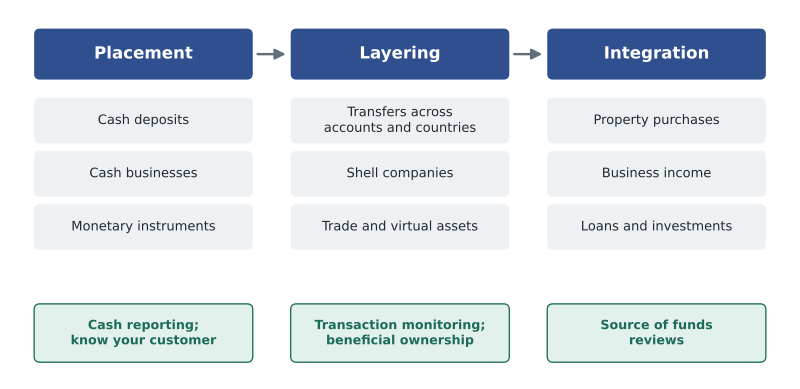
Real laundering rarely follows the stages neatly, and the proceeds of fraud are often already in the financial system when the crime is committed, so placement is unnecessary. In the Northfield case, Saltmarsh Industrial Supply Inc. paid the shell company by electronic transfer; the money was in a bank from the start. What the perpetrator needed was layering and integration: moving money from the shell's account to personal accounts and assets without drawing attention.
Common typologies
Financial intelligence units and the international Financial Action Task Force (FATF) publish typologies, descriptions of methods seen in real cases. Trade-based money laundering misprices or misdescribes goods in international trade, so that value moves between countries disguised as payment for goods. Real estate is used because large, illiquid assets can absorb large sums and their values are subjective; British Columbia's Commission of Inquiry into Money Laundering, led by Austin Cullen, reported in June 2022 that laundering had affected the province's real estate, casinos and luxury goods sectors and that regulators had been slow to respond. Professional money laundering networks offer laundering as a service, often using networks of shell companies and accounts. Virtual assets allow fast cross-border transfers and can be moved through mixers or exchanges with weak controls. Cash-intensive businesses, such as restaurants or car washes, can mix criminal cash with legitimate receipts.
Structuring, also called smurfing, is the practice of breaking cash transactions into amounts below a reporting threshold so that no report is filed. It is one of the oldest placement techniques and one of the easiest to detect with data.
The legal framework
In the United States, the Bank Secrecy Act (BSA) and its regulations require financial institutions, broadly defined to include banks, money services businesses, broker-dealers, casinos and others, to maintain anti-money laundering programs, identify customers, keep records and report to FinCEN, the Financial Crimes Enforcement Network. Currency transaction reports are required for cash transactions over 10,000 dollars, and suspicious activity reports are required for suspicious transactions above lower thresholds. Structuring cash transactions to evade the reporting requirement is itself a federal crime, even if the money is legitimate. The Anti-Money Laundering Act of 2020 modernized the BSA and expanded a whistleblower program. Laundering is a federal crime under the money laundering statutes. Accountants are generally not BSA financial institutions, but they can face liability if they knowingly facilitate laundering, and they often work on AML matters as investigators and advisers.
Enforcement against financial institutions can be severe when programs fail. In October 2024, TD Bank's US operations pleaded guilty in the United States to Bank Secrecy Act and money laundering conspiracy charges and agreed to penalties of about 3.1 billion US dollars, an independent monitorship and a cap on the growth of its US assets, after authorities found that its monitoring had failed to address large volumes of suspicious transactions. Earlier in 2024, FINTRAC had imposed an administrative penalty of about 9.2 million dollars on the bank in Canada. The case is now a standard example of how weak transaction monitoring, under-resourced compliance and a culture that tolerates known gaps lead to criminal liability.
Beneficial ownership
Shell companies and trusts are the main tools for hiding who controls money. Beneficial ownership rules aim to make the real people behind legal entities known to authorities and, in some cases, to the public. A beneficial owner is an individual who ultimately owns or controls an entity, usually defined by a percentage of ownership (often 25 percent) or by control through other means.
In the United States, the Corporate Transparency Act, enacted as part of the Anti-Money Laundering Act of 2020, required most companies to report their beneficial owners to FinCEN. After legal challenges, FinCEN issued an interim rule in March 2025 exempting domestic companies and US persons, and a final rule announced on August 11, 2026 and effective August 14, 2026 made that exemption permanent. Only certain foreign entities registered to do business in the United States must now report, and only for their non-US beneficial owners. Investigators therefore rely on state corporate filings, which often identify only registered agents, on property records, court records, banks' own customer due diligence records obtained through legal process, and commercial databases.
For the Saltmarsh Industrial Supply Inc. investigation, Corbett Lane Forensic LLP searches the corporate registry for Northfield Logistics Services. It was registered on March 21, 2022, a week before it was added to Saltmarsh Industrial Supply Inc.'s vendor master, with one director, G. Pellerin, at 14 Ferncliff Drive. HR records show that Pellerin is R. Calloway's brother-in-law. The registry does not show who controls the company's bank account; that will require the bank's records, which counsel can seek through the civil process.
Screening for structuring
Banks monitor accounts for patterns such as structuring using automated rules and models. Forensic accountants reviewing a bank's monitoring, or investigating a subject's accounts once records are obtained, apply similar tests. The program below screens one invented account for cash deposits just under a 10,000 reporting threshold and for runs of deposits on consecutive days that together exceed it.
# Screening an account for possible structuring: cash deposits kept just under a 10,000
# reporting threshold, and deposits on consecutive days that add up past it (invented data).
from datetime import date, timedelta

THRESHOLD = 10000
deposits = [  # (date, branch, cash amount)
    (date(2025, 6, 2), "Main St", 9500), (date(2025, 6, 3), "Quay Rd", 9200),
    (date(2025, 6, 4), "Main St", 4100), (date(2025, 6, 11), "Airport", 9850),
    (date(2025, 6, 12), "Quay Rd", 9700), (date(2025, 6, 20), "Main St", 2300),
    (date(2025, 6, 23), "Airport", 9400), (date(2025, 6, 24), "Main St", 9950),
    (date(2025, 6, 30), "Quay Rd", 12500),
]
near = [d for d in deposits if 0.8 * THRESHOLD <= d[2] < THRESHOLD]
print(f"Deposits between {0.8*THRESHOLD:,.0f} and {THRESHOLD - 1:,}: {len(near)} of {len(deposits)}")
for d in near:
    print(f"  {d[0]}  {d[1]:<8}{d[2]:>8,}")
print("\nRuns of deposits on consecutive days totalling more than the threshold:")
deposits.sort()
i = 0
while i < len(deposits):
    run = [deposits[i]]
    while i + 1 < len(deposits) and deposits[i + 1][0] - run[-1][0] <= timedelta(days=1):
        i += 1; run.append(deposits[i])
    total = sum(r[2] for r in run)
    if len(run) > 1 and total > THRESHOLD and all(r[2] < THRESHOLD for r in run):
        branches = sorted({r[1] for r in run})
        print(f"  {run[0][0]} to {run[-1][0]}: {len(run)} deposits, total {total:,}, branches {', '.join(branches)}")
    i += 1
over = [d for d in deposits if d[2] >= THRESHOLD]
print(f"\nDeposits at or above the threshold (reported normally): {len(over)}")Deposits between 8,000 and 9,999: 6 of 9 2025-06-02 Main St 9,500 2025-06-03 Quay Rd 9,200 2025-06-11 Airport 9,850 2025-06-12 Quay Rd 9,700 2025-06-23 Airport 9,400 2025-06-24 Main St 9,950 Runs of deposits on consecutive days totaling more than the threshold: 2025-06-02 to 2025-06-04: 3 deposits, total 22,800, branches Main St, Quay Rd 2025-06-11 to 2025-06-12: 2 deposits, total 19,550, branches Airport, Quay Rd 2025-06-23 to 2025-06-24: 2 deposits, total 19,350, branches Airport, Main St Deposits at or above the threshold (reported normally): 1
Six of the nine deposits fall between 8,000 and 9,999, and three runs of deposits on consecutive days, at different branches, together exceed the threshold. That is the classic structuring pattern: someone appears to be keeping each deposit below the reporting level and spreading deposits across branches. The single deposit of 12,500, which would have been reported normally, does not change the picture. A bank analyst would escalate the account for review and, if no legitimate explanation emerged, file a suspicious transaction or activity report. As the program's comments note, the screen identifies a pattern for review; legitimate businesses sometimes make deposits of similar size, and only the facts can distinguish them.
Red flags of laundering in accounting work
Accountants and auditors who are not AML reporting entities may still see red flags in client records: transactions with no clear business purpose, complex ownership structures with no apparent reason, payments to or from high-risk jurisdictions or unrelated third parties, round-sum transfers in and out of an account, loans from offshore companies with unusual terms, cash deposits inconsistent with the business, rapid movement of funds through accounts, and reluctance to explain the source of funds. Depending on their role and jurisdiction, they may have reporting obligations, a duty to consider whether to continue the engagement, and professional obligations not to be associated with misleading information. They should seek legal advice rather than confront the client, because tipping off a subject of a suspicious transaction report can itself be an offense.
Worked problem
Following the money from a shell account
Bank records obtained by court order show that the shell company account receiving 458,940 from Saltmarsh over four years made monthly transfers to the personal account of the employee's brother-in-law, who then paid down a mortgage on a property owned jointly with the employee and transferred funds to an investment account in the employee's name. Map these flows to the stages of laundering.
Show solution
- Placement is unnecessary: the fraud proceeds entered the banking system as payments from the victim.
- Layering: transfers from the shell account to the relative's personal account obscure the link to the employee.
- Integration: mortgage payments on a jointly owned property and deposits to the employee's investment account return the funds as apparently normal assets.
- Evidence needed: bank statements, mortgage records, property title and investment statements, linked by dates and amounts.
Answer: The flows show layering through a relative's account and integration into property and investments; tracing them links the proceeds to the employee.
Common mistakes
MistakeAssuming laundering always starts with cash.
InsteadFraud proceeds often start in the banking system, so focus on layering and integration.
MistakeTreating structuring screens as proof of laundering.
InsteadUse them to identify patterns for review and test for legitimate explanations.
MistakeConfronting a client about a suspicious transaction.
InsteadSeek legal advice; tipping off can be an offense and may destroy evidence.
MistakeRelying on a registry search to identify who controls a company.
InsteadRegistries may be incomplete; corroborate with bank, property and court records.
MistakeAssuming US companies still report beneficial owners to FinCEN.
InsteadSince August 2026, domestic companies are permanently exempt; only certain foreign entities report.
MistakeViewing AML failures as only a compliance issue.
InsteadWeak monitoring and tolerated gaps can lead to criminal liability, as in the TD Bank case.
Summary and key terms
- Money laundering moves criminal proceeds through placement, layering and integration.
- Typologies include trade-based laundering, real estate, professional networks, virtual assets and cash businesses.
- The BSA requires financial institutions to run AML programs and report to FinCEN; structuring is itself a crime.
- TD Bank's 2024 guilty plea, with about 3.1 billion US dollars in penalties, shows the cost of failed monitoring.
- The Corporate Transparency Act's reporting now applies only to certain foreign entities after FinCEN's August 2026 final rule.
- Structuring screens look for deposits just under thresholds and runs that exceed them.
- Accountants should seek legal advice about red flags rather than confront clients.
- FinCEN
- The Financial Crimes Enforcement Network, the US financial intelligence unit.
- Currency transaction report
- A report to FinCEN of cash transactions over 10,000 dollars.
- Money laundering
- Making the proceeds of crime appear to come from legitimate sources.
- Placement
- Introducing criminal proceeds into the financial system.
- Layering
- Moving funds through transactions to obscure their origin.
- Integration
- Returning laundered funds to the criminal in apparently legitimate form.
- Structuring
- Breaking cash transactions into amounts below a reporting threshold.
- Beneficial owner
- An individual who ultimately owns or controls a legal entity.
- Trade-based money laundering
- Moving value between countries by mispricing or misdescribing traded goods.
- Typology
- A description of a laundering method observed in real cases.
Practice problems
Work each problem on paper first, then reveal the answer to check.
Describe the three stages of money laundering.
Show answer
Placement introduces proceeds into the financial system, layering obscures their origin, and integration returns them in apparently legitimate form.
Why was placement unnecessary in the Northfield scheme?
Show answer
The proceeds were paid by electronic transfer, so they were in the banking system from the start.
In the structuring program, how many deposits fall between 8,000 and 9,999?
Show answer
Six of nine.
Change the 2025-06-04 deposit to 400 and rerun. Is the first run still flagged?
Show answer
Yes; 9,500 + 9,200 + 400 = 19,100 still exceeds the threshold.
What did the Cullen Commission report in 2022?
Show answer
That laundering had affected British Columbia's real estate, casinos and luxury goods sectors and that the response had been slow.
Name two changes made by Canada's Bill C-12 to the PCMLTFA.
Show answer
About fortyfold higher maximum penalties and a new very serious violation for ineffective compliance programs; also mandatory enrollment with FINTRAC.
Who must still report beneficial ownership under the Corporate Transparency Act after August 2026?
Show answer
Only certain foreign entities registered to do business in the US, for their non-US beneficial owners.
Why should an accountant not confront a client about a suspicious transaction?
Show answer
Tipping off can be an offense and may destroy evidence; legal advice is needed first.
Give four red flags of laundering an accountant might see.
Show answer
Transactions without business purpose, complex ownership without reason, high-risk jurisdictions, round-sum transfers, unusual offshore loans, unexplained cash deposits.
What did the registry search for Northfield show?
Show answer
It was registered on March 21, 2022 with one director, G. Pellerin, at 14 Ferncliff Drive, Calloway's brother-in-law.
Lesson quiz · 5 questions
Score 60% or more to complete this lesson.
Create a free account to save your progress, take quizzes and earn a certificate.