
ACCT-460 · Lesson 5 of 12 · 26 min
Corruption and bribery
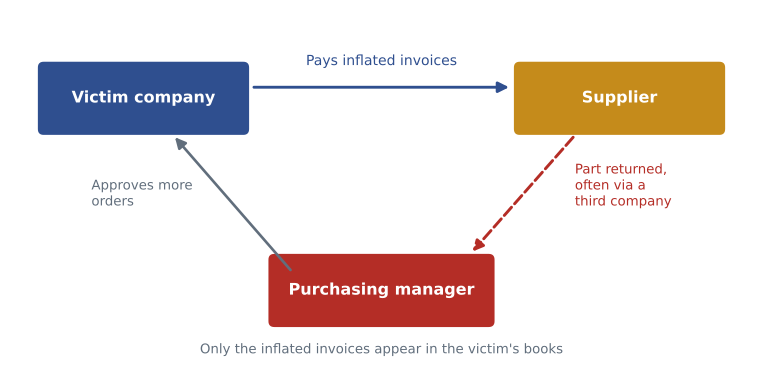
Corruption is the misuse of entrusted power for private gain. In the occupational fraud data from lesson 2, it appears in nearly half of all cases, often alongside other schemes, and its typical loss is larger than that of asset misappropriation. It is also harder to detect, because the key transaction, the bribe or kickback, usually happens outside the victim organization's books. A purchasing manager who accepts payments from a supplier in exchange for orders leaves no trace in the company's ledger except the orders themselves, which may look normal or only slightly overpriced. This lesson explains the main forms of corruption, the laws that apply in both countries, the red flags that point to corruption, and how forensic accountants investigate it.
Forms of corruption
A conflict of interest exists when an employee or agent has an undisclosed personal interest in a transaction that could influence their decisions, such as a purchasing manager who owns part of a supplier, or a manager who hires a relative's company. Not every conflict is fraud: many organizations allow conflicts that are disclosed and managed. It becomes fraud when the interest is concealed and the employee acts on it to the organization's detriment, for example by steering contracts or approving inflated prices.
Bribery is offering, giving, receiving or soliciting something of value to influence a decision. Commercial bribery involves private parties, such as a supplier paying a customer's buyer; public bribery involves government officials, such as paying an inspector to approve a project or a foreign official to win a contract. Kickbacks are a form of bribery in which part of the payment the victim makes to a supplier is returned to the employee who arranged the purchase, often through inflated invoices or a shell company. Illegal gratuities are gifts or payments given after a decision as a reward, without an agreement in advance; in public sector contexts they may still be offenses. Economic extortion occurs when an employee demands payment from a supplier as a condition of doing business.
Bid rigging is a form of collusion in procurement. Suppliers agree among themselves who will win a contract and at what price, using techniques such as cover bidding (losing bidders submit deliberately high bids), bid suppression (some bidders agree not to bid), bid rotation (bidders take turns winning) and market allocation (bidders divide customers or regions). Bid rigging may involve an insider at the buying organization who shares information or designs specifications to favor one supplier. It is a criminal offense under competition law in both countries: the Competition Act in Canada and the Sherman Act in the United States.
The legal framework
In the United States, commercial bribery is prohibited by many state laws and by federal statutes such as the Travel Act and the mail and wire fraud statutes. The Foreign Corrupt Practices Act (FCPA) has two parts. Its anti-bribery provisions prohibit corruptly giving anything of value to a foreign official to obtain or retain business; they apply to issuers, domestic concerns and others acting in the United States, and include a narrow exception for facilitating payments for routine governmental action. Its accounting provisions require issuers to keep books and records that accurately reflect transactions and to maintain adequate internal accounting controls, and they apply whether or not bribery is proved, which makes them central to accountants. Enforcement changed sharply in 2025: an executive order on February 10, 2025 paused FCPA enforcement for 180 days for a policy review, and the Department of Justice issued new FCPA guidelines on June 9, 2025, directing prosecutors to focus on individual misconduct, cases linked to cartels and transnational criminal organizations, harm to US companies' competitiveness, national security and substantial bribes, and away from routine business practices and low-value courtesies. A revised Corporate Enforcement Policy in May 2025 set clearer paths to declinations and non-prosecution agreements. Reports through early 2026 indicated few corporate resolutions and no SEC FCPA actions since the order. The statute itself is unchanged, the limitation period is generally five or six years, and later administrations could enforce more actively.
Organizations operating internationally also face foreign laws, of which the United Kingdom's Bribery Act 2010 is the most widely cited. It covers both public and private bribery and creates a corporate offense of failing to prevent bribery by persons associated with the organization, with a defense for adequate procedures. Multinational companies therefore often design anti-corruption programs to meet the strictest standard that applies to any part of the group.
For accountants, the books-and-records dimension deserves emphasis. Bribes are almost never recorded as bribes. They appear as consulting fees, commissions to agents, marketing expenses, charitable donations, travel and entertainment, discounts or rebates, or payments to suppliers for inflated invoices. Investigating corruption is therefore largely a matter of finding payments whose recorded description does not match their substance, and the people who arranged them.
Red flags of corruption
| Area | Red flags |
|---|---|
| Vendors and agents | Agents or consultants with vague services, high commissions, offshore accounts or links to officials; vendors favored despite poor performance; new vendors linked to employees |
| Procurement | Sole-source awards without justification; specifications that only one supplier can meet; bids that are just below the winner's or in a rotating pattern; late bids accepted; contracts split to avoid approval thresholds |
| Payments | Payments to third parties not named in the contract; round-sum payments; cash payments; payments to countries unrelated to the work; unusual rebates or credit notes |
| Employees | Lifestyle beyond income; refusal to take vacation or share duties; close social ties with a supplier; resistance to audits of a particular supplier |
| Accounting | Large or vague entries to consulting, marketing or donations; manual entries that bypass the purchase system; inconsistent descriptions between invoices and contracts |
No single red flag proves corruption; many have innocent explanations. Investigators look for clusters and for the combination of an insider with influence and a counterparty who benefits.
Scoring vendors for follow-up at Saltmarsh Industrial Supply Inc.
As part of the review that began with the Northfield allegation, Corbett Lane Forensic LLP scores Saltmarsh Industrial Supply Inc.'s active vendors on a set of shell-company and corruption red flags drawn from the vendor master, the payment history, corporate registry searches and inquiries of the business units. The weights reflect the team's judgment of how strongly each flag points to a problem; an address shared with an employee weighs most. The program below shows the scoring for five vendors.
# Red-flag scoring of vendors for shell-company and corruption risk (invented data).
# Each red flag carries a weight; the score ranks vendors for follow-up, it does not prove fraud.
WEIGHTS = {
    "residential or mail-drop address": 3, "no phone or website": 2, "created in last 5 years": 1,
    "single approver for all invoices": 3, "invoices just below approval limit": 3,
    "round or sequential invoice numbers": 2, "services with no receiving evidence": 3,
    "address matches employee record": 5, "sole-source without bids": 2,
}
vendors = {
    "Northfield Logistics Services": ["residential or mail-drop address", "no phone or website",
        "created in last 5 years", "single approver for all invoices", "invoices just below approval limit",
        "round or sequential invoice numbers", "services with no receiving evidence",
        "address matches employee record"],
    "Bayline Packaging": ["created in last 5 years", "invoices just below approval limit"],
    "Coastal Safety Wholesale": ["sole-source without bids"],
    "Atlantic Fastener Co.": [],
    "Keel and Rudder Consulting": ["no phone or website", "created in last 5 years",
        "services with no receiving evidence", "sole-source without bids"],
}
rows = sorted(((sum(WEIGHTS[f] for f in flags), v, len(flags)) for v, flags in vendors.items()), reverse=True)
top = sum(WEIGHTS.values())
print(f"{'Vendor':<32}{'flags':>6}{'score':>7}  priority")
for score, v, n in rows:
    pr = "investigate" if score >= 10 else "review" if score >= 5 else "routine"
    print(f"{v:<32}{n:>6}{score:>7}  {pr}")
print(f"\nMaximum possible score: {top}")Vendor flags score priority Northfield Logistics Services 8 22 investigate Keel and Rudder Consulting 4 8 review Bayline Packaging 2 4 routine Coastal Safety Wholesale 1 2 routine Atlantic Fastener Co. 0 0 routine Maximum possible score: 24
Northfield scores 22 of a possible 24, with eight of nine flags; the only flag it lacks is sole-sourcing, because logistics services are not normally put to bid at Saltmarsh Industrial Supply Inc.. Keel and Rudder Consulting, the vendor from the example in lesson 3, scores 8 and is placed in the review category; its telephone number later turns out to belong to an employee in purchasing, S. Fraser, which the link analysis in lesson 10 connects. Bayline Packaging and the two long-standing suppliers score low. The scores rank vendors for follow-up; they do not prove anything, and the weights themselves are judgments that the report should disclose.
Investigating corruption
Corruption investigations usually proceed from the victim's own records outward. Within the organization, investigators analyze the vendor or agent relationship: how the vendor was selected and approved, the contracts and their terms, the invoices and what they describe, evidence of goods or services received, prices compared with other suppliers or market rates, and the people involved at each step. They review emails and messages of the employees involved, where policy and law allow, for discussions with the counterparty. They compare employees' declared conflicts of interest with corporate registry data, property records and social media.
Proving the payment from the supplier to the employee usually requires information outside the organization, such as the supplier's records, bank records of the employee or an intermediary, or a cooperating witness. Private investigators cannot compel production of such records; they are obtained through civil litigation (for example by court orders to preserve and produce documents), through the cooperation of the supplier, or by law enforcement. A forensic accountant who suspects bribery of a public official should advise counsel early, because the organization may face decisions about self-reporting, and because investigative steps that alert the subject may destroy evidence or prejudice a criminal case.
Anti-corruption programs that reduce the risk include a tone at the top that rejects bribery, clear policies on gifts, hospitality and conflicts of interest, annual conflict declarations, risk-based due diligence on agents and intermediaries, contractual audit rights, approval controls over high-risk payments such as commissions and donations, competitive procurement with independent bid evaluation, training, a hotline, and periodic testing by internal audit. Regulators in both countries consider the quality of such programs when deciding how to treat an organization that self-reports misconduct.
Worked problem
Analyzing a bid pattern
Over three years, a municipality awarded twelve paving contracts. Four contractors bid on all of them; each won three, in a repeating order, and the losing bids were usually 8 to 12 percent above the winner. What does the pattern suggest, and what should the forensic accountant do?
Show solution
- The repeating order of winners suggests bid rotation, and the consistent gap suggests cover bidding.
- Compare the winning prices with engineering estimates and with prices in neighboring municipalities to estimate any overcharge.
- Examine bid documents for common features such as identical errors, formatting or metadata, and check whether bids were prepared or delivered together.
- Report the analysis to counsel, who can advise on referral to the competition authority; avoid contacting the contractors directly.
Answer: The pattern is consistent with bid rotation and cover bidding; the accountant quantifies the possible overcharge, documents the indicators and leaves decisions about referral and contact to counsel.
Common mistakes
MistakeExpecting to find bribes recorded as bribes.
InsteadLook for payments whose substance does not match their description: consulting, commissions, donations, rebates.
MistakeTreating every undisclosed conflict as fraud.
InsteadDetermine whether the interest was concealed and acted on to the organization's detriment.
MistakeAssuming the FCPA no longer matters after the 2025 pause.
InsteadThe statute is unchanged, enforcement priorities can shift and the limitation period is long.
MistakeContacting a suspected supplier before securing internal evidence.
InsteadComplete internal documentary work first and involve counsel in decisions about external contact.
MistakeRelying on red-flag scores as proof.
InsteadUse scores to rank follow-up, disclose the weights and corroborate with documents.
MistakeIgnoring the books-and-records dimension.
InsteadEven without proof of bribery, inaccurate records and weak controls may breach the law.
Summary and key terms
- Corruption includes conflicts of interest, bribery, kickbacks, illegal gratuities, extortion and bid rigging.
- Bribes usually occur outside the victim's books and appear as mislabeled payments.
- The FCPA has anti-bribery and accounting provisions; 2025 brought a pause, new guidelines and narrower enforcement priorities.
- Bid rigging is a criminal offense under competition law in both countries.
- Red flags cluster around agents, procurement, payments, employee behavior and accounting entries.
- Vendor scoring ranks follow-up; external evidence of payments usually requires litigation, cooperation or law enforcement.
- Anti-corruption programs combine policy, due diligence, payment controls, training, hotlines and testing.
- FCPA accounting provisions
- Requirements for issuers to keep accurate books and records and maintain adequate internal accounting controls.
- Deferred prosecution agreement
- An agreement under which charges are filed but prosecution is deferred if the company meets conditions.
- Corruption
- The misuse of entrusted power for private gain.
- Conflict of interest
- A personal interest that could influence an employee's decisions on behalf of the organization.
- Kickback
- A payment returned to an employee who arranged a purchase, usually funded by inflated prices.
- Commercial bribery
- Bribery between private parties to influence business decisions.
- Bid rigging
- Collusion among bidders to decide who wins a contract and at what price.
- Cover bidding
- Submitting a deliberately losing bid to give the appearance of competition.
- Illegal gratuity
- A reward given after a decision without a prior agreement, prohibited in some contexts.
Practice problems
Work each problem on paper first, then reveal the answer to check.
Why is corruption harder to detect from the victim's books than a billing scheme?
Show answer
The bribe or kickback is paid outside the victim's records; only the orders, perhaps overpriced, appear.
When does a conflict of interest become fraud?
Show answer
When it is concealed and the employee acts on it to the organization's detriment.
Name four bid-rigging techniques.
Show answer
Cover bidding, bid suppression, bid rotation and market allocation.
List five ways bribes may be described in accounting records.
Show answer
Consulting fees, agent commissions, marketing, donations, travel and entertainment, rebates or discounts, inflated supplier invoices.
In the scoring program, which flag does Northfield lack, and why?
Show answer
Sole-source without bids, because logistics services are not normally put to bid at Saltmarsh.
Add 'single approver for all invoices' to Bayline Packaging and rerun. What is its new score and priority?
Show answer
7, which places it in the review category.
Why should the scoring weights be disclosed in a report?
Show answer
They are judgments; disclosure lets readers assess and challenge the ranking.
How do investigators usually obtain evidence of payments from a supplier to an employee?
Show answer
Through civil court orders, the supplier's cooperation, cooperating witnesses or law enforcement.
Why should counsel be involved early if bribery of a public official is suspected?
Show answer
Self-reporting decisions, legal exposure and the risk of prejudicing a criminal case.
Give four elements of an anti-corruption program.
Show answer
Tone at the top, gifts and conflicts policies, due diligence on intermediaries, payment controls, competitive procurement, training, hotline, testing.
Lesson quiz · 5 questions
Score 60% or more to complete this lesson.
Create a free account to save your progress, take quizzes and earn a certificate.