
ACCT-101 · Lesson 6 of 12 · 31 min
Adjusting entries II: accruals, depreciation and the adjusted trial balance
Deferrals, covered in lesson 5, deal with cash that moved before the revenue or expense. Accruals deal with the opposite case: revenue earned or expense incurred before any cash has moved and before any document has been recorded. Depreciation spreads the cost of long-lived assets over the periods that use them. This lesson covers accrued revenues, accrued expenses and depreciation, completes the May adjustments for Birchwood Bikes, and prepares the adjusted trial balance from which lesson 7 builds the financial statements.
Accrued revenues
An accrued revenue is revenue earned in the period but not yet recorded, usually because the customer has not yet been billed. Work completed in the last days of the month, interest earned on a savings account or a loan made to someone else, and rent earned on property leased to a tenant who pays later are typical examples. The adjusting entry debits a receivable and credits revenue. When the bill is later sent and paid, the receipt is recorded as cash in and receivable out, with no further revenue.
Worked problem
Unbilled repairs at month end
On 31 May Birchwood Bikes finished overhauling a fleet of 12 bicycles for a courier company. The agreed price is $1,200, and the invoice will be sent on 3 June.
Show solution
- The work is done, so the revenue is earned in May.
- Adjusting entry on 31 May: debit Accounts receivable 1,200; credit Service revenue 1,200.
- On 3 June, sending the invoice requires no entry because the receivable already exists. When the courier pays on 20 June: debit Cash 1,200; credit Accounts receivable 1,200.
Answer: Debit Accounts receivable $1,200; credit Service revenue $1,200 on 31 May.
Accrued expenses
An accrued expense is an expense incurred in the period but not yet recorded or paid. The most common are wages earned by employees since the last payday, interest that has built up on a loan since the last payment, and services such as utilities or professional fees used but not yet billed. The adjusting entry debits the expense and credits a liability such as Wages payable or Interest payable.
Worked problem
Accrued wages
Birchwood Bikes pays its part-time mechanic every second Friday. The last payday in May was Friday 24 May. For work on 27 to 31 May the mechanic has earned $420, which will be paid on 7 June together with the following week's wages of $540.
Show solution
- The $420 is a May expense because the work was done in May.
- 31 May adjusting entry: debit Wages expense 420; credit Wages payable 420.
- On 7 June, the payroll of $960 is recorded as: debit Wages payable 420; debit Wages expense 540; credit Cash 960.
- This avoids recording all $960 as a June expense.
Answer: Debit Wages expense $420; credit Wages payable $420.
Interest is calculated with the simple interest formula: interest equals principal times annual rate times the fraction of the year. Banks and loan agreements specify whether the fraction is counted in months or days and whether a year has 360 or 365 days; in this course, months are used unless a day count is given.
Worked problem
Accrued interest on the note
The $20,000 bank note signed on 2 May carries interest at 6 % a year, payable every three months. Record interest for May (treat May as one month).
Show solution
- Interest for one month = 20,000 × 0.06 × 1/12 = $100.
- Adjusting entry: debit Interest expense 100; credit Interest payable 100.
- When the first quarterly payment of $300 is made on 2 August, interest payable for May and June ($200) is cleared and July's $100 is expensed, assuming June and July adjustments were also made.
Answer: Debit Interest expense $100; credit Interest payable $100.
Depreciation
Equipment, vehicles, buildings and other long-lived assets help earn revenue for many years, so their cost is spread over their useful lives. This allocation is called depreciation (for physical assets; the equivalent for intangible assets is amortization). Depreciation is not an attempt to measure the asset's market value; it is a systematic way of matching cost with the periods that benefit. Land is not depreciated because its useful life is not limited.
The depreciation adjustment debits Depreciation expense and credits Accumulated depreciation, a contra asset account. A contra account has a balance opposite to the account it relates to and is reported as a deduction from it. Using a contra account keeps the original cost visible in the Equipment account while accumulating the depreciation recorded to date. Cost less accumulated depreciation is the asset's carrying amount (also called book value or net book value).
| Method | Annual depreciation | Pattern |
|---|---|---|
| Straight-line | (Cost − residual value) ÷ useful life | Same amount every year |
| Declining balance | Carrying amount at start of year × rate (for double-declining, rate = 2 ÷ life) | Larger amounts early, smaller later |
| Units of production | (Cost − residual value) × units this period ÷ total expected units | Follows actual use |
Worked problem
Straight-line depreciation
Birchwood Bikes' repair equipment cost $18,000 on 3 May. It is expected to last five years with no residual value. Find monthly depreciation and record May's adjustment.
Show solution
- Annual depreciation = (18,000 − 0) ÷ 5 = $3,600.
- Monthly depreciation = 3,600 ÷ 12 = $300. Businesses often take a full month for an asset bought early in the month; policies vary.
- Adjusting entry: debit Depreciation expense 300; credit Accumulated depreciation, equipment 300.
- Carrying amount at 31 May = 18,000 − 300 = $17,700.
Answer: Debit Depreciation expense $300; credit Accumulated depreciation $300.
# Straight-line versus double-declining-balance depreciation (illustrative)
cost, residual, life = 18000, 0, 5

print("Year  Straight-line  Double-declining  DDB carrying amount")
carrying = cost
rate = 2 / life
for year in range(1, life + 1):
    sl = (cost - residual) / life
    ddb = carrying * rate
    if year == life:                 # final year: take whatever brings it to residual
        ddb = carrying - residual
    carrying -= ddb
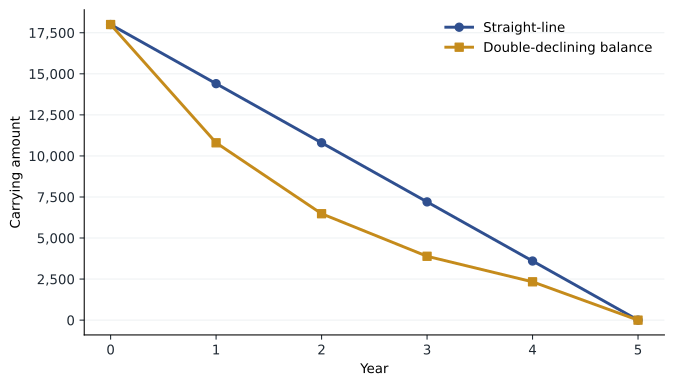
print(f"{year:>4}{sl:>15,.0f}{ddb:>18,.0f}{carrying:>21,.0f}")Year Straight-line Double-declining DDB carrying amount 1 3,600 7,200 10,800 2 3,600 4,320 6,480 3 3,600 2,592 3,888 4 3,600 1,555 2,333 5 3,600 2,333 0
Both methods depreciate the full $18,000 over five years; they differ only in timing. Double-declining balance records $7,200 in the first year and much less later. Which method to use is an accounting policy choice: standards require the method that best reflects the pattern in which the asset's benefits are consumed. Tax rules are separate.
For income tax, the US uses the Modified Accelerated Cost Recovery System (MACRS), with prescribed recovery periods, plus bonus depreciation and Section 179 expensing that let many businesses deduct equipment costs immediately. A business keeps its book depreciation and its tax depreciation separately; the difference creates the deferred taxes studied in ACCT-212. FIN-201 lesson 8 shows how tax deductions affect project cash flows.
The adjusted trial balance
After all adjustments are journalized and posted, a new trial balance, the adjusted trial balance, is prepared. It contains every balance needed for the financial statements. Here are Birchwood Bikes' six May adjustments together.
| # | Adjustment | Debit | Credit | Amount |
|---|---|---|---|---|
| a | Insurance expired | Insurance expense | Prepaid insurance | 300 |
| b | Supplies used | Supplies expense | Supplies | 600 |
| c | Depreciation | Depreciation expense | Accumulated depreciation | 300 |
| d | Wages accrued | Wages expense | Wages payable | 420 |
| e | Interest accrued | Interest expense | Interest payable | 100 |
| f | Unbilled repairs | Accounts receivable | Service revenue | 1,200 |
# Apply adjusting entries to the unadjusted trial balance (illustrative)
tb = {"Cash": 37800, "Accounts receivable": 1000, "Supplies": 1500,
      "Prepaid insurance": 3600, "Equipment": 18000,
      "Accumulated depreciation": 0, "Accounts payable": 850,
      "Wages payable": 0, "Interest payable": 0, "Note payable": 20000,
      "Share capital": 40000, "Dividends": 500, "Service revenue": 7000,
      "Rent expense": 2000, "Wages expense": 3100, "Utilities expense": 350,
      "Insurance expense": 0, "Supplies expense": 0,
      "Depreciation expense": 0, "Interest expense": 0}
debit_normal = {"Cash", "Accounts receivable", "Supplies", "Prepaid insurance",
                "Equipment", "Dividends", "Rent expense", "Wages expense",
                "Utilities expense", "Insurance expense", "Supplies expense",
                "Depreciation expense", "Interest expense"}
adjustments = [("Insurance expense", "Prepaid insurance", 300),
               ("Supplies expense", "Supplies", 600),
               ("Depreciation expense", "Accumulated depreciation", 300),
               ("Wages expense", "Wages payable", 420),
               ("Interest expense", "Interest payable", 100),
               ("Accounts receivable", "Service revenue", 1200)]

def post(acct, amt, side):
    sign = 1 if (side == "Dr") == (acct in debit_normal) else -1
    tb[acct] += sign * amt

for dr, cr, amt in adjustments:
    post(dr, amt, "Dr"); post(cr, amt, "Cr")

dr_total = sum(v for k, v in tb.items() if k in debit_normal)
cr_total = sum(v for k, v in tb.items() if k not in debit_normal)
for k, v in tb.items():
    side = "Dr" if k in debit_normal else "Cr"
    print(f"{k:<26}{v:>8,} {side}")
print(f"Totals: debits {dr_total:,} credits {cr_total:,}")Cash 37,800 Dr Accounts receivable 2,200 Dr Supplies 900 Dr Prepaid insurance 3,300 Dr Equipment 18,000 Dr Accumulated depreciation 300 Cr Accounts payable 850 Cr Wages payable 420 Cr Interest payable 100 Cr Note payable 20,000 Cr Share capital 40,000 Cr Dividends 500 Dr Service revenue 8,200 Cr Rent expense 2,000 Dr Wages expense 3,520 Dr Utilities expense 350 Dr Insurance expense 300 Dr Supplies expense 600 Dr Depreciation expense 300 Dr Interest expense 100 Dr Totals: debits 69,870 credits 69,870
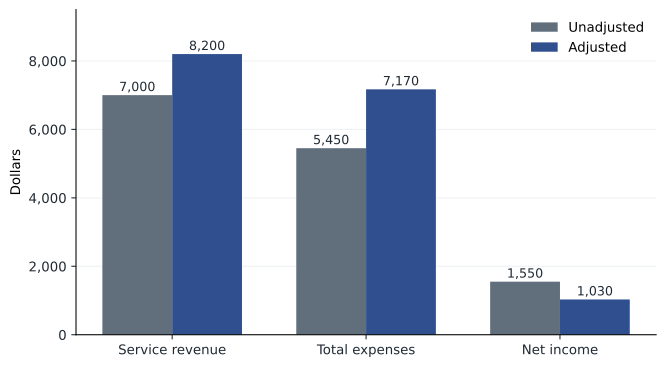
The adjusted trial balance totals $69,870 on each side. Compared with the unadjusted trial balance, revenue has risen by $1,200 and expenses by $1,720, so the adjustments reduced May's net income by $520. That is typical for a new business: costs such as depreciation, interest and accrued wages are easy to forget, and without adjustments a business can believe it is more profitable than it is.
| Account | Debit | Credit |
|---|---|---|
| Cash | 37,800 | |
| Accounts receivable | 2,200 | |
| Supplies | 900 | |
| Prepaid insurance | 3,300 | |
| Equipment | 18,000 | |
| Accumulated depreciation, equipment | 300 | |
| Accounts payable | 850 | |
| Wages payable | 420 | |
| Interest payable | 100 | |
| Note payable | 20,000 | |
| Common stock | 40,000 | |
| Dividends | 500 | |
| Service revenue | 8,200 | |
| Rent expense | 2,000 | |
| Wages expense | 3,520 | |
| Utilities expense | 350 | |
| Insurance expense | 300 | |
| Supplies expense | 600 | |
| Depreciation expense | 300 | |
| Interest expense | 100 | |
| Totals | 69,870 | 69,870 |
Reversing entries
Some businesses make optional reversing entries on the first day of the new period to undo certain accruals. If the 31 May wages accrual is reversed on 1 June (debit Wages payable 420, credit Wages expense 420), the payroll clerk can record the 7 June payroll in the usual way as a $960 debit to Wages expense, and June's expense will still come out right at $540. Reversing entries are a convenience for routine recording; they are not required, and the financial statements are the same with or without them. Accounting software often offers an 'auto-reverse' option for accruals.
Estimates and judgment
Adjusting entries depend on estimates: the useful life and residual value of equipment, the percentage of a job completed, the amount of an unbilled utility bill. Estimates must be reasonable, supported and applied consistently, and when better information arrives they are revised going forward rather than by restating past periods, unless an error was made. Because estimates affect profit, they are another place where pressure to show good results can creep in. Stretching an asset's estimated life from five years to ten halves its annual depreciation and raises reported profit, without any change in the business.
Common mistakes
MistakeWaiting until wages are paid to record them, so the expense lands in the wrong month.
InsteadAccrue wages earned but unpaid at period end: debit Wages expense, credit Wages payable.
MistakeCrediting the Equipment account directly for depreciation.
InsteadCredit Accumulated depreciation, a contra asset, so the original cost stays visible.
MistakeThinking depreciation measures an asset's market value.
InsteadDepreciation allocates cost over useful life; carrying amount can differ greatly from market value.
MistakeDepreciating land.
InsteadLand has an unlimited useful life and is not depreciated; buildings on it are.
MistakeRecording revenue again when an accrued receivable is collected.
InsteadThe revenue was accrued at period end; collection is debit Cash, credit Accounts receivable.
Summary and key terms
- Accrued revenues are earned but unrecorded: debit receivable, credit revenue.
- Accrued expenses are incurred but unrecorded: debit expense, credit payable.
- Interest = principal × annual rate × time.
- Depreciation allocates cost over useful life: debit Depreciation expense, credit Accumulated depreciation (a contra asset).
- Straight-line spreads cost evenly; declining balance front-loads it; both reach the same total.
- The adjusted trial balance contains every balance needed for the financial statements.
- Reversing entries are optional conveniences that do not change the statements.
- Accrual
- An adjustment for revenue earned or expense incurred before cash is received or paid.
- Accrued revenue
- Revenue earned but not yet recorded or received; recorded as a receivable.
- Accrued expense
- An expense incurred but not yet recorded or paid; recorded as a liability.
- Depreciation
- The systematic allocation of the cost of a long-lived physical asset over its useful life.
- Accumulated depreciation
- A contra asset account holding the total depreciation recorded on an asset to date.
- Contra account
- An account with a balance opposite to its related account, reported as a deduction from it.
- Carrying amount
- Cost less accumulated depreciation; also called book value.
- Residual value
- The estimated amount an asset will be worth at the end of its useful life.
- Adjusted trial balance
- A trial balance prepared after adjusting entries are posted.
- Reversing entry
- An optional entry on the first day of a period that reverses a prior-period accrual.
Practice problems
Work each problem on paper first, then reveal the answer to check.
A $50,000 note at 8 % was signed on 1 November. Accrue interest at 31 December.
Show answer
Interest = 50,000 × 0.08 × 2/12 = $666.67; debit Interest expense, credit Interest payable.
Employees earn $1,500 a day for a five-day week paid on Friday. The year ends on Wednesday. Accrue wages.
Show answer
3 days × 1,500 = $4,500; debit Wages expense, credit Wages payable.
A van costs $42,000, has a residual value of $6,000 and a six-year life. Find straight-line annual depreciation.
Show answer
(42,000 − 6,000) ÷ 6 = $6,000.
Find first-year double-declining depreciation for the van.
Show answer
Rate 2 ÷ 6 = 33.3 %; 42,000 × 1/3 = $14,000 (residual is ignored until the end).
A consultant completed $3,500 of work in December that will be billed in January. Record the December adjustment.
Show answer
Debit Accounts receivable 3,500; credit Service revenue 3,500.
Why is accumulated depreciation used instead of crediting Equipment?
Show answer
It preserves original cost and shows total depreciation separately for users.
If an accrued wages adjustment of $420 is omitted, what are the effects?
Show answer
Expenses understated, net income overstated, liabilities understated by $420; assets and cash unaffected.
Record the 1 June reversing entry for the May wages accrual, then the 7 June payroll of $960.
Show answer
1 June: debit Wages payable 420, credit Wages expense 420. 7 June: debit Wages expense 960, credit Cash 960.
What is the carrying amount of the Birchwood equipment at 31 December of its first year (8 months of depreciation)?
Show answer
18,000 − 8 × 300 = $15,600.
Modify the depreciation program for a $30,000 asset with a $5,000 residual value over four years. What is straight-line annual depreciation?
Show answer
(30,000 − 5,000) ÷ 4 = $6,250.
Lesson quiz · 5 questions
Score 60% or more to complete this lesson.
Create a free account to save your progress, take quizzes and earn a certificate.