
VIS-130 · Lesson 1 of 12 · 32 min
Why image makers study art history
Every photograph, film shot and social video you will ever make enters a conversation that began long before cameras existed. Painters spent centuries working out how to suggest depth on a flat surface, how to lead the eye, how to make light feel warm or threatening, and how to tell a story in a single frame. Photographers and filmmakers inherited those solutions, argued with them and invented new ones. This course traces that conversation from ancient proportion systems to contemporary digital and Indigenous art, always asking one practical question: what can an image maker today borrow, adapt or deliberately reject? This first lesson explains why art history matters for people who make images, introduces the core vocabulary of visual analysis, and sets out a method for looking slowly and writing about what you see.
Art history is a toolkit, not a list of names
Many people picture art history as memorizing artists, dates and famous paintings. Dates and names matter, because they let you place a work in its time and see how ideas spread, but they are not the point. For an image maker, art history is a toolkit of solved problems. When a cinematographer lights a face with a single window on one side, she is using a solution Dutch painters refined in the seventeenth century. When a photographer places a small figure against a vast mountain, he is drawing on a Romantic idea about human smallness in nature. When a designer arranges a poster on a strict grid, she is using principles developed at the Bauhaus in the 1920s.
Knowing where these solutions came from has three practical benefits.
- It gives you more options. If you only know the visual habits of the last five years of social media, you will make images that look like everyone else's. A wider visual memory lets you choose deliberately.
- It gives you language. Directors, clients, editors and collaborators often communicate through references: "light it like a Vermeer", "make it feel like a Hopper painting", "go for a Bauhaus look". You need to know what those references mean and which specific qualities they point to.
- It helps you avoid clichés and borrowing without understanding. Copying the surface of a style without grasping why it worked often produces empty imitation. Understanding the original problem lets you adapt the solution to your own subject.
Looking slowly
The most important skill this course teaches is slow looking. Museum research has repeatedly found that visitors spend only seconds in front of most works, often less time than they spend reading the wall label. Image makers need the opposite habit. Before you decide what an image means or whether you like it, spend several minutes simply noticing what is there.
A simple routine helps. First, describe the image as if to someone who cannot see it: what is depicted, where things are placed, how big they are, what colours and tones dominate. Second, notice where your eye goes first, second and third, and try to explain why. Third, ask how the image was made: the medium, the scale, the tools, the visible marks or the camera position. Only then move to interpretation: what the image seems to be about, what mood it creates, and what choices produce that mood.
The formal vocabulary
Art historians and critics use a shared vocabulary of formal elements, the building blocks of any image. You met many of them in VIS-101 Visual Design and Composition; here they become tools for analyzing historical works.
| Element | What it describes | Questions to ask |
|---|---|---|
| Line | edges, contours, directions, implied lines such as gazes | Where do lines lead the eye? Are they calm or energetic? |
| Shape and mass | flat areas and the sense of volume | Are forms geometric or organic, heavy or light? |
| Value | lightness and darkness | Is the range wide or narrow? Where is the brightest point? |
| Colour | hue, saturation and temperature | Is the palette warm or cool, harmonious or clashing? |
| Space | depth, overlap, perspective, flatness | Does the image open into depth or stay flat? |
| Texture | real or depicted surface quality | Are brushstrokes visible? Is the surface smooth? |
| Composition | the arrangement of all elements | What is central, what is marginal, what is balanced? |
| Scale | the size of the work and of things within it | How does physical size change the experience? |
These terms are descriptive. Saying that a painting has a narrow value range with one bright highlight on a face is an observation anyone can check. The interpretation comes next: perhaps the highlight isolates the figure and suggests revelation or vulnerability.
Content, context and meaning
Art historians also distinguish several layers of meaning. The subject is what is shown: a woman reading a letter, a ship in a storm, a bowl of fruit. Iconography studies conventional symbols attached to subjects, such as a skull meaning mortality or a lily meaning purity in European religious art. Context covers the circumstances of making and viewing: who commissioned the work, where it hung, what audience it addressed, what technologies and ideas were available. Interpretation pulls these together into an argument about what the work does and means.
The German-born art historian Erwin Panofsky described three levels of looking that remain useful: a first level of recognizing forms and subjects, a second level of recognizing conventional themes and symbols, and a third level of interpreting the deeper cultural meaning a work reveals. You do not need the terminology to use the idea. A photograph of a protest can be read at the level of what it shows, at the level of familiar visual conventions it uses, and at the level of what it says about its society.
Lineage: how images talk to each other
One of the most useful ideas in this course is visual lineage, the way later images borrow, quote, transform or argue with earlier ones. Lineage can be direct, when a filmmaker consciously recreates a painting's composition, or indirect, when a convention passes through many hands until nobody remembers its origin. The centred, symmetrical portrait, the low-angle hero shot, the lone figure on a hilltop and the overhead view of a city all have histories.
Tracing lineage is not about proving that one image copied another. It is about understanding how conventions carry meaning. A low angle made rulers look powerful in sculpture and painting for centuries before cameras existed, so when a film uses a low angle on a character, it taps a long association between looking up and authority. Knowing the lineage lets you use the convention knowingly, or overturn it for effect.
Worked problem
Tracing a simple visual lineage
A student film opens with a single figure seen from behind, standing on a rocky ridge above a valley filled with fog. Identify a likely art-historical source for this composition and explain what meaning the convention carries.
Show solution
- Describe the composition: a lone figure, back to the viewer, placed high in the frame and looking out over a vast, partly hidden landscape.
- Recall the source: this arrangement is strongly associated with German Romantic painting of the early nineteenth century, especially Caspar David Friedrich's figure seen from behind above a sea of fog, painted around 1818 and now in public domain.
- Identify the convention's meaning: the figure seen from behind invites us to share the view, while the fog and scale suggest the sublime, a mixture of awe and smallness before nature.
- Connect to the film: opening with this composition signals introspection and awe, and may suggest a character on the edge of a personal journey.
Answer: The shot borrows the Romantic convention of the solitary figure seen from behind facing a vast, fog-filled landscape. It invites the audience to share the character's gaze and frames the moment as one of awe, reflection and uncertainty about what lies ahead.
Images in time: periods, movements and styles
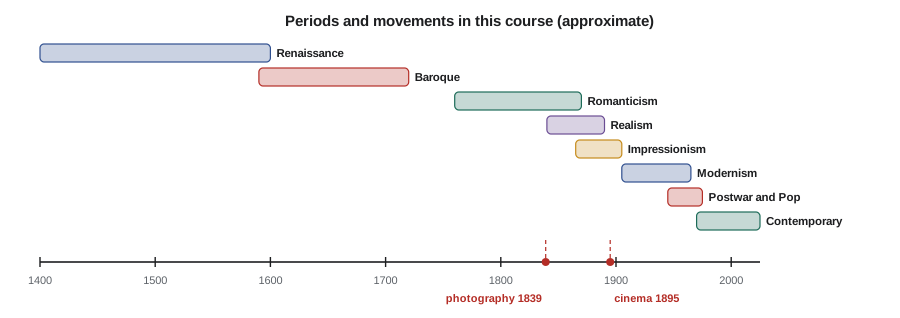
Art history organizes images into periods, movements and styles. A period is a span of time, such as the Renaissance or the twentieth century. A movement is a group of artists who share aims, often with a name, a manifesto or exhibitions, such as Impressionism or Surrealism. A style is a recognizable set of formal habits, which may belong to an individual, a workshop, a movement or a whole culture.
These labels are useful but rough. They were often invented later by critics and historians, sometimes as insults: "Impressionism" began as a mocking term from a hostile review in 1874, and "Gothic" was coined by later writers who considered medieval architecture barbaric. Artists rarely fit neatly into one box, and movements overlap. Treat the labels as handles for discussion, not as walls.
Whose history? Expanding the canon
For a long time, art history courses in Europe and North America focused almost entirely on a narrow canon of European and American male artists. That canon still matters, because so many image-making conventions came from it, but it is not the whole story. Women artists were often excluded from training and exhibitions, and their work was underrecorded. Artists from Africa, Asia, the Americas and Indigenous nations developed sophisticated visual traditions that European historians long ignored or classified as craft rather than art.
This course follows the main European and North American lineage that shaped photography and cinema, while regularly widening the view: Japanese prints that transformed European composition, African sculpture that influenced modernism, women artists from the Renaissance to the present, and Indigenous artists whose work both draws on long traditions and responds to colonial histories.
In Canada, expanding the canon means paying particular attention to First Nations, Inuit and Métis art, from Northwest Coast formline design to Inuit printmaking and the Woodland School, and to the institutions that now collect and present it, such as the National Gallery of Canada in Ottawa, the Art Gallery of Ontario in Toronto and the Montreal Museum of Fine Arts. Lesson 11 explores these traditions and the protocols that govern respectful engagement with them.
Seeing art today
You will meet most historical art through reproductions: books, websites, phone screens and slide projections. Reproductions are invaluable but misleading in predictable ways. They flatten texture, change colour, standardize scale and remove the work from its setting. A painting several metres wide and a postcard-sized miniature look the same size on a laptop. An altarpiece designed to be seen by candlelight above a church altar looks very different under even gallery lighting or on a backlit screen.
Image makers should therefore treat reproductions as notes, not as the work itself. Whenever possible, visit galleries and look at originals. Pay attention to the scale, the surface, the way light falls on the paint, and the distance at which the work seems designed to be seen. These are exactly the kinds of observations that transfer to your own practice, because you too must decide the scale, surface and viewing conditions of your images.
Many Canadian public galleries offer free or reduced admission on certain days or for students, and several hold major collections online. The National Gallery of Canada and the Art Gallery of Ontario both publish large digital collections with high-resolution images of works in the public domain.
Copyright, public domain and borrowing
Because image makers borrow from art history, you need a basic understanding of copyright. Copyright protects original works for a limited time, after which they enter the public domain and can be freely copied. Works by old masters are long out of copyright, although a museum's photograph of a painting can raise separate questions in some jurisdictions. Modern and contemporary works are usually still protected. Being inspired by a style, technique or general convention is generally lawful; copying a protected work's specific expression is not, unless an exception applies.
In Canada, copyright generally lasts for the life of the author plus 70 years, after the term was extended in 2022; works whose protection had already expired before the extension did not regain it. Fair dealing permits some uses for purposes such as research, education, criticism, review and parody, subject to fairness factors developed by the courts.
In this course, all figures are original diagrams. Artworks are described in words, and you should look them up in museum collections or reputable books. When you make your own work in dialogue with art history, borrow ideas, conventions and techniques freely, but create your own images.
Writing about images
Throughout this course you will write short analyses. Good visual analysis has four ingredients. First, a clear claim about what the image does, not just what it shows. Second, specific visual evidence: placement, scale, colour, value, line and texture. Third, relevant context, used to support the reading rather than replace it. Fourth, precise vocabulary. Compare two sentences about the same painting: "The painting is very dramatic and makes you feel things" says almost nothing; "A single beam of light falls diagonally across the dark room, picking out the faces of the men at the table and leaving the rest in deep shadow, so that the moment of recognition feels sudden and revelatory" makes a checkable claim tied to evidence.
Worked problem
From description to analysis
A described still life shows a single lemon, half peeled, on a dark table edge, with the peel spiralling down over the edge into darkness. A bright window light comes from the upper left. Write two sentences of analysis.
Show solution
- Describe the key formal facts: a strong light from upper left, a dark background, a bright lemon placed at the table edge, and a spiralling peel leading downward.
- Track the eye: it goes first to the bright lemon, then follows the peel's curve down toward the shadow.
- Ask what the arrangement does: the precarious position at the edge and the peel falling into darkness create tension and suggest decay or the passing of time, a common theme in Dutch still lifes.
- Combine claim and evidence in clear sentences.
Answer: The strong light from the upper left isolates the bright lemon against the dark background, making it the clear focus. The peel spiralling over the table edge into shadow leads the eye downward and, together with the fruit's precarious position, suggests the fragility and passing of pleasure that Dutch still lifes often explored.
How this course is organized
The lessons move roughly in historical order, but each focuses on lessons for image makers. Lesson 2 covers classical and medieval foundations of proportion and symbolism. Lessons 3 and 4 explore the Renaissance invention of perspective and the Baroque mastery of light. Lesson 5 turns to Romantic and Realist landscape, and Lesson 6 to Impressionism and colour. Lesson 7 examines photography's invention and its dialogue with painting. Lessons 8 and 9 trace modernism, the Bauhaus, Surrealism and the avant-garde, including early experimental film. Lesson 10 covers postwar art and the mass-media image, and Lesson 11 contemporary, Indigenous and digital art. Lesson 12 is a capstone in which you write a visual lineage essay connecting a historical work to an image you make.
Common mistakes
MistakeTreating art history as a list of names and dates to memorize
InsteadTreat it as a toolkit of visual solutions you can study, adapt or reject in your own work
MistakeInterpreting an image before describing it
InsteadDescribe what is actually there first, then build interpretation on that evidence
MistakeJudging a work only from a small reproduction on a screen
InsteadRemember that reproductions flatten texture, scale and colour, and see originals when possible
MistakeTreating movement labels as rigid categories
InsteadUse period and movement labels as rough handles, knowing many were invented later and artists cross boundaries
MistakeAssuming that being inspired by an artwork lets you copy it exactly
InsteadBorrow ideas, conventions and techniques freely but create your own images, and check copyright for modern works
Summary and key terms
- Art history gives image makers a toolkit of solved visual problems, a shared language of references and a defence against cliché.
- Slow looking means describing what is there, tracking the eye, asking how the work was made and only then interpreting.
- Formal elements such as line, shape, value, colour, space, texture, composition and scale provide a checkable vocabulary for analysis.
- Meaning works at several levels: subject, conventional symbols and themes, and deeper cultural meaning shaped by context.
- Visual lineage traces how conventions pass from painting to photography and film, carrying associations such as power, awe or intimacy.
- The traditional canon is narrow; this course widens it with women artists, global traditions and Indigenous art.
- Reproductions are notes rather than the work itself, and copyright law shapes how image makers may borrow from protected works.
- Formal analysis
- Close description and interpretation of an image's visual elements such as line, value, colour and composition
- Iconography
- The study of conventional subjects and symbols in images, such as a skull representing mortality
- Context
- The historical, social, technical and physical circumstances in which a work was made and seen
- Visual lineage
- The chain of borrowing and transformation that connects later images to earlier ones
- Movement
- A group of artists sharing aims, often with a name, manifesto or exhibitions
- Style
- A recognizable set of formal habits belonging to an artist, group, period or culture
- Canon
- The set of works and artists traditionally treated as most important in a field
- Public domain
- The status of works no longer protected by copyright, which anyone may copy
- Value
- The lightness or darkness of a tone, independent of its hue
- Slow looking
- Deliberate, extended observation of an image before forming judgments
Practice problems
Work each problem on paper first, then reveal the answer to check.
Name three practical benefits of art history for image makers.
Show answer
More visual options, a shared language of references, and protection against cliché and shallow imitation.
List the four steps of the slow-looking routine in this lesson.
Show answer
Describe what is there, track where the eye goes, ask how the work was made, then interpret.
Is "the painting is beautiful" a formal observation? Explain.
Show answer
No. It is a judgment; a formal observation names checkable features such as a narrow value range or a diagonal composition.
What does iconography study?
Show answer
Conventional subjects and symbols, such as a lily meaning purity in European religious art.
Give one way a reproduction can mislead a viewer.
Show answer
It can change the apparent scale, flatten texture or alter colour and lighting conditions.
What is the difference between a period and a movement?
Show answer
A period is a span of time; a movement is a group of artists sharing aims, often with a name or manifesto.
Why should you treat movement labels cautiously?
Show answer
Many were invented later by critics, sometimes as insults, and artists rarely fit neatly into one category.
Name one tradition this course adds to the traditional canon.
Show answer
Examples include Japanese prints, African sculpture, women artists or Indigenous art.
In one sentence, explain what visual lineage means.
Show answer
It is the way later images borrow and transform conventions from earlier images, carrying their associations forward.
What makes a strong sentence of visual analysis?
Show answer
A clear claim about what the image does, supported by specific visual evidence and precise vocabulary.
Lesson quiz · 5 questions
Score 60% or more to complete this lesson.
Create a free account to save your progress, take quizzes and earn a certificate.