
TRD-107 · Lesson 9 of 12 · 19 min
Union and non-union paths
In most trades you can build a career either with a unionized employer or with a non-union one, and many tradespeople work in both at different times. The two paths differ in how you are hired, how you are trained, how wages and benefits are set and how work is found when a job ends. Neither is right for everyone. This lesson explains how each path works, what the trade-offs are and how to compare offers fairly, without the slogans that often surround the subject.
How unionized construction works
In unionized construction, workers in a trade belong to a local of a building trades union, such as the United Association for plumbers and pipefitters, the International Brotherhood of Electrical Workers for electricians, or the carpenters', sheet metal workers', ironworkers' or labourers' unions. The union negotiates a collective agreement with contractors that sets wages, benefits, pension contributions, overtime, apprentice percentages and working conditions. In Ontario's industrial, commercial and institutional sector, many trades bargain province-wide agreements on a common schedule; residential and other sectors have their own arrangements.
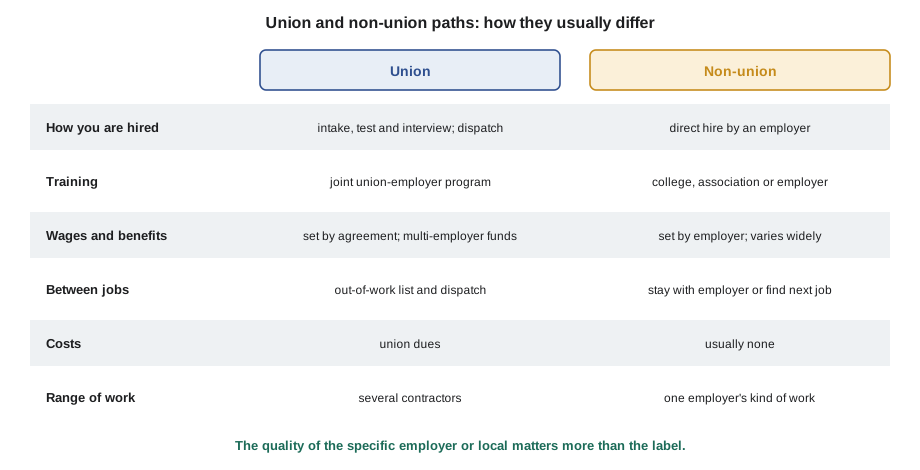
Union apprenticeships are usually run jointly by the union and the contractors through a training centre. Apprentices apply during an intake period, are selected through tests and interviews, and are then placed with contractors who have signed the agreement. Over the course of the apprenticeship, an apprentice may work for several contractors, which can give a wide range of experience. Classroom training is delivered at the union's training centre, often funded by contributions from every hour worked under the agreement.
When a project ends, union members return to the union's out-of-work list, sometimes called the hiring hall, and are dispatched to the next contractor that requests workers, usually in order. Benefits and pensions are typically held in multi-employer funds, so they continue as members move between contractors. Members pay union dues, often a monthly amount plus a share of hourly wages.
How non-union construction works
Non-union employers, sometimes called open shop or merit shop contractors, hire workers directly and set wages and benefits themselves, within the limits of employment standards and any other laws. Some non-union workers belong to unions that operate differently from the building trades, such as the Christian Labour Association of Canada, which represents workers at many contractors in Ontario and western Canada. Others work with no union at all. Non-union contractors do a large share of residential construction and much commercial and industrial work as well.
Non-union apprentices are usually hired directly by an employer, who registers them as apprentices and sends them to college for their in-school levels. Some contractor associations help their members find and train apprentices. When work ends, a non-union worker looks for the next job themselves, often through their network, unless the employer has more work for them.
Weighing the trade-offs
Each path has strengths that matter more to some people than others. The common arguments on each side are worth understanding, along with their limits.
People who prefer the union path often point to wages and benefits set by agreement and the same for every member at a level, strong pension and health plans that move with you between contractors, structured apprenticeship with a wide range of work, safety training and representation if there is a dispute with an employer, and a hiring hall that helps find work when a job ends. Critics point to dues, to dispatch rules that can mean waiting on the list in slow times, to less individual negotiation of pay and to areas where few union contractors operate.
People who prefer the non-union path often point to the chance to stay with one employer long-term and grow with the company, the flexibility to negotiate pay based on individual performance, the absence of dues, and the large share of work, especially residential and service, done by non-union contractors. Critics point to wages and benefits that vary widely between employers, pensions that may be weaker or absent, training quality that depends heavily on the employer and the need to find your own next job when work ends.
In practice, the quality of the specific employer or local matters more than the label. There are excellent and poor union contractors and excellent and poor non-union ones. Ask the same questions of each: What will I earn now and later, including benefits? How good is the training, and what range of work will I get? How steady is the work, and what happens when it slows down? How seriously does the company take safety?
Comparing a total package
Comparing offers by hourly wage alone can mislead you. Union packages often include large contributions to benefit and pension funds that do not appear in the hourly rate; non-union offers may include benefits that do not appear either, such as a company truck or paid travel time. The program below compares two invented offers by total yearly value, including benefits, pension and dues, and by how many hours a year you are likely to work.
# compare two invented job offers by total yearly value
offers = {
    "Offer A": {"wage": 30.00, "benefits_per_h": 4.50, "pension_per_h": 5.00, "dues_per_year": 1200,
                "expected_hours": 1700},
    "Offer B": {"wage": 32.00, "benefits_per_h": 2.00, "pension_per_h": 1.00, "dues_per_year": 0,
                "expected_hours": 1900},
}
for name, o in offers.items():
    pay = o["wage"] * o["expected_hours"]
    extras = (o["benefits_per_h"] + o["pension_per_h"]) * o["expected_hours"]
    net = pay + extras - o["dues_per_year"]
    print(f"{name}: pay {pay:9,.0f} + benefits and pension {extras:8,.0f} - dues {o['dues_per_year']:5,} = {net:9,.0f}")
print(f" per hour worked: {net / o['expected_hours']:.2f}")Offer A: pay 51,000 + benefits and pension 16,150 - dues 1,200 = 65,950
per hour worked: 38.79
Offer B: pay 60,800 + benefits and pension 5,700 - dues 0 = 66,500
per hour worked: 35.00In this example, the offer with the lower hourly wage is worth more per hour once benefits and pension are included, but the other offer comes out ahead over a year because it provides more hours of work. Small changes in the assumptions, such as a few hundred more or fewer hours, can flip the result, which is why the steadiness of work matters as much as the rate. Use real numbers from the offers you have, and ask each employer or local how many hours their workers usually get in a year.
Moving between the paths
Many tradespeople move between union and non-union work over a career. Certification belongs to the worker, not the employer or the union, so a certified journeyperson can work in either. An apprentice moving partway through can usually transfer their registered hours and in-school levels, though a union may assess where to place them on its wage schedule. Some workers join a union when a non-union employer is organized; others leave union work for a non-union employer or to start their own business.
The Kingsway Tower crews
Northbridge Mechanical is a non-union contractor, and Maya was hired directly by Dave after her interview. Brightline Electric, Sam's employer, has a collective agreement with the electricians' local; Sam got his apprenticeship through the local's intake, after an aptitude test and an interview, and has already worked for two contractors. During lunch one day, the two compared notes. Sam's hourly rate was a little lower than Maya's, but his benefit and pension contributions were much larger, and his classroom training was at the union's training centre. Maya liked that she had stayed with one crew and one mentor. Neither tried to convince the other; they agreed that the right choice depended on the employer and on what each of them wanted.
| Question to ask | Why it matters |
|---|---|
| What is the total package per hour, including benefits and pension? | Hourly rates alone hide large differences |
| How many hours do workers here usually get in a year? | Steady work can matter more than the rate |
| How is training delivered, and what range of work will I get? | Training quality decides how good a tradesperson you become |
| What happens when this project ends? | Dispatch, recall or finding your own job |
| What are the dues or other costs? | They reduce take-home value |
| What is the safety record and culture? | It affects your health and your career |
Unions, safety and training funds
One area where the two paths are often compared is safety and training. Building trades unions and their contractors typically pay a set amount from every hour worked into training funds, which pay for training centres, instructors, equipment and upgrading courses for journeypersons as well as apprentices. Members can often take courses in new technology, specialty certifications or supervision at little or no cost. Many non-union contractor associations run their own training programs and charge member companies or apprentices, and some large non-union employers invest heavily in in-house training. In both cases, ask what training is available after you are certified, not just during the apprenticeship.
Safety performance depends far more on the specific employer and site than on the label. Some of the best safety programs in the industry are run by union contractors, and some by non-union ones. Look at how a company talks about safety, whether supervisors stop unsafe work, how incidents are investigated and whether workers feel free to raise concerns.
Representation and disputes
A union member who has a dispute with an employer, over pay, discipline, layoff order or working conditions, can usually take it to a union representative and, if needed, through the grievance procedure in the collective agreement, which can end in binding arbitration. A non-union worker deals with the employer directly and, if the dispute involves a legal right, can go to the government agency that enforces employment standards, health and safety or human rights law. Both paths have protections; they work differently.
Thinking long term
The choice you make as an apprentice is not permanent, but it shapes the first years of your career. Think about where you want to be in ten or twenty years. If you value a portable pension and benefits, a structured route through many contractors and a hiring hall, the union path may suit you. If you want to grow with one company, perhaps into a leadership role or eventually to run your own business, a good non-union employer may be the better fit, though many union members also become foremen, superintendents and contractors. Talk to people on both sides who are ten or twenty years further along, and listen to what they wish they had known.
Whichever path you choose, treat co-workers on the other side with respect. On many projects, union and non-union crews work on the same site, and the general contractor, the schedule and the safety rules are the same for everyone. Arguments about which path is better rarely change anyone's mind and can make a site unpleasant. The professional approach is to do good work, keep your opinions for the lunchroom with friends and judge people by how they work, not by which card is in their wallet.
Common mistakes
MistakeChoosing on the hourly rate alone.
InsteadCompare the total package and the hours of work you can expect.
MistakeAssuming all union or all non-union employers are alike.
InsteadJudge the specific employer or local on training, safety, pay and steadiness.
MistakeBelieving you can never switch paths.
InsteadCertification belongs to you; many tradespeople work on both sides over a career.
MistakeIgnoring pensions early in your career.
InsteadRetirement contributions compound for decades; include them in your comparison.
MistakeArguing about it on site.
InsteadRespect co-workers' choices; crews from both sides often share a site.
Summary and key terms
- Union construction workers belong to a building trades local that bargains wages, benefits and conditions with contractors.
- Union apprenticeships are run jointly through training centres, with dispatch to contractors and multi-employer benefit funds.
- Non-union workers are hired directly by employers who set pay and benefits within the law; training is through employers, colleges or associations.
- Each path has real strengths and weaknesses; the specific employer or local matters more than the label.
- Compare offers by total yearly value, including benefits, pension, dues and expected hours.
- Certification belongs to the worker, so tradespeople can move between paths over a career.
- Building trades union
- A union representing workers in a construction trade, organized in locals.
- Collective agreement
- A contract between a union and employers setting wages, benefits and conditions.
- Hiring hall
- A union's out-of-work list and dispatch system for sending members to contractors.
- Open shop
- A non-union contractor, also called merit shop.
- Multi-employer fund
- A benefit or pension fund that receives contributions from many employers, so coverage moves with the worker.
Practice problems
Work each problem on paper first, then reveal the answer to check.
How are union apprentices usually selected?
Show answer
Through an intake with tests and interviews, then placement with signatory contractors.
What is a hiring hall?
Show answer
The union's out-of-work list and system for dispatching members to contractors.
Give two common arguments for each path.
Show answer
Union: set wages and strong portable benefits, structured training with a wide range of work, dispatch between jobs. Non-union: long-term growth with one employer, individual pay negotiation, no dues, large share of work.
In the comparison program, why does the result change with expected hours?
Show answer
Yearly value depends on both the rate per hour and how many hours you actually work.
Can a certified journeyperson work on both sides?
Show answer
Yes; certification belongs to the worker.
What matters more than the union or non-union label?
Show answer
The quality of the specific employer or local: pay, training, steadiness and safety.
Lesson quiz · 5 questions
Score 60% or more to complete this lesson.
Create a free account to save your progress, take quizzes and earn a certificate.