
TRD-107 · Lesson 1 of 12 · 19 min
Choosing a trade and reading the job market
Maya Chen did not grow up planning to be a plumber. In her last year of high school she was good at math, liked building things and hated the idea of four more years in a classroom. A cousin who worked as a service plumber took her on a ride-along for a day, and by lunchtime she had watched him find a hidden leak with a moisture meter, replace a failed water heater and explain both jobs to the homeowners in plain words. Two years later she is a first-year apprentice with Northbridge Mechanical on Kingsway Tower, a 12-storey residential building in Hamilton, working beside her journeyperson mentor, Luis Ferreira.
This course follows Maya and the rest of the Kingsway Tower crew through the business side of a trades career: how apprenticeship works, how you get registered, how hours and skills are recorded, how school and exams fit in, how certification and licensing work, how to pay for it all, where a trade can lead and what it takes to run your own business. This first lesson starts at the beginning, with choosing a trade and learning to read the job market before you commit years to it.
What a trade is
A trade is an occupation learned mainly by doing the work under the supervision of a qualified worker, backed by classroom training and, in many trades, a final certification exam. The qualified worker is usually called a journeyperson, a word that comes from the French journée: historically, a person qualified to be paid by the day. Trades sit alongside, not below, other routes into skilled work. A certified electrician, steamfitter or millwright needs as much specialized knowledge as many university graduates, and often earns as much or more.
Trades are usually grouped into a few families. Construction trades build and renovate buildings and infrastructure: carpenters, electricians, plumbers, sheet metal workers, ironworkers, bricklayers, painters and many more. Industrial trades install and maintain equipment in plants, mines and mills: millwrights, industrial electricians, instrument technicians and machinists. Motive power trades keep vehicles and mobile equipment running: automotive service technicians, heavy equipment technicians and truck and transport mechanics. Service trades work with the public in homes and businesses: hairstylists, cooks, and the service side of plumbing, refrigeration and electrical work.
In Canada, each province and territory decides which trades it recognizes and which of those are compulsory. In a compulsory trade, you must be a registered apprentice or a certified journeyperson to do the work legally; Ontario has 23 compulsory trades, including plumber and electrician. In a voluntary trade, certification shows your skill but is not required by law. The Red Seal Program, covered in lesson 8, sets a common national standard for more than 50 trades.
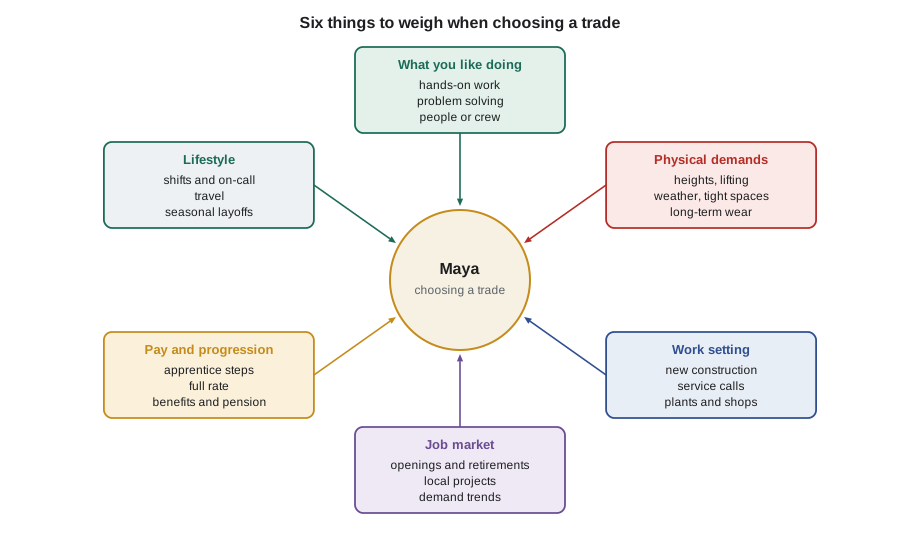
Matching the trade to you
The most common reason apprentices leave a trade early is not that they cannot learn the work but that the work does not suit them. Before you choose, be honest about a few things. Do you like working with your hands for most of the day, or do you prefer a mix of hands-on work and paperwork? Are you comfortable at heights, in crawl spaces, in the cold and in the heat? Do you like solving puzzles, such as tracing a fault in a circuit or a leak in a wall, or do you prefer building something new from a drawing? Do you enjoy talking to customers, or would you rather deal only with your crew?
Different trades, and different parts of the same trade, answer those questions differently. A new-construction plumber like Maya spends her days on one big site with the same crew, working from drawings, often outdoors in the early stages. A service plumber like Grace Lin, who works out of Northbridge's service department, drives to a different home or business several times a day, diagnoses problems alone and talks to customers constantly. Both are plumbers; the days feel completely different. Sam Torres, an electrical apprentice with Brightline Electric on the same tower, chose electrical work partly because he liked the logic of circuits and partly because the work is mostly indoors once the building is closed in.
Physical demands deserve a hard look. Most construction trades involve lifting, carrying, kneeling, climbing ladders and working in awkward positions, often for hours. Good technique, proper tools and lifting aids make a big difference, and many trades are becoming less physically punishing as equipment improves, but the work is still physical. If you have a health condition, talk to people in the trade and to a doctor about how it might affect you. Many tradespeople with injuries or conditions find a niche, such as estimating, inspection or service, where the demands are different.
Trying a trade before committing
The cheapest way to find out whether you like a trade is to try it. Good ways to do that include:
- Job shadowing or ride-alongs: spending a day with someone in the trade, as Maya did with her cousin.
High school programs: technical courses and co-op placements, and in Ontario the Ontario Youth Apprenticeship Program (OYAP) and Specialist High Skills Major programs, let students try trades and sometimes start counting hours before graduation.
Pre-apprenticeship programs: short college or community programs, often free or low cost, that teach basic trade skills and safety and help connect graduates with employers.
- Entry-level work as a helper or labourer: many apprentices start as a general labourer on a site, show they are reliable and get offered an apprenticeship.
- Talking to people: ask journeypersons and apprentices what they like and dislike, what a typical week looks like and what they wish they had known before starting.
Questions worth asking anyone in the trade: What does a normal day look like? How much of the year are you working, and how much are you laid off or between jobs? How physically hard is it after ten years? What do new apprentices usually get wrong? Where do people in this trade end up after twenty years?
Reading the job market
Choosing a trade is a career decision, and careers depend on demand. A trade that is booming in one region can be quiet in another, and demand changes as projects start and finish. Reading the job market means looking at a few kinds of information and putting them together.
National and provincial forecasts. BuildForce Canada publishes construction labour forecasts by province and trade, and the federal Job Bank gives outlooks and wage ranges for each occupation by region. Both point to the same long-term pattern: a large share of today's certified tradespeople are approaching retirement, and replacing them will take years of steady recruiting. Federal programs launched in 2026 under the name Team Canada Strong aim to recruit and train tens of thousands of new Red Seal tradespeople by the early 2030s.
Local demand. National numbers tell you little about your town. Look at what is being built nearby: new housing, hospitals, transit lines, plants, data centres. Check local job postings and apprenticeship openings, and ask training centres and colleges how quickly their graduates find work. Talk to contractors about whether they are hiring.
Pay. Look at starting apprentice wages and journeyperson wages in your area, but also at how steady the work is. A trade with high hourly pay but long gaps between jobs can earn less over a year than a trade with lower pay and steady work. Ask about overtime, shift premiums, benefits and pensions, not just the hourly rate.
Trends. Some trades are growing because of technology and policy changes: electricians and refrigeration mechanics because of heat pumps, electric vehicle chargers and building electrification; instrument and control technicians because of automation. Others depend heavily on the housing market or on a few large projects. No forecast is certain, but a trade with steady demand from several sources is a safer bet than one tied to a single boom.
A rough comparison of paths
Apprenticeship is an earn-while-you-learn path. Instead of paying tuition for several years before working, an apprentice is paid from the first day, usually a percentage of the journeyperson rate that rises as they progress. Classroom training costs money and takes time away from work, but it is short compared with a full-time diploma or degree, and grants, loans and income support can cover much of it. The program below compares cumulative earnings over ten years for two invented paths: a four-year apprenticeship, and two years of full-time college followed by a job at a steady salary. The numbers are illustrative, not real wages for any trade or place, but the shape is typical.
# cumulative earnings over 10 years for two invented paths (illustrative numbers)
JOURNEY_RATE = 40.0          # per hour, journeyperson rate
HOURS = 1800                 # paid hours per year after time in school
apprentice_pct = [0.50, 0.60, 0.70, 0.80]   # share of the journeyperson rate, years 1-4
school_weeks = 8             # weeks of classroom training per year in years 1-4 (unpaid)

def apprentice(year):
    if year <= 4:
        work_hours = HOURS - school_weeks * 40
        return apprentice_pct[year - 1] * JOURNEY_RATE * work_hours
    return JOURNEY_RATE * HOURS

def college(year):
    if year <= 2:
        return -9000          # tuition and books, part-time earnings ignored
    return 30.0 * HOURS       # salaried job at an equivalent of 30 per hour

a = c = 0
for y in range(1, 11):
    a += apprentice(y); c += college(y)
print(f"year {y:2d}: apprenticeship {a:9,.0f} college path {c:9,.0f}")year 1: apprenticeship 29,600 college path -9,000 year 2: apprenticeship 65,120 college path -18,000 year 3: apprenticeship 106,560 college path 36,000 year 4: apprenticeship 153,920 college path 90,000 year 5: apprenticeship 225,920 college path 144,000 year 6: apprenticeship 297,920 college path 198,000 year 7: apprenticeship 369,920 college path 252,000 year 8: apprenticeship 441,920 college path 306,000 year 9: apprenticeship 513,920 college path 360,000 year 10: apprenticeship 585,920 college path 414,000
The point is not that one path always wins. It is that an apprenticeship's earnings start immediately and grow, so by the time a college graduate starts working, an apprentice has often earned a substantial amount and carries little debt. The comparison changes with the trade, the region and the person: some college programs lead to high salaries, and some trades have long periods of unemployment. Run your own numbers with real local wages before you decide.
Maya's decision
Maya used a simple method. She listed three trades that interested her (plumber, electrician and refrigeration mechanic), spent a day with someone in each, and then scored each one out of five on the factors in the figure above: how much she liked the work, how she felt about the physical side, the work setting, local demand, pay and progression, and lifestyle. Plumbing and electrical scored almost the same. She chose plumbing because Northbridge was hiring first-year apprentices and her cousin could introduce her, which was a practical tiebreaker rather than a grand plan. She also kept her scoring sheet, because it reminded her why she chose the trade on the hard days of her first winter.
| Factor | Questions to ask | Where to find answers |
|---|---|---|
| The work itself | What do you do all day? What do you like and dislike? | Job shadowing, ride-alongs, talking to tradespeople |
| Physical demands | Heights, lifting, weather, confined spaces? | Site visits, occupational descriptions, people in the trade |
| Work setting | New construction, service, industrial, shop? | Employers, training centres |
| Job market | Openings, retirements, local projects? | BuildForce Canada, Job Bank, local postings |
| Pay and progression | Apprentice wage schedule, journeyperson rate, steadiness of work? | Collective agreements, employers, wage surveys |
| Lifestyle | Shifts, travel, seasonal layoffs, on-call work? | People in the trade, employers |
Common mistakes
MistakeChoosing a trade only because the hourly rate is high.
InsteadLook at how steady the work is, the physical demands and whether you will enjoy it for decades.
MistakeRelying on a national forecast alone.
InsteadCheck local projects, postings and how quickly local graduates find work.
MistakeCommitting without trying the work.
InsteadShadow someone, take a pre-apprenticeship program or start as a helper first.
MistakeAssuming all jobs in a trade feel the same.
InsteadNew construction, service and industrial work can be very different days in the same trade.
MistakeIgnoring the physical side.
InsteadAsk experienced tradespeople how their bodies feel after ten or twenty years, and learn good technique early.
Summary and key terms
- A trade is learned mainly on the job under a journeyperson, backed by classroom training and often a certification exam.
- Trades fall into families such as construction, industrial, motive power and service, and the same trade can offer very different kinds of days.
- Provinces and territories decide which trades are compulsory; in a compulsory trade you must be an apprentice or certified to do the work.
- Try a trade through shadowing, school programs, pre-apprenticeship or helper work before committing.
- Read the job market at the national, regional and local level, and look at steadiness of work as well as pay.
- Apprenticeship pays from the first day, so cumulative earnings start early even though apprentice wages start below the journeyperson rate.
- Trade
- An occupation learned mainly on the job under a qualified worker, usually with classroom training and a certification exam.
- Journeyperson
- A fully qualified, certified worker in a trade.
- Apprentice
- A person learning a trade on the job under a journeyperson, usually under a registered agreement.
- Compulsory trade
- A trade in which you must be a registered apprentice or certified journeyperson to do the work legally.
- Pre-apprenticeship
- A short program that teaches basic trade skills and safety to prepare people for an apprenticeship.
- Labour market information
- Data and forecasts about jobs, wages and demand for workers in an occupation and region.
Practice problems
Work each problem on paper first, then reveal the answer to check.
Name four families of trades and give one example of each.
Show answer
Construction (plumber), industrial (millwright), motive power (heavy equipment technician), service (cook or hairstylist).
Give three ways to try a trade before committing.
Show answer
Any three of: job shadowing or ride-alongs, high school programs, pre-apprenticeship, entry-level helper work, talking to people in the trade.
Why can a trade with a high hourly rate earn less over a year than one with a lower rate?
Show answer
Long gaps between jobs or seasonal layoffs reduce the paid hours.
In the program above, why are apprenticeship earnings lower in years 1 to 4?
Show answer
Apprentices earn a percentage of the journeyperson rate and lose paid weeks to classroom training.
What local information should you check besides national forecasts?
Show answer
Nearby projects, job postings, apprenticeship openings and how quickly local graduates find work.
How did Maya break the tie between plumbing and electrical?
Show answer
A practical factor: Northbridge was hiring first-year plumbing apprentices and she had a contact.
Lesson quiz · 5 questions
Score 60% or more to complete this lesson.
Create a free account to save your progress, take quizzes and earn a certificate.