
TRD-105 · Lesson 9 of 12 · 22 min
Hoists, chain falls and lever hoists
Most of the lifting a mechanical or electrical crew does by hand never involves a crane. Pumps are lifted onto pads, valves and fittings are held in place while they are bolted, pipe is pulled into alignment, motors are lowered into position and heavy fixtures are raised to the ceiling, all with small hoists that one or two people operate. These hoists are compact and simple, which is exactly why they are misused: hung from whatever is handy, pulled sideways, extended with a pipe for more leverage or loaded beyond their rating because the load did not look that heavy.
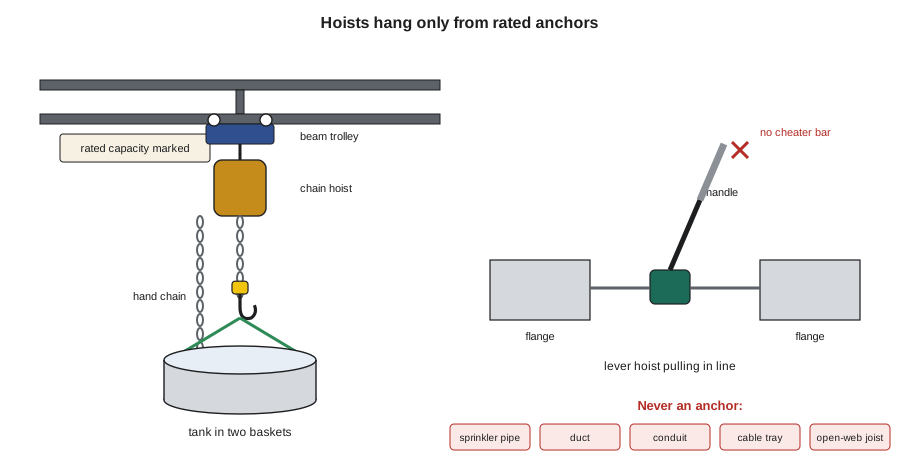
Maya's crew used a chain hoist on a beam trolley to move the domestic hot water tank into the P1 mechanical room, and a lever hoist to pull the tank's inlet pipe into alignment afterward. This lesson covers both, plus electric hoists, beam clamps, trolleys and gantries, and the most important question of all: what the hoist is hanging from.
Types of hoists
Manual chain hoists (chain falls)
A manual chain hoist, often called a chain fall or chain block, lifts a load by a hand chain that the operator pulls. Gears inside multiply the operator's pull so that one person can lift hundreds or thousands of kilograms. The load chain runs through the hoist to a hook at the bottom, and a brake holds the load as soon as the operator stops pulling. The top hook or a lug hangs the hoist from a rated support. Chain hoists are designed for vertical lifting and are rated by capacity, for example a half tonne, one tonne or two tonnes, or in the United States a half ton, one ton or two tons.
A properly sized chain hoist at its rated load should need about the pull of one person on the hand chain. If it takes two people heaving on the chain, the hoist is overloaded, binding or damaged. The rule on every site is that one person pulls the hand chain; never add a second person or a bar to get more force.
Lever hoists (come-alongs)
A lever hoist uses a ratcheting handle instead of a hand chain. Each stroke of the handle draws in the load chain or wire rope a short distance. Lever hoists can work in any direction, horizontally or vertically, which makes them useful for pulling, tensioning and positioning, for example drawing two flanges together or tensioning a tie. The term come-along is used for lever hoists generally and also for the simpler cable-and-ratchet pullers sold for general use. Those cheaper pullers are often not rated for overhead lifting at all, so check the marking before using one to lift anything.
The handle length on a lever hoist is designed so that a person's normal pull produces the rated load. A pipe slipped over the handle as a cheater bar can multiply the force far beyond the rating and break the hoist or the anchor. Some lever hoists have an overload device that slips if the force gets too high; never defeat it.
Electric and air hoists
Electric chain hoists and air-powered hoists lift faster and higher with less effort, and are used for repetitive or heavy lifts, often on a trolley running along a beam or on a temporary gantry. They have pendant controls with up, down and travel buttons, upper and lower limit switches that stop the hook before it hits the hoist or runs out of chain, and often an overload clutch. Operators must check the controls, the limit switches and the brake before each shift, keep the pendant cord clear of the load and never ride the load or use the limit switch as a routine stop.
Hoist standards
Hoists used in Canada are commonly built and maintained to CSA B167, which covers overhead travelling cranes and hoists, and to the matching ASME B30 standards: B30.16 for overhead hoists and B30.21 for lever hoists. Ontario's construction regulation requires hoisting devices to be used within their rated capacity, kept in good condition, inspected and operated by competent workers.
Each hoist is marked with its rated capacity. Many also have a serial number for inspection records. Like slings, hoists get a frequent inspection by the user before each shift of use and a periodic, documented inspection by a competent person. Before each use, check that the hooks and latches are sound and the hooks have not opened or twisted, that the load chain is not stretched, kinked, twisted, nicked or corroded, that the chain runs smoothly and is correctly reeved, that the brake holds a load, and that the capacity marking is legible.
Know your anchor
A hoist is only as strong as the point it hangs from. This is where hoisting accidents most often start, because a building under construction is full of things that look strong and are not designed to carry a concentrated hanging load.
Never hang a hoist from:
- Piping, sprinkler lines, conduit, ductwork, cable tray or their hangers. They are designed to carry their own weight, not a pump.
- Open-web steel joists or roof joist bridging, unless the structural engineer of record has approved the point and the load. Joists are designed for spread-out loads; a concentrated load at the wrong place can buckle a chord.
- Scaffold members, guardrails, stairs, ladders or temporary bracing.
- Concrete inserts, anchors or embedded plates whose rating you do not know.
Approved anchor points include permanent lifting beams and rails with a marked capacity, beam clamps fitted to structural steel beams with an engineer's approval for the load, purpose-installed lifting eyes or inserts with a rated capacity, and temporary gantries or A-frames rated for the load. On Kingsway Tower, the P1 mechanical room has a permanent monorail beam over the pump area, marked with its rated capacity, installed for future equipment changes. Luis checked that marking before hanging the trolley.
Remember that the anchor carries more than the load. It carries the load, the hoist, the rigging and any extra force from jerking or from lifting off-centre. Some sites and engineers apply an extra factor for these effects. When in doubt, ask the supervisor to get the structural engineer's approval in writing.
Beam clamps and trolleys
A beam clamp grips the bottom flange of a steel beam and provides a hanging point for a hoist. A beam trolley does the same but rolls along the flange so the hoist and load can be moved horizontally. Both are rated, must be sized for the beam's flange width and thickness, and must be adjusted so the wheels or jaws sit squarely on the flange. A trolley that is set too wide can drop off the flange; one set too narrow can bind. End stops on the beam keep the trolley from running off the end.
Moving a load horizontally on a trolley is done by pushing the load gently or, on geared trolleys, by pulling the trolley's own hand chain. Never pull a hoist sideways to drag a load across the floor. A side pull puts bending loads on the hoist, the hook and the anchor that they are not designed for, and can make the load swing violently when it lifts off.
Safe hoisting practice
- Know the weight and confirm the hoist, the rigging and the anchor are all rated for it.
- Hang the hoist so the load chain is vertical and directly over the load's centre of gravity.
- Seat the load in the bowl of the hook, with the latch closed, never on the tip.
- Take up the slack slowly, stop, and check that the load is balanced and the rigging is seated before lifting further.
- Lift only as high as needed, keep the load low while moving it, and never leave a suspended load unattended.
- Keep your body out from under the load and out of pinch points; pull the hand chain from the side, not from directly underneath.
- Do not wrap the load chain around the load as a sling; use proper slings.
- Do not run the load chain against an edge or let it twist; a twisted chain jams and can break.
- Lower onto blocking so slings can be removed without trapping hands.
Handing a load from one hoist to another
Sometimes a load must travel further than one hoist can reach, for example from a doorway to a pad behind a pipe rack. Riggers then hand the load from one hoist to a second hoist hung from another anchor, a technique often called drifting. It needs care: as the load moves between the two hoists, the share of weight on each changes, the chains run at an angle and each hoist and anchor sees a side pull. Drifting should be planned by an experienced rigger, with each hoist and anchor rated for the full load, small movements, constant communication and a clear rule that only one person directs both hoists. Apprentices help with drifting only under close supervision.
Gantries and A-frames
Where no overhead anchor exists, a portable gantry (a beam on two legs, often on wheels) or an A-frame provides one. Gantries are rated as a whole system, including the beam, the legs and the trolley; they must be set on level, firm floor with wheel locks engaged and must not be moved while loaded unless the manufacturer allows it. Never build a gantry from scrap steel or lumber: it is a lifting device and must be designed and rated as one.
Worked example: checking a chain hoist setup
Worked problem
The hot water tank in the mechanical room
The tank weighs 680 kg. Luis plans to use a 1 t chain hoist (weight 15 kg) on a 1 t geared trolley (weight 20 kg) running on the monorail beam, which is marked 2,000 kg. The slings and shackle weigh 5 kg. The hoist's gear gives a mechanical advantage of about 40 with an efficiency of about 80 percent. Is the setup suitable, and roughly what pull does Maya need on the hand chain?
Show solution
- Load on the hoist hook: 680 + 5 = 685 kg, within the hoist's 1,000 kg rating (69 percent).
- Load on the trolley: 685 + 15 = 700 kg, within the trolley's 1,000 kg rating.
- Load on the beam: 700 + 20 = 720 kg, well within the beam's marked 2,000 kg.
- Hand chain pull ≈ 685 / (40 × 0.80) = 21 kg of force, a comfortable pull for one person.
Answer: Every component is within its rating, and one person can pull the hand chain. If the pull felt much heavier, Maya should stop: something would be wrong.
The program below runs the same check for any combination of load, hoist, trolley and anchor. It adds each component's weight to the load the next component carries, compares each with its rating, and estimates the hand chain pull.
# check each component of a chain hoist setup and estimate the hand-chain pull (kg)
load = 680; rigging = 5
stack = [  # (component, rated capacity kg, own weight kg), from the hook upward
    ("chain hoist", 1000, 15),
    ("geared trolley", 1000, 20),
    ("monorail beam (marked)", 2000, 0),
]
carried = load + rigging
for name, rating, own in stack:
    pct = 100 * carried / rating
    print(f"{name:24} carries {carried:6.0f} kg of {rating} kg ({pct:4.0f}%)  {'OK' if carried <= rating else 'OVERLOADED'}")
    carried += own                      # the next component also carries this one
advantage, efficiency = 40, 0.80
pull = (load + rigging) / (advantage * efficiency)
print(f"hand chain pull about {pull:.0f} kg-force")
print("one person can manage this" if pull <= 40 else "too heavy: stop and check the hoist")chain hoist carries 685 kg of 1000 kg ( 68%) OK geared trolley carries 700 kg of 1000 kg ( 70%) OK monorail beam (marked) carries 720 kg of 2000 kg ( 36%) OK hand chain pull about 21 kg-force one person can manage this
The mechanical advantage and efficiency figures are illustrative; each hoist's actual pull at rated load is in its manual. The point is the pattern: a correctly sized hoist needs a moderate one-person pull.
Common mistakes
MistakeHanging a chain hoist from a sprinkler pipe or duct.
InsteadUse only rated beams, clamps, inserts or gantries approved for the load.
MistakeHaving two people pull the hand chain to lift a heavy load.
InsteadOne person pulls; if it takes more, the hoist is overloaded or damaged. Stop.
MistakePutting a pipe over a lever hoist handle for more force.
InsteadNever use a cheater bar; use a larger hoist if needed.
MistakeDragging a load sideways with a vertical hoist.
InsteadMove the load on a trolley, or plan a proper drift with rated anchors.
MistakeUsing a general-purpose cable puller for overhead lifting.
InsteadCheck that the device is marked and rated for lifting before using it overhead.
MistakeWrapping the load chain around the load instead of using a sling.
InsteadUse proper slings and seat them in the hook's bowl.
Summary and key terms
- Chain hoists lift vertically by hand chain; lever hoists pull in any direction with a ratchet handle.
- One person's pull should lift the rated load; never add people or cheater bars.
- Inspect hooks, latches, load chain, brake and markings before each shift of use.
- A hoist is only as strong as its anchor: never hang from pipes, ducts, conduit, tray or unapproved joists.
- The anchor carries the load plus the hoist, trolley and rigging.
- Keep the load chain vertical over the centre of gravity; avoid side pulls, and plan drifting carefully.
- Chain hoist
- A hoist that lifts a load by gears driven by a hand chain; also called a chain fall or chain block.
- Lever hoist
- A ratcheting hoist operated by a handle, usable in any direction.
- Come-along
- A common name for a lever hoist or a simple ratcheting cable puller.
- Beam clamp
- A device that grips a beam flange to provide a hanging point.
- Beam trolley
- A wheeled device that runs along a beam flange to carry a hoist horizontally.
- Drifting
- Transferring a load from one hoist to another to move it horizontally.
- Gantry
- A portable frame with a beam supported on legs, used as a hoisting anchor.
- Limit switch
- A device on a powered hoist that stops the hook at the top or bottom of its travel.
Practice problems
Work each problem on paper first, then reveal the answer to check.
Why must only one person pull the hand chain of a chain hoist?
Show answer
If more force is needed, the hoist is overloaded or damaged; adding people hides the problem.
Name four things a hoist must never hang from.
Show answer
Any four of: piping, sprinkler lines, conduit, ductwork, cable tray, unapproved joists, scaffolds or guardrails, unrated inserts.
What does the anchor carry besides the load?
Show answer
The hoist, trolley, rigging and any extra force from jerking or off-centre lifting.
Why is a side pull with a hoist dangerous?
Show answer
It bends the hoist, hook and anchor and can make the load swing violently.
What should you check on a trolley before use?
Show answer
Rating, correct adjustment to the flange width, wheels square on the flange and end stops on the beam.
When can a general-purpose cable puller be used overhead?
Show answer
Only if it is marked and rated for lifting; many are not.
Lesson quiz · 5 questions
Score 60% or more to complete this lesson.
Create a free account to save your progress, take quizzes and earn a certificate.