
TRD-105 · Lesson 11 of 12 · 22 min
Mobile elevating work platforms
On the ground floor of Kingsway Tower, the retail space has a high ceiling full of sprinkler mains, ductwork, cable tray and drain piping. Nobody built a scaffold there. Instead, three scissor lifts move around the floor all day, carrying trades up to the ceiling and down again. On the outside of the building, a boom lift reaches over the canopy to the second-floor balconies for railing and sealant work. These machines are called mobile elevating work platforms, or MEWPs. They are fast, flexible and safe when used correctly, but they tip over, throw people out, crush workers against ceilings and contact power lines when they are not.
Maya got her MEWP training this month so she could install hangers and drain piping in the retail ceiling. Her trainer's first words were: "This is not a forklift and it is not a toy. It is a machine that puts you in the air, and it will do exactly what you tell it to, including the wrong thing."
Types of MEWPs
The CSA B354 standards, updated in 2017 in step with the American A92 standards, classify MEWPs by group and type so that training and safe use rules can be matched to the machine.
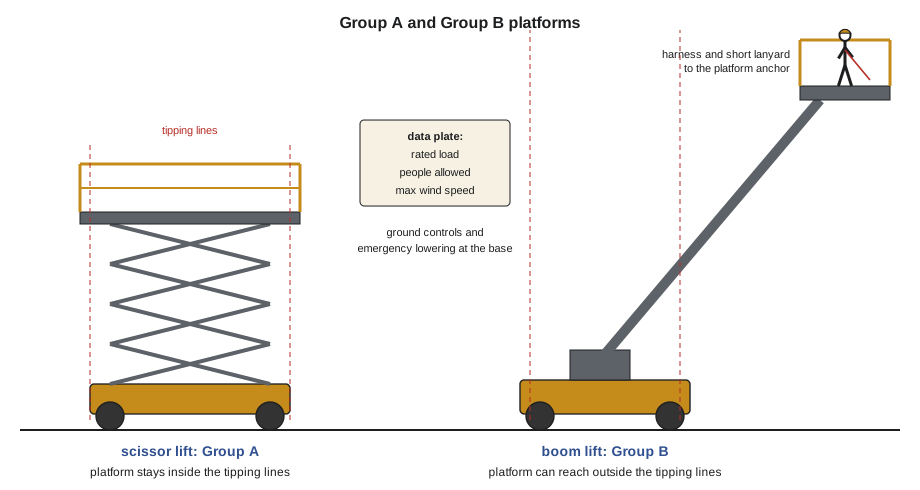
- Group A: the platform stays inside the machine's tipping lines in every position. Scissor lifts and vertical mast lifts are Group A.
- Group B: the platform can move outside the tipping lines. Boom lifts, both telescopic and articulating, and truck-mounted aerial devices are Group B.
- Type 1: the machine can travel only when stowed (lowered).
- Type 2: the machine can travel while raised, controlled from the chassis.
- Type 3: the machine can travel while raised, controlled from the platform. Most self-propelled scissor and boom lifts are Type 3.
So a self-propelled scissor lift is a Group A, Type 3 MEWP, and a self-propelled boom lift is Group B, Type 3. The group and type are on the machine's data plate and in its manual.
Training and familiarization
Ontario's construction regulation requires elevating work platforms to be operated only by workers who have been trained and given instructions on the specific type of platform, and the CSA B354 standards set out operator training, familiarization with the specific model, occupant training and supervisor training. Kingsway Tower requires a training card for every operator and a documented familiarization on each model before it is used.
Training covers theory and hands-on operation. Familiarization is the extra step of learning the particular machine in front of you: where the controls and emergency stop are, how the emergency lowering works, what the rated load and wind limit are, and what safety devices it has. Two scissor lifts from different manufacturers can have completely different controls. Occupants who ride in the platform but do not operate it also need to know how to use the emergency stop and how to lower the platform if the operator is hurt.
Before you use it: three inspections
Every shift starts with checks, and Maya's trainer insisted she do them in order:
- Pre-use inspection: walk around the machine with the manufacturer's checklist. Look for damage, leaks, missing parts, damaged tires, worn or loose guardrails, a gate that does not close, damaged cables or hoses and missing or unreadable decals. Check fluid levels and battery charge, and confirm the operator's manual is in its holder.
- Function test: from the ground controls, then from the platform controls, check that every function works and stops properly, including the emergency stop, the tilt alarm, the descent alarm, the emergency lowering and any secondary guarding device.
- Workplace inspection: look at where you will use it. Check the floor for holes, open trenches, drop-offs, slopes, soft ground, debris and covers that may not take the weight. Look up for overhead obstructions, beams, sprinkler pipes and power lines. Check the weather, especially wind outdoors, and the traffic of people and vehicles around you.
If anything fails, the machine is tagged out and reported. Never use a MEWP with a disabled safety device, a jumpered switch or a missing gate.
Hazards and how to control them
Tip-over
MEWPs tip over when they are driven onto slopes steeper than their rating, when a wheel drops into a hole or off a curb, when they stand on soft ground or a weak cover, when they are overloaded, when they are used in winds above their rating, or when side forces are applied, for example by pulling on pipe or pushing against the building. Every MEWP has a tilt alarm that warns or stops elevation if the chassis is out of level; never ignore or silence it. Drive slowly when raised, avoid potholes and drop-offs, and keep a spotter near edges.
Ejection and falls
A boom lift can catapult its occupants out of the platform if the chassis jolts, for example when a wheel drops into a hole or the machine is struck, because the long boom whips the platform. Falls also happen when workers climb onto or lean over the guardrails, sit on them, or stand on a bucket or ladder inside the platform to reach higher. The rules: stay on the platform floor, keep both feet on it, close the gate or chain, never climb the rails, and never use ladders, planks or buckets to gain height.
In boom lifts, occupants wear a full body harness with a short lanyard attached to the manufacturer's anchor point in the platform, set up for travel restraint where possible so the worker cannot be thrown out. In scissor lifts, the guardrails are the primary fall protection, but the manufacturer, the site or the task may also require a harness; follow the manual and the site's rules. Ontario's fall protection requirements apply to work from platforms as from any height.
Never tie off to a structure outside the platform from inside a MEWP; if the machine moves, the lanyard can pull the worker out or drag the machine over.
Crushing and entrapment
Operators can be crushed between the platform's guardrail and an overhead beam, joist, duct or slab when they raise or drive the platform with their head down, looking at the controls. This happens most often in tight ceilings like the Kingsway Tower retail space. Many newer machines have secondary guarding devices, such as pressure-sensing bars or proximity sensors, that stop the motion if the operator is pushed against the controls. Look up before raising, raise slowly near obstructions, and keep your body inside the platform and clear of the controls' path.
Electrocution
Booms and platforms near overhead power lines carry the same danger as cranes. Keep the minimum distances from Lesson 8, use a spotter when work is near lines, and remember that even an insulated aerial device is only insulated when it has been tested and is used as designed. A standard MEWP is not insulated.
Overload
The data plate lists the platform's rated load and the maximum number of people. Some machines have two ratings: a higher load in a restricted range and a lower load when fully extended, or one rating indoors and another outdoors. The rated load includes people, tools and materials. MEWPs are not material hoists: they are for people with the tools and materials needed for the job, and long pipe or heavy materials loaded onto a platform can overload it, overhang it and catch wind or obstructions. Many newer machines have load sensing that stops operation when overloaded.
Wind
MEWPs are rated for a maximum wind speed. Machines rated for indoor use only have a wind rating of zero and must not be used outdoors. Outdoor-rated machines commonly allow a maximum around 12.5 metres per second, about 28 miles per hour, but check the data plate, because some have lower limits, and large panels or sheets on the platform act as sails and reduce the safe wind speed further. Gusts matter, not just average wind. On Kingsway Tower, the boom lift operator checks a handheld anemometer at platform height before going up and stops work if the limit is approached.
Rescue planning
Every MEWP use needs a rescue plan, because a worker stuck in a raised platform, injured, suspended in a harness after a fall, or trapped against a ceiling needs help within minutes. The plan names who on the ground knows how to use the ground controls and the emergency lowering system, and keeps that person nearby whenever the platform is raised. It also covers how to call for help and what to do if the machine fails in the air. Suspension in a harness can quickly become dangerous, as TRD-101 explained, so rescue must be fast. Maya's trainer made every trainee lower an empty platform with the emergency system before signing off their familiarization.
Driving and parking
Drive in the direction you can see, use a spotter where the view is blocked, and watch for people, holes and overhead obstructions at the same time. Lower the platform before driving on slopes or rough ground, and respect the manufacturer's maximum slope for driving stowed and the limit for elevated travel. At the end of the shift, lower the platform fully, park on level ground away from traffic and edges, turn the key off, remove it and charge or fuel the machine in the designated area. Charging batteries gives off gas that needs ventilation.
Worked example: is the platform overloaded?
Worked problem
Carrying hangers and pipe on a scissor lift
Maya's scissor lift has a rated load of 320 kg for two people indoors, and 230 kg for one person outdoors. Maya (68 kg) and Luis (90 kg) will work indoors with 25 kg of tools and threaded rod, a 30 kg box of hangers and four 3 m lengths of 75 mm cast iron drain pipe at 13 kg each. Is the load within the rating?
Show solution
- Load = 68 + 90 + 25 + 30 + 4 × 13 = 265 kg.
- Indoor two-person rating = 320 kg, so the load is 83 percent of rating.
- It is within the rating, but the 3 m pipe overhangs a narrow platform. Take two lengths at a time, or have pipe passed up as needed, and keep the load inside the guardrails.
Answer: Within the indoor rating, but carry fewer pipe lengths at a time and keep everything inside the guardrails.
The program below checks a platform load against the correct rating for the conditions and checks the measured wind against the machine's limit.
# MEWP load and wind check (kg, m/s); ratings from an example data plate
ratings = {("indoor", 2): 320, ("outdoor", 1): 230}   # (use, max people): rated load kg
wind_limit = {"indoor": 0.0, "outdoor": 12.5}         # m/s
def check(use, people, items, wind):
    cap = ratings.get((use, len(people)))
    if cap is None:
        return "not rated for that number of people in this use"
    load = sum(people) + sum(items)
    msgs = [f"load {load} kg of {cap} kg ({100*load/cap:.0f}%)"]
    if load > cap: msgs.append("OVERLOADED")
    if use == "outdoor" and wind > wind_limit[use]: msgs.append("WIND OVER LIMIT")
    return ", ".join(msgs)
print("retail ceiling:", check("indoor", [68, 90], [25, 30, 13, 13, 13, 13], 0))
print("balcony, calm: ", check("outdoor", [90], [40, 30], 6.0))
print("balcony, gusty:", check("outdoor", [90], [40, 30], 14.0))
print("balcony, two: ", check("outdoor", [90, 68], [40], 6.0))retail ceiling: load 265 kg of 320 kg (83%) balcony, calm: load 160 kg of 230 kg (70%) balcony, gusty: load 160 kg of 230 kg (70%), WIND OVER LIMIT balcony, two: not rated for that number of people in this use
The last case shows a common trap: this machine allows two people indoors but only one outdoors, so the same crew and tools that are fine inside are not allowed on the balcony job.
Common mistakes
MistakeUsing a MEWP without familiarization on that model.
InsteadLearn the specific machine's controls, emergency lowering, ratings and safety devices before use.
MistakeStanding on the guardrail or a bucket to reach higher.
InsteadKeep both feet on the platform floor; reposition the machine or use a taller one.
MistakeTying off to the building from a boom lift.
InsteadAttach the lanyard only to the platform's anchor point.
MistakeRaising the platform while looking down at the controls.
InsteadLook up for overhead obstructions and raise slowly near them.
MistakeUsing an indoor-only scissor lift outside on a breezy day.
InsteadUse only outdoor-rated machines outdoors, within their wind limit.
MistakeGoing up with no one on the ground who can lower the platform.
InsteadKeep a trained person nearby who knows the ground controls and emergency lowering.
Summary and key terms
- MEWPs are Group A (platform inside tipping lines, such as scissor lifts) or Group B (can reach outside, such as boom lifts), and Type 1, 2 or 3 by how they travel.
- Operators need training and familiarization on the specific model under Ontario's regulation and CSA B354.
- Do a pre-use inspection, a function test and a workplace inspection before each use.
- Main hazards are tip-over, ejection and falls, crushing against overhead structure, electrocution and overload.
- Wear a harness attached to the platform anchor in boom lifts; follow the manual and site rules in scissor lifts.
- Respect rated load, occupant numbers and wind limits, and have a rescue plan with a trained person on the ground.
- MEWP
- Mobile elevating work platform: a machine that raises people on a platform to work at height.
- Group A
- A MEWP whose platform stays inside its tipping lines, such as a scissor lift.
- Group B
- A MEWP whose platform can move outside its tipping lines, such as a boom lift.
- Type 3
- A MEWP that can travel while raised, controlled from the platform.
- Familiarization
- Learning the controls, ratings and safety devices of the specific machine model to be used.
- Tilt alarm
- A device that warns or stops elevation when the chassis is out of level.
- Secondary guarding
- A device that stops platform motion if the operator is pushed against the controls or an obstruction.
- Travel restraint
- A lanyard setup that keeps a worker from reaching a point where they could fall or be thrown out.
Practice problems
Work each problem on paper first, then reveal the answer to check.
Is a self-propelled boom lift Group A or Group B?
Show answer
Group B, because its platform can reach outside the tipping lines.
Name the three inspections done before using a MEWP.
Show answer
Pre-use inspection, function test and workplace inspection.
Why is a jolt dangerous on a boom lift?
Show answer
The boom can whip the platform and catapult the occupants out.
Where does a boom lift occupant attach their lanyard?
Show answer
To the manufacturer's anchor point in the platform, never to the structure.
What does a wind rating of zero on a data plate mean?
Show answer
The machine is for indoor use only.
Why must someone on the ground know the emergency lowering?
Show answer
To bring down a worker who is injured, trapped or stuck if the machine fails.
Lesson quiz · 5 questions
Score 60% or more to complete this lesson.
Create a free account to save your progress, take quizzes and earn a certificate.