
TRD-105 · Lesson 8 of 12 · 20 min
Lift planning, exclusion zones and critical lifts
Every lift is planned. For a pallet of drywall on the tower crane, the plan may be a thirty-second conversation and a quick look at the load chart. For the rooftop make-up air unit at Kingsway Tower, the plan was a four-page document with a drawing, calculations, a list of roles and a sign-off from the lift director and the crane operator, prepared a week ahead and reviewed again the morning of the lift. The difference is not whether there is a plan but how much detail the lift needs. This lesson covers what every lift plan considers, how cranes' capacity changes with radius, how exclusion zones are set up, how power lines are handled and what makes a lift critical.
What every lift plan answers
Whether it is spoken or written, a lift plan answers the same questions:
- What is the load, how much does it weigh and where is its centre of gravity? (Lesson 2)
- How will it be rigged, and is every piece of rigging rated for its share at the actual angles? (Lessons 3 to 5)
- Which crane or hoist, in what configuration, and at what radius? What does the load chart allow at that radius, and what percentage of capacity will the lift use?
- Where does the load start, what path does it travel and where does it land? Is the landing area ready, with cribbing, and strong enough to take the load?
- What could it hit: buildings, other cranes, scaffolds, overhead power lines, trees, people?
- Who does what: lift director, operator, rigger, signaller, tag line handlers? (Lesson 1)
- How will the crew communicate, and who has control at each stage? (Lesson 7)
- What are the limits on wind, visibility and weather, and what is the plan if they are exceeded or something goes wrong mid-lift?
- How is the area controlled so no one is under or near the load, including the public?
Capacity changes with radius
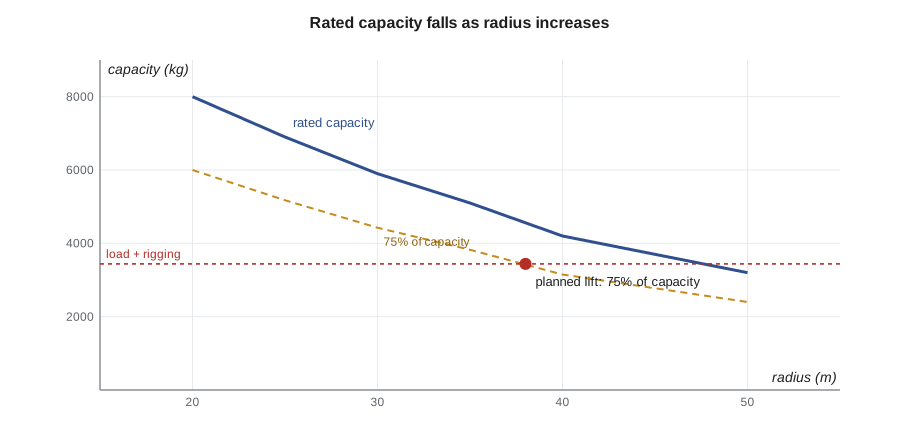
A crane's capacity is not a single number. It depends on the configuration (boom or jib length, counterweight, outriggers) and above all on the radius: the horizontal distance from the crane's centre of rotation to the centre of the load. The further out the load, the greater its tipping effect and the less the crane can lift. A mobile crane that can lift many tonnes close in may be able to lift only a fraction of that at full reach. A tower crane's capacity falls along the jib in the same way.
The crane's load chart, provided by the manufacturer and kept in the cab, lists the rated capacity for each configuration at each radius. Rated capacity already includes the manufacturer's safety margins; it must never be exceeded. Charts also note what must be deducted from the chart value: the hook block, the slings, shackles and spreader bar, and on mobile cranes anything else attached such as an unused jib.
Ground conditions matter as much as the chart. A mobile crane's outriggers transfer enormous point loads into the ground. They sit on pads or mats sized to spread the load, on ground that has been checked for buried services, recent backfill and voids. A crane set up over an underground parking structure, like the street side of Kingsway Tower, needs an engineer's confirmation that the slab can carry the outrigger loads.
Worked example: percentage of capacity
Worked problem
The make-up air unit lift
The make-up air unit weighs 2,950 kg. The spreader bar weighs 180 kg, the slings and shackles 60 kg and the tower crane's hook block 250 kg. The unit lands 38 m from the crane's centre, where the load chart for this jib allows 4,560 kg. What percentage of capacity does the lift use?
Show solution
- Total load on the crane = 2,950 + 180 + 60 + 250 = 3,440 kg.
- Percentage of capacity = 3,440 / 4,560 = 0.754, or just over 75 percent.
- Check the pick point at the street too: if it is at a longer radius, the capacity there is lower and governs.
Answer: Just over 75 percent of the chart capacity at the landing radius: right at the critical lift threshold Kingsway Tower uses, so it was planned as a critical lift.
Notably, the rigging and the hook block added almost 500 kilograms, or more than 1,000 pounds, to the unit's own weight. Leaving them out would have made the lift look comfortably under the threshold.
Critical lifts
Some lifts carry more risk than routine picks and get a formal, written plan reviewed and signed off before the lift. Companies and sites define these critical lifts for themselves, often in their safety program, but common triggers are:
- A load above a set percentage of the crane's rated capacity at the radius used, commonly 75 percent (some use 80 or 90 percent for certain cranes).
- Two or more cranes lifting one load (a tandem lift), or a crane working near another crane.
- Lifts over occupied buildings, public roads, operating facilities or other areas where people cannot be fully cleared.
- Lifts near energized overhead power lines.
- Lifting people in a work basket suspended from a crane, which is allowed only under strict additional rules.
- Unusual, very valuable, irreplaceable or awkward loads, loads with an uncertain weight or centre of gravity, and lifts where the crane is on a structure or uncertain ground.
A critical lift plan usually includes a drawing of the crane position, radius and load path; the load chart values and percentage of capacity; the rigging calculations; ground or structure bearing checks; the roles and signatures of the lift director and operator; and, where required, an engineer's review. It is reviewed with everyone involved immediately before the lift, and the lift is stopped if conditions change.
Exclusion zones and public protection
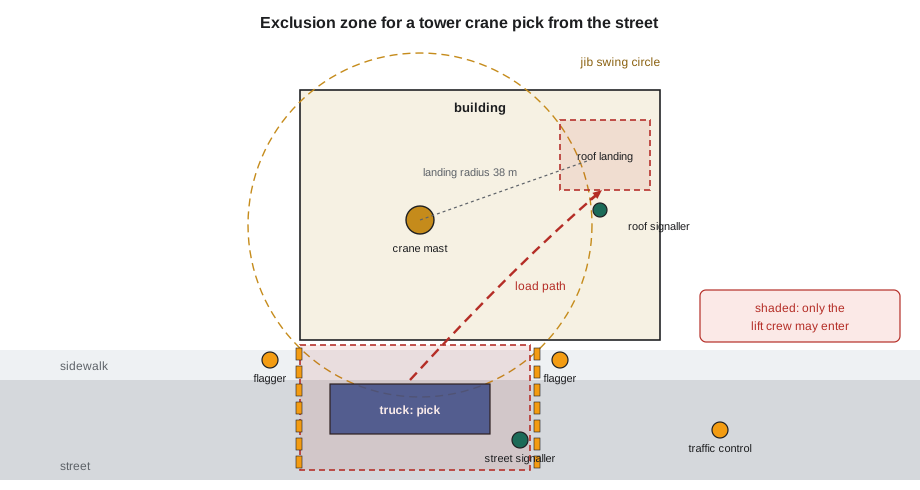
The safest place for people during a lift is far away from it. An exclusion zone is the area that only the lift crew may enter while a load is suspended. It covers the pick area, the path of the load and the landing area, plus enough extra distance to allow for a load that swings, falls or bounces. On a tower crane site, the crane's whole swing area can be a no-go zone during lifts, with barricades and signs.
Kingsway Tower uses barricades and spotters to keep people out, and the crane does not swing loads over the sidewalk or the street. When the make-up air unit was lifted from a truck parked on the street, the city's permit allowed a temporary lane and sidewalk closure, with paid-duty traffic control on the street and flaggers at the sidewalk. Inside the building, floors below the landing path were cleared and taped off.
Ontario's construction regulation prohibits loads from being carried over workers and requires measures to protect workers and the public from falling loads. Cities, including Hamilton, require permits for lifts that use or swing over public roads and sidewalks.
Overhead power lines
Contact between a crane, boom, load or rigging and an overhead power line is one of the deadliest events in construction. The electricity does not need to arc through the operator; it often kills a rigger, a tag line handler or someone touching the load or the crane on the ground. Power can also jump across a gap without contact, which is why minimum distances apply.
Ontario's construction regulation sets minimum distances that a crane, its load and any part of the equipment must keep from energized overhead lines unless the power utility has made other arrangements. Commonly cited values are 3 metres for lines from 750 volts to 150,000 volts, 4.5 metres for lines above 150,000 volts up to 250,000 volts, and 6 metres above 250,000 volts. Where equipment could come within those distances, a competent signaller is designated to warn the operator, and the utility should be contacted to de-energize, relocate or insulate the line.
Treat every overhead line as energized until the utility confirms otherwise in writing. Plan the crane position and the load path to stay well clear, mark the limits on the ground with warning lines or flags, and use a dedicated spotter whose only job is watching the clearance. Tag lines must be dry and non-conductive, but they do not make a power line contact safe.
Weather and changing conditions
Wind is the most common reason to stop a lift. Crane manufacturers set maximum wind speeds for operation, and loads with a large surface area, such as formwork, wall panels and plywood bundles, may need much lower limits because the wind turns them into sails. The lift director checks the forecast and the crane's anemometer before and during the lift. Lightning, heavy rain, fog that hides the signaller and ice on the load are all reasons to stop or postpone. A plan made on a calm day is not a plan for a windy one.
A capacity check program
The program below interpolates an example load chart to find the rated capacity at the planned radius, adds the rigging to the load, works out the percentage of capacity and flags the lift as critical above 75 percent. The chart values are invented for illustration; a real check uses the actual crane's chart for its exact configuration.
# percentage of crane capacity at a radius, from an example load chart (kg, m)
chart = [(20, 8000), (25, 6900), (30, 5900), (35, 5100), (40, 4200), (45, 3700), (50, 3200)]
def capacity(r):
    for (r1, c1), (r2, c2) in zip(chart, chart[1:]):
        if r1 <= r <= r2:
            return c1 + (c2 - c1) * (r - r1) / (r2 - r1)
    raise ValueError("radius outside chart")
load = 2950
rigging = {"spreader bar": 180, "slings and shackles": 60, "hook block": 250}
total = load + sum(rigging.values())
for name, r in (("street pick", 33.0), ("roof landing", 38.0)):
    cap = capacity(r)
    pct = 100 * total / cap
    tag = "CRITICAL LIFT" if pct > 75 else "routine"
    if pct > 100: tag = "OVER CAPACITY - DO NOT LIFT"
print(f"{name:12} radius {r:4.1f} m capacity {cap:6.0f} kg load {total} kg {pct:5.1f}% {tag}")street pick radius 33.0 m capacity 5420 kg load 3440 kg 63.5% routine roof landing radius 38.0 m capacity 4560 kg load 3440 kg 75.4% CRITICAL LIFT
With these example numbers the street pick is routine but the roof landing is just over 75 percent, so the whole lift is planned as critical: a lift is only as safe as its worst point.
Common mistakes
MistakeChecking the load chart only at the landing radius.
InsteadCheck capacity at the pick, the landing and every radius along the path; the worst one governs.
MistakeForgetting to add the hook block and rigging to the load.
InsteadAdd every item below the boom tip that the crane carries.
MistakeSwinging loads over workers or the public.
InsteadPlan the path and the exclusion zone so nobody is ever under a load.
MistakeAssuming an overhead line is de-energized.
InsteadTreat it as live until the utility confirms otherwise, and keep the required distance.
MistakeGoing ahead in wind because the lift was planned on a calm day.
InsteadCheck wind limits before and during the lift and stop when they are exceeded.
MistakeSetting up outriggers on unknown ground or over a slab without checks.
InsteadCheck bearing, buried services and voids, use mats, and get engineering confirmation over structures.
Summary and key terms
- Every lift has a plan; critical lifts get a written, reviewed and signed plan.
- Crane capacity falls as radius increases; the load chart for the exact configuration governs.
- Add the hook block and all rigging to the load, and check capacity along the whole path.
- Common critical lift triggers include more than about 75 percent of capacity, tandem lifts, lifts over the public and work near power lines.
- Exclusion zones keep everyone but the lift crew away from the pick, path and landing.
- Ontario sets minimum distances from energized lines, commonly 3, 4.5 and 6 metres by voltage.
- Lift plan
- The method, equipment, roles and controls for a lift, spoken for simple lifts and written for critical ones.
- Radius
- The horizontal distance from a crane's centre of rotation to the centre of the load.
- Load chart
- The manufacturer's table of rated capacity by configuration and radius.
- Critical lift
- A lift with higher risk that requires a formal written and reviewed plan.
- Tandem lift
- A lift in which two or more cranes share one load.
- Outrigger mat
- A pad that spreads a crane outrigger's load over a larger ground area.
- Limit of approach
- The minimum distance that equipment and loads must keep from an energized power line.
- Anemometer
- An instrument that measures wind speed, often mounted on a crane.
Practice problems
Work each problem on paper first, then reveal the answer to check.
A crane can lift 5,000 kg at the planned radius. The load plus rigging is 3,900 kg. What percentage of capacity is that?
Show answer
3,900 / 5,000 = 78 percent, which is a critical lift under a 75 percent rule.
Why does capacity drop as the radius grows?
Show answer
The load's tipping effect on the crane increases with distance.
Name four common critical lift triggers.
Show answer
Any four of: over about 75 percent of capacity, tandem lifts, over the public or occupied areas, near power lines, lifting people, unusual or uncertain loads.
What must be added to the load when checking the chart?
Show answer
The hook block, slings, shackles, spreader bars and anything else the crane carries.
What distance does Ontario commonly require from a 27,600 V line?
Show answer
3 metres (for 750 V to 150,000 V).
Why are large flat panels given lower wind limits?
Show answer
They catch the wind like sails and can swing violently.
Lesson quiz · 5 questions
Score 60% or more to complete this lesson.
Create a free account to save your progress, take quizzes and earn a certificate.