
TRD-105 · Lesson 7 of 12 · 22 min
Hand signals and communication
From the cab of the Kingsway Tower crane, the operator sits about forty metres above the street. On many lifts the load disappears behind the building, below a slab edge or inside the floor plate as it is landed. At that point the operator is driving blind, and the only link between the operator and the load is the signaller. If that link is clear, the lift is smooth and safe. If it is muddled, by an unclear signal, two people signalling at once, a radio that cuts out, or a signaller who walks out of sight, the operator is guessing with tonnes of steel on the hook.
This lesson covers the standard hand signals, how radios are used, where the signaller stands, and how communication works on smaller hoisting jobs. Sam Torres went through signal training this month, because his electrical crew will be landing transformers and switchgear on the roof and in the electrical rooms. Maya sat in on the session; even if she never signals a crane, she needs to recognize the signals so she understands what the crane is about to do.
Why standard signals
Hand signals for cranes are standardized so that every operator and every signaller uses the same language on every site. In Canada, the standard signals for mobile cranes are set out in CSA Z150, and the same family of signals is used for tower cranes and other hoisting equipment. The signal chart is posted in or near the crane cab, and operators may refuse to act on a signal they do not understand.
Non-standard signals are sometimes needed for unusual work, but only if the operator, the signaller and the lift director agree on them in advance and they do not conflict with any standard signal. Inventing a signal in the middle of a lift is not acceptable.
The core hand signals
The signals below are the ones every tradesperson on a crane site should recognize. Each uses clear, deliberate arm movements that can be seen from far away. Signallers often wear high-visibility gloves or sleeves so their hands stand out.
| Signal | How it is given | Meaning |
|---|---|---|
| Hoist | Forearm vertical, index finger pointing up, hand moving in small horizontal circles | Raise the load |
| Lower | Arm extended down, index finger pointing down, hand moving in small horizontal circles | Lower the load |
| Stop | Arm extended to the side, palm down, moving the arm back and forth horizontally | Stop the motion |
| Emergency stop | Both arms extended to the sides, palms down, moving back and forth horizontally | Stop immediately |
| Swing | Arm extended, pointing with a finger in the direction the boom or jib should swing | Swing in that direction |
| Move slowly | One hand gives the signal while the other hand is held motionless near it | Do the signalled motion slowly |
| Raise boom | Arm extended, fingers closed, thumb pointing up | Raise the boom (mobile crane) |
| Lower boom | Arm extended, fingers closed, thumb pointing down | Lower the boom (mobile crane) |
| Dog everything | Hands clasped together in front of the body | Stop all motion and hold; pause the operation |
Tower cranes add trolley signals for moving the hook in or out along the jib, and mobile cranes add signals for telescoping the boom, travelling and selecting the main hoist or the whipline (auxiliary hoist). The operator and signaller confirm before the lift which signals will be used.
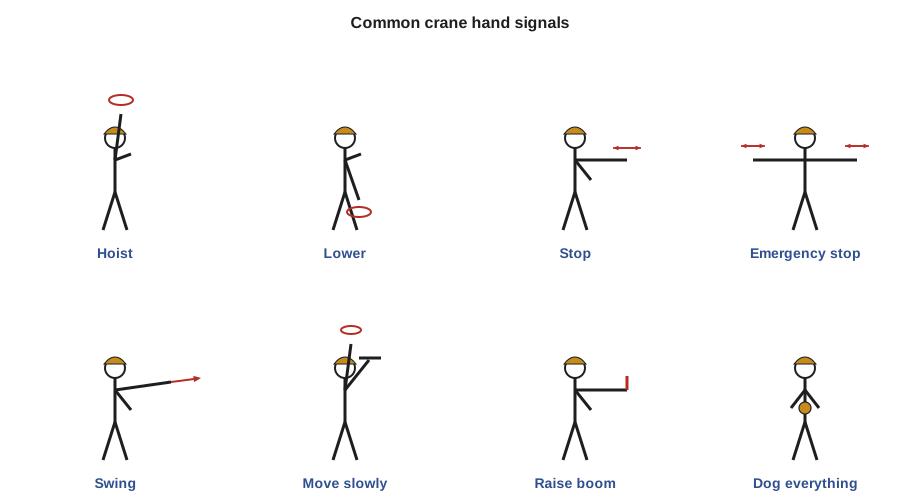
The stop signal belongs to everyone
Only the designated signaller directs the lift. But the stop and emergency stop signals can be given by anyone who sees danger: a worker who notices a sling slipping, a tag line handler who loses control, a passer-by who sees someone walk into the drop zone. The operator must obey a stop signal no matter who gives it. On Kingsway Tower, workers are told at orientation: if you see something wrong with a lift, give the stop signal, shout, and do not worry about being wrong. A lift can always be restarted.
Where the signaller stands
The signaller must be able to see the load and its path, and the operator must be able to see the signaller clearly, or hear them on the radio. A good position:
- Is in clear view of the operator, against a background where arm signals stand out.
- Gives a view of the load, the landing area and anything the load could strike.
- Is safe: outside the load's path and the swing radius, away from slab edges, and not where the signaller could be pinned between the load and a structure.
- Has a clear escape route if the load swings or drops.
If one person cannot see both the operator and the load, the lift needs radios or a relay of signallers. Relays are used only when necessary, with a clear hand-off: one signaller controls the load at a time, and both the operator and the signallers know who has control at each stage.
Radio communication
Most tower crane lifts at Kingsway Tower use radios, because the operator is high above and the loads go to places the operator cannot see. Radio signalling has its own rules:
- Use a dedicated channel for the crane, free from other site traffic.
- Check the radios at the start of the shift and before critical lifts, and carry spare batteries.
- Identify the crane and the signaller at the start, so the operator knows who is speaking.
- Talk continuously while the load is moving, describing the direction and distance: "Load coming down, down, ten metres, five metres, slow, slow, stop." Long silences are dangerous because the operator cannot tell a pause from a dropped connection.
- If communication is lost, the operator stops all motion immediately and does not move the load until communication is restored.
- Use clear, simple words, avoid slang and confirm instructions when there is any doubt.
Ontario's construction regulation and the site's lift plan set out when a signaller is required and how communication is to be kept. Kingsway Tower's rules require voice contact to be continuous whenever a load is moving out of the operator's view.
Where hand signals and radio are both in use, the crew agrees in advance which one governs. Usually the radio is primary, with hand signals as backup. A stop signal by either means is always obeyed.
Language and confirmation
Construction crews often include workers whose first language differs from the operator's. Standard hand signals help, because they work across languages. On the radio, use short standard phrases and agree on the unit of distance: metres or feet, never both. The signaller says what the load should do, not what the crane should do: "hoist slowly" rather than "pull it up a bit". If the operator hesitates or does something unexpected, stop and confirm.
Communication on smaller hoisting jobs
Not every lift involves a crane. When Maya's crew used the chain hoist to move the hot water tank, Luis was the only person giving directions. Before the lift he told everyone: "I call the moves. Maya pulls only when I say. Anyone sees a problem, yell stop." He used simple words and hand gestures: up, down, hold, stop. On a noisy site, the crew agreed that a raised open hand meant stop.
The same principles apply on every lift: one person gives directions, everyone knows the signals before the lift, and anyone can stop it. Pre-lift talks take a minute and prevent the most common misunderstanding: someone thinking "go" when someone else meant "wait".
Common signalling errors
Hector keeps a short list of the signalling errors he sees most often on new signallers. The first is signalling too fast: small, hurried hand movements that look alike from a distance, so that hoist and lower are confused. The second is drifting out of sight: the signaller follows the load around a corner and the operator suddenly has nobody to watch. The third is giving the next signal before the last motion has finished, which leaves the operator unsure which instruction to follow. The fourth is chatting on the crane channel, which hides the one message that matters. And the fifth is forgetting the swing: watching the load go up while the jib or boom swings toward another crane, a scaffold or a power line. Good signallers move deliberately, stay visible, give one instruction at a time and watch the whole machine as well as the load.
Signals for other equipment
Other machines on site have their own signals. Forklifts, telehandlers, excavators and concrete pump booms use signals that are similar to crane signals but not identical. Elevating work platforms are controlled by the person on the platform, but a spotter on the ground often guides the operator near overhead hazards or in tight spaces. Whatever the equipment, agree on the signals in advance, and never try to direct a machine you have not been trained to signal.
Worked example: planning communication for a blind lift
Worked problem
Landing switchgear on the roof
The tower crane must lift a 1,400 kg electrical switchgear section from the street to a mechanical penthouse on the roof. The operator can see the pick at the street but not the landing point, which is behind the penthouse wall. How should communication be set up?
Show solution
- Name one signaller at the street for the pick and the first part of the hoist, and a second signaller on the roof for the landing.
- Put both signallers and the operator on the crane's dedicated radio channel, and test it before the lift.
- Agree the hand-off point: when the load passes the roof parapet, the street signaller says "roof has control" and the roof signaller confirms before giving any signal.
- Agree the units (metres or feet) and that the operator stops if the radio goes quiet while the load is moving.
- Remind the whole crew, including Sam's electrical team at the landing, that anyone may give the stop signal.
Answer: Two signallers with a clear, confirmed hand-off on a tested dedicated channel, continuous voice contact, and stop on lost communication.
The program below models one rule of radio signalling: if the operator hears nothing for longer than an agreed time while the load is moving, the operator stops. It steps through a short log of radio messages and flags any silent gap that is too long.
# radio log for a moving load: stop if silence exceeds the agreed limit
limit = 4.0   # seconds of silence allowed while the load is moving
log = [  # (time in seconds, message from the signaller)
    (0.0, "Crane 1, roof signaller has control"),
    (1.5, "hoist slowly"),
    (3.0, "hoisting, hoisting"),
    (5.5, "swing left, slowly"),
    (11.0, "swing left"),          # a 5.5 s gap before this message
    (12.5, "stop"),
]
moving = False
for (t0, m0), (t1, m1) in zip(log, log[1:]):
    if m0 != "stop" and "control" not in m0:
        moving = True
    gap = t1 - t0
    status = "OPERATOR STOPS: lost contact" if moving and gap > limit else "ok"
    print(f"{t0:5.1f}s  {m0:35} gap {gap:4.1f}s  {status}")
print(f"{log[-1][0]:5.1f}s {log[-1][1]}")0.0s Crane 1, roof signaller has control gap 1.5s ok 1.5s hoist slowly gap 1.5s ok 3.0s hoisting, hoisting gap 2.5s ok 5.5s swing left, slowly gap 5.5s OPERATOR STOPS: lost contact 11.0s swing left gap 1.5s ok 12.5s stop
In the log, the signaller went quiet for more than five seconds during a swing. A good operator stops and asks before going on; a good signaller keeps talking so the gap never happens.
Common mistakes
MistakeTwo people giving the operator directions at once.
InsteadOne designated signaller directs the lift; only the stop signal can come from anyone.
MistakeInventing a signal during the lift.
InsteadUse the standard signals; agree any special signals in advance.
MistakeGoing silent on the radio while the load is moving.
InsteadTalk continuously so the operator knows the link is working.
MistakeStanding where you could be pinned between the load and the building.
InsteadChoose a position in view of the operator, out of the load path, with an escape route.
MistakeMixing metres and feet in radio directions.
InsteadAgree on one unit before the lift.
MistakeSignalling equipment you have not been trained to signal.
InsteadGet trained, or let a qualified signaller do it.
Summary and key terms
- Standard hand signals let operators and signallers work in the same language on any site.
- CSA Z150 sets out the standard crane signals in Canada; the chart is posted at the crane.
- Only the designated signaller directs a lift, but anyone may give the stop signal and the operator must obey it.
- The signaller stands in view of the operator and the load, out of the load path, with an escape route.
- Radio signalling uses a tested dedicated channel and continuous talk; lost contact means stop.
- Even small hoist lifts need one person giving directions and agreed signals.
- Signaller
- The designated person who directs the operator during a lift.
- Dog everything
- A signal to stop all motion and hold.
- Emergency stop
- A signal, with both arms out and moving, to stop immediately.
- Blind lift
- A lift where the operator cannot see the load or the landing area.
- Dedicated channel
- A radio channel used only for the crane operation.
- Relay signalling
- Passing control of a lift from one signaller to another at an agreed point.
- Whipline
- The auxiliary hoist line on a mobile crane, used for lighter, faster lifts.
- Trolley
- The carriage that moves the hook along a tower crane's jib.
Practice problems
Work each problem on paper first, then reveal the answer to check.
Describe the hoist signal.
Show answer
Forearm vertical, index finger pointing up, hand moving in small horizontal circles.
Describe the emergency stop signal.
Show answer
Both arms extended to the sides, palms down, moving back and forth horizontally.
How do you signal that a motion should be done slowly?
Show answer
Give the signal with one hand while holding the other hand motionless near it.
What must the operator do if radio contact is lost while a load is moving?
Show answer
Stop all motion until communication is restored.
Why must signallers keep talking during radio-controlled lifts?
Show answer
Silence could mean a dropped connection, and the operator cannot tell the difference.
When are two signallers used, and how is control passed?
Show answer
When one cannot see both the operator and the load; control is handed off at an agreed point and confirmed.
Lesson quiz · 5 questions
Score 60% or more to complete this lesson.
Create a free account to save your progress, take quizzes and earn a certificate.