
TRD-105 · Lesson 6 of 12 · 22 min
Inspecting rigging and removal criteria
A sling that lifted the same load safely yesterday can fail today. Rigging lives a hard life: dragged across concrete, pinched under loads, cut on edges, splashed with chemicals, run over by forklifts, left in the sun and rain. Damage builds up slowly and often hides in places you only see if you look on purpose. Inspection is how riggers catch that damage before it catches them. This lesson covers who inspects, how often, what to look for in each type of rigging, and what to do with gear that fails.
On her first day helping with the hot water tank, Maya watched Luis inspect two round slings and a shackle before he would put them anywhere near the tank. He ran each sling through his hands from end to end, turned it over, read the tag, checked the cover for cuts, and looked at the shackle pin threads. It took four minutes. "Every time," he said. "Not because I don't trust the last guy. Because the last guy can't see what happened to it after he put it down."
Three levels of inspection
Sling and hardware standards describe three levels of inspection. Site rules and regulations set the details, but the structure is the same everywhere.
- Initial inspection: before new or repaired rigging is first put into service, a competent or qualified person checks that it matches the order, is correctly tagged and has no damage from shipping.
- Frequent inspection: before each use, or at least each shift or day it is used, the person using the rigging inspects it visually and by touch. This is the inspection Luis did, and it is the one every apprentice must learn to do properly.
- Periodic inspection: a thorough, documented inspection by a competent or qualified person at regular intervals. The sling standard calls for it at least once a year for normal service, and monthly to quarterly for severe service such as heavy use, rough loads or harsh environments. Records of periodic inspections are kept, and many sites mark the date with a coloured tag or tie that changes every period.
Ontario's construction regulation requires rigging to be inspected by a competent worker before it is used, and to be kept in good condition. Kingsway Tower's site rules add a quarterly colour code for slings and hardware, so anyone can see at a glance whether a sling's periodic inspection is current.
If the colour on a sling is out of date, the sling is treated as not inspected and cannot be used until it has been inspected and re-marked.
How to inspect
A good inspection is systematic. Hector teaches the same routine for every sling:
- Read the tag first. Is it there, is it legible, and does the capacity suit today's load and hitch? No tag, no lift.
- Check the colour code or inspection record. Is the periodic inspection current?
- Clean off heavy dirt or grease if it hides the surface.
- Look and feel along the full length, turning the sling over. Run gloved hands along wire rope and synthetics; look at every link of a chain.
- Check the ends: eyes, splices, sleeves, hooks, master links and fittings.
- Decide. If anything meets a removal criterion, or if you are unsure, take it out of service and show it to a competent person.
Inspect in good light, and do it before the lift, not while the crane operator is waiting with the hook over your head. Rushing an inspection is how damage is missed.
Wire rope slings: removal criteria
Wire rope damage often starts with a few broken wires and gets worse quickly. The sling standard and the manufacturer give limits. Typical criteria for removing a single-part wire rope sling from service include:
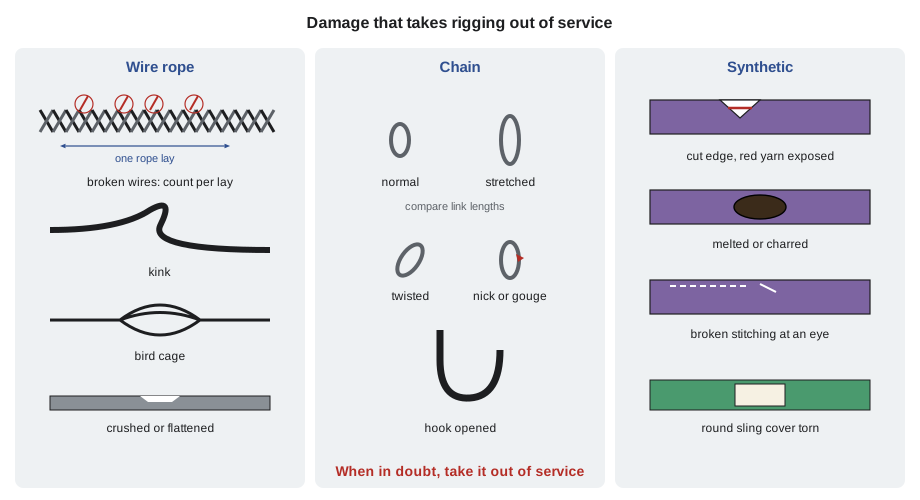
- Broken wires: about 10 randomly distributed broken wires in one rope lay, or about 5 broken wires in one strand in one rope lay. A rope lay is the length along the rope in which one strand makes one complete turn around the core.
- Kinking, crushing, bird caging (strands spreading out like a cage) or any other damage that distorts the rope's structure.
- Severe wear or abrasion: when the outside wires have lost about a third of their original diameter.
- Heat damage: discoloured, burned or arc-struck wires, including weld spatter.
- Severe corrosion, pitting or a core that has dried out and is causing internal wear.
- End attachments that are cracked, deformed, worn or moved, including sleeves that have slipped.
- A missing or illegible tag.
Count broken wires by marking out one lay along the worst-looking part of the rope and counting every broken wire within it. Broken wires near an end fitting are especially serious, because that is where stress concentrates.
Alloy chain slings: removal criteria
- A missing or illegible tag.
- Cracks, breaks, or any sign of heat damage, weld spatter or arc strikes.
- Stretched links: links that have elongated or closed up, often found by laying the sling out and comparing link lengths, or with a manufacturer's gauge. A sling that has grown longer overall has been overloaded.
- Bent, twisted or deformed links, and links that no longer move freely against each other.
- Nicks, gouges, excessive wear or corrosion beyond the manufacturer's limits, usually measured as a reduction in link diameter.
- Hooks that are opened, twisted or cracked, latches that do not work, and damaged master links or couplers.
Inspect chain slings link by link. Lay them out straight on a clean floor so stretched or twisted links stand out. Only the manufacturer or a qualified repair facility may repair a chain sling, and repaired slings must be proof tested before they return to service.
Synthetic web and round slings: removal criteria
- A missing or illegible tag.
- Cuts, holes, tears, punctures or snags, and any exposed red warning yarns.
- Broken or worn stitching in load-bearing splices or eyes.
- Melting, charring, glazed spots or weld spatter burns.
- Acid or caustic burns, discoloured or brittle areas, or a stiff, hardened feel.
- Excessive abrasive wear, fuzziness that has removed significant fibre, or crushed areas.
- Knots in any part of the sling.
- For round slings, a torn or worn cover that exposes the inner load-bearing yarns.
- Fittings that are pitted, corroded, cracked, bent or distorted.
Synthetic slings give few warnings before they fail, and their damage can be hidden under dirt. Clean them with water if needed and inspect both faces and both edges. Some manufacturers also give a useful-life guide or recommend replacement after a period of exposure to sunlight; follow it.
Hardware: removal criteria
- Missing or illegible manufacturer's markings or rated load.
- Shackles: a bent or distorted body or pin, a pin that will not thread in fully by hand or seat properly, cracks, excessive wear (often taken as about 10 percent of the original dimension), or heat damage.
- Hooks: a throat opening beyond the limit, a twisted tip, cracks, wear in the bowl, or a damaged latch.
- Eyebolts and hoist rings: bent shanks, damaged threads, a shoulder that will not seat, or a ring that will not swivel or pivot freely.
- Spreader bars and lifting beams: cracks in welds, bent members, damaged lugs, missing capacity markings.
Taking gear out of service
When rigging fails inspection, it must not be used again by anyone. Simply putting it back in the gang box invites the next person to use it. The usual procedure is:
- Tag it immediately with a do-not-use tag, or follow the site's system for defective gear.
- Remove it from the work area and put it in a marked quarantine area or container.
- Report it to your supervisor so it can be replaced and, if needed, so the cause can be looked at.
- Destroy or permanently disable slings that cannot be repaired, for example by cutting synthetic slings in half, so they cannot be pulled out of the garbage and used.
Damage is also information. A sling with a cut edge means somebody rigged against a sharp corner without protection. A stretched chain means somebody overloaded it. Reporting the damage helps the crew fix the habit that caused it.
Inspecting during and after use
Inspection does not end once the load is hooked up. As the slings take the weight during the trial lift, the rigger watches for slipping, twisting, uneven loading and contact with edges. After the lift, the rigger checks again before putting the gear away, because a lift can damage a sling: a load that shifted, a sling that ran over an edge, a hook that took a shock. Slings that took a shock load or a dropped load are inspected by a competent person before they are used again.
Worked example: counting broken wires
Worked problem
Is this wire rope sling still usable?
During a frequent inspection, Sam finds a stretch of a single-part wire rope sling with broken wires. Within one rope lay he counts 7 broken wires spread over several strands, with 3 of them in the same strand. Near the sleeve at one eye, he finds 2 more broken wires. Should the sling stay in service?
Show solution
- Randomly distributed broken wires in one lay: 7, below the typical limit of about 10.
- Broken wires in one strand in one lay: 3, below the typical limit of about 5.
- But broken wires next to an end fitting are a serious sign, and many manufacturers and site rules set a much lower limit at the fittings, sometimes just one or two.
- Sam should take the sling out of service and have a competent person examine it. The safe answer when close to a limit, or unsure, is to remove it.
Answer: Remove it from service for a competent person's decision; broken wires at the end fitting are enough to retire it.
The program below records the results of a frequent inspection for several slings and decides whether each passes, using typical removal criteria. Real limits come from the sling standard, the manufacturer and the site rules.
# frequent inspection log: apply typical removal criteria to each sling
slings = [
    {"id": "WR-14", "type": "wire rope", "tag": True, "current": True,
     "broken_lay": 7, "broken_strand": 3, "broken_at_fitting": 2, "kink": False},
    {"id": "RS-03", "type": "round sling", "tag": True, "current": True,
     "cover_torn": False, "yarn_exposed": False, "burn": False},
    {"id": "CH-02", "type": "chain", "tag": True, "current": False,
     "stretched": False, "twisted": False, "cracks": False},
    {"id": "WB-21", "type": "web", "tag": True, "current": True,
     "red_yarn": True, "cut": True, "burn": False},
]
def reasons(s):
    r = []
    if not s["tag"]: r.append("no tag")
    if not s["current"]: r.append("periodic inspection out of date")
    if s["type"] == "wire rope":
        if s["broken_lay"] >= 10: r.append("10+ broken wires in a lay")
        if s["broken_strand"] >= 5: r.append("5+ broken wires in a strand")
        if s["broken_at_fitting"] > 0: r.append("broken wires at end fitting")
        if s["kink"]: r.append("kink")
    else:
        r += [k.replace("_", " ") for k, v in s.items()
              if v is True and k not in ("tag", "current")]
    return r
for s in slings:
    r = reasons(s)
print(f"{s['id']:6} {s['type']:11} {'REMOVE: ' + ', '.join(r) if r else 'pass'}")WR-14 wire rope REMOVE: broken wires at end fitting RS-03 round sling pass CH-02 chain REMOVE: periodic inspection out of date WB-21 web REMOVE: red yarn, cut
Two of the four slings fail for physical damage, and a third fails only because its periodic inspection is out of date. That one may be perfectly sound, but until a competent person inspects it and updates its colour, it is not used.
Common mistakes
MistakeInspecting rigging while the crane waits with the hook overhead.
InsteadInspect before the lift in good light, and take the time it needs.
MistakePutting a damaged sling back in the gang box.
InsteadTag it, remove it, report it and, if it cannot be repaired, destroy it.
MistakeIgnoring a sling whose colour code is out of date because it looks fine.
InsteadTreat it as uninspected until a competent person checks and re-marks it.
MistakeCounting broken wires along the whole sling instead of within one lay.
InsteadMark out one rope lay at the worst spot and count the broken wires within it.
MistakeHaving a welder repair a chain link.
InsteadOnly the manufacturer or a qualified repair facility repairs chain slings, followed by a proof test.
MistakeSkipping the post-lift check after a load shifted.
InsteadRe-inspect rigging after any shock, shift or contact with an edge.
Summary and key terms
- Rigging gets three levels of inspection: initial, frequent (before each use) and periodic (documented).
- Ontario requires rigging to be inspected by a competent worker before use.
- Wire rope comes out of service for broken wires beyond limits, kinks, bird caging, crushing, heat damage, heavy wear or damaged ends.
- Chain comes out for stretched, twisted, cracked or gouged links, damaged hooks, heat damage or a missing tag.
- Synthetic slings come out for cuts, exposed red yarn, burns, chemical damage, broken stitching, knots or a missing tag.
- Defective rigging is tagged, removed, reported and destroyed if it cannot be repaired.
- Frequent inspection
- A visual and hands-on inspection by the user before each use or each shift.
- Periodic inspection
- A thorough, documented inspection by a competent or qualified person at regular intervals.
- Rope lay
- The length of rope in which one strand makes one complete turn around the core.
- Bird caging
- Wire rope damage where the strands spread apart like a cage.
- Red warning yarn
- A coloured core yarn in some web slings that shows when the sling must be removed.
- Proof test
- A test load applied by the manufacturer or repairer to confirm a repaired sling is sound.
- Quarantine area
- A marked area or container where defective gear is kept so nobody uses it.
- Colour code
- A site system of coloured tags or ties that shows which inspection period a sling has passed.
Practice problems
Work each problem on paper first, then reveal the answer to check.
What are the three levels of rigging inspection?
Show answer
Initial, frequent (before each use) and periodic (documented).
What is a rope lay?
Show answer
The length of rope in which one strand makes one full turn around the core.
Name three reasons to remove a web sling.
Show answer
Any three of: missing tag, cuts or holes, exposed red yarn, burns, chemical damage, broken stitching, knots, heavy abrasion.
How can a stretched chain sling be spotted?
Show answer
Lay it out straight and compare link lengths or use the manufacturer's gauge; the sling may be longer overall.
Why are unrepairable synthetic slings cut in half before disposal?
Show answer
So nobody can pull them out of the garbage and use them.
A sling's colour tag shows last quarter. Can it be used?
Show answer
No; it is treated as uninspected until a competent person inspects and re-marks it.
Lesson quiz · 5 questions
Score 60% or more to complete this lesson.
Create a free account to save your progress, take quizzes and earn a certificate.