
SMW-410 · Lesson 8 of 12 · 19 min
Combustible dust safety
A pile of sawdust burns slowly. The same dust, blown into a cloud inside a duct or a collector, can burn almost instantly and explode with enough force to blow a collector apart. Then a second, larger explosion follows, when the pressure wave shakes dust off beams, ledges and duct tops throughout the building and that dust ignites too. Wood, flour, sugar, grain, many plastics, and metals such as aluminum and magnesium all form combustible dusts. Industrial dust explosions have killed and injured many workers; one of the most cited, at a sugar refinery in Georgia in 2008, killed fourteen people. Sheet metal workers build the ducts and collectors that move these dusts, and those systems can either control the hazard or spread it. This lesson covers what makes dust explode and what the codes require to prevent it.
The dust explosion pentagon
A fire needs three things: fuel, oxygen and an ignition source. A dust explosion needs two more. The dust must be dispersed into a cloud at a concentration within its explosible range, and the cloud must be confined, as it is inside a duct, a collector, a bin or a room. Together these five make the dust explosion pentagon. Take away any one and there is no explosion. Most of the protection in a dust system works by removing a side: keeping dust out of the air outside the system, keeping ignition sources out of the system, relieving the confinement safely with vents, or isolating one part of the system from the rest so an explosion cannot travel.
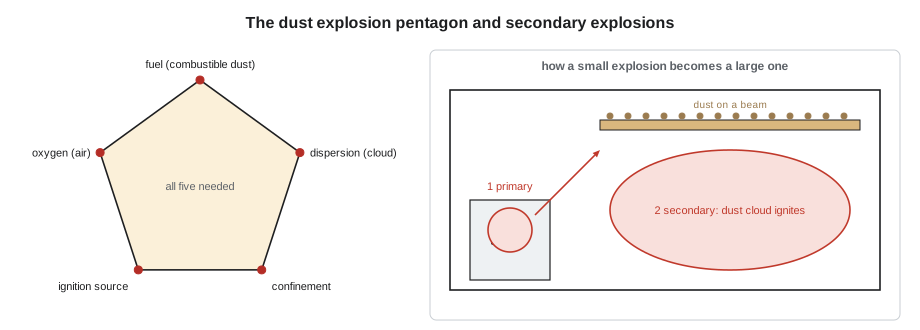
Secondary explosions are why housekeeping matters as much as the equipment. A thin layer of dust over a large floor or on top of ducts and beams can supply far more fuel than the collector holds. The standards treat accumulated dust over a large area of a room as a hazard in itself, and a good rule in any woodshop is that if you can write your name in the dust on a surface, it is time to clean it. Cleaning is done with vacuum systems rated for combustible dust, not by blowing it off with compressed air, which just raises a cloud.
How explosive is the dust?
Dusts are tested in a standard explosion vessel. Two numbers come out of the test: the maximum explosion pressure, and the rate of pressure rise, normalized for vessel size, called the Kst value. Dusts are grouped into explosion classes by their Kst: class St 1 for Kst up to 200 bar·m/s, St 2 from 200 to 300, and St 3 above 300. Most wood dusts fall in St 1, though fine sanding dust can be more reactive than coarse sawdust. Some metal dusts are St 3 and need special handling. The test also gives the minimum ignition energy, which shows how easily a spark or static discharge could set the cloud off, and the minimum explosible concentration.
| Explosion class | Kst range (bar·m/s) | Examples (typical) |
|---|---|---|
| St 1 | Up to 200 | Many wood dusts, grain, sugar |
| St 2 | 200 to 300 | Some fine organic dusts, some plastics |
| St 3 | Above 300 | Aluminum and magnesium powders |
Tomasz had Ironbark's dust tested at a laboratory, using samples of the fine sanding dust collected from the existing portable units, because the designer must use data for the actual material. The result put it in St 1, with a Kst near the upper part of the range typical for fine wood dust, and that value went into the vent and isolation design.
Standards and the dust hazard analysis
NFPA 660, Standard for Combustible Dusts and Particulate Solids, published in its first edition in 2025, brought together the earlier NFPA standards for the fundamentals of combustible dust, for woodworking and wood processing, for agricultural and food dusts, for metals and for chemical dusts in one document; wood processing and woodworking now has its own chapter. The National Fire Code of Canada and the National Building Code of Canada, as adopted in Nova Scotia, contain dust explosion requirements and reference NFPA standards, and the provincial occupational health and safety rules require employers to control the hazard. Insurers often require compliance with the NFPA standard as a condition of coverage.
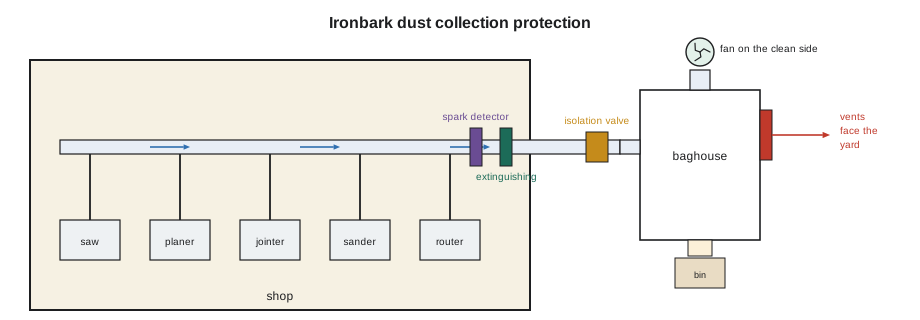
The central requirement of the NFPA approach is the dust hazard analysis. The owner, with qualified help, studies every place combustible dust is handled, collected or can accumulate, identifies where fires and explosions could start and spread, and records the safeguards in place or needed. The analysis is reviewed when the process changes. Ironbark's dust hazard analysis was done by Tomasz's firm before the system was designed, and its findings drove the layout: collector outdoors, explosion vents aimed at the yard, isolation on the inlet duct, spark detection in the main, metal ducts throughout, and a housekeeping program inside the shop.
Keeping ignition out
Ignition sources in a woodshop dust system include sparks from a saw striking a nail or a staple, hot particles from sanding, friction from a failing fan bearing, tramp metal, static electricity, and electrical equipment. Protection works on each. Magnets or metal detectors at feed points catch tramp metal. Spark detection and extinguishing systems use infrared sensors in the duct to spot glowing particles and spray a short burst of water downstream within a fraction of a second, before the spark reaches the collector. Fans for dust systems are of spark-resistant construction, so a rub between the impeller and the housing does not produce sparks, and fans are often placed on the clean side of the collector so the dust never passes through them.
Static electricity is controlled by bonding and grounding. Dust moving through a duct generates static charge, and an isolated section of duct or a plastic hose can build enough charge to spark. Ducts for combustible dust are metal, with every section bonded electrically to the next and the system grounded. Flexible hose at machines must be the conductive or static-dissipative type and connected to the grounded duct. Plastic pipe, popular for small home shops, is not acceptable in a commercial combustible-dust system.
Explosion venting
Even with ignition controlled, the design assumes an explosion could happen inside the collector, and protects people and the building from it. The most common protection on an outdoor collector is explosion venting, to NFPA 68. Vent panels in the collector wall, designed to burst at a low set pressure, open in the first moments of an explosion and let the burning dust and pressure escape before the collector's walls fail. The vent area is set by the collector volume, the dust's Kst and maximum pressure, the vent's opening pressure and the strength of the collector. A vented explosion throws a fireball and pressure wave out from the vent, so the vents must face a safe area free of people, walkways, roads and buildings, or be fitted with ducts that lead the discharge to such an area.
# Rough vent area for a low-strength enclosure (older simplified form, illustrative only)
import math
C = 0.026          # vent constant for an St 1 dust, bar^0.5 (illustrative)
P_red = 0.20       # reduced pressure the collector can safely withstand, bar
L, W, H = 3.0, 2.4, 6.0     # collector box dimensions, m
A_s = 2 * (L * W + L * H + W * H)   # internal surface area, m2
A_v = C * A_s / math.sqrt(P_red)
print(f"internal surface area {A_s:.1f} m2")
print(f"vent area about {A_v:.1f} m2")
print("real vents are sized by the collector maker to NFPA 68 from test data")internal surface area 79.2 m2 vent area about 4.6 m2 real vents are sized by the collector maker to NFPA 68 from test data
The code shows the scale of the answer, not a design: the collector manufacturer sizes and certifies the vents for the tested dust. For indoor equipment that cannot be vented safely, flameless vents, which pass the pressure through a flame-arresting mesh and keep the fireball in, or explosion suppression systems, which detect the pressure rise and inject an extinguishing agent in milliseconds, are used instead.
Explosion isolation
An explosion in the collector pushes a flame front and a pressure wave back along the inlet duct toward the building. Isolation devices stop it, under NFPA 69. On Ironbark's system the inlet duct carries a passive flap valve near the collector, which is held open by the airflow in normal operation and slams shut when the explosion pressure wave reverses the flow, closing the duct before the flame arrives. Other isolation methods include fast-acting mechanical valves triggered by sensors, chemical isolation barriers that inject agent into the duct, and the rotary airlock under the hopper. The location of a flap valve is critical: too close to the collector and it cannot close in time, too far and the flame passes it. The valve maker's listing sets the allowed distance range for the duct size and dust, and Keelson installs it exactly there.
What the installer must get right
Many of the protections depend directly on Keelson's work. Ducts must be metal, joined tightly, bonded across every joint and grounded. Clean-out doors must be tight so the system does not leak dust into the shop. The spark detector and extinguishing nozzle positions must be exactly as the spark system supplier's layout shows, because the response time depends on the distance between them. The flap valve must be at its listed distance, installed the right way round, with an inspection port. Vent panels must not be painted, obstructed or fitted with anything that adds mass. Supports must hold the duct where an explosion could jerk it. And duct routes must avoid horizontal ledges and pockets inside the building where dust could settle.
# Check bonding resistance readings across duct joints
readings = [0.4, 0.6, 0.3, 12.5, 0.5, 0.7, 0.4, 0.9]     # ohms measured across each joint with a low-resistance meter
limit = 10         # acceptance value used on this job, ohms (illustrative)
bad = [i + 1 for i, r in enumerate(readings) if r > limit]
print(f"{len(readings)} joints checked, highest {max(readings)} ohms")
print("all joints bonded" if not bad else f"rework joints {bad}")8 joints checked, highest 12.5 ohms rework joints [4]
Joint four failed because a painted flange kept the bonding strap's star washers from biting into bare metal. Kai cleaned the paint under the washers and the joint read well under an ohm.
Worked problem
Placing the flap valve
The flap valve listing allows installation between 3 m and 7 m from the collector inlet for the Ironbark duct size and dust. The inlet duct runs 9 m from the building wall to the collector, with an elbow 2 m from the collector. Where should the valve go?
Show solution
- The valve must be in a straight run, not in or right after an elbow.
- Distance from the collector to the elbow is 2 m, too close for the valve.
- Beyond the elbow, the straight run from 2 m to 9 m is available.
- Place the valve at about 5 m from the collector, inside the listed range and in straight duct, with access for inspection.
Answer: At 5 m the valve is inside its listed range, in a straight run, and reachable for its required inspections.
Housekeeping deserves one more word, because it is the protection the owner controls every day. A layer of fine wood dust on beams, ledges and light fixtures can be lifted into the air by a small first explosion inside a machine or a duct, and the secondary explosion that follows is usually the one that does the most damage. The refinery disaster described at the start of this lesson was driven by exactly that kind of accumulated dust. At Ironbark, Siobhan's crew now vacuums high surfaces on a schedule with a vacuum suitable for combustible dust, never blows dust down with compressed air, and keeps a log the insurer can check.
Common mistakes
MistakeBlowing dust off beams with compressed air.
InsteadUse a vacuum rated for combustible dust; blowing raises a dust cloud.
MistakeUsing plastic pipe or ordinary hose for a combustible-dust system.
InsteadUse bonded, grounded metal duct and conductive hose.
MistakeAiming explosion vents toward a walkway or the building.
InsteadDirect vents to a safe area or use ducted or flameless venting.
MistakeInstalling the flap valve wherever it fits.
InsteadInstall it within the listed distance range, in straight duct, the right way round.
MistakePainting over vent panels.
InsteadLeave vents clean and unobstructed; added mass changes how they open.
Summary and key terms
- A dust explosion needs fuel, oxygen, ignition, a dispersed cloud and confinement.
- Secondary explosions from accumulated dust can be worse than the first; housekeeping matters.
- Kst classes describe how violently a dust explodes; designs use test data for the actual dust.
- NFPA 660 now consolidates the NFPA combustible dust standards; a dust hazard analysis is central.
- Spark detection, spark-resistant fans, bonding and grounding keep ignition out.
- Explosion vents relieve pressure to a safe area; isolation devices keep an explosion from travelling back.
- Combustible dust
- Fine solid particles that can burn or explode when dispersed in air.
- Dust explosion pentagon
- Fuel, oxygen, ignition, dispersion and confinement.
- Kst
- The normalized rate of pressure rise in a dust explosion test.
- Dust hazard analysis
- A study of where dust fires and explosions could occur and the safeguards needed.
- Explosion vent
- A panel that opens in an explosion to relieve pressure to a safe area.
- Flap valve
- A passive isolation valve that closes when an explosion reverses the flow.
Practice problems
Work each problem on paper first, then reveal the answer to check.
Name the five sides of the dust explosion pentagon.
Show answer
Fuel, oxygen, ignition source, dispersion and confinement.
Why must every duct joint in a woodshop system be bonded?
Show answer
So static charge cannot build on an isolated section and spark.
What does a spark detection system do?
Show answer
Spots glowing particles in the duct and sprays water downstream before they reach the collector.
Why is the fan often placed on the clean side of the collector?
Show answer
So the dust never passes through the fan, removing it as an ignition source.
Lesson quiz · 5 questions
Score 60% or more to complete this lesson.
Create a free account to save your progress, take quizzes and earn a certificate.