
SMW-410 · Lesson 1 of 12 · 20 min
Industrial ventilation principles
Most of the air systems a sheet metal worker builds exist to keep people comfortable: they bring in outdoor air, heat or cool it, and spread it gently through a building. The systems in this course have a harder job. They exist to remove something that should not stay in the room: grease-laden smoke over a fryer, wood dust from a planer, welding fume, solvent vapour from a paint booth or a chemical fume in a laboratory. If those systems are built badly, the result is not a stuffy classroom but a duct fire, a dust explosion, or a worker breathing a contaminant every shift for years. Industrial ventilation and exhaust is where the sheet metal trade's work touches fire codes and occupational health most directly.
This course follows Kai Ferreira through his fourth and final year of apprenticeship at Keelson Sheet Metal in Halifax. Kai has already welded the grease duct for the Brine & Ember restaurant in SMW-230 and helped balance its make-up air in SMW-330. Now Halima Noor, Keelson's owner, has put him on the company's ventilation and exhaust work under Aggie MacLeod, the journeyperson who taught him to weld, with Walt Szymanski running the shop and Lin Zhao doing the drawings. Three jobs carry the course: the complete hood, grease duct and make-up air package at Brine & Ember; laboratory fume hoods and isolation-room exhaust at the Eastgate Hospital addition; and a new client, Ironbark Millwork, a cabinet and architectural woodwork shop that has outgrown its portable dust collectors and needs a proper central system.
General ventilation and local exhaust
There are two basic ways to control an airborne contaminant with air. General ventilation, also called dilution ventilation, brings clean air into a whole room and exhausts room air, so the contaminant is diluted to a lower concentration. Local exhaust ventilation captures the contaminant at or close to the point where it is released, before it mixes into the room, and carries it away in a duct to a collector or to a safe discharge point outdoors. A bathroom fan is general ventilation; a welding fume arm pulled up close to the arc is local exhaust.
Each approach has a place. General ventilation works for contaminants that are released in small amounts, spread out over a large area, and of low toxicity, and for heat removal. It is simple and cheap to install, but it does nothing to protect the worker closest to the source, who breathes the contaminant before it is diluted, and the amount of air it needs rises quickly as the release rate rises. Local exhaust is almost always the right choice for toxic contaminants, for dusts, for grease and smoke from cooking, and for anything flammable. It moves far less air than dilution for the same protection, so it costs less to run, and it keeps the contaminant out of the worker's breathing zone. Its weakness is that it only works if the hood is designed for the process and positioned where the contaminant is actually released.
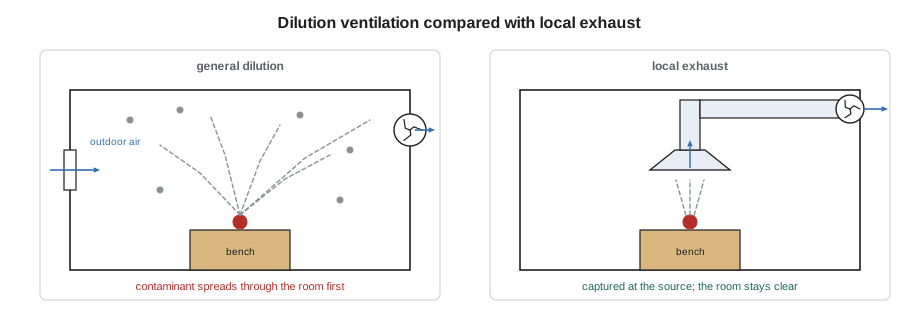
Where ventilation sits in the hierarchy of controls
Occupational health specialists rank ways of controlling a hazard from most to least effective: eliminate the hazard, substitute something less hazardous, use engineering controls, use administrative controls such as work schedules and training, and finally rely on personal protective equipment. Ventilation is an engineering control. It ranks above respirators because it removes the hazard from the air for everyone in the room without depending on each person wearing equipment correctly, and above administrative controls because it works all shift without anyone having to remember a rule.
In Nova Scotia, the Occupational Health and Safety Act and its regulations require employers to control workplace exposure to hazardous substances, and the occupational exposure limits used in the province are based on the threshold limit values published by the American Conference of Governmental Industrial Hygienists (ACGIH). An industrial hygienist measures exposure, compares it with the limit, and recommends controls. When a ventilation system is designed to protect workers, the target is not just to meet the limit but to keep exposures well below it, because limits are not a sharp line between safe and unsafe.
Kai's part in this is not to measure exposures, which is the hygienist's job, but to understand why a system is designed the way it is, so that he builds and installs it the way it was meant to work. A hood moved a few hundred millimetres away from a saw to make installation easier, a branch duct downsized because the shop had a fitting on the shelf, or a blast gate left half closed can turn a well-designed system into one that looks right and protects nobody.
Contaminants and how they behave
Contaminants come in different physical forms, and the form decides how they move and how they can be captured. Gases and vapours mix with air at the molecular level and follow the air wherever it goes; they cannot be filtered out by an ordinary filter, and they are controlled by capture and dilution or by special adsorbers. Particles behave differently depending on their size. Large particles, such as chips and coarse sawdust, are thrown by the tool and fall quickly under gravity, so the hood must catch them in flight. Fine dust and fume, a few micrometres and smaller, stay suspended for a long time and drift with room air currents, and these are the particles that reach deep into the lungs. Mists and smoke, such as cooking aerosols, contain small liquid droplets as well as gases.
Heat matters too. A hot process, such as a fryer, a griddle or a welding arc, produces a rising plume of warm air that carries the contaminant upward. A canopy hood above a hot source works with that plume. A cold process with no plume, such as hand sanding, needs a hood that pulls the contaminant sideways or downward against no natural help. Lessons 2 and 6 come back to this, because the right hood shape and airflow depend on it.
| Form | Examples on Keelson jobs | How it is controlled |
|---|---|---|
| Gas or vapour | Solvent vapour in a spray booth, lab chemical vapours | Capture at the source, dilution, discharge high and away |
| Fume (very fine solid) | Welding fume, metal fume | Close capture, filters rated for fine particles |
| Dust (larger solid) | Sawdust and wood chips, grinding dust | Capture at the tool, ducts at high velocity, collectors |
| Mist and smoke | Cooking aerosols, grease vapour | Canopy hoods with grease filters, exhaust to outdoors |
| Heat | Ovens, fryers, dishwashers | Canopy hoods, general ventilation |
Dilution ventilation arithmetic
Dilution ventilation is sized from the rate at which a contaminant is released and the concentration it must be held below. For a steady release into a well-mixed room, the steady concentration equals the release rate divided by the ventilation rate. Real rooms are never perfectly mixed, so designers divide the ideal ventilation rate by a mixing factor, or equivalently multiply the needed airflow by a safety factor, often between 3 and 10, depending on how well the air is distributed and how toxic the substance is. That factor is one reason dilution becomes expensive for anything but mild contaminants.
Air changes per hour is another common way to describe general ventilation. It is the airflow in volume per hour divided by the room volume. Codes and guidelines often set minimum air change rates for rooms such as storage areas, battery rooms and some hospital spaces. Air changes are easy to measure and check, but they say nothing about where the air goes, so a room with ten air changes per hour can still have stagnant corners.
Here G is the release rate of the contaminant, C is the concentration to be held, and K is the mixing safety factor. The second expression converts any airflow into air changes per hour. The Python block below runs both calculations for the Ironbark finishing room, where a small amount of solvent evaporates from wiping operations outside the spray booth.
# Dilution airflow for a steady release, and air changes per hour
G = 0.60         # solvent release, mg/s
C = 0.0025       # concentration to hold, mg/L (2.5 mg/m3)
K = 5            # mixing safety factor (poor mixing -> larger K)
Q = K * G / C    # required airflow, L/s
room = 510       # room volume, m3
ach = Q * 3.6 / room
print(f"required airflow {Q:.0f} L/s")
print(f"air changes per hour {ach:.1f}")required airflow 1200 L/s air changes per hour 8.5
The answer, 1,200 L/s, is a lot of air to heat in a Nova Scotia winter for one small source. That is the usual result: once a contaminant is released into a room, diluting it is expensive. Capturing the same solvent at the wiping bench with a slot hood, as Lesson 6 shows, would need a fraction of the airflow, and the hygienist recommends exactly that.
The parts of a local exhaust system
Every local exhaust system has the same five parts. The hood captures the contaminant. The duct carries it, at a velocity high enough that dust does not settle and grease or condensate does not collect. An air cleaner, such as a dust collector, a grease filter or a scrubber, removes the contaminant before the air is discharged, where the process and the environmental rules require it. The fan provides the pressure difference that moves the air. The stack discharges the exhaust outdoors, high enough and fast enough that it does not come back in through the air intakes. A sixth part is easy to forget: make-up air, the outdoor air that replaces what the exhaust removes. Without it, the building goes negative, doors are hard to open, combustion appliances spill, and the hood itself loses airflow.
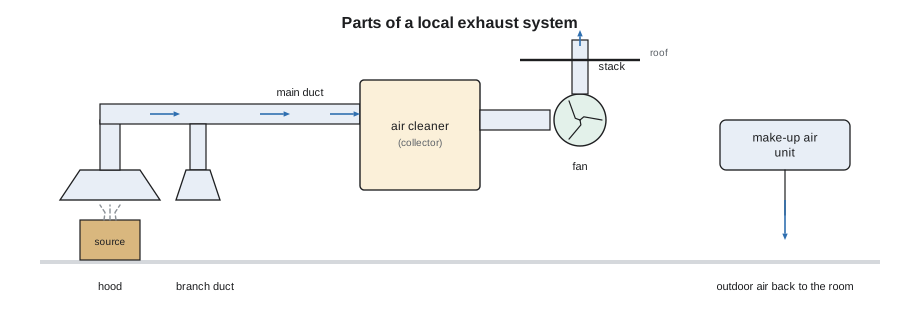
Kai's work touches every part. The shop fabricates hoods to the designer's dimensions, builds and installs the duct, sets the collector and the fan on their supports, connects them, runs the stack through the roof, and installs the make-up air ducts. The quality of that work decides whether the system meets its design. Leaks in a negative-pressure exhaust duct pull room air in instead of contaminant; sharp elbows and abrupt branch entries waste fan pressure; and a stack that ends in a rain cap pointing down sends exhaust straight back to the roof.
Negative pressure, leaks and where the exhaust goes
Exhaust ducts run under negative pressure from the hood to the fan, so a leak draws room air in rather than letting contaminant out. That is one reason fans are usually placed at the end of the system, outdoors or on the roof: everything inside the building is under suction, and the positive-pressure section after the fan, where a leak would push contaminant out, is outside. The exception that matters most is the grease duct. Grease ducts must be liquid-tight because grease condenses and runs along them, and a fire inside one is fed by that grease, so even under suction they are welded continuously, as Kai did in SMW-230.
Where the exhaust is discharged matters as much as how it is captured. Codes set minimum distances between exhaust outlets and air intakes, property lines and windows, and engineers usually discharge contaminated exhaust vertically at a good velocity through a straight stack. A rain cap that deflects the discharge downward defeats the purpose; a straight stack with a drain or a vertical discharge cap keeps rain out without pushing the plume back down.
Worked problem
Air changes in the Ironbark finishing room
The Ironbark finishing room is 12 m × 8.5 m × 5 m high. The existing wall fan is rated at 850 L/s. Walt asks Kai how many air changes per hour the fan gives before anyone talks about upgrading it.
Show solution
- Room volume: 12 × 8.5 × 5 = 510 m³.
- Airflow per hour: 850 L/s × 3.6 = 3,060 m³/h.
- Air changes per hour: 3,060 ÷ 510 = 6.0.
- Compare with the 1,200 L/s dilution rate from the code block: the existing fan is well short for dilution of the wiping solvent.
Answer: Six air changes per hour is reasonable general ventilation for the room, but not enough to dilute the solvent; capture at the bench is the better answer.
Common mistakes
MistakeUsing a bigger general exhaust fan to control a toxic contaminant at one bench.
InsteadCapture it at the source with local exhaust; dilution protects the worker at the source least.
MistakeMoving a hood away from the source to make installation easier.
InsteadBuild the hood where the designer placed it; capture falls off quickly with distance.
MistakeForgetting the make-up air.
InsteadEvery exhaust system needs replacement air, or it loses flow and the building goes negative.
MistakeDischarging exhaust under a downward rain cap.
InsteadUse a straight vertical stack with a suitable cap so the plume rises clear.
MistakeTreating air changes per hour as proof of good ventilation.
InsteadCheck where the air goes; mixing and capture matter more than the number.
Summary and key terms
- General ventilation dilutes contaminants in the whole room; local exhaust captures them at the source.
- Local exhaust is the usual choice for toxic, flammable, dusty and greasy contaminants.
- Ventilation is an engineering control and ranks above administrative controls and respirators.
- Gases follow the air; large particles must be caught in flight; fine particles drift with room air.
- Dilution airflow is the release rate divided by the allowed concentration, times a mixing factor.
- A local exhaust system has a hood, duct, air cleaner, fan, stack and make-up air.
- Dilution ventilation
- General ventilation that lowers contaminant concentration by mixing in clean air.
- Local exhaust ventilation
- Exhaust that captures a contaminant at or near its source.
- Air changes per hour
- Hourly airflow divided by room volume.
- Mixing factor
- A safety factor applied to dilution airflow for imperfect mixing.
- Make-up air
- Outdoor air supplied to replace air removed by exhaust.
- Breathing zone
- The air around a worker's nose and mouth.
Practice problems
Work each problem on paper first, then reveal the answer to check.
Why does local exhaust usually use less air than dilution for the same protection?
Show answer
It captures the contaminant before it mixes into the room, so it only has to move the air around the source.
A room of 400 m³ gets 555 L/s of exhaust. About how many air changes per hour is that?
Show answer
555 × 3.6 ÷ 400 = 5.0 air changes per hour.
Why are exhaust fans usually placed at the end of the system?
Show answer
So the ducts inside the building are under suction and leaks draw air in rather than letting contaminant out.
Which particles are hardest to see and most harmful to breathe?
Show answer
Fine dust and fume a few micrometres and smaller, which stay suspended and reach deep into the lungs.
Lesson quiz · 5 questions
Score 60% or more to complete this lesson.
Create a free account to save your progress, take quizzes and earn a certificate.