
SMW-410 · Lesson 5 of 12 · 20 min
Kitchen fire protection and maintenance
Restaurant fires usually start on the cook line, in a fryer or on a charbroiler, but the ones that destroy buildings are the ones that get into the hood and the grease duct. A thin coat of grease on the inside of a duct is enough fuel for a fire that races up the duct, heats the steel red, ignites anything combustible within reach and spreads through ceiling spaces and shafts. Everything in Lesson 3, from welded seams to rated shafts, is there to keep such a fire inside the duct. This lesson covers the other two defences: the fire suppression system that puts out a fire at the hood, and the maintenance that keeps the grease from building up in the first place. Kai does not install suppression systems or clean ducts, but his work makes both possible, and he needs to know what they require.
How a hood fire starts and spreads
Cooking oil heated past its smoke point gives off vapour and eventually reaches its autoignition temperature, when it bursts into flame without a spark. A flare-up on a charbroiler or a dry fryer can send flames up to the filters. Clean, properly installed baffle filters act as a flame barrier, but filters loaded with grease become fuel themselves, and flames that pass the filters reach the plenum behind them and the duct beyond. Once a duct fire starts, the fan keeps feeding it air, and the grease along the duct burns in a line toward the roof.
That chain explains the protection. Clean filters and correct filter-to-appliance distances stop most flare-ups at the filters. The suppression system knocks down a fire at the appliances and in the plenum and duct entry. The welded, cleanable duct and its rated enclosure contain any fire that gets past both. And regular cleaning removes the fuel from the hood, plenum, duct and fan so there is little for a fire to burn.
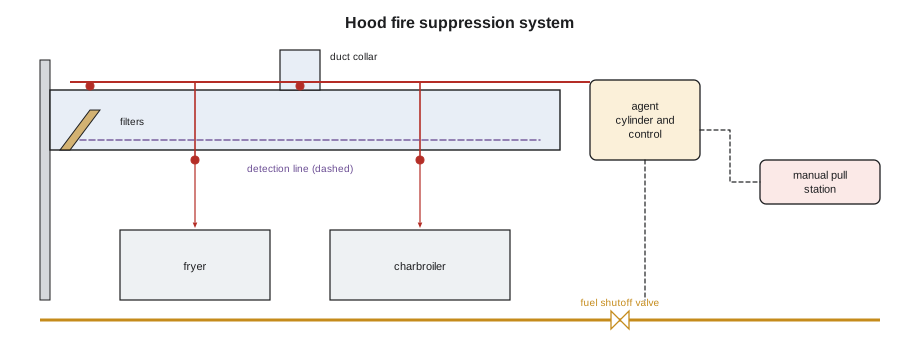
Wet-chemical suppression systems
Hoods over grease-producing appliances must be protected by an automatic fire-extinguishing system. Almost all modern systems use a wet-chemical agent, a potassium-based solution that reacts with hot cooking oil to form a soapy layer, a process called saponification, which smothers the fire and cools the oil so it does not reignite. Systems in Canada are listed to the Canadian standard for pre-engineered wet-chemical cooking protection systems and installed to NFPA 17A and NFPA 96 by a contractor trained and authorized by the system manufacturer. The listing tests systems against fires in modern high-efficiency fryers and vegetable oils, which burn hotter than the animal fats used decades ago.
A typical system has an agent cylinder in a cabinet at the end of the hood, a network of stainless pipe to nozzles aimed at each appliance, into the plenum behind the filters and into the duct collar, a detection line of fusible links or other heat detectors along the hood, and a mechanical or electrical release. When a link melts, the release fires the cylinder, the agent discharges through the nozzles, and the system shuts off the gas and electricity to all the appliances under the hood. A manual pull station, usually at the kitchen's path of exit, lets staff fire the system by hand. Where the building has a fire alarm system, the suppression system is connected to it.
Nozzle coverage is appliance-specific. The listing says how many nozzles each appliance needs, where they go and how high above the cooking surface. If Rania later moves the charbroiler to a new spot, or swaps the fryers for larger ones, the suppression system has to be re-evaluated and changed by the suppression contractor. Appliances on casters are fitted with restraints so they go back to the position the nozzles are aimed at after cleaning.
| Part | What it does | Who handles it |
|---|---|---|
| Grease filters | Remove grease and act as a flame barrier | Hood installer; kitchen staff clean them |
| Detection line | Senses heat over the appliances and plenum | Suppression contractor |
| Agent cylinder and piping | Stores and delivers the wet-chemical agent | Suppression contractor |
| Nozzles | Aim agent at appliances, plenum and duct collar | Suppression contractor, through hood openings Keelson provides |
| Fuel and power shutoff | Stops gas and electricity to the appliances on discharge | Gas fitter and electrician, with the suppression contractor |
| Manual pull station | Lets staff fire the system by hand | Suppression contractor |
| Portable extinguisher | Hand extinguisher for small fires near the line | Owner, under the fire code |
What Keelson does for the suppression contractor
Coordination is Keelson's main contribution. The nozzle and detector penetrations through the hood and the duct collar are made liquid-tight with listed fittings, at the locations the suppression contractor's layout shows, before the hood is hung if possible. Lin draws the hood with every penetration marked. The hood is hung level and at the height in the listing, because the nozzle heights above the appliances depend on it. Access is left above the hood for the piping. Where a listed hood includes a fire-actuated damper in its exhaust collar or make-up air plenum, Keelson installs the hood with that damper accessible, and the make-up air duct connection to the hood plenum, if there is one, includes the fire damper the listing requires.
The other contribution is not drilling into anything after the system is installed. A hole in a hood for a light or a sign after the suppression system is commissioned can break the liquid-tight hood and redirect a nozzle. Any change goes back to the suppression contractor and the hood manufacturer.
Portable extinguishers and staff training
The fire code also requires portable extinguishers in commercial kitchens. For cooking oil fires, the right type is a Class K extinguisher, which contains a wet-chemical agent similar to the fixed system. It is located close to the cook line, within the travel distance the fire code allows, and staff are trained to fire the fixed system first, using the pull station, and only then use the Class K extinguisher. Water must never be used on a grease fire; it flashes to steam and sprays burning oil.
Cleaning the hood, duct and fan
The best fire protection is little or no grease in the system. NFPA 96 requires the whole exhaust system, from the hood to the fan, to be inspected for grease build-up on a schedule that depends on the type and volume of cooking, and cleaned to bare metal whenever inspection finds a build-up. The schedule in the standard is roughly this: systems serving solid-fuel cooking monthly; high-volume cooking, such as 24-hour restaurants, charbroiling and wok cooking, quarterly; moderate-volume cooking semi-annually; and low-volume cooking, such as churches, seasonal businesses and day camps, annually. Brine & Ember, with a charbroiler and long summer hours, is on the quarterly schedule.
| Type or volume of cooking | Inspection interval for grease build-up |
|---|---|
| Solid-fuel cooking | Monthly |
| High-volume cooking (24-hour, charbroiling, wok) | Quarterly |
| Moderate-volume cooking | Semi-annually |
| Low-volume cooking (churches, seasonal, day camps) | Annually |
Cleaning is done by trained and certified exhaust cleaning contractors, who scrape and pressure-wash the hood plenum, every reachable part of the duct and the fan, and who post a label or certificate in the kitchen showing the date and what was cleaned, including any part they could not reach. That last item is where Keelson's work shows. A duct with every cleanout installed where Lesson 3 required, with matching access doors in the shaft and a hinged fan on the roof, can be cleaned completely. A duct with a cleanout missing behind a ceiling, or a fan bolted down without a hinge, leaves an uncleaned section that the certificate must report, and that the fire inspector will ask about.
# Plan exhaust cleaning visits for a year and estimate grease load between visits
schedule = {"solid fuel": 1, "high volume": 3, "moderate volume": 6, "low volume": 12}
kitchen = "high volume"
months = schedule[kitchen]
visits = 12 // months
print(f"{kitchen}: inspect every {months} months -> {visits} visits a year")
# rough grease deposit estimate in the duct between visits (illustrative)
deposit_rate = 0.4     # mm of build-up per month in the horizontal run
print(f"build-up between visits about {deposit_rate * months:.1f} mm")
limit = 1.0          # depth that calls for cleaning (illustrative), mm
print("clean at every visit" if deposit_rate * months >= limit else "inspect and clean as needed")high volume: inspect every 3 months -> 4 visits a year build-up between visits about 1.2 mm clean at every visit
Inspections by the authorities and the insurer
Before Brine & Ember opens, the hood, duct and suppression system are inspected. The municipal building inspector looks at the hood and duct installation, clearances, the enclosure and the light test. The fire service, under the Nova Scotia fire safety regulations and the National Fire Code of Canada as adopted in the province, witnesses an acceptance test of the suppression system, often a test discharge with the agent cylinder replaced by a test device, and checks the fuel shutoffs, pull station and extinguishers. After opening, the suppression system is inspected by a qualified service company at least every six months, and the fire inspector checks the cleaning certificates and service tags on routine visits. The restaurant's insurer often asks for the same records.
Kai's part is to have the paperwork ready: the light test record, photographs of the duct and enclosure before the shaft was closed, the listing documents for the hood, the enclosure wrap certificate for the one wrapped section, and the cleanout and access door locations on the record drawing. Aggie's rule is that the inspector should never have to ask for something twice.
Worked problem
Counting cleanouts on the Brine & Ember duct
The duct leaves the hood collar, turns horizontal, runs 7.5 m to the shaft, turns up and rises three floors, about 11 m, to the roof fan. Dev's specification asks for a cleanout at every change of direction and at no more than 3.7 m along horizontal runs. How many cleanouts does Kai install, and where?
Show solution
- Changes of direction: hood collar to horizontal, horizontal to vertical at the shaft: 2 cleanouts.
- Horizontal run: 7.5 ÷ 3.7 = 2.03, so one more cleanout part way along the run, giving spacing within the limit.
- Vertical riser: Dev also asks for one cleanout per floor in the shaft, so 3 more, each with a rated access door.
- The roof fan's hinge gives access to the top of the riser.
Answer: Six cleanouts in all, each with access, plus the hinged fan; with these, the cleaning contractor can reach every part of the duct and certify it.
Records, tags and the owner's role
Every suppression system service and every hood and duct cleaning leaves a record. The suppression contractor attaches a service tag showing the date, the company and the work done, and NFPA 96 requires cleaning contractors to leave a certificate in the kitchen showing when the system was cleaned and any areas they could not reach. Fire inspectors look for those tags first, and an out-of-date tag is one of the most common reasons a restaurant is written up. Rania Haddad keeps the service schedule taped inside the office door, with the next dates for the semi-annual suppression service and the hood and duct cleaning, which is set by the cooking volume and fuel.
Cleaning contractors also report damage, and that is often how Keelson gets maintenance work. A report of a cleanout that cannot be opened, a fan with no hinge kit that the cleaners had to leave dirty, or a section of duct with no access at all is a code problem the owner must fix. Keelson's fix is usually to add listed access panels, replace a fan curb with one that allows the fan to tilt, or rebuild a section of duct so it can be reached and cleaned. Each penetration added to an existing grease duct must be liquid-tight and made with listed panels or welded frames, and each one changes the record that the next inspector reads.
Staff training closes the loop. Kitchen workers should know where the manual pull station is, that water must never be thrown on a grease fire, that the Class K extinguisher is for use after the system has discharged, and that the system must be serviced and the fuel restored by qualified people after any discharge. Insurers often ask to see that training on record alongside the service and cleaning tags.
Common mistakes
MistakeMoving or swapping appliances under a hood without telling the suppression contractor.
InsteadHave the system re-evaluated; nozzle coverage is appliance-specific.
MistakeDrilling a hood for a light after the suppression system is commissioned.
InsteadRoute all changes through the hood manufacturer and the suppression contractor.
MistakeUsing water on a grease fire.
InsteadFire the fixed system, then use a Class K extinguisher.
MistakeLeaving a section of duct with no cleanout access.
InsteadProvide cleanouts and access doors so every part can be cleaned to bare metal.
MistakeBolting the roof fan down without a hinge kit.
InsteadInstall the listed hinge so the fan tilts back for cleaning.
Summary and key terms
- Grease build-up in filters, plenum and duct is the fuel for the most damaging kitchen fires.
- Wet-chemical suppression systems protect the appliances, plenum and duct collar and shut off fuel and power.
- Nozzle coverage depends on the appliances; changes need the suppression contractor.
- Class K portable extinguishers back up the fixed system; water must never be used on grease.
- NFPA 96 sets inspection intervals by cooking type and volume, and cleaning is to bare metal.
- Cleanouts, access doors and a hinged fan make full cleaning possible.
- Wet-chemical agent
- A potassium-based extinguishing solution that forms a soapy layer on burning cooking oil.
- Saponification
- The reaction that turns hot oil and the agent into a smothering soapy layer.
- Fusible link
- A heat-sensitive link that melts to release the suppression system.
- Manual pull station
- A device near the exit that fires the suppression system by hand.
- Class K extinguisher
- A portable extinguisher for cooking oil and fat fires.
- Cleaning certificate
- A label or record posted after exhaust cleaning showing what was cleaned.
Practice problems
Work each problem on paper first, then reveal the answer to check.
Why do modern suppression systems use wet-chemical agents?
Show answer
They form a soapy layer on hot oil that smothers the fire and cools the oil so it does not reignite.
A church kitchen is used for occasional dinners. How often is its exhaust inspected for grease build-up under NFPA 96?
Show answer
Annually, as low-volume cooking.
What does the suppression system shut off when it discharges?
Show answer
Gas and electricity to all the appliances under the hood.
Why does a hinged roof fan matter to fire safety?
Show answer
It lets the cleaners tilt the fan back and clean the top of the duct and the fan itself.
Lesson quiz · 5 questions
Score 60% or more to complete this lesson.
Create a free account to save your progress, take quizzes and earn a certificate.