
SMW-410 · Lesson 7 of 12 · 19 min
Dust collection systems
The hoods and ducts of Lesson 6 bring the dust to one place. The dust collector separates it from the air so the dust can be stored and taken away and the air can be discharged or, under strict conditions, returned to the building. Choosing and installing the collector is one of the biggest decisions in a dust system, because it sets the fan size, the floor or yard space needed, the maintenance the owner will face and, for combustible dusts such as wood, much of the fire and explosion protection covered in Lesson 8.
Ironbark Millwork currently uses three portable bag-type collectors on wheels, each serving two or three machines through flexible hose. They fill quickly, leak fine dust through their bags into the shop, and are moved around and disconnected as the work changes, so most of the time some machines have no collection at all. Siobhan wants a single central system with ducts to every machine and a collector outside the building. Tomasz has designed it, and Keelson's job is to build the ducts, set the collector, the fan and the discharge equipment, and get it running.
How collectors separate dust
Dust collectors use a few basic principles. Settling chambers slow the air so heavy particles fall out under gravity; they only work for coarse material. Cyclones spin the air so particles are thrown outward against the wall by centrifugal force and slide down to a hopper; they handle chips and coarse dust well but let fine dust through. Fabric filters, the baghouses and cartridge collectors, pass the air through a woven or felted fabric that traps particles of almost every size; they are the usual choice where fine dust must be removed. Wet scrubbers wash the dust out with water and are used for some sticky or explosive dusts but rarely in woodshops.
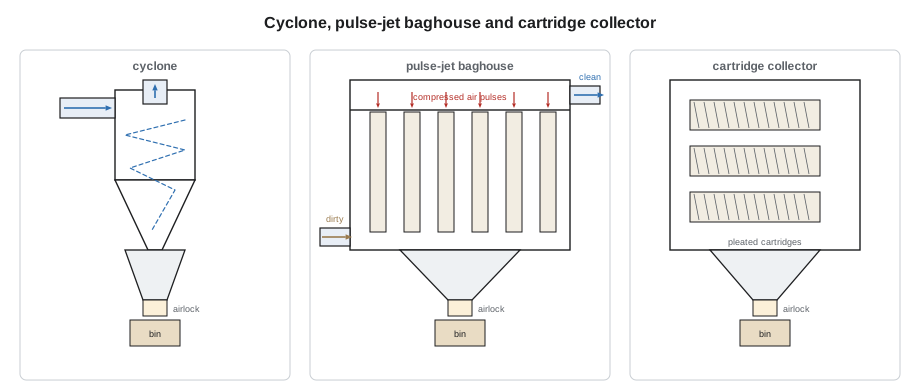
| Collector | Good for | Limits |
|---|---|---|
| Cyclone | Chips, shavings, coarse dust; pre-cleaning before a filter | Lets fine dust through; needs a filter after it for most indoor uses |
| Pulse-jet baghouse | Fine and coarse dust, large airflows, continuous use | Larger and more costly; needs compressed air for cleaning |
| Cartridge collector | Fine, dry, non-fibrous dust; welding fume; compact sites | Pleats can blind with fibrous or sticky dust such as long wood shavings |
| Wet scrubber | Sticky, hot or some explosive dusts | Water treatment and freezing; uncommon in woodshops |
Fabric filters and air-to-cloth ratio
In a baghouse, dusty air enters the lower hopper, slows down so that heavy particles drop out, then rises through rows of long filter bags held open by wire cages. Dust collects on the outside of each bag and clean air passes through to the clean-air plenum above. Within minutes the dust layer on the bags, called the filter cake, does much of the filtering itself. As the cake grows, the pressure drop across the bags rises, and the bags must be cleaned. In a pulse-jet collector, short bursts of compressed air are fired down into each row of bags in turn, flexing the fabric and knocking the cake off into the hopper while the collector keeps running.
The key sizing number for a fabric filter is the air-to-cloth ratio: the airflow divided by the total filter area. It is really a velocity, the speed at which air passes through the fabric. Too high a ratio and the pressure drop climbs, the cake becomes hard to clean and fine dust is pushed through the fabric. Too low and the collector is larger and more expensive than it needs to be. Manufacturers publish recommended ratios for each dust and cleaning method; for wood dust in a pulse-jet baghouse, a typical design ratio is around 2.4 m/min, and lower for fine sanding dust.
# Filter area and bag count for the Ironbark baghouse
import math
Q = 3500               # design airflow, L/s
ratio = 2.4           # design air-to-cloth ratio, m/min
area = Q * 60 / 1000 / ratio
D, L = 0.15, 2.4       # bag diameter and length, m
bag = math.pi * D * L
n = math.ceil(area / bag)
print(f"cloth area needed {area:.0f} m2")
print(f"each bag {bag:.2f} m2 -> {n} bags")
actual = Q * 60 / 1000 / (n * bag)
print(f"actual air-to-cloth ratio {actual:.2f} m/min")cloth area needed 88 m2 each bag 1.13 m2 -> 78 bags actual air-to-cloth ratio 2.38 m/min
Tomasz specified a pulse-jet baghouse with 78 bags for the 3,500 L/s system. A cyclone pre-separator is not needed because the baghouse's inlet hopper drops out the heaviest chips, and the bags are a polyester felt suited to wood dust. Because wood dust is combustible, the collector also has explosion protection, which Lesson 8 covers, and that is the main reason it is outdoors.
Cyclones
Cyclones remain common in woodshops as the first stage of collection or as the only collector for chips and shavings that are discharged to a trailer outside. Air enters tangentially near the top and spins down in an outer vortex, throwing particles against the wall, then turns and rises up the centre to leave through the top outlet. Large particles are collected almost completely; small ones follow the air out. Engineers describe cyclone performance by a cut size, the particle diameter collected with 50 percent efficiency. Smaller, faster cyclones have smaller cut sizes but higher pressure drops.
# Cut size and efficiency of a cyclone (Lapple model, simplified)
import math
mu = 1.8e-5        # air viscosity, Pa s
W = 0.20           # inlet width, m
N = 6              # effective turns of the outer vortex
Vin = 18.0         # inlet velocity, m/s
rho_p = 500        # wood particle density, kg/m3 (illustrative)
d50 = math.sqrt(9 * mu * W / (2 * math.pi * N * Vin * rho_p))
print(f"cut size d50 = {d50 * 1e6:.1f} micrometres")
for d_um in (2, 5, 10, 20, 50, 100):
    eff = 1 / (1 + (d50 * 1e6 / d_um) ** 2)
print(f" {d_um:>3} micrometre particles: {100 * eff:.0f} percent collected")cut size d50 = 9.8 micrometres
2 micrometre particles: 4 percent collected
5 micrometre particles: 21 percent collected
10 micrometre particles: 51 percent collected
20 micrometre particles: 81 percent collected
50 micrometre particles: 96 percent collected
100 micrometre particles: 99 percent collectedA cut size of about ten micrometres means the cyclone collects almost all chips and coarse sawdust but lets much of the fine sanding dust through. That fine fraction is exactly the dust that is most harmful to breathe and most easily ignited, which is why a cyclone alone is not enough for Ironbark's sanders.
Discharge, storage and the airlock
Dust collected in the hopper has to leave the collector without letting air in or out. Under the hopper sits a rotary airlock, a motor-driven valve with vanes like a revolving door, which drops dust into a bin, a bag or a trailer while holding the pressure difference. On a combustible-dust collector the airlock also helps stop a flame front or explosion from travelling out of the hopper into the bin area. The bin or trailer must be emptied before it backs dust up into the hopper; a full hopper sends dust straight into the bags, blinds them and stops the system.
Ironbark's waste goes into a covered roll-off bin under the airlock, and Siobhan has arranged with a local farm to take the clean softwood shavings for animal bedding. Mixed waste from sanding medium-density fibreboard goes to disposal, because its resins make it unsuitable for bedding, so the shop keeps the panel saw and sanders on a separate collection schedule.
Return air or exhaust
A woodshop system moving 3,500 L/s exhausts as much air as a large make-up air unit can supply, and heating that air in winter is costly. The temptation is to return the filtered air from the collector to the shop. For combustible dusts, the fire codes and NFPA 660, the consolidated standard for combustible dusts that replaced NFPA 652 and 664 in its 2025 edition, allow recirculation only under strict conditions, because a fire or explosion in the collector can travel back into the building through the return duct. Those conditions include high-efficiency filtration, monitoring of the filter, and isolation devices that close in a fire or explosion. Tomasz's design exhausts the cleaned air outdoors and supplies tempered make-up air to the shop, which avoids those risks and is simpler to inspect.
Installing the collector
The collector arrives in sections on a flatbed and is erected on a concrete pad the general contractor has poured, sized and positioned from the collector manufacturer's drawings. The explosion vent panels on the collector face a direction where a vented fireball would not reach people, walkways or the building, which Tomasz set by placing the pad on the yard side of the building away from the parking lot. Keelson sets the sections with a crane, bolts and seals them, installs the bags and cages, connects the inlet duct, the fan and the exhaust stack, and brings the compressed air line to the pulse-jet manifold. The electrician wires the fan, the airlock and the controls. Kai checks that every bag is seated and clamped, because a single loose bag lets dust straight through into the clean side.
Worked problem
Choosing the collector size
Ironbark's machines need: table saw 330, panel saw 470, planer 940, jointer 330, two sanding stations 470 each, and the CNC router 470 L/s. What is the design airflow, and at the design ratio, roughly how much cloth is needed?
Show solution
- Total: 330 + 470 + 940 + 330 + 470 + 470 + 470 = 3,480 L/s, rounded to 3,500.
- Airflow per minute: 3.5 m³/s × 60 = 210 m³/min.
- Cloth area: 210 ÷ 2.4 = 87.5 m².
- That is the figure the code block uses to count bags.
Answer: The collector needs about 88 m² of cloth; the bag count follows from the bag size.
Starting up and running in a collector
A new baghouse does not reach its working pressure drop on the first day. Clean bags have little resistance, so the fan delivers more air than design until a dust cake builds up on the fabric, and the cake is what actually does most of the fine filtering. Many manufacturers recommend precoating new bags with a dry powder, such as lime or a commercial precoat, before the dusty process starts, so that fine dust does not drive deep into the fabric and blind it. Tomasz's start-up procedure for Ironbark called for a precoat and then a check of the differential pressure gauge across the bags every day for the first two weeks, with the readings logged.
The gauge is the operator's best tool. A pressure drop that stays very low may mean a torn bag or a missing clamp, often confirmed by dust at the clean-air outlet. A pressure drop that rises steadily and will not come down with cleaning means the bags are blinding, often from moisture or a sticky dust. Pulse-jet cleaning that runs too often wastes compressed air and shortens bag life; cleaning that runs too seldom lets the pressure climb and the airflow fall at the machines. Most modern controllers clean on demand, starting the pulses when the pressure drop reaches a set point and stopping when it falls back.
Airflow at the machines is the measure that matters to the shop. Kai measured the velocity in each branch with a pitot tube at start-up and wrote the results on a tag at each blast gate, so the next check can be compared against the original. If a machine's hood starts leaving chips on the floor, the first steps are to look for an open gate on an unused machine, a blocked branch, a full bin or a dirty set of bags, before anyone suggests a bigger fan.
Common mistakes
MistakeUsing a cyclone alone for fine sanding dust.
InsteadFollow it with a fabric filter; cyclones let fine dust through.
MistakeRunning a baghouse at a much higher air-to-cloth ratio than recommended.
InsteadSize the cloth area to the manufacturer's ratio for the dust.
MistakeLetting the bin under the airlock fill up.
InsteadEmpty it on schedule; a full hopper blinds the bags and stops the system.
MistakeReturning filtered combustible-dust exhaust to the shop without the protections required.
InsteadExhaust it, or meet every recirculation condition in the standard.
MistakeLeaving a bag loose on its cell plate.
InsteadSeat and clamp every bag; one loose bag lets dust into the clean side.
Summary and key terms
- Collectors use gravity, centrifugal force, fabric filtration or water to separate dust from air.
- Cyclones suit chips and coarse dust; fabric filters remove fine dust.
- Fabric filters are sized by air-to-cloth ratio and cleaned by pulse jets or shaking.
- Rotary airlocks discharge dust while holding the pressure difference.
- Recirculating air from a combustible-dust collector is allowed only under strict conditions.
- Collectors for combustible dust go outdoors, with vents directed away from people and buildings.
- Dust collector
- Equipment that separates dust from an exhaust air stream.
- Cyclone
- A collector that spins the air so particles are thrown to the wall and fall out.
- Baghouse
- A fabric filter collector with rows of filter bags.
- Air-to-cloth ratio
- Airflow divided by filter area; the velocity through the fabric.
- Filter cake
- The layer of collected dust on a filter that helps it filter.
- Rotary airlock
- A vaned valve that discharges dust from a hopper while sealing the air.
Practice problems
Work each problem on paper first, then reveal the answer to check.
Why does a baghouse's pressure drop rise between cleaning pulses?
Show answer
The dust cake on the bags grows thicker.
A collector handles 2,000 L/s at a ratio of 2.4 m/min. How much cloth is needed?
Show answer
2.0 × 60 ÷ 2.4 = 50 m².
Why is a cyclone not enough on its own for sanding dust?
Show answer
It lets much of the fine dust through, and fine dust is the most harmful and most easily ignited.
What does a rotary airlock do?
Show answer
Drops dust from the hopper into a bin while keeping air from leaking through.
Lesson quiz · 5 questions
Score 60% or more to complete this lesson.
Create a free account to save your progress, take quizzes and earn a certificate.