
SMW-410 · Lesson 10 of 12 · 19 min
Fans for industrial systems
The fan is the only moving part in most exhaust systems, and it is where the energy goes. In an industrial system it must deliver a high pressure as well as a large airflow, keep working with dirty, hot, sticky or corrosive air, and, in combustible-dust and solvent systems, not become an ignition source. Kai met fans and fan laws in SMW-330, from the balancing side. This lesson looks at them from the selection and installation side: which fan type suits which job, how ratings are certified, what spark-resistant construction means, how the fan is driven, and how the connection to the duct changes its performance.
Centrifugal fans
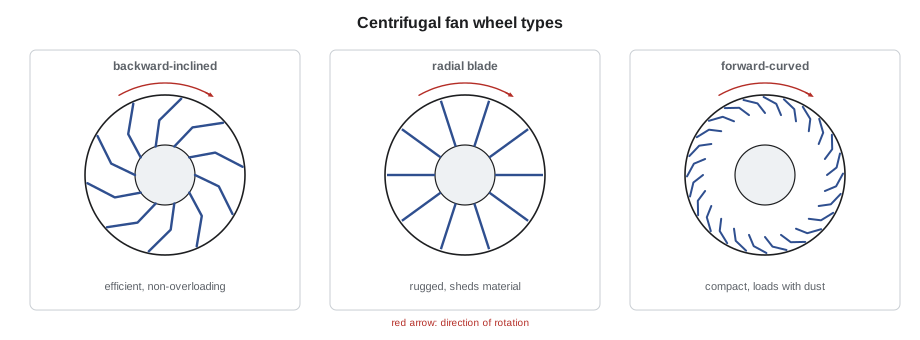
Most industrial exhaust fans are centrifugal: air enters the centre of a spinning wheel and is thrown outward by the blades into a scroll-shaped housing, which turns it through 90 degrees and discharges it. The shape of the blades decides the fan's character. Backward-inclined and airfoil wheels have blades that lean away from the direction of rotation; they are efficient, quiet and have a non-overloading power curve, which means the motor cannot be overloaded if the system resistance drops. They suit clean or lightly dusty air, such as the clean side of a dust collector or a laboratory exhaust. Radial-blade wheels have flat blades straight out from the hub; they are less efficient but rugged, and they shed material rather than collecting it, so they are used where dust or chips pass through the fan, such as material-handling fans that blow shavings to a cyclone. Forward-curved wheels, common in small air handlers, are rarely used for industrial exhaust because they load up with dust and their power rises steeply with flow.
Upblast centrifugal fans built for restaurant grease exhaust are a special family: a centrifugal wheel in a spun aluminum or steel housing that discharges straight up, with a grease drain and a hinge kit, listed for grease duct service. Brine & Ember's fan is one of these. Utility set fans, with a centrifugal wheel in a scroll housing on a steel base, are the usual choice for the Ironbark collector and for lab exhaust at higher pressures.
Axial and mixed-flow fans
Axial fans move air parallel to the shaft, like a propeller. Propeller fans in a wall panel move large volumes against very low pressure and are used for general ventilation, such as the existing wall fan in the Ironbark finishing room. Tube-axial and vane-axial fans, with the propeller in a cylindrical housing and, for vane-axials, guide vanes that straighten the swirl, reach higher pressures and fit neatly in a duct run. Mixed-flow inline fans combine features of both and are common for lab and general exhaust in ducts. Axial fans generally handle dusty air poorly and are noisier at a given duty than a well-chosen centrifugal fan.
| Fan type | Typical use on Keelson jobs | Notes |
|---|---|---|
| Backward-inclined or airfoil centrifugal | Collector clean side, lab exhaust, make-up air | Efficient; non-overloading; not for heavy dust through the wheel |
| Radial blade centrifugal | Material handling, dust or chips through the fan | Rugged, self-cleaning, less efficient |
| Upblast centrifugal (listed) | Restaurant grease exhaust | Vertical discharge, grease drain, hinge kit |
| Propeller | Wall ventilation, heat removal | Very low pressure only |
| Tube-axial or vane-axial | Inline general or fume exhaust | Compact; higher pressures with vanes |
| Mixed-flow inline | Lab and general exhaust in ducts | Good compromise of size and pressure |
Fan ratings and certified performance
Fan catalogues show performance tables and curves of airflow against pressure at various speeds, with the power needed. Those figures come from laboratory tests, and the standard way of testing fans is AMCA 210, the laboratory method for rating fan air performance, published jointly by the Air Movement and Control Association and ASHRAE. AMCA's certified ratings program, set out in AMCA 211 for air performance and AMCA 311 for sound, lets manufacturers display a seal showing that their published ratings have been checked by independent testing. Engineers usually specify certified fans, because a fan that does not meet its catalogue rating will not meet the system design no matter how well it is installed.
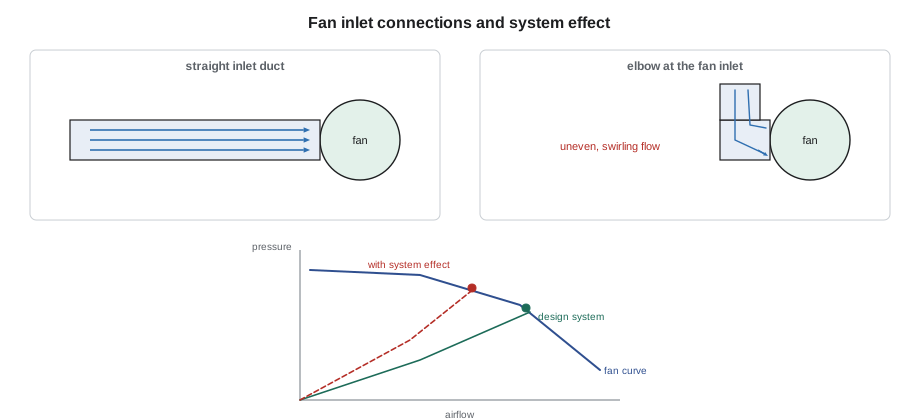
The rating is for a fan tested with ideal inlet and outlet ducts. The fan in the field rarely has those connections, and the difference is the system effect from SMW-330. An elbow right at the fan inlet, an inlet box that spins the air, or a short abrupt discharge can each cost a significant part of the fan's pressure. The fan curve does not change; the system effect is an extra loss the designer adds to the system so the operating point comes out where it should. Installation is where system effect is either avoided or built in, and Kai's job is to install inlet and outlet connections the way the drawings show, with the straight duct lengths the designer allowed for.
Fan laws and power
The fan laws from SMW-330 apply to industrial fans too. In an unchanged system, airflow varies directly with speed, pressure with the square of speed and power with the cube. Fan power, the power delivered to the air, is the airflow times the total pressure; the shaft power the motor must supply is that divided by the fan's efficiency, and the electrical input is higher again because of the motor and drive losses. Because power rises with the cube of speed, a dust system running ten percent faster than it needs to uses about a third more power.
# Shaft power for the Ironbark dust fan and the effect of speed
Q = 3.5            # airflow, m3/s
p = 2500            # fan total pressure, Pa
eta = 0.70         # fan efficiency (backward-inclined, clean side)
shaft = Q * p / (1000 * eta)
print(f"shaft power {shaft:.1f} kW")
for ratio in (0.9, 1.0, 1.1):
print(f"speed x{ratio}: airflow {Q * ratio:.2f} m3/s, pressure {p * ratio**2:.0f} Pa, power {shaft * ratio**3:.1f} kW")shaft power 12.5 kW speed x0.9: airflow 3.15 m3/s, pressure 2025 Pa, power 9.1 kW speed x1.0: airflow 3.50 m3/s, pressure 2500 Pa, power 12.5 kW speed x1.1: airflow 3.85 m3/s, pressure 3025 Pa, power 16.6 kW
Drives, motors and speed control
Fans are driven either directly, with the wheel on the motor shaft, or through belts and pulleys. Direct drive is simple and has no belt losses or belt maintenance, but the fan runs at the motor's speed unless a variable-frequency drive changes it. Belt drive lets the designer choose any fan speed by choosing the pulley sizes, and it keeps the motor out of the airstream, which is useful for hot, greasy or dusty exhaust; restaurant upblast fans and many utility sets are belt driven for exactly that reason. Belts need tensioning and replacement, and a slipping belt quietly lowers the airflow.
Variable-frequency drives are now common on industrial fans. They let the TAB technician set the fan to the speed the system actually needs rather than changing pulleys, they allow demand control on kitchen hoods and lab exhaust, and they give a soft start that is easier on belts and the electrical supply. On a dust system the drive can hold a constant suction in the main as gates open and close at the machines, which keeps transport velocity up in the branches that are working. The electrician installs the drive; the TAB technician sets its limits; the installer makes sure the motor is suitable for drive operation and is grounded as the manufacturer requires, because drive-induced shaft currents can damage bearings.
Spark-resistant construction
A fan that handles combustible dust, or flammable vapour, must not create sparks if the wheel rubs the housing or something strikes the wheel. AMCA Standard 99-0401 defines three classes of spark-resistant construction. Type A, the most protective, has all parts of the fan in contact with the airstream made of nonferrous material such as aluminum. Type B has a nonferrous wheel and a nonferrous ring around the shaft opening. Type C is designed so that a shift of the wheel or shaft does not let two ferrous parts strike each other, usually with a nonferrous inlet cone and rub strips. The engineer chooses the type for the hazard; motors outside the airstream and suitable for the electrical classification, and bonding and grounding of the fan, are part of the same protection.
Tomasz specified a Type B backward-inclined utility set for the Ironbark system, on the clean side of the baghouse, with the motor outside the airstream. Placing the fan after the collector means only filtered air passes through it, which removes most of the ignition risk and lets the more efficient wheel type be used. A radial-blade fan on the dirty side would have handled the dust but needed more power and a higher spark-resistance class.
Installing industrial fans
Fans are heavy, vibrate, and are connected to ducts that must not carry that vibration into the building. Keelson sets the fan on its base or on vibration isolators as specified, levels it, and connects it with flexible connectors at the inlet and outlet; for grease and combustible-dust service, the connector material and design must suit the service, and some specifications do not allow fabric connectors at all on those systems. Belt-driven fans need their belts aligned and tensioned, guards installed, and the rotation checked before the system is balanced. Fans on roofs need curbs and supports that resist wind and allow service access. And every fan needs a lockable disconnect within sight, so the person servicing it controls the power.
# Motor current check at start-up against nameplate
volts = 575           # measured voltage, three-phase
amps = 13.2            # measured current per phase
pf, eff = 0.86, 0.92  # assumed power factor and motor efficiency
import math
kw_in = math.sqrt(3) * volts * amps * pf / 1000
shaft = kw_in * eff
print(f"electrical input {kw_in:.1f} kW, estimated shaft output {shaft:.1f} kW")
fla = 15.0           # nameplate full-load amps
print("within nameplate" if amps <= fla else "over nameplate: check the system and the drive")electrical input 11.3 kW, estimated shaft output 10.4 kW within nameplate
Worked problem
Checking a speed change on the Brine & Ember fan
At start-up the Brine & Ember upblast fan delivers 1,330 L/s against the listed hood's required 1,400 L/s. The fan runs at 1,100 rpm with a motor drawing 2.4 kW at the shaft. What speed is needed, and what will the shaft power be?
Show solution
- Speed ratio: 1,400 ÷ 1,330 = 1.053.
- New speed: 1,100 × 1.053 = about 1,158 rpm.
- Power ratio: 1.053³ = 1.167.
- New shaft power: 2.4 × 1.167 = 2.8 kW, which the fan's 3.7 kW motor can supply.
Answer: A pulley change to about 1,160 rpm brings the hood to its listed rate with power to spare; the TAB group confirms it with a traverse.
Fan noise and vibration in service
A fan that was quiet at start-up and grows noisy over months is telling the maintenance staff something. Dust or grease building up on the wheel throws it out of balance, and the vibration that follows wears bearings and loosens supports; on a restaurant upblast fan, grease on the wheel is also a fire hazard and a sign the cleaning schedule is not being kept. A worn or loose belt squeals on start-up, and a bearing near the end of its life rumbles. Keelson's service technicians check vibration with a hand-held meter, compare it with the reading recorded at start-up, and clean or rebalance the wheel before the bearings fail. Keeping the start-up readings, the belt sizes and the pulley settings in the closeout record makes this work faster for whoever comes next.
Common mistakes
MistakeChoosing a forward-curved fan for a dusty exhaust.
InsteadUse a backward-inclined fan on clean air or a radial fan if dust passes through.
MistakePutting an elbow right at the fan inlet to save space.
InsteadProvide the straight inlet duct the design allows for, or the fan falls short.
MistakeSpecifying a fan from an uncertified catalogue.
InsteadUse certified ratings so the fan delivers what it claims.
MistakeUsing a standard steel fan on a combustible-dust or solvent system.
InsteadUse the spark-resistant type the engineer specifies, bonded and grounded.
MistakeLeaving belts loose after installation.
InsteadAlign and tension belts and check rotation before balancing.
Summary and key terms
- Backward-inclined fans are efficient for clean air; radial fans handle dust through the wheel.
- Restaurant grease exhaust uses listed upblast fans with grease drains and hinges.
- AMCA 210 sets the test method and AMCA certified ratings confirm published performance.
- Poor inlet and outlet connections cause system effect, a loss the fan curve does not show.
- Power rises with the cube of speed; drives let fans run at the speed the system needs.
- AMCA 99-0401 defines spark-resistant construction types A, B and C.
- Backward-inclined fan
- A centrifugal fan with blades leaning back from rotation; efficient and non-overloading.
- Radial blade fan
- A centrifugal fan with straight blades that sheds material.
- System effect
- Performance lost because of poor fan inlet or outlet connections.
- Certified ratings
- Published fan performance checked by an independent program.
- Spark-resistant construction
- Fan construction that avoids sparks if parts rub or are struck.
- Variable-frequency drive
- An electronic drive that varies motor speed.
Practice problems
Work each problem on paper first, then reveal the answer to check.
Why is a backward-inclined fan called non-overloading?
Show answer
Its power peaks within its range, so the motor is not overloaded if the system resistance drops.
A fan is slowed to 90 percent speed. Roughly what happens to its power?
Show answer
It falls to about 0.9³ = 0.73 of the original.
Why place a woodshop fan on the clean side of the collector?
Show answer
Only filtered air passes through it, reducing wear and the ignition risk.
What does AMCA 210 describe?
Show answer
The laboratory method for rating fan air performance.
Lesson quiz · 5 questions
Score 60% or more to complete this lesson.
Create a free account to save your progress, take quizzes and earn a certificate.