
SMW-320 · Lesson 2 of 12 · 20 min
Metals for architecture: movement and compatibility
The metal on a roof or wall lives through every summer afternoon and every winter night for as long as the building stands. It expands and contracts with temperature every day, it weathers, and it sits in contact with other metals, fasteners, mortar, wood and runoff from the rest of the roof. Choosing the metal and detailing it for movement and contact are what decide whether architectural work lasts ten years or a hundred. This lesson compares the common architectural metals, then explains thermal movement and galvanic corrosion, the two effects that cause most failures.
Copper
Copper has been used on roofs for centuries because it is easy to form, solders well, and protects itself as it weathers. New copper is bright salmon-pink. Within months it darkens to brown, then over years, depending on the climate and how much salt and sulphur are in the air, it develops the green patina of copper carbonates and sulphates. The patina is a stable, thin layer, and under it the metal corrodes very slowly. A copper roof that is well detailed can last well over a century; St. Brendan's nave roof, put on in the 1880s, is still sound in most places.
Architectural copper is sold by weight per square foot, in ounces, a habit kept in both countries. Sixteen-ounce copper, which weighs one pound per square foot, is about 0.55 mm (0.0216 in) thick and is the usual choice for roofing and most flashing. Twenty-ounce copper is used for gutters, copings and larger pieces that need more stiffness. Copper for building work is cold-rolled sheet to ASTM B370 in tempers from soft to cold-rolled; roofing usually uses the slightly harder cold-rolled temper, because soft copper dents and creeps. Lead-coated copper, and copper with a factory pre-patinated finish, are also available.
Zinc, stainless steel and aluminum
Architectural zinc, an alloy of zinc with small amounts of copper and titanium, weathers to a soft blue-grey and is popular for modern wall cladding and roofing in Europe and increasingly in North America. It moves more with temperature than copper and must be installed over a ventilated or structured underlay, because moisture trapped against its underside attacks it. Stainless steel, usually type 304 or, near salt air, type 316, is very durable, hard to form and expensive; it is used for copings, flashings in difficult places and in contact with copper. Aluminum is light and corrosion resistant in clean air, easy to form, and usually used with a factory paint finish for edge metal, copings, gutters and cladding panels. It is attacked by wet concrete, mortar and copper runoff.
Coated steel
Most commercial roof edges, copings and metal roofing in both countries are coated steel. Galvanized steel has a zinc coating; Galvalume-type steel has an aluminum-zinc alloy coating that usually lasts longer on roofs. Both are made to ASTM standards, A653 for galvanized and A792 for aluminum-zinc, with coating mass designations such as G90 or Z275 for galvanized. Most architectural coated steel also has a factory-applied paint system, often a polyvinylidene fluoride or silicone-modified polyester finish, that gives colour and protects the metallic coating. The cut edges of coated steel expose bare steel; they are normally hemmed or turned under so they are not left exposed to weather.
| Metal | Typical use | Weathering | Main cautions |
|---|---|---|---|
| Copper (16 to 20 oz) | Roofing, flashing, gutters, copings | Brown, then green patina | Runoff stains and attacks zinc, aluminum and galvanized steel |
| Architectural zinc | Cladding, roofing | Blue-grey patina | Needs a ventilated underside; high thermal movement |
| Stainless steel 304 or 316 | Copings, flashing, contact with copper | Little change | Hard to form; use 316 near salt |
| Prefinished aluminum | Edge metal, copings, gutters, panels | Paint lasts decades | Attacked by mortar and copper runoff |
| Prefinished coated steel | Edge metal, copings, roofing, panels | Paint lasts decades | Hem cut edges; scratches expose the coating |
Thermal movement
Every metal changes length with temperature, and the change is proportional to the length, the temperature change and the metal's coefficient of thermal expansion. On a roof, the temperature swing is much larger than the air temperature swing, because metal in summer sun gets far hotter than the air and radiates heat to the night sky in winter. Architectural design usually assumes a metal surface range of about 100 Celsius degrees, or about 180 Fahrenheit degrees, between the coldest winter night and the hottest summer afternoon.
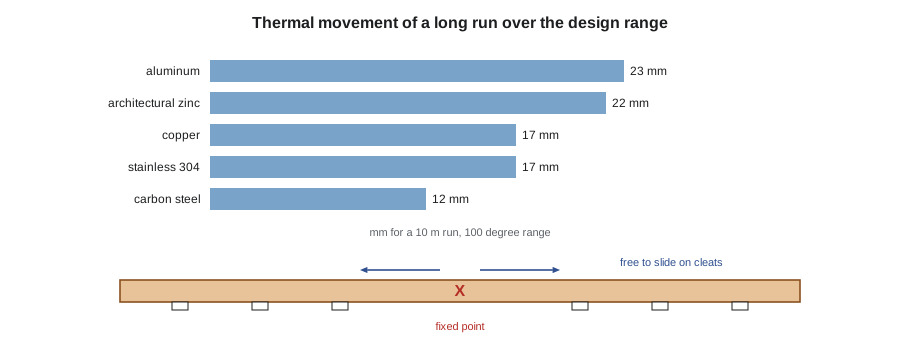
Here ΔL is the change in length, α the coefficient of thermal expansion, L the length and ΔT the temperature change. Copper's coefficient is about 17 millionths per Celsius degree, aluminum's about 23, architectural zinc's about 22, stainless steel's about 17 for the austenitic grades, and carbon steel's about 12. The numbers look tiny, but on a long piece they are not.
Kai compared the movement of a 10 m run of gutter or coping in each metal over Keelson's design range.
# Thermal movement of a long run of metal over the design temperature range
length = 10.0          # m
dT = 100             # design surface temperature range, Celsius degree
alpha = {            # coefficient of expansion, per Celsius degree (approximate)
    "copper": 17e-6,
    "aluminum": 23e-6,
    "architectural zinc": 22e-6,
    "stainless 304": 17e-6,
    "carbon steel": 12e-6,
}
for metal, a in alpha.items():
    move = a * length * dT * 1000
print(f"{metal:20s} {move:5.1f} mm")copper 17.0 mm aluminum 23.0 mm architectural zinc 22.0 mm stainless 304 17.0 mm carbon steel 12.0 mm
A 10 m aluminum coping grows and shrinks by about 23 mm over a year. If it were fastened solidly at both ends, the metal would buckle in summer and tear its fasteners or open its joints in winter. That is why architectural sheet metal is fixed at one point and allowed to slide everywhere else, and why long runs are broken with expansion joints. The general SMACNA guidance limits the distance between expansion joints in gutters and copings to a few metres or tens of feet depending on the metal and profile, and lesson 6 uses it for gutters.
Cleats and fixing for movement
Cleats are the traditional answer to movement. A cleat is a small strip of metal fastened to the deck or blocking and folded into the seam or hem of the panel, so it holds the panel down but lets it slide along its length. Fixed cleats, with no slide, are used at one point on each panel; sliding or expansion cleats are used at the rest. On copings and edges, a continuous cleat along the face edge holds the hem, and the metal is fastened only at the back or through slotted holes. Exposed fasteners through the face of long pieces should be avoided, or limited to one fixed point, because they either tear out or crack the metal around them.
The cleats must be compatible with the panel. St. Brendan's apse had a batten seam roof repaired in the 1960s with galvanized steel cleats. Copper and galvanized steel in contact, in the wet, form a battery that corrodes the zinc and then the steel; by the time Keelson opened the apse roof, many of the cleats had rusted through and the roll caps were loose. The repair used copper cleats, as the original roof had.
Galvanic corrosion
When two different metals touch in the presence of an electrolyte, such as rainwater with a little salt or acid in it, they form a cell. The metal that is more active in the galvanic series becomes the anode and corrodes faster; the more noble metal becomes the cathode and is protected. The further apart the two metals are in the series, and the larger the cathode compared with the anode, the faster the attack. A small zinc-coated fastener in a big sheet of copper is the worst case.
| More active (anode) | More noble (cathode) | |
|---|---|---|
| Zinc and galvanized coatings | → | Aluminum |
| Aluminum | → | Carbon steel and cast iron |
| Carbon steel | → | Lead and tin solder |
| Lead | → | Copper and brass |
| Copper | → | Stainless steel in its passive state |
Galvanic action also travels with water. Rain that runs off copper picks up dissolved copper ions; when it reaches galvanized steel or aluminum downstream, the copper plates out on the surface and starts tiny cells that pit the less noble metal. So a copper roof should not drain onto aluminum or galvanized gutters, and a copper flashing above a galvanized one is a mistake that shows up as rust streaks within a few years. Water flowing the other way, from aluminum onto copper, does little harm. St. Brendan's had galvanized downspouts added in the 1950s; they had rusted through at every elbow, and the restoration replaces them with copper.
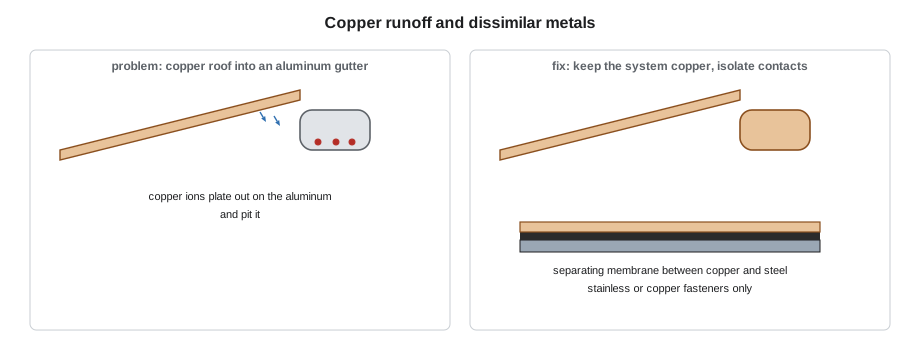
Where two metals must touch, the contact is broken with a non-conductive separator, such as a self-adhered membrane, a bituminous coating or a plastic washer, and fasteners are chosen to match or be more noble than the metal they pass through. Copper is fastened with copper or bronze nails or stainless steel screws; aluminum with aluminum or stainless; coated steel with coated or stainless fasteners. Kai made a pocket card for the fastener rules and kept it in his tool belt.
# Galvanic check: is this pair of metals safe together in the wet?
series = ["zinc", "galvanized steel", "aluminum", "carbon steel", "lead", "copper", "stainless steel"]
pairs = [("copper", "galvanized steel"), ("copper", "stainless steel"), ("aluminum", "stainless steel"),
         ("aluminum", "copper"), ("copper", "lead")]
for a, b in pairs:
    gap = abs(series.index(a) - series.index(b))
    anode = a if series.index(a) < series.index(b) else b
    risk = "avoid or isolate" if gap >= 3 else ("isolate if wet and the anode is small" if gap == 2 else "generally acceptable")
print(f"{a} + {b}: {anode} would corrode first; {risk}")copper + galvanized steel: galvanized steel would corrode first; avoid or isolate copper + stainless steel: copper would corrode first; generally acceptable aluminum + stainless steel: aluminum would corrode first; avoid or isolate aluminum + copper: aluminum would corrode first; avoid or isolate copper + lead: lead would corrode first; generally acceptable
The rule is coarse, because real galvanic behaviour depends on the electrolyte, the area ratio and the surface condition, but it catches the combinations that cause most trouble on roofs. Copper with lead and copper with stainless are long-standing, accepted combinations; copper with galvanized steel or aluminum needs isolation or a different design.
Contact with other materials
Metal also reacts with non-metals. Wet mortar, concrete and some cement boards attack aluminum and zinc. Treated lumber with copper-based preservatives attacks aluminum and galvanized steel fasteners, so flashings and fasteners against it must be compatible. Cedar and some oak contain acids that stain copper and attack zinc. Acidic runoff from moss or asphalt shingles can attack copper at the drip line. And all metals need the water to leave: a pan that holds a puddle, or a flashing laid flat against wet wood, corrodes from underneath. Underlayments under metal roofing, such as a slip sheet over a self-adhered membrane, let the metal slide and keep the membrane's adhesive from sticking to it.
Worked problem
Movement of a copper coping run
The St. Brendan's parapet coping on the hall wing runs 14.4 m in 16 oz copper. Over a 100-degree Celsius range, how much does it move, and how should it be fixed?
Show solution
- ΔL = 17 × 10⁻⁶ × 14 400 mm × 100 = 24.5 mm.
- That is too much for one run fixed at its ends; it needs expansion joints.
- With joints dividing it into three runs of about 4.8 m, each moves about 8 mm, fixed at its centre and free at both ends.
Answer: Break the coping into three runs with two expansion joints, fix each at its centre, and hold the rest on continuous cleats.
Ordering and storing architectural metal
Architectural metal is easy to damage before it is ever installed. Prefinished coil and sheet come with a peelable film that protects the paint during forming, and it should stay on in the shop and come off soon after installation. Copper and zinc are stored dry and flat, interleaved with paper, because water trapped between sheets in a stack stains them in patches that never weather evenly. Walt keeps a separate rack and bench for copper, as he does for stainless, so steel filings from other work cannot embed in the copper and rust on the finished roof.
Common mistakes
MistakeFastening a long coping solidly at both ends.
InsteadFix each run at one point and let the rest slide on cleats.
MistakeUsing galvanized cleats or nails in copper work.
InsteadUse copper, bronze or stainless fasteners and cleats with copper.
MistakeDraining a copper roof into aluminum or galvanized gutters.
InsteadKeep the drainage path copper, or redesign the drainage.
MistakeLaying aluminum flashing in wet mortar.
InsteadIsolate aluminum from mortar and concrete with a coating or membrane.
MistakeLeaving cut edges of coated steel exposed.
InsteadHem or turn cut edges under so the steel is not left bare.
Summary and key terms
- Copper, zinc, stainless, aluminum and coated steel each suit different architectural uses.
- Architectural copper is sold by ounces per square foot; 16 oz is about 0.55 mm (0.0216 in) thick.
- Thermal movement is α × L × ΔT and is large on long pieces with roof temperature swings.
- Fix each piece at one point and let it slide on cleats; break long runs with expansion joints.
- Galvanic corrosion attacks the more active metal; copper runoff attacks zinc, galvanized steel and aluminum downstream.
- Isolate dissimilar metals and match fasteners to the metal they pass through.
- Patina
- The stable weathered surface layer that forms on copper or zinc.
- Cleat
- A small strip fastened to the substrate and folded into a seam or hem to hold metal while letting it move.
- Coefficient of thermal expansion
- The fractional change in length per degree of temperature change.
- Galvanic series
- A ranking of metals from most active to most noble in a given electrolyte.
- Anode
- In a galvanic pair, the metal that corrodes.
- Expansion joint
- A joint in a long run of metal that lets each section move independently.
Practice problems
Work each problem on paper first, then reveal the answer to check.
How thick is 16 oz copper?
Show answer
About 0.55 mm.
A 6 m stainless coping sees a 100-degree range. How much does it move?
Show answer
17 × 10⁻⁶ × 6000 × 100 ≈ 10 mm.
Why did the galvanized cleats on the St. Brendan's apse fail?
Show answer
Galvanic corrosion: galvanized steel is far more active than the copper it touched.
Which fastener material may be used in copper flashing?
Show answer
Copper, bronze or stainless steel.
Lesson quiz · 5 questions
Score 60% or more to complete this lesson.
Create a free account to save your progress, take quizzes and earn a certificate.