
SLS-299 · Lesson 6 of 12 · 18 min
The stakeholder map
▶ Video coming soon A video version of this lesson is on the way.
Maya's discovery letter asked for a meeting with Gareth Pruden and Joanne Whitecap, and Simone arranged it for Tuesday, January 12, 2027, in the scenario. Darnell played Gareth and Leah Marchand played Joanne, each from a private brief. A week later, on Tuesday, January 19, Maya met Simone and Gareth together to agree a timeline for the decision.
This stage produces two deliverables: a stakeholder map that shows who is involved in the decision, what each person cares about and where each stands, and a mutual action plan that sets out the steps both sides will take to reach a decision by a date.
The meeting with Gareth and Joanne
Gareth opened by saying he had read the move timeline Simone forwarded in November and that it was "the first thing a supplier sent us that was about our problem instead of their catalogue." He then explained the process. Wheatland's finance policy requires three written quotes for any purchase over 25,000 dollars. He had invited three suppliers to quote: Ridgeline; Corwin Office Interiors, a national dealer with an office in the city; and Northline Direct, an online furniture seller that ships flat-packed furniture and uses third-party installers.
He shared his scoring sheet, which Simone had mentioned. Quotes would be due at noon on Tuesday, February 9. Each supplier would present to a small committee in the week of February 1. Gareth would score the quotes, take a recommendation to the finance committee on February 16, and Rachel would take it to the board on March 9.
| Criterion | Weight | What Gareth said he would look for |
|---|---|---|
| Price and total cost | 30 | The quoted price and what it costs Wheatland over the life of the furniture |
| Quality and warranty | 25 | Durability, ergonomics for schedulers, warranty length |
| Delivery and installation plan | 25 | A credible plan to be working by June 28 |
| Service and support | 20 | Who fixes things, how fast, at all three sites |
On budget, Gareth was direct. The board had approved a move budget in October of 140,000 dollars: 18,000 for the movers, 6,000 for signs, 16,000 for network cabling, and "about 100,000 for furniture and technology, including a contingency." He did not say how large the contingency was, and Maya did not press. He also explained why the timing mattered beyond the move: Wheatland's fiscal year ends on March 31, and money budgeted for 2026-27 must be committed by then or go back to the board.
Joanne's concerns were narrower and firmer. After the fax-tray incident in September, she would not approve any printing setup that left health information on paper in shared areas or on unprotected device drives. She wanted four things: printing released only when the person was at the device, encrypted storage on every printer, a certificate that each device's drive had been wiped when it was removed, and a written agreement covering any access Ridgeline's technicians might have to stored documents. Because Wheatland handles personal health information under its health authority contracts, she treats records under The Health Information Protection Act and would expect an information management service provider agreement. She added one more request: no client names in meeting-room booking titles.
Roles in the decision
SLS-211 and SLS-220 taught that complex purchases involve a buying group, and that each person plays a role. The roles are not job titles. They describe what a person does in this decision.
| Person | Role | Influence | Stance toward Ridgeline | What they care about |
|---|---|---|---|---|
| Board, chaired by Harold Fenske | Final approval | High | Unknown | Value for money, risk to the move |
| Rachel Okonkwo | Sponsor; recommends to the board | High | Warm (heard of Ridgeline from Dr. Anand) | Training caregivers, linking branches |
| Gareth Pruden | Economic gatekeeper; runs the quotes | High | Neutral, positive about the timeline | Total cost, fiscal-year timing, risk |
| Simone Bélanger | Champion candidate; runs the move | Medium | Supportive | Being working by June 28 |
| Joanne Whitecap | Approver for privacy; possible blocker | Medium | Neutral | No health information exposed |
| Trevor Nakai | Technical evaluator | Medium | Neutral | Single sign-on, network security |
| Deshawn Miller | User representative | Low to medium | Supportive | Adjustable desks, quiet, two screens |
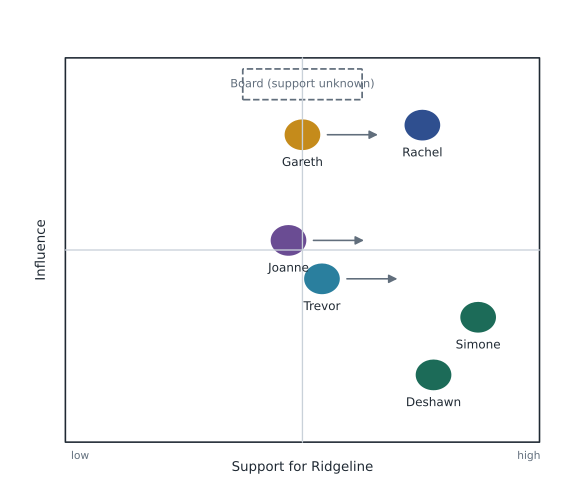
Testing the champion
A champion is someone inside the customer who wants the seller to win and has the influence to help. SLS-211 warned against confusing a friendly contact with a champion. Ridgeline's test has three parts: the person has influence over the decision, the person gains something if the seller's solution wins, and the person is willing to act, such as sharing information or arranging access.
| Test | Evidence for Simone | Result |
|---|---|---|
| Influence | Makes the operational recommendation; Gareth listens to her on dates | Partly: she does not control the scoring |
| Gains if we win | A credible plan to meet June 28 protects her project | Yes |
| Willing to act | Forwarded the timeline, arranged the site visit and the Gareth meeting | Yes |
Simone passed two of the three tests fully and one partly. Maya concluded that Simone was a genuine champion with limited formal power, and that her plan should give Simone what she needed to argue for Ridgeline inside Wheatland: a clear installation plan she could defend to Gareth and the board.
Working backward from the move
The most useful thing Maya learned on January 12 was not about people at all. Gareth's criteria weighted the delivery and installation plan at 25 points, and the move date could not slip. Maya worked backward from the install window to see what each supplier's lead time meant.
Worked problem
When must the furniture be ordered?
Installation starts on Monday, June 14, 2027. Ridgeline plans one week of buffer before installation, so furniture must arrive by Monday, June 7. Ridgeline's lead time for this furniture is 6 weeks from order. Corwin quoted 12 weeks to Wheatland, as Gareth mentioned. What is the latest order date for each, and how does it compare with the board's decision on March 9?
Show solution
- Ridgeline: June 7 minus 6 weeks is Monday, April 26.
- Corwin: June 7 minus 12 weeks is Monday, March 15.
- The board decides on Tuesday, March 9, and the contract is signed the next day at the earliest.
- Corwin's order would have to be placed within four working days of the board decision, with no slack for layout changes; Ridgeline has about seven weeks of slack.
Answer: Ridgeline must be ordered by April 26 and Corwin by March 15. Corwin's lead time leaves almost no room for delay, which matters under a criterion worth 25 points.
Maya did not plan to criticize Corwin. She planned to show Wheatland its own dates, with each supplier's lead time on them, and let Gareth draw the conclusion. A comparison the customer makes for himself is more persuasive than one the seller makes for him, and it avoids any claim about a competitor that Maya could not support.
The mutual action plan
On January 19, Maya proposed a mutual action plan that set out the steps both sides would take, with owners and dates. SLS-211 taught that a good mutual action plan is written with the customer, not for the customer, and that it includes the customer's internal steps as well as the seller's.
| Date | Step | Owner |
|---|---|---|
| January 26 | Share solution outline for Simone and Trevor to check | Maya |
| January 29 | Confirm Joanne's privacy requirements in writing | Joanne, Maya |
| February 2 | Ridgeline presentation to the committee | Maya, Simone |
| February 9, noon | Written quote due | Maya |
| February 16 | Recommendation to the finance committee | Gareth |
| February 17 to 26 | Questions and final terms | Gareth, Maya |
| March 9 | Board decision | Rachel |
| March 10 | Contract signed electronically | Gareth, Ridgeline |
| March 12 | Order placed and layout confirmed | Maya, Simone |
| June 14 to 25 | Installation | Ridgeline |
| June 28 | Office working | Simone |
Gareth asked for one change: he wanted the step on Joanne's requirements moved before the presentation, because he did not want to score a supplier who could not meet them. Maya agreed. The change was small, but Darnell pointed out that Gareth editing the plan was a sign of ownership: a customer who changes a plan is treating it as his own.
| Criterion | Points | Full points when | Maya |
|---|---|---|---|
| Roles and influence | 5 | Every stakeholder placed with a role, influence and stance, with evidence | 5 |
| Champion test | 3 | Champion tested against influence, gain and willingness | 3 |
| Decision criteria and process | 4 | Criteria, weights, steps and dates captured accurately | 4 |
| Mutual action plan | 5 | Customer and seller steps, owners and dates, agreed with the customer | 5 |
| Use of information | 3 | Competitors handled fairly; customer information kept confidential | 2 |
| Total | 20 | 19 |
Maya lost a point because her first draft of the map called Corwin "slow". Darnell asked her to replace it with the fact: a 12-week lead time quoted to Wheatland.
Reflection
- Which stakeholder could stop the deal, and what does that person need to see?
- Does your champion pass all three tests? If not, how will you compensate?
- Which step in your mutual action plan is most likely to slip, and what would you do?
Understanding the competition fairly
Gareth had named the two other suppliers, and Maya needed to understand them without crossing any lines. She used three sources: what Gareth and Simone had said, the competitors' own public websites, and Ridgeline's past experience when it had competed with them. She did not ask anyone at Wheatland to share a competitor's quote, and she did not contact either competitor.
| Supplier | What Maya knew | Source | Likely strength | Likely weakness for Wheatland |
|---|---|---|---|---|
| Corwin Office Interiors | National dealer, local showroom, 12-week lead time quoted | Gareth; Corwin website | Range, brand names, price on volume | Lead time against the June dates |
| Northline Direct | Online seller, flat-packed furniture, third-party installers | Gareth; Northline website | Lowest product price | Installation and service at three sites |
| Ridgeline | Local, furniture plus room technology, booking and printing | Maya | Single plan for the whole move, local service | Furniture price likely higher than Northline |
Two areas of law shaped how she would use this. Under the Competition Act, any comparison she made with a competitor had to be true and not misleading in its general impression, and claims about performance had to rest on adequate and proper testing. Section 47 of the Act makes bid-rigging a criminal offence, so any contact with Corwin or Northline about the quote, even a casual conversation at an industry event, was off limits. Ridgeline's sales code, from SLS-150, adds a simpler rule: never say anything about a competitor that you would not say with the competitor in the room.
Reaching the economic buyer properly
The board would make the final decision, and Rachel would present the recommendation. Maya had not met Rachel. Her plan for reaching the top of the account had three parts, each designed to respect the people below.
| Step | How | Why this way |
|---|---|---|
| Ask Simone and Gareth | "Would it help if Rachel saw our plan before February 2?" | Keeps the champion and the gatekeeper in control |
| Give Rachel something useful | A one-page summary of training and branch benefits, in her words from the public post | Executives read one page, not forty |
| Never contact the board | No calls or emails to board members | The board acts through Rachel and Gareth; going around them would damage trust |
Gareth agreed that Rachel would join the presentation on February 2. That changed Maya's planning: the presentation would now have the sponsor in the room, so it had to speak to Rachel's goals as well as Gareth's criteria.
Keeping the map current
A stakeholder map goes out of date quickly. People change their minds, new people join the decision, and a quiet stakeholder can become a loud one. Ridgeline asks sellers to review the map after every significant meeting and to date each change. Between January 12 and January 19, Maya made three updates: Joanne's stance moved from unknown to neutral once she had stated her requirements; Trevor's concern about single sign-on became a written requirement; and Rachel was added to the presentation. Each update had a source and a date in the CRM, so that Darnell, reviewing the deal, could see how the picture had changed and why.
Common mistakes
MistakeThe person you talk to most is the champion.
InsteadA champion has influence, gains if you win and is willing to act.
MistakeThe mutual action plan is the seller's project plan.
InsteadIt is written with the customer and includes the customer's internal steps.
MistakePoint out a competitor's weaknesses.
InsteadShow the customer the facts and let the customer compare.
MistakeThe budget is the only number that matters.
InsteadDates such as the fiscal year end and lead times can matter as much.
Summary and key terms
- The stakeholder map shows each person's role, influence, stance and interests.
- At Wheatland, the board approves, Rachel sponsors, Gareth runs the quotes, Simone is a champion with limited formal power, Joanne can block on privacy and Trevor approves anything on the network.
- Gareth's scoring sheet weights price and total cost 30, quality 25, delivery and installation 25 and service 20.
- Working backward from the June 14 install, Ridgeline must be ordered by April 26 and Corwin by March 15.
- The mutual action plan, agreed on January 19 and edited by Gareth, runs from the solution outline to a working office on June 28.
- Stakeholder map
- A chart of the people involved in a decision, with their roles, influence and stance.
- Champion
- A person inside the customer who has influence, gains if the seller wins and is willing to act.
- Mutual action plan
- A shared plan of the steps both sides will take to reach a decision by a date.
- Lead time
- The time between placing an order and receiving the goods.
- Information management service provider
- Under Saskatchewan's Health Information Protection Act, an organization that processes, stores or handles personal health information for a trustee.
Practice problems
Work each problem on paper first, then reveal the answer to check.
Why did Gareth's edit to the mutual action plan please Darnell?
Show answer
It showed Gareth treating the plan as his own.
A supplier has an 8-week lead time. Using the June 7 arrival date, when must it be ordered?
Show answer
Monday, April 12, 2027.
Which stakeholder could block the deal even if price and delivery were right?
Show answer
Joanne, if the privacy requirements were not met.
Lesson quiz · 5 questions
Score 60% or more to complete this lesson.
Create a free account to save your progress, take quizzes and earn a certificate.