
SLS-299 · Lesson 5 of 12 · 18 min
Discovery
▶ Video coming soon A video version of this lesson is on the way.
Discovery in the scenario happened in two meetings. The first was a 45-minute video call with Simone on Thursday, December 10, 2026. The second, a week later on Thursday, December 17, was a site visit: an hour at Wheatland's current head office, then a walk through the empty floors of the new building with Simone, the scheduling lead Deshawn Miller and the IT contractor Trevor Nakai.
Farida's private brief for Simone contained several facts that Simone would share only if asked the right question. Darnell built the brief that way on purpose. In real discovery, the most important facts are rarely volunteered; a customer answers the questions she is asked and assumes the seller already knows the rest.
The discovery plan
Maya's deliverable for this stage has two parts: a discovery plan prepared before the first meeting, and a summary letter sent afterward. The plan sets objectives, lists the questions, and names what Maya will not do.
| Section | Maya's plan for December 10 |
|---|---|
| Objectives | Confirm the scope of the move; learn how branch staff train today; find out who decides and how; learn what has been ruled out |
| Hypotheses to test | Training-room video, furniture, booking across sites, printing (lowest) |
| Opening | Thank her, confirm 45 minutes, agree the agenda, ask what she hopes to get from the call |
| Questions | Situation, problem, implication and need-payoff questions, below |
| What not to do | No prices, no product demonstrations, no criticism of the other dealers |
| Close | Agree a summary and a next step, ideally the site visit |
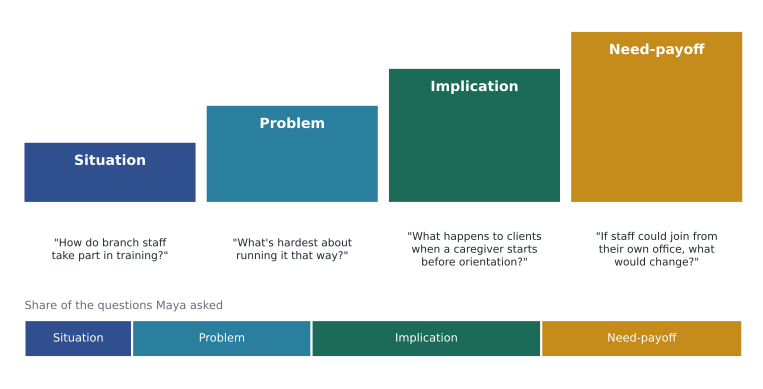
Questions in the SPIN sequence
SLS-211 taught Neil Rackham's SPIN sequence, from his study of about 35,000 sales calls published in 1988. Situation questions establish facts, problem questions uncover difficulties, implication questions explore what those difficulties cost, and need-payoff questions let the customer describe the value of a solution in her own words. Rackham found that successful sellers in large sales asked relatively few situation questions, because buyers find them tedious, and many more implication and need-payoff questions.
| Type | Maya's question | What Simone said |
|---|---|---|
| Situation | "Which parts of the move are you responsible for, and which sit with someone else?" | She runs the move; Gareth runs the quotes and the budget; the board approves |
| Situation | "How do branch staff take part in training today?" | New branch hires drive to head office for a two-day orientation |
| Problem | "What's hardest about running orientation that way?" | Branch hires wait for a group of five, so some start visits before they are fully trained |
| Implication | "What happens to clients when a new caregiver starts before orientation?" | More supervision visits by nurses, and two client complaints last year |
| Implication | "How often do branch staff make the trip?" | About 60 trips a year, two hours each way, mileage and paid travel time |
| Need-payoff | "If branch staff could join orientation from their own office, what would change?" | "We could train people in their first week instead of waiting for a group." |
| Situation | "How do orders from physicians reach the scheduling team?" | By fax, printed at reception |
| Problem | "Has the fax setup ever caused trouble?" | In September a client's medication order sat in the tray and a visitor saw it; Joanne logged a privacy incident |
| Need-payoff | "What would you want from printing in the new office, if you could design it?" | "Nothing sitting in a tray for anyone to read." |
The question about physician orders was the turning point of the call. Simone had described the move as "mostly a furniture job". Maya's question about faxes opened a problem that Simone had not connected with the move at all: a privacy incident that Joanne, the privacy officer, was still worried about. Printing had been Maya's lowest-ranked hypothesis. It moved to second place in ten minutes.
Quantifying the problem
A problem becomes a business case when it has a number. In the call, Maya asked Simone for the figures behind the training trips, and Simone offered to pull them from the mileage claims. They arrived the next day.
Worked problem
The cost of travelling to training
Wheatland's records show about 60 trips a year by branch staff to head-office training. Each trip averages 160 dollars in mileage and 2.5 hours of paid travel time at a loaded wage of 32 dollars an hour. Quarterly all-staff sessions are also held in a rented hotel meeting room at 900 dollars each. What do these cost Wheatland a year?
Show solution
- Paid travel time per trip: 2.5 × 32 = 80 dollars.
- Cost per trip: 160 + 80 = 240 dollars.
- \[60 \times 240 = 14{,}400 \text{ dollars a year in travel}\]
- \[4 \times 900 = 3{,}600 \text{ dollars a year in room rental}\]
- Total: 14,400 + 3,600 = 18,000 dollars a year.
Answer: About 18,000 dollars a year, before counting the harder-to-price effects: caregivers who start before orientation, extra nurse supervision visits and two client complaints.
Maya was careful about what she would claim. The travel and rental costs were Wheatland's own figures, so they were hard numbers. The effects on clients were real but not priced, so she would describe them, not add them to the total. Lesson 7 builds these figures into the value case.
The site visit
The site visit on December 17 answered practical questions that a call cannot. At the current office, Maya counted nine printers across the floor plan, including two that Simone had forgotten, and saw the fax tray at reception. She asked Deshawn what the 18 schedulers needed. His answer was specific: desks that could be raised and lowered, because schedulers sit on the phone most of the day; screens big enough for two schedule views; and quiet, because "we're talking to clients and their families about very personal things."
At the new building, Trevor showed where the network cabling would run and said that anything connecting to the network would need his approval and would have to support single sign-on with Wheatland's email accounts. Simone walked Maya through the dates: the landlord would finish the fit-out on May 28, furniture and technology had to be installed between June 14 and June 25, the move was the weekend of June 26 and 27, and the office had to be working on Monday, June 28, because Wheatland's current lease ended on June 30.
| Constraint | Detail | Why it matters |
|---|---|---|
| Install window | June 14 to June 25, 2027 | Lead times must leave room for delays |
| Move weekend | June 26 and 27 | Everything must be working by June 28 |
| Old lease ends | June 30 | A late move means paying extra rent |
| IT approval | Single sign-on, Trevor's approval | Room technology and printers must meet it |
| Quiet for schedulers | Calls about personal care | Affects desk layout and screens |
| Existing items kept | Board table, filing cabinets | Reduces the furniture scope |
The summary letter
Ridgeline sends every discovery a written summary within a day, as SLS-211 taught. The letter restates what the customer said in her words, confirms what is still unknown, and proposes the next step. It is the first document that shows Wheatland whether Maya was listening.
| Section | Maya's letter to Simone, December 18 |
|---|---|
| What you told us | The move must be working by June 28; branch hires wait for group orientation; physician orders arrive by fax at reception; schedulers need adjustable desks and quiet |
| What it costs today | About 14,400 dollars a year in training travel and 3,600 dollars in room rental, from Wheatland's records |
| What we still need to learn | The approved budget, how quotes will be compared, the board's timing, Joanne's privacy requirements |
| What we are not proposing yet | Any prices or products, until we have met Gareth and Joanne |
| Suggested next step | A meeting with Gareth and Joanne in the week of January 11 |
| Criterion | Points | Full points when | Maya |
|---|---|---|---|
| Plan | 3 | Objectives, hypotheses, questions and limits written before the call | 3 |
| Questioning | 6 | More implication and need-payoff questions than situation questions; hidden facts found | 6 |
| Quantifying | 4 | At least one problem priced from the customer's own data | 4 |
| Listening | 3 | Customer's words captured; no pitching | 2 |
| Summary letter and next step | 4 | Sent within a day, accurate, with a specific next step | 4 |
| Total | 20 | 19 |
Farida took a point off listening because, when Simone mentioned the two furniture dealers, Maya said, "Our warranty is much better than theirs." It was the only time she pitched, and Farida's brief had Simone become slightly guarded for the next five minutes.
Reflection
- Which question in your discovery uncovered a fact the customer had not connected with the project?
- Where did you talk more than you planned, and what did it cost?
- Which numbers in your summary are the customer's own, and which are your estimates?
Learning the decision before the solution
Two of Maya's objectives were about the decision rather than the problem: who decides and how, and what has been ruled out. Sellers often leave these questions until late, because they feel more awkward than questions about pain. Darnell's view is the opposite. A seller who learns the problem in detail but not the decision process will build an excellent solution and then watch it stall in a committee she has never met.
Maya asked three decision questions near the end of the call, after Simone had described the problems, so that they felt like natural next steps rather than an interrogation.
| Decision question | Simone's answer | MEDDPICC element |
|---|---|---|
| "Once you have quotes, what happens next?" | Gareth compares three quotes and takes a recommendation to the finance committee on February 16; the board decides on March 9 | Decision process |
| "How will the quotes be compared?" | "Gareth has a scoring sheet. Price matters, obviously, but the move date matters more." | Decision criteria |
| "Is there anything you've already ruled out?" | "We looked at moving the old furniture, but most of it is twenty years old and the desks don't adjust." | Identified pain; scope |
With these answers, the MEDDPICC grid from lesson 3 began to fill. Maya now knew the decision process and its dates, had a first view of the decision criteria, and knew that new furniture was confirmed rather than guessed. She still did not know the budget, the paper process or the competitors' names. She also learned something about Simone's role as a possible champion: Simone would make a recommendation, but Gareth controlled the scoring sheet. Maya would need to meet him before the quotes were requested.
Notes during discovery
Ridgeline asks sellers to take notes in three columns during discovery: what the customer said, in her words where possible; what it might mean; and what to ask or check next. The discipline stops a seller from writing down her own interpretation as if it were the customer's statement, a mistake that causes trouble when the summary letter repeats something the customer never said.
| Customer said | Might mean | Ask or check |
|---|---|---|
| "Mostly a furniture job." | Scope may be narrower than the hypotheses | Ask how branch staff train; ask about printing |
| "We could train people in their first week." | Strong need-payoff for training-room video | Get the trip and cost figures |
| "Joanne logged it." | Privacy officer has a live concern | Ask to meet Joanne |
| "Gareth has a scoring sheet." | Formal criteria exist | Ask Gareth for the criteria and weights |
Maya kept her notes on paper during the video call and typed them into the CRM within an hour, while she still remembered the tone of each answer. She did not record the call. Under PIPEDA and Saskatchewan practice, recording a business call for sales purposes needs the other person's knowledge and agreement, and Ridgeline's policy is to ask first and to record only when there is a clear reason. For discovery, she judged that notes were enough and that asking to record would make Simone more guarded.
Agreeing the next step
The call ended with a specific next step, not a general promise to stay in touch. Maya proposed the site visit for the following Thursday and asked whether Trevor and Deshawn could join, because their needs would shape the solution. Simone agreed and sent the calendar invitation herself before the call ended, which Darnell counts as a good sign: a prospect who takes an action is more committed than one who only agrees to one.
Common mistakes
MistakeDiscovery is a chance to show product knowledge.
InsteadDiscovery is for the customer's problems; product talk comes later.
MistakeThe customer will tell you the important facts.
InsteadImportant facts often appear only when you ask the right question.
MistakeAdd every effect you can think of to the cost of the problem.
InsteadPrice what the customer's data supports; describe the rest.
MistakeA summary letter is a formality.
InsteadIt proves you listened and sets the next step in writing.
Summary and key terms
- Discovery used a written plan, two meetings and a summary letter.
- Maya asked mostly problem, implication and need-payoff questions, following Rackham's SPIN research.
- A question about how physician orders arrive revealed a privacy incident and moved printing from the lowest hypothesis to the second.
- Travel and room rental for training cost Wheatland about 18,000 dollars a year, from its own records.
- The site visit set firm constraints: an install window of June 14 to 25, a move on June 26 and 27, and IT approval for anything on the network.
- The summary letter confirmed what was said, what is unknown and the next step.
- Discovery
- The stage of a sale in which the seller learns the customer's situation, problems and priorities.
- Situation question
- A question that establishes facts about the customer's current state.
- Implication question
- A question that explores the consequences of a problem.
- Need-payoff question
- A question that invites the customer to describe the value of solving a problem.
- Summary letter
- A written follow-up that restates what the customer said and proposes the next step.
Practice problems
Work each problem on paper first, then reveal the answer to check.
Why did Farida's brief hide some facts unless Maya asked the right question?
Show answer
Because in real discovery the most important facts are rarely volunteered.
If trips rose to 72 a year at 240 dollars each, what would travel cost?
Show answer
72 × 240 = 17,280 dollars a year.
Why did Maya describe but not price the effects on clients?
Show answer
Wheatland's data supported the travel and rental costs but not a dollar figure for client effects.
Lesson quiz · 5 questions
Score 60% or more to complete this lesson.
Create a free account to save your progress, take quizzes and earn a certificate.