
SLS-257 · Lesson 4 of 12 · 21 min
In-store events
▶ Video coming soon A video version of this lesson is on the way.
On Friday, October 9, 2026, Noura Saleh, the store's visual merchandising lead, joined the marketing meeting with an idea she had been carrying around since the summer. Customers kept asking her the same questions on the floor: how to fit a sectional into a narrow living room, how to choose a rug size, how to mix wood tones. "What if we answered them all at once?" she said. "An evening in the store, a short talk, the floor set up as examples, and coffee. People come for the advice and stay to look." Bev liked it but had one condition: "We measure it. If it doesn't sell, it's a nice party, and we can't afford many of those." The group set the date for Thursday, October 22, and called it Design Night.
This lesson is about in-store events: planned occasions that bring people into the store for something other than a sale. Events give a store something online competitors cannot easily copy, a reason to visit in person and a way to show expertise. They also take staff time, cost money and are easy to judge by how pleasant they felt rather than by what they achieved. The lesson covers the types of retail event, how to plan one, the practical and legal checks, and how Juniper & Pine measured its first Design Night.
Why stores run events
Events serve several marketing jobs at once. They attract new customers who might not visit for a sale but will come for advice or an experience. They retain existing customers by giving them a reason to return between big purchases. They show expertise: a talk by a designer or a cooking demonstration on an induction range proves that the store knows its products. They create content for social media and email (lessons 6 and 9). And they build community, especially for a local store competing with national chains and websites. A household that has spent an evening at the store, met the staff and learned something is more likely to think of the store first.
| Type | Example | Main purpose |
|---|---|---|
| Workshop or talk | Design Night: small living rooms, rug sizing, mixing wood tones | Show expertise; attract new customers |
| Product demonstration | An induction cooking demonstration in the appliance gallery | Help customers understand a product before a big purchase |
| Clinic or consultation day | A mattress fitting day with a sleep products specialist | Turn hesitant browsers into buyers |
| Member or customer preview | An early look at the spring collection for past customers | Reward and retain existing customers |
| Community or charity event | A winter blanket drive for a local shelter | Build goodwill and local presence |
| Local makers market | Local artisans selling ceramics and art for one weekend | Bring new people in; partner with the community |
| Family event | A Saturday morning craft table while parents shop | Make the store easier to visit |
Planning an event
Every event starts with the same questions as a promotion: what is it for, and how will we know whether it worked? Design Night's purpose was written in one sentence on the planning sheet: "Attract households who are planning a living-room project in the next six months, and show them that Juniper & Pine can help." That sentence shaped everything else. The talk would cover living rooms, not the whole house. Invitations would go to customers who had bought something small in the past year, and to the public through social media, rather than to everyone. And the measure of success would be purchases by attending households in the weeks after, not the number of people in the room.
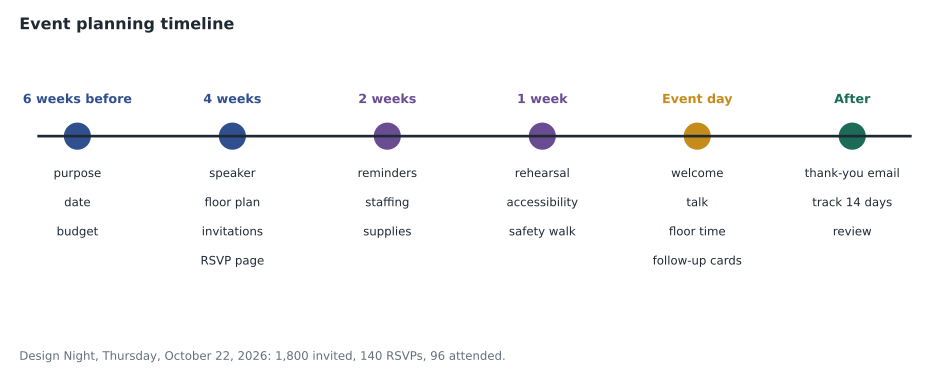
The planning sheet covered the practical details in order. Audience and invitations: 1,800 customers who had bought décor or small furniture in the previous year and had agreed to receive marketing email, plus posts on the store's social media pages and a sign at the counter. Format: doors at 6:30, a 25-minute talk at 7:00, then an hour of open floor time with staff at stations for sofas, rugs and lighting. Capacity: Noura set a limit of 120 people so that nobody would struggle to see or move. Staffing: six staff, including two associates on the floor, Tessa at the welcome table, Noura giving the talk and Marcus handling the space. Budget: refreshments, printed handouts and staff time, with a 20-dollar thank-you certificate for every attendee, valid for 30 days. Follow-up: a short card for attendees to note their project, and a thank-you email the next day.
Practical and legal checks
An event changes how a store is used, and that brings responsibilities. The store's normal occupancy limit and fire exits apply; displays rearranged for the evening must not block exits or the clear routes required for accessibility, a point SLS-251 covered in detail. Food must be handled safely, which is one reason many stores serve packaged snacks and coffee from a supplier rather than preparing food themselves. Serving alcohol at a store event generally needs a special permit from the Saskatchewan Liquor and Gaming Authority, and brings extra risk, so Juniper & Pine decided not to serve it.
Accessibility matters for the invitation as well as the building. The RSVP page asked whether guests needed seating near the front, a sign language interpreter or other help, and the store set aside chairs at the front for anyone who could not stand for the talk. The talk's slides used large type, and Noura repeated audience questions into the microphone so that everyone could hear them. Photographs for social media were taken only of people who agreed, and the RSVP page said so. Any prize draw at the event would count as a contest under the rules in lesson 9, so Tessa chose to give every attendee the same certificate instead of holding a draw.
| Area | Check |
|---|---|
| Purpose | One-sentence purpose and the measure of success written down |
| Space | Occupancy limit, exits and accessible routes clear after the floor is rearranged |
| Accessibility | RSVP asks about needs; seating, large-type slides, microphone |
| Food | Packaged or supplier-prepared food; allergy information on display; no alcohol |
| Consent | Photos only with permission; invitations sent only to customers who agreed to marketing email |
| Staffing | Named roles; staff briefed on the offer and the follow-up card |
| Records | Attendee names linked to customer records so later purchases can be counted |
On the night
One hundred and forty people said they would come, and 96 people from 71 households did, about 69 in 100 of those who replied. Of the 71 households, 49 were existing customers and 22 were new to the store. Noura's talk, "Small living rooms, big ideas", used three room settings the floor team had built for the evening, and the questions afterward ran fifteen minutes over. Aiden worked the rug station. Following Bev's advice, he did not pitch; he asked each visitor about their room, wrote the measurements on the back of a business card and offered to put a few options aside. Three households asked him to call them about rugs the following week.
The store sold 9,840 dollars of goods during the evening itself, mostly décor, rugs and two accent chairs. More importantly, 31 of the 71 households filled in the project card, and 18 of those described a sofa, sectional or dining purchase planned within six months. Tessa added each one to the customer file with a note of the project, so that associates could follow up properly rather than with a generic offer.
Worked problem
Measuring Design Night
Over the evening and the 14 days after, the 71 attending households bought 41,440 dollars of goods. To estimate what they would have spent anyway, Tessa looked at a comparison group: similar customers who were invited but did not attend. Their spending over the same 14 days suggested that the attending households would normally have spent about 14,000 dollars. The event cost 620 dollars in refreshments, 420 dollars in staff time and 180 dollars in printing, and 23 of the 20-dollar certificates were used. At a 39.4 in 100 gross margin, what was the event's estimated net contribution?
Show solution
- Estimated extra sales:
- \[41{,}440 - 14{,}000 = 27{,}440\]
- Gross margin on the extra sales:
- \[27{,}440 \times 0.394 \approx 10{,}811\]
- Cost of the certificates used:
- \[23 \times 20 = 460\]
- Total event cost:
- \[620 + 420 + 180 + 460 = 1{,}680\]
- Estimated net contribution:
- \[10{,}811 - 1{,}680 = 9{,}131\]
Answer: Design Night contributed an estimated 9,100 dollars of margin after its costs. The estimate is generous in one way and cautious in another. Households who choose to attend a design evening are probably more interested in buying than those who stay home, so the comparison group may understate what they would have spent anyway. On the other hand, the 18 households planning big purchases within six months are not yet counted at all. Tessa recorded both cautions next to the figure.
Comparing events with other spending
A useful way to compare events with other marketing is the cost per attending household and the cost per new customer. Design Night's costs of 1,680 dollars spread over 71 households is about 24 dollars per household. If only the 22 new households are counted, it is about 76 dollars for each new household that walked in and met the staff, a figure Tessa compared with what the store paid for a new customer through online advertising. Neither number proves that an event works on its own, but they let the store ask sensible questions about where the next marketing dollar should go.
Worked problem
Cost per household and per new household
Design Night cost 1,680 dollars in total, and 71 households attended, 22 of them new to the store. What was the cost per attending household and per new household?
Show solution
- Cost per attending household:
- \[1{,}680 \div 71 \approx 23.66\]
- Cost per new household:
- \[1{,}680 \div 22 \approx 76.36\]
Answer: The event cost about 24 dollars per attending household and about 76 dollars per new household. A store can compare these figures with the cost of reaching households through other channels, while remembering that a visit to an event is usually worth more than a click on an advertisement.
After the event
The day after Design Night, every attendee who had agreed to marketing email received a short thank-you message with the three room settings as photos, the rug-sizing guide from the talk and a reminder that the certificate was valid until November 21. Associates called the 18 households with planned big purchases within a week, using the project notes. And on Friday, October 30, the marketing meeting reviewed the results and agreed to run two more events in the first half of 2027: a spring collection preview for past customers in March and a mattress fitting day in May, both written into the 2027 plan. Noura asked for one change: a smaller room for the talk next time, so that people at the back could see the slides.
Matching events to customers
Not every event suits every customer. Design Night drew décor buyers and young homeowners planning their first big purchases. A mattress fitting day suits households replacing a bed; a spring preview suits the store's champions, who like to see new ranges first; a cooking demonstration in the appliance department suits kitchen renovators. Tessa planned the 2027 events around the segments from lesson 7, so that each invitation went to the customers most likely to find the evening useful rather than to the whole list. That also kept the number of event emails each household received to a sensible level, a point lesson 6 makes about list fatigue.
Common mistakes
MistakeJudge an event by how many people came.
InsteadJudge it by its stated purpose, such as purchases by attending households compared with a sensible estimate of what they would have bought anyway.
MistakeInvite everyone on the email list.
InsteadInvite the audience the event is designed for, and only people who agreed to receive marketing messages.
MistakeRearrange the floor however the event needs.
InsteadExits, occupancy limits and accessible routes still apply during events.
MistakeHold a prize draw to boost attendance.
InsteadA draw is a contest with legal rules; a gift for every attendee is simpler and avoids them.
MistakePitch hard during the event to make the most of the crowd.
InsteadAdvice and good follow-up build trust; aggressive selling at an advice evening drives people away.
Summary and key terms
- In-store events attract new customers, retain existing ones, show expertise, create content and build community.
- Common types include workshops, demonstrations, consultation days, customer previews, charity events, makers markets and family events.
- Plan from a one-sentence purpose and a measure of success, then audience, format, capacity, staffing, budget and follow-up.
- Events must respect occupancy, exits, accessibility, food safety, alcohol permits and consent for photos and marketing.
- Measure events by the purchases of attending households against a comparison, net of costs; note the self-selection of attendees.
- Cost per attending household and per new household help compare events with other marketing.
- In-store event
- A planned occasion that brings people into a store for something other than a sale.
- Occupancy limit
- The maximum number of people allowed in a space at one time under building and fire rules.
- Comparison group
- A group similar to those who took part, used to estimate what would have happened without the activity.
- Self-selection
- A bias that arises when the people who choose to take part differ from those who do not.
- Cost per new customer
- The cost of an activity divided by the number of new customers it reached or won.
Practice problems
Work each problem on paper first, then reveal the answer to check.
An event cost 1,200 dollars and 60 households attended, 15 of them new. What was the cost per new household?
Show answer
1,200 divided by 15 is 80 dollars.
Why might a comparison group of invited non-attendees understate what attendees would have bought anyway?
Show answer
People who choose to attend are probably more interested in buying, so they would likely have spent more than the non-attendees.
Give two accessibility steps for an in-store talk.
Show answer
Ask about needs on the RSVP, reserve seating near the front, use large-type slides and a microphone.
Why did Juniper & Pine give every attendee a certificate instead of holding a prize draw?
Show answer
A draw would count as a contest with legal requirements; a gift for everyone avoids them.
Lesson quiz · 5 questions
Score 60% or more to complete this lesson.
Create a free account to save your progress, take quizzes and earn a certificate.