
SLS-257 · Lesson 12 of 12 · 22 min
Case study: launching a loyalty program
▶ Video coming soon A video version of this lesson is on the way.
At two o'clock on Friday, November 13, 2026, the owners of Juniper & Pine Home sat down in the meeting room above the showroom. The first item on the agenda was Bev's spring 2027 upholstery plan from SLS-253. The second was Tessa's proposal for Home Club, the loyalty program the store had been designing since September, when the national chain opened on the other side of Regina with its own app. Aiden had helped build almost every number in it, and Tessa asked him to present the measurement plan himself.
This case study follows the proposal from start to finish: the problem it addresses, the program's design, its costs and the sales it would need, the legal checks for the store's location, the launch plan, the measurement plan and the owners' decision. Every figure for 2027 is a plan. It brings together the ideas of the whole course, and it is meant to be read as a model of how a store makes a marketing decision that costs real money: by setting out what it expects, what could go wrong and how it will know.
The problem
Tessa opened with the numbers from lesson 1. In 2025, the store's net sales were 12.40 million dollars, and 5.08 million, 41 in 100, came from households that had bought before. Only 36 in 100 of households that bought in a given year bought again within 24 months. The store did not lack customers; it lacked a reason, beyond habit, for them to come back, and a way to recognize them when they did. Aiden's tally from lesson 2 made the second point sharply: of 41 customers on one Saturday who had shopped before, the store's systems recognized only 11.
The competitive pressure was real but should not be overstated. The national chain's program offered points worth about 3 in 100 of spending and app-only discounts. Juniper & Pine could not and should not match it on discounts. Its advantage was service, advice and local knowledge, and the program was designed to make those visible and to reward the customers who valued them.
The design
The proposal summarized the design from lesson 2. Home Club would be free to join, at the counter, online or through an associate's tablet. Members would earn 1 point per dollar spent, and 500 points would convert to a 10-dollar reward certificate, a reward rate of 2 in 100. Appliances would earn points but would be excluded from bonus point offers, because their gross margin of about 21 in 100 left little room. Benefits beyond points would carry most of the program's appeal: a free in-home measuring visit, early access to sales and events, a welcome offer of bonus points on the first purchase after joining, and member-only design evenings like Design Night.
Members who spent 3,000 dollars or more in a calendar year would become Home Club Plus members, with free standard delivery, normally 79 dollars, for the following year. Points would not expire because time had passed; they would lapse only after 24 months without any account activity, with a reminder 60 days before. Reward certificates would be valid for 12 months, with the date printed on them. Members could see their points at the counter, online and on receipts, and could leave the program at any time.
What it would cost, and what it would need to earn
Lesson 2 estimated the first-year cost at 60,000 dollars. Since then, Tessa had added the cost of the Plus delivery perk. She estimated that about 300 households would reach Plus status and use free delivery once in the first year.
Worked problem
First-year cost and the sales needed to break even
The lesson 2 estimate was 42,000 dollars of points expected to be redeemed, 7,800 dollars of software, 4,200 dollars of materials and training and 6,000 dollars of launch advertising. Free delivery for about 300 Plus households at 79 dollars each is added. At a gross margin rate of 0.394, how many dollars of incremental sales would the program need in its first year to cover its cost?
Show solution
- The delivery perk:
- \[300 \times 79 = 23{,}700\]
- Total first-year cost:
- \[42{,}000 + 7{,}800 + 4{,}200 + 6{,}000 + 23{,}700 = 83{,}700\]
- Incremental sales needed to break even:
- \[83{,}700 \div 0.394 \approx 212{,}437\]
Answer: The program would need about 212,000 dollars of sales that would not otherwise have happened. That is the number every result would be compared with.
Aiden then put the break-even point beside the program's targets. With 4,000 members expected to spend about 3.0 million dollars in the first year, the program would need to cause about 7 in 100 of that spending. In lesson 1, an example assumed members would have spent 2.8 million dollars anyway, leaving 200,000 dollars of incremental sales. At that level the program would fall just short.
Worked problem
Would the program pay for itself?
Suppose members spend 3.0 million dollars and would have spent 2.8 million without the program. What is the first-year profit or loss? What would the result be if members would have spent 2.75 million anyway?
Show solution
- Incremental margin at 200,000 dollars of incremental sales:
- \[200{,}000 \times 0.394 = 78{,}800 \qquad 78{,}800 - 83{,}700 = -4{,}900\]
- Incremental margin at 250,000 dollars of incremental sales:
- \[250{,}000 \times 0.394 = 98{,}500 \qquad 98{,}500 - 83{,}700 = 14{,}800\]
Answer: The result swings from a loss of about 4,900 dollars to a profit of about 14,800 dollars on a difference of 50,000 dollars in incremental sales, less than 2 in 100 of members' spending. The first-year result would be close to break-even either way. Tessa argued that the case rested mainly on later years, when software and launch costs fall, the customer records improve and the repeat rate has time to rise.
One of the owners pointed out that the points cost was itself uncertain. Lesson 2 assumed breakage of 30 in 100, meaning 30 in 100 of points would never be redeemed. If members redeemed more than expected, the cost would rise. Aiden showed that if breakage were 20 in 100 instead of 30, the points cost would rise from 42,000 to 48,000 dollars, because 60,000 dollars of points would be issued and 80 in 100 redeemed. He also reminded the owners that, under IFRS 15, part of each member sale would be recorded as a liability for points until they were redeemed or lapsed, so the program would change how the store's sales appeared in its accounts from the first month.
Legal checks for the store's location
Tessa's proposal included a page of legal checks, prepared with the store's lawyer, for Saskatchewan. Each item had an owner and a date before launch.
| Area | What the store will do |
|---|---|
| Email consent (CASL) | An unticked box at sign-up asking for express consent, with the store's name, contact details and a note that consent can be withdrawn; records kept with date and wording |
| Text messages (CASL) | Separate express consent for texts; identification and an unsubscribe method in every text |
| Implied consent ending | Ask the 2,100 implied-consent email contacts for express consent at sign-up, before their two-year periods end |
| Privacy (PIPEDA) | A plain privacy notice explaining what is collected, why, how recommendations work and how to leave; no date of birth; breach procedures updated |
| Bill C-36 | Watch the bill's progress; design for its expected consent and deletion rights |
| Promotions (Competition Act) | Bonus offers and "member price" claims to follow the ordinary-price rules; all conditions shown clearly |
| Contests | The spring giveaway to follow section 74.06 disclosure, with a skill-testing question |
| Points expiry | No expiry from time alone, matching the strictest provincial rules even though Saskatchewan's gift card rules do not cover points |
The checklist made one point that changed the design. Tessa had originally planned to give 200 bonus points for joining by text. The lawyer pointed out that CASL consent must be sought separately, not bundled into the terms of joining or tied to a benefit, so the bonus was moved to joining Home Club in any way, with text consent asked for separately and optionally.
Launch plan and staff training
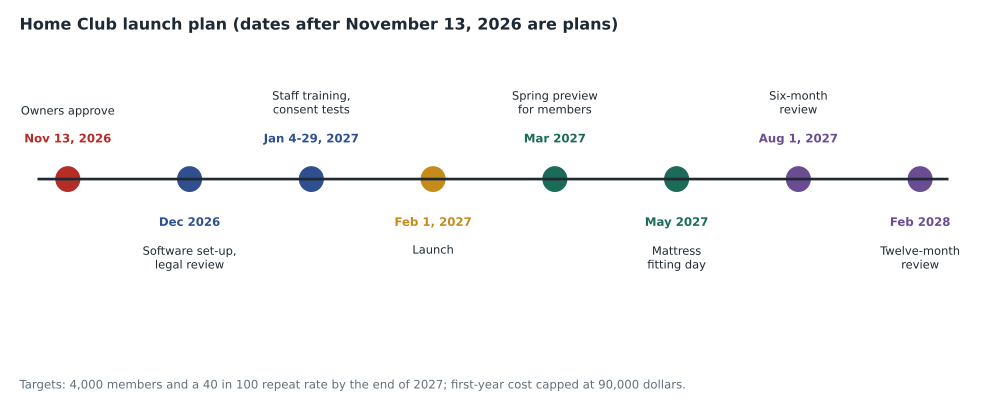
The launch was set for Monday, February 1, 2027, after the January clearance and before the spring season, giving the store a quiet month to train staff and test systems. Every associate, cashier and phone staff member would complete a two-hour training session in January, covering how to explain the program in under 30 seconds, how to sign customers up with proper consent, how to find a customer's record, and what never to do: pressure customers to join, sign anyone up without asking or promise rewards the program does not offer.
Associates would not be paid per sign-up. Tessa had seen at another store how sign-up bonuses led to duplicate accounts and customers enrolled without understanding. Instead, the store would track sign-up rates by team and recognize good practice at the monthly meeting. The launch would be announced to existing email subscribers, in the store, on social media and through the business profile, with 6,000 dollars of launch advertising focused on the trade area.
The measurement plan
Aiden presented the measurement plan. It followed lesson 11 closely. Before launch, the store would record a baseline from the 2025 and 2026 records for every known household: purchases, spending and visits. After launch, it would compare each member household's change in spending with the change among similar households that had not joined, matched by segment, past spending and distance from the store. Every bonus offer to members would have a random holdout of 10 in 100. And the repeat rate, the program's main target, would be tracked monthly against its 36 in 100 starting point.
| Measure | Starting point | Six-month check (August 1, 2027) | Twelve-month target (February 2028) |
|---|---|---|---|
| Members | 0 | 2,000 | 4,000 |
| Returning customers recognized at the counter | About 27 in 100 (11 of 41) | 60 in 100 | 80 in 100 |
| 24-month repeat rate | 36 in 100 | Tracked | 38 in 100, toward 40 by end of 2027 |
| Incremental sales (matched comparison) | None | On track for 106,000 dollars | 212,000 dollars |
| First-year cost | None | Under 45,000 dollars | Under 90,000 dollars |
| Complaints about the program | None | Reviewed monthly | Reviewed monthly |
"The honest summary," Aiden said, "is that the first year will be close to break-even, the comparison will be rough and we will learn the most in the second year. If the numbers at six months are far below the line, we should be ready to change the design rather than defend it."
Risks and what the owners asked
The owners asked four hard questions. What if members just buy what they would have bought anyway? Then the program would mostly subsidize existing loyalty, as research on loyalty programs suggests often happens; the measurement plan was built to detect that, and the benefits were weighted toward service rather than discounts to limit the cost. What if the chain doubles its points? The store would not follow; its program was not designed to compete on discount. What if the data is misused or lost? The store would collect less data than before, not more, train staff on privacy and test its breach procedures. What if staff find it a burden? The January training and simple sign-up process were meant to prevent that, and associates' views would be part of the six-month review.
A fifth question came from the owner who had been most sceptical. "Why not spend the 83,700 dollars on more of what already works, like Design Night and the emails?" Tessa's answer was that those worked better because the store knew who its customers were, and Home Club was mainly a way to know more of them. Recognizing a customer when they return was the foundation every other part of the store's marketing depended on.
The decision
After 40 minutes of discussion, the owners approved Home Club with four conditions. The first-year cost would be capped at 90,000 dollars, and the Plus delivery perk would be reviewed if its cost ran more than 20 in 100 above plan. The six-month review on August 1, 2027 would include a recommendation to continue, change or stop. No associate would receive pay tied to sign-ups. And the legal checklist would be signed off before any advertising began. The upholstery plan, discussed earlier in the meeting, would be launched with a Home Club early-access event in March, the first member event of 2027.
Afterwards, Bev found Aiden in the stockroom. "You didn't oversell it," she said. "That's why they said yes." The lesson of the case is the lesson of the course: retail marketing works best when it is built on the customers a store already has, measured honestly, kept within the law, and judged by whether it gives customers a genuine reason to come back.
Common mistakes
MistakeLaunch the program and measure members against non-members.
InsteadRecord a baseline and compare members with similar non-members, using holdouts for offers.
MistakeMatch the competitor's points rate to stay competitive.
InsteadCompete on the store's strengths; a discount war with a larger rival is one the store cannot win.
MistakePay associates for each sign-up to drive membership.
InsteadSign-up bonuses lead to duplicates and unwilling members; recognize good practice instead.
MistakeTie a bonus to agreeing to marketing texts.
InsteadConsent must be freely given; ask for text consent separately and optionally.
MistakePromise the owners a quick return.
InsteadSet out the break-even point, the uncertainty and the review dates honestly.
Summary and key terms
- The program addresses a recognition and repeat-purchase problem, not a lack of customers.
- Its design rewards spending modestly and relies mainly on service benefits.
- First-year cost of about 83,700 dollars needs about 212,000 dollars of incremental sales to break even.
- Small changes in how much members would have spent anyway swing the result from loss to profit.
- Legal checks cover consent, privacy, promotions, contests, certificates and reviews for the store's location.
- Measurement compares members with similar non-members, uses holdouts and sets six- and twelve-month reviews.
- The owners approved with a cost cap, review points and no sign-up pay.
- Home Club Plus
- The program's upper level, for members spending 3,000 dollars or more in a year.
- Break-even incremental sales
- The extra sales whose margin would just cover the program's cost.
- Matched comparison
- Comparing members with non-members who are similar in segment, spending and location.
- Cost cap
- A maximum the owners set on the program's first-year spending.
- Six-month review
- A planned check on results with a recommendation to continue, change or stop.
- Liability for points
- The part of sales recorded as owed to members until their points are redeemed or lapse.
Practice problems
Work each problem on paper first, then reveal the answer to check.
A program costs 50,000 dollars a year and the margin rate is 0.40. What incremental sales does it need to break even?
Show answer
50,000 divided by 0.40 is 125,000 dollars.
If 250 Plus members each use one free delivery worth 79 dollars, what does the perk cost?
Show answer
250 times 79 is 19,750 dollars.
Why should associates not be paid per sign-up?
Show answer
It encourages duplicate accounts and customers signed up without understanding or wanting the program.
Give two parts of the Home Club measurement plan.
Show answer
A baseline before launch and a matched comparison with similar non-members; holdouts for offers.
Lesson quiz · 5 questions
Score 60% or more to complete this lesson.
Create a free account to save your progress, take quizzes and earn a certificate.