
SLS-256 · Lesson 2 of 12 · 19 min
The longer retail sales cycle
▶ Video coming soon A video version of this lesson is on the way.
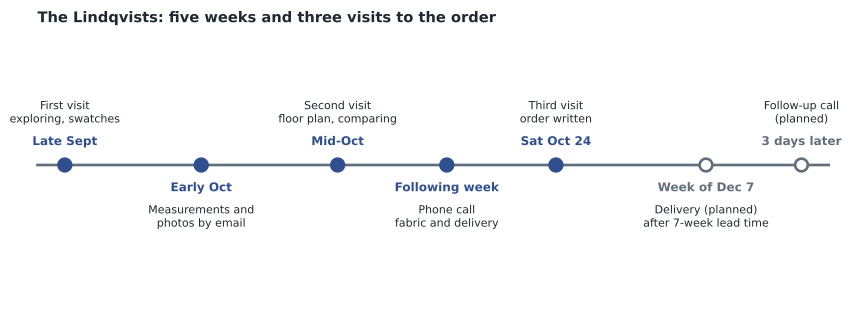
Ellen and Tom Lindqvist first walked into Juniper & Pine on a Saturday in late September 2026. They had just bought an older bungalow in Regina's east end and needed a living room and a dining room, from bare floors. Carl Jensen spent forty minutes with them. They sat on six sofas, took four fabric swatches and a brochure, photographed price tags, and left without buying anything. Carl wrote two lines in the clienteling app: the measurements they had guessed at, and their worry that a light fabric would not survive two dogs.
Aiden, who was still in décor that week, watched them go and asked Carl whether he had lost the sale. Carl shook his head. "That was a good first visit," he said. "They're not ready, and if I'd pushed, they'd have gone somewhere else to think. Now they know my name, they have swatches in their car, and I know about the dogs." The Lindqvists bought on their third visit, in late October, after a measured floor plan, a phone call and a second Saturday. Their story is the thread of this lesson.
Why big-ticket sales take longer
A retail sales cycle is the time and the steps from a customer's first contact with the store to the completed purchase. In décor it is often a single visit. For considered purchases it usually stretches over days or weeks, for reasons that come straight from lesson 1.
- Research. Most customers have already looked online before their first visit, and they keep looking afterward. They compare models, read reviews and check other stores.
- More than one decision-maker. The person in the store is often not the only person deciding. A partner, a parent or a roommate has to see it, sit on it or agree to the price.
- Fit and logistics. Big items have to fit the room, the doorway, the stairwell and sometimes the elevator. Customers need to measure, and often they come back with numbers that change the choice.
- Money. Customers check budgets, wait for a paycheque, look at financing, or wait for a sale they expect.
- Timing. Many purchases are tied to an event: a move, a renovation, a baby, a guest visit or a broken appliance. The event sets the deadline.
The exception is the distress purchase, when the old item has failed. A family whose refrigerator stopped working on a Friday night needs a new one by Sunday. Distress buyers move fast, care most about availability and delivery, and are especially vulnerable to pressure. Carl's rule for them was simple: "Solve the problem first, and don't use their emergency to sell them things they wouldn't buy on a calm day."
The stages of a considered retail purchase
Juniper & Pine trains its main-floor sellers to think of a considered purchase in five stages. They are not strict steps, and customers move back and forth between them, but each stage has its own job for the seller.
| Stage | What the customer is doing | What the seller does |
|---|---|---|
| 1. Exploring | Gathering ideas, setting a rough budget, seeing what exists | Welcomes, asks about the project, shows the range, gives swatches and brochures, records notes and consent to follow up |
| 2. Defining | Measuring, deciding on size, style, fabric and features | Helps measure, sketches a floor plan, explains trade-offs, narrows to two or three options |
| 3. Comparing | Checking prices and alternatives, involving others | Answers questions honestly, explains what is included, invites the other decision-makers |
| 4. Deciding | Choosing, arranging money and delivery | Confirms the choice, explains financing and protection options without pressure, writes a clear order |
| 5. Living with it | Receiving, using and judging the purchase | Confirms delivery, checks in after delivery, handles problems quickly |
Making each visit count
Carl's view was that a seller does not control how long a customer takes. A seller controls whether each visit moves the customer forward. He judged a first visit by three questions: did the customer leave knowing more than when they arrived, did they leave with something that kept the store in their mind, and did he leave with something that would make the next conversation better?
For the Lindqvists, the answer to all three was yes. They left knowing that performance fabrics existed, that a sectional with a chaise would fit their room better than a sofa and loveseat, and that the store could make one in a dog-friendly fabric. They had swatches to try against their walls and their dogs. Carl had their names, the dogs, a rough room size, their move-in date and, because Ellen agreed, permission to send them the measured floor-plan template by email.
Before the second visit, Carl did three things. He checked the lead times for the two sectionals they liked, because the Lindqvists wanted the room finished before Tom's parents visited in December. He printed a floor plan using the measurements Ellen had emailed. And he set aside the two fabric samples closest to their swatches. When they arrived, the conversation started from where the first one ended instead of starting over.
Keeping in touch without pushing
Between visits, a short, useful contact keeps the purchase moving. Good follow-up answers a question the customer had, sends something they asked for, or tells them about a real change, such as a fabric arriving or a delivery date opening up. Poor follow-up is a generic "just checking in" message, repeated until the customer stops answering.
Follow-up must also respect the law. Under Canada's anti-spam law (CASL), a commercial email or text needs the customer's consent. A customer who asks for information about a product gives the store implied consent for six months after the inquiry, and a customer who buys gives implied consent for two years after the purchase. Express consent, recorded with the date and how it was given, lasts until the customer withdraws it. Every message must identify the store and include a working unsubscribe that is honoured within ten business days. The clienteling app at Juniper & Pine records how each customer agreed to be contacted.
Carl kept his follow-ups short and specific. His message to the Lindqvists after the first visit read: "Hi Ellen, here's the floor-plan sheet I mentioned. If you send me the room measurements and a photo of the window wall, I'll sketch both sectionals in your space before you come back. Carl, Juniper & Pine." Ellen replied the same evening with the numbers.
Worked problem
How follow-up changes the numbers
Juniper & Pine tracked 100 first visits to the upholstery gallery in September 2026. Twelve groups bought on the first visit. Of the 88 who left, 40 agreed to follow-up and received a useful message from their seller; 12 of those 40 came back, and half of the returners bought. Of the 48 who left without follow-up, 6 came back on their own and half of them bought. How many of the 100 first visits became sales, and what was the return rate in each group?
Show solution
- First-visit sales: 12.
- Followed-up group: 12 returned out of 40.
- \[\frac{12}{40} = 0.30 \text{, or 30 in 100}\]
- Sales from that group: half of 12 is 6.
- Group with no follow-up: 6 returned out of 48.
- \[\frac{6}{48} = 0.125 \text{, or 12.5 in 100}\]
- Sales from that group: half of 6 is 3.
- Total sales from 100 first visits:
- \[12 + 6 + 3 = 21\]
Answer: Twenty-one of the 100 first visits became sales. Customers who received a useful follow-up came back at 30 in 100, more than twice the 12.5 in 100 of those who did not. Most of the sales came after the first visit, which is normal for considered purchases.
The numbers in this example are Juniper & Pine's, and they come from one month in one department. They are not a rule. Bev used them to make a different point: if the floor team judged itself only by first-visit sales, it would miss more than four in ten of the sales it eventually made.
Holds, quotes and deadlines
Considered purchases need tools that let a customer pause without losing their place. Juniper & Pine uses three.
- Written quotes. Every main-floor quote shows the item, fabric or finish, price, delivery charge, taxes and the date the price is good until. The customer can take it home, show a partner and compare it with other stores.
- Holds. A seller can hold an in-stock item for a customer for 48 hours without a deposit. Longer holds need a deposit and a manager's approval, because a held item cannot be sold to anyone else.
- Deposits on special orders. Custom-ordered upholstery requires a deposit of 25 in 100 of the order, with the cancellation terms explained and printed on the order.
Real deadlines help customers decide, and sellers should mention them when they exist: a fabric being discontinued, a sale price ending, a delivery slot before a holiday, or a lead time that will push delivery past the customer's event. Invented deadlines do the opposite. Telling a customer "this price is only good today" when it is not is a false claim, and customers who discover it rarely come back. SLS-150 explained that false urgency can also be a misleading representation under consumer protection law.
For the Lindqvists, the real deadline was Tom's parents' visit. The sectional they chose had a seven-week lead time in the fabric they wanted. Carl told them on the second visit that ordering by the end of October would mean delivery in mid-December at the latest, and that the store's next upholstery promotion would not start until January. They ordered on October 24.
Measuring a long cycle
Because big-ticket customers often buy on a later visit, a store that measures only today's close rate gets a misleading picture. Juniper & Pine's clienteling app links each sale to earlier visits by the same customer, so Bev can see how many visits sales take, how long the cycle runs, and which sellers' first visits turn into later sales. Carl's first visits converted well over the following month even though he closed fewer customers on the first visit than some newer sellers. Bev counted that as a strength, not a weakness.
There are also limits to patience. Some customers browse for months and never buy, and a seller with a busy Saturday cannot give every browser forty minutes. Carl's approach was to match the time to the stage: short and welcoming for early exploring, longer and more detailed once the customer has measurements and a timeline. "When they come back with a tape measure," he said, "that's when you clear your afternoon."
Reading signals between visits
Because a long cycle stretches over weeks, a seller sees the customer only in pieces. Carl taught Aiden to treat each contact as a reading of where the customer is now, not where they were last time. The same family can move forward, stall or step back between visits, and the seller's next move should follow the signal rather than a script.
| Signal | What it usually means | A helpful response |
|---|---|---|
| Asks about delivery dates or lead times | Moving from comparing to deciding | Give real dates and explain what would hold them |
| Brings a partner, parent or friend | A second decision-maker needs to be satisfied | Recap the needs briefly and let the newcomer ask questions first |
| Sends measurements or photos | Serious about fit; still defining | Check the measurements and reply with what fits and what does not |
| Asks the same question twice | An unresolved worry | Answer it again, more simply, and ask what is behind it |
| Mentions a competitor's quote | Comparing value, not only price | Compare the items line by line, honestly |
| Stops replying after a quote | Busy, undecided or bought elsewhere | One short check-in, then leave the door open |
Carl's rule for a customer who goes quiet was simple: one reminder when the quote is about to expire, one short message a few weeks later if there is a real reason (a new fabric, a delivery date opening up), and then nothing unless the customer gets in touch. "Two contacts with a reason is service," he said. "Five without one is chasing." The customer's consent to messages sets the outer limit, but courtesy sets a tighter one.
Aiden noticed how much Carl's notes in the clienteling app helped. When Tom Lindqvist called the week after the second visit about fabric and delivery, Carl could see at once the room measurements, the two dogs and Ellen's worry that a light fabric would not survive them. The call took five minutes instead of fifteen, and Tom said it felt like talking to someone who remembered them. Good notes are short, factual and written the same day: the room, the people, the budget, what was tried, what was promised and when to follow up.
Common mistakes
MistakeTreating a first visit without a sale as a failure.
InsteadJudge a first visit by whether the customer and the seller both leave with something that moves the purchase forward.
MistakeStarting every visit from the beginning.
InsteadReview the notes before the customer arrives and pick up where the last visit ended.
MistakeSending repeated "just checking in" messages.
InsteadSend short, specific follow-ups that answer a question or report a real change.
MistakeFollowing up without checking consent.
InsteadConfirm and record how the customer agreed to be contacted, and honour every unsubscribe.
MistakeInventing deadlines to speed up a decision.
InsteadMention real deadlines only, such as lead times, discontinued fabrics or sale end dates.
Summary and key terms
- A considered purchase usually takes several visits over days or weeks because customers research, involve other decision-makers, measure, arrange money and work to a deadline.
- Juniper & Pine describes five stages: exploring, defining, comparing, deciding and living with it.
- A good visit moves the customer forward and leaves both sides with something useful.
- Short, specific follow-up with consent brings many more customers back.
- Written quotes, short holds and deposits on special orders let customers pause without losing their place.
- Real deadlines help decisions; invented ones damage trust and can break the law.
- Stores should measure sales across visits, not only first-visit closes.
- Sales cycle
- The time and steps from first contact to completed purchase.
- Distress purchase
- A purchase made because the old item has failed, usually urgently.
- Hold
- Setting aside an in-stock item for a customer for a limited time.
- Implied consent
- Consent to commercial messages inferred from a purchase or inquiry, limited in time under CASL.
- Lead time
- The time from placing an order to the item being ready for delivery.
- Written quote
- A dated document showing the item, price, charges and how long the price is good.
Practice problems
Work each problem on paper first, then reveal the answer to check.
Give three reasons big-ticket purchases take longer than small ones.
Show answer
Any three of: research, several decision-makers, fit and logistics, money, timing tied to an event.
Of 60 customers who received follow-up, 15 came back. What was the return rate?
Show answer
15 ÷ 60 = 0.25, or 25 in 100.
Why should a seller avoid saying a price is only good today when it is not?
Show answer
It is a false claim that damages trust and can be a misleading representation under consumer protection law.
Lesson quiz · 5 questions
Score 60% or more to complete this lesson.
Create a free account to save your progress, take quizzes and earn a certificate.