
SLS-256 · Lesson 11 of 12 · 25 min
Commission selling in retail
▶ Video coming soon A video version of this lesson is on the way.
Aiden's first pay statement on the main floor arrived on a Friday in early November, and he brought it to the clinic the following Wednesday with three questions circled. Why was there a negative line for a recliner? Why had a sectional he sold at a discount paid less than one he sold at full price? And how did Carl, who worked the same hours, earn almost twice as much? Carl laughed. "Those are the right three questions," he said. "Answer them and you understand the job."
Many big-ticket retail sellers are paid partly or mainly on commission. Commission links pay to results, rewards skill and effort, and lets a store pay more to its best sellers. It also creates the pressures discussed throughout this course: the pull toward bigger tickets, add-ons and fast closes. Understanding how a pay plan works helps a seller earn well and stay honest, and helps a manager design a plan that rewards the right behaviour.
Common retail pay plans
Retail sales pay plans come in a few standard shapes.
- Hourly wage only. Common in décor, small-ticket and self-service stores. Pay does not depend on sales, so there is no pressure to push, but also little reward for skill.
- Base plus commission. An hourly or salary base, plus a commission on sales or on margin. This is Juniper & Pine's main-floor plan.
- Straight commission. Pay comes entirely from commission, subject to minimum wage law. Common in vehicle sales and some furniture stores.
- Draw against commission. The seller receives a regular advance, the draw, which is deducted from commission earned. A recoverable draw must be paid back from later commissions if earnings fall short; a non-recoverable draw works as a guaranteed minimum.
- Bonuses and spiffs. Extra payments for hitting targets or for selling particular products. A spiff is a small payment, often from a manufacturer, for each unit of a specific product sold.
Each design changes behaviour. Commission on sales rewards bigger tickets but ignores whether the store made money on them; commission on margin rewards selling at full price and selling higher-margin items. Spiffs can steer sellers toward one brand regardless of what suits the customer, which is why many stores, including Juniper & Pine, require sellers to tell customers if they are asked whether they earn more on a product, and do not allow spiffs that conflict with the store's recommendations.
Juniper & Pine's main-floor plan
Main-floor sellers at Juniper & Pine earn a base of 16.00 dollars an hour, slightly above Saskatchewan's minimum wage of 15.70 dollars from October 1, 2026, plus commission on gross margin: 8 in 100 of margin on furniture and mattresses, 6 in 100 of margin on appliances, and 10 in 100 of the price of protection plans that are still in force 30 days after the sale. Returns and cancellations are charged back against later commission.
Worked problem
Aiden's week
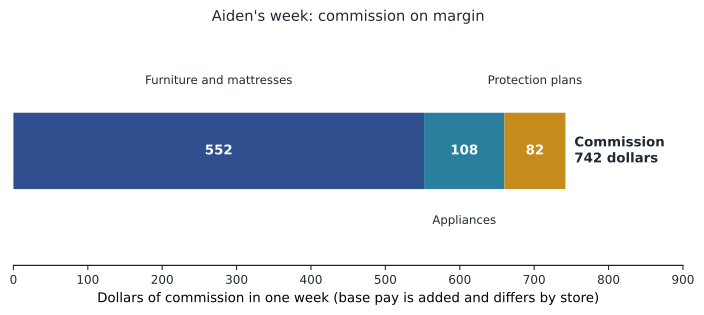
In one week, Aiden worked 38 hours. His furniture and mattress sales produced 6,900 dollars of gross margin, his appliance sales 1,800 dollars, and five protection plans totalling 820 dollars were still in force after 30 days. What did he earn?
Show solution
- Base pay:
- \[38 \times 16.00 = 608 \text{ dollars}\]
- Furniture and mattress commission:
- \[6{,}900 \times 0.08 = 552 \text{ dollars}\]
- Appliance commission:
- \[1{,}800 \times 0.06 = 108 \text{ dollars}\]
- Protection plan commission:
- \[820 \times 0.10 = 82 \text{ dollars}\]
- Total:
- \[608 + 552 + 108 + 82 = 1{,}350 \text{ dollars}\]
Answer: Aiden earned 1,350 dollars before deductions: 608 from his base and 742 in commission. More than half his pay came from commission, even in his first weeks on the floor.
Why commission on margin
Aiden's second question was why a discounted sectional paid him less. Juniper & Pine pays commission on margin rather than sales precisely so that a seller's pay moves with the store's profit. A discount comes straight out of margin.
Worked problem
What a discount does to commission
Aiden sold a 3,299-dollar sectional with a gross margin of about 46 in 100, so 1,517.54 dollars of margin. To close the sale he gave a 10 in 100 discount, 329.90 dollars. What happened to the store's margin and to his commission at 8 in 100 of margin?
Show solution
- Margin after the discount:
- \[1{,}517.54 - 329.90 = 1{,}187.64 \text{ dollars}\]
- Commission at full price:
- \[1{,}517.54 \times 0.08 = 121.40 \text{ dollars}\]
- Commission after the discount:
- \[1{,}187.64 \times 0.08 = 95.01 \text{ dollars}\]
- Commission lost:
- \[121.40 - 95.01 = 26.39 \text{ dollars}\]
Answer: The discount cut the store's margin by 329.90 dollars, more than a fifth, and Aiden's commission by about 26 dollars. A 10 in 100 discount on price became a 22 in 100 cut in margin, which is why discounts should be traded for something, as SLS-213 explained, not given away.
Chargebacks and returns
The negative line on Aiden's statement was a chargeback. A customer had returned a recliner within the 30-day return period, and the 92 dollars of commission he had earned on its 1,150 dollars of margin was deducted from his next pay. Chargebacks are standard in commission plans, because the store did not, in the end, make the sale. They also give sellers a direct reason to sell the right product and set honest expectations: a customer who was oversold is more likely to return it.
Plans must be clear about chargebacks: which events trigger them, for how long after the sale, and whether they can reduce pay below the minimum wage. They cannot.
Minimum wage and overtime
In Saskatchewan, The Saskatchewan Employment Act requires employers to pay at least the minimum wage, 15.70 dollars an hour from October 1, 2026, for every hour worked, including for commissioned employees, and to pay overtime at one and a half times the hourly wage for hours over 8 in a day or 40 in a week, with some exceptions for modified schedules. For a commission employee, the employer must check that total pay for the pay period covers the minimum wage and any overtime. Chargebacks and draws cannot reduce pay below that floor.
Worked problem
A slow week on straight commission
Nadine's dealership pays straight commission. In a slow week, a salesperson works 40 hours and earns 420 dollars of commission. Does that meet Saskatchewan's minimum wage of 15.70 dollars, and if not, how much must the employer add?
Show solution
- Effective hourly rate:
- \[\frac{420}{40} = 10.50 \text{ dollars an hour}\]
- Minimum pay for 40 hours:
- \[40 \times 15.70 = 628 \text{ dollars}\]
- Top-up required:
- \[628 - 420 = 208 \text{ dollars}\]
Answer: The commission works out to 10.50 dollars an hour, below the minimum, so the employer must pay at least 208 dollars more for that week. Whether that top-up can be recovered from later commission depends on the plan and the law; it can never leave a pay period below the minimum.
Why Carl earned more
Aiden's third question had a simple answer and a long explanation. Carl's sales produced more margin per hour, for reasons that had nothing to do with pushing. More than half his customers came back or were referred, so he spent less time on browsers. He rarely discounted, because customers trusted his prices. He had few returns, because he set honest expectations. And his customers bought the right add-ons because he explained them well, not because he pressed. "Every lesson in this clinic shows up on my pay statement," he said. "Trust is the best-paying thing I own."
Commission and ethics
Commission plans work best when the seller's interest and the customer's interest point the same way. They point apart when a seller earns more for an outcome the customer would not choose with full information. Juniper & Pine's rules address the main risks.
- Commission on plans is paid only on plans still in force after 30 days, so pressure sales that are cancelled earn nothing.
- Chargebacks on returns discourage overselling.
- Sellers follow the store's split rules when two sellers help the same customer, so nobody fights over a customer on the floor.
- Sellers tell customers honestly how they are paid if asked.
- Managers review discount rates, cancellations and complaints for each seller, alongside sales.
Customers often ask whether a seller is on commission. Carl's answer was always the same: "Yes, I'm paid partly on what I sell. Which is why I want you to buy the right thing, so you keep it and come back." Most customers found the honesty reassuring.
Comparing pay plans
Pay plans shape behaviour. A seller paid only by the hour has little reason to spend extra time with a hesitant customer; a seller paid only on commission may be tempted to rush or push. Comparing plans on the same week of work shows what each one rewards.
Worked problem
The same week under three plans
Aiden's week produced 6,900 dollars of furniture and mattress margin, 1,800 dollars of appliance margin and 820 dollars of protection plans kept, over 38 hours. Compare his pay under Juniper & Pine's plan (16.00 dollars an hour plus commission), a flat 21.00 dollars an hour with no commission, and straight commission at 12 in 100 of all margin plus 10 in 100 of plans, with a minimum-wage top-up.
Show solution
- Juniper & Pine's plan (from earlier in this lesson):
- \[38 \times 16.00 + 742 = 608 + 742 = 1{,}350 \text{ dollars}\]
- Flat hourly:
- \[38 \times 21.00 = 798 \text{ dollars}\]
- Straight commission:
- \[(6{,}900 + 1{,}800) \times 0.12 + 820 \times 0.10 = 1{,}044 + 82 = 1{,}126 \text{ dollars}\]
Answer: In a good week, both commission plans pay more than the flat wage, and Juniper & Pine's plan pays the most. In a slow week the order can reverse: straight commission falls to the minimum-wage floor while the flat wage stays at 798 dollars. The base in Juniper & Pine's plan is a cushion that lets sellers take time with customers who are not ready to buy.
Split sales
When two sellers help the same customer, such as one on the first visit and another when the customer returns on the first seller's day off, the store's split rules decide who is paid. Juniper & Pine splits commission evenly when both sellers recorded meaningful contact in the clienteling app within the previous 30 days, and pays the full commission to the original seller if the second one only wrote up an order the customer had already chosen with a quote.
Worked problem
A split sale
A sectional produces 2,400 dollars of margin. Aiden met the customer first and recorded a quote; Bev helped them compare fabrics on a second visit and wrote the order. What does each seller earn at 8 in 100 of margin?
Show solution
- Total commission:
- \[2{,}400 \times 0.08 = 192 \text{ dollars}\]
- Each seller's half:
- \[192 \div 2 = 96 \text{ dollars}\]
Answer: Each earns 96 dollars. Because the rules are written down and the clienteling notes show who did what, there is nothing to argue about on the floor, and both sellers have a reason to help a colleague's customer well.
Juniper & Pine reviews its pay plan once a year with a sample of sellers. Carl had argued for two changes that the store adopted: paying plan commission only on plans kept for 30 days, so there was no reward for pressure, and adding a small quarterly bonus based on the customer survey score, so that service counted alongside margin. Aiden noticed that both changes paid him for doing what the course had taught: honest selling that customers did not regret.
Common mistakes
MistakeAssuming a discount costs only the discount's share of your commission.
InsteadRemember that a discount comes out of margin, so it cuts margin and commission by a larger share.
MistakeIgnoring chargebacks when judging a sale.
InsteadCount only sales that stay sold; returns and cancellations come back off pay.
MistakeBelieving commission pay can fall below minimum wage in a slow period.
InsteadEmployers must top up to the minimum for every hour worked.
MistakeSteering customers to a product for a spiff.
InsteadRecommend what fits the customer and disclose how you are paid if asked.
MistakeFighting over customers on the floor.
InsteadFollow the store's rotation and split rules.
Summary and key terms
- Retail sellers may be paid hourly, base plus commission, straight commission, a draw against commission, or with bonuses and spiffs, and each design shapes behaviour.
- Juniper & Pine pays a base plus commission on margin, with plan commission only on plans kept 30 days and chargebacks on returns.
- Commission on margin links pay to the store's profit, so a discount cuts commission by a larger share than its share of the price.
- Minimum wage law applies to commissioned sellers in both countries, and employers must top up pay that falls short; overtime rules differ.
- Experienced sellers earn more mainly through repeat customers, few discounts and few returns, all built on trust.
- Good plans align the seller's and customer's interests.
- Commission
- Pay based on sales or margin produced.
- Draw
- An advance against future commission; recoverable if it must be repaid, non-recoverable if it is a guaranteed minimum.
- Spiff
- A small payment for each unit of a particular product sold, often funded by a manufacturer.
- Chargeback
- Commission deducted when a sale is returned or a plan is cancelled.
- Commission on margin
- Commission calculated as a share of gross margin rather than sales.
- Split rule
- A store rule for sharing a sale between sellers who helped the same customer.
Practice problems
Work each problem on paper first, then reveal the answer to check.
A seller earns 8 in 100 of margin. A sale has 2,000 dollars of margin. What is the commission, and what is it after a 300-dollar discount?
Show answer
2,000 × 0.08 = 160; (2,000 − 300) × 0.08 = 136 dollars.
A seller works 35 hours and earns 450 dollars of commission only. At Saskatchewan's 15.70 minimum, what top-up is needed?
Show answer
35 × 15.70 = 549.50; 549.50 − 450 = 99.50 dollars.
Why does Juniper & Pine pay plan commission only on plans kept 30 days?
Show answer
So that pressure sales that are quickly cancelled earn nothing, which aligns pay with the customer's real choice.
Lesson quiz · 5 questions
Score 60% or more to complete this lesson.
Create a free account to save your progress, take quizzes and earn a certificate.