
SLS-253 · Lesson 6 of 12 · 25 min
Stock turn and weeks of supply
▶ Video coming soon A video version of this lesson is on the way.
Marcus Dube ran the warehouse behind Juniper & Pine's showroom, and on October 19, 2026, it was nearly full. Holiday appliance orders were arriving, the reorders of grey and oatmeal sectionals from lesson 5 were due, and three bays were still holding dining sets that had been there since spring. At the numbers morning, Marcus brought a question for Bev. "Everybody tells me we need more stock for the holidays," he said. "Nobody tells me where to put it. How do we know how much is the right amount?" Bev's answer was two measures: stock turn, which looks back at how hard the inventory has been working, and weeks of supply, which looks ahead at how long it will last.
What stock turn measures
Stock turn, also called inventory turnover, is the number of times a store sells and replaces its average inventory in a year. A department that turns its stock four times a year holds, on average, about three months of sales. One that turns twice holds about six months. Faster turn generally means less money tied up in inventory, less space needed to hold it, fewer markdowns on goods that sit and fresher merchandise on the floor.
Turn can be calculated at cost or at retail, and the two must not be mixed. At cost, divide cost of goods sold by average inventory valued at cost. At retail, divide net sales by average inventory valued at retail prices.
Juniper & Pine tracks each furniture piece and appliance individually and values its inventory at cost, so it calculates turn at cost.
Finding the average inventory
The average inventory should reflect the whole year, not just the stock on one date. A store that counts its inventory only on December 31, after the holiday rush has emptied the shelves, will overstate its turn. The usual method adds the inventory at the start of the year to the inventory at the end of each month and divides by the number of figures. With monthly figures, that is 13 values; with quarterly figures, it is 5.
Worked problem
The mattress department's turn
Juniper & Pine's mattress inventory at cost was 240,000 dollars on January 1, 2025, then 270,000 dollars on March 31, 230,000 dollars on June 30, 260,000 dollars on September 30 and 250,000 dollars on December 31. The department's cost of goods sold for 2025 was 800,000 dollars. Find the average inventory, the turn and the average number of days an item spent in stock.
Show solution
- Average inventory = (240,000 + 270,000 + 230,000 + 260,000 + 250,000) ÷ 5 = 1,250,000 ÷ 5 = 250,000 dollars.
- \[\text{Turn} = \frac{800{,}000}{250{,}000} = 3.2\]
- \[\text{Days of inventory} = \frac{365}{3.2} \approx 114\]
Answer: The mattress department turned its inventory 3.2 times in 2025; an average mattress spent about 114 days, or nearly four months, in stock.
The last step uses a common companion measure. Days of inventory (also called days of supply on hand) is 365 divided by the annual turn. It turns an abstract ratio into something easier to picture: how long, on average, an item waits before it is sold.
Turn across the store
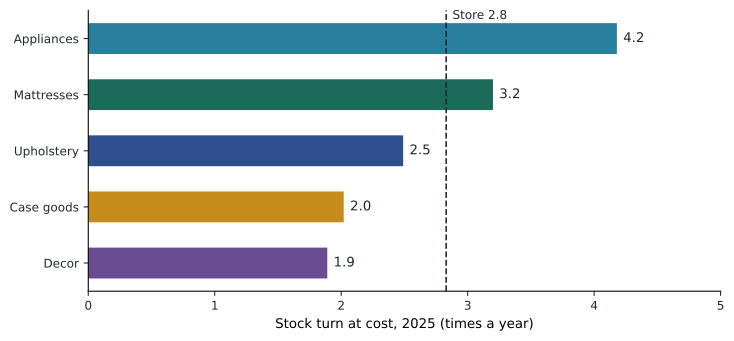
The five departments turned their inventory at very different rates in 2025.
| Department | Cost of goods sold | Average inventory at cost | Turn at cost | Days of inventory |
|---|---|---|---|---|
| Upholstery | 1.944 million | 0.78 million | about 2.5 | about 146 |
| Case goods | 1.456 million | 0.72 million | about 2.0 | about 180 |
| Mattresses | 0.800 million | 0.25 million | 3.2 | about 114 |
| Appliances | 2.923 million | 0.70 million | about 4.2 | about 87 |
| Décor and accessories | 0.396 million | 0.21 million | about 1.9 | about 194 |
| Store total | 7.519 million | 2.66 million | about 2.8 | about 129 |
Appliances turn fastest. Customers buy appliances when they need them, the store keeps only the models that sell and the manufacturers deliver quickly. Décor turns slowest, partly because a store needs a wide assortment of small items to look full and attractive, and partly because Juniper & Pine had overbought several décor lines in 2025. Case goods are slow because dining and bedroom sets are bulky, come in many pieces and finishes, and are often bought only every ten or fifteen years.
There is no single right turn for a store. Grocers turn their inventory more than ten times a year; jewellers may turn theirs less than twice. What matters is how a department compares with its own history, with its plan and with similar stores, and whether the turn is good enough given the department's margin. Lesson 7 puts margin and turn together in a single measure.
Cost turn and retail turn are not the same
Because inventory at retail includes the markup, turn calculated at retail will usually be lower than turn at cost when markdowns have pulled the selling prices below the original tickets. Comparing a cost turn with a retail turn, or with a benchmark calculated the other way, gives a misleading answer.
Worked problem
Upholstery at retail
Upholstery's average inventory at cost in 2025 was 0.78 million dollars, and the goods in stock carried an average markup of 52 in 100 on retail. Its net sales were 3.6 million dollars. Estimate its turn at retail and compare it with its turn at cost.
Show solution
- Average inventory at retail = 0.78 ÷ (1 − 0.52) = 0.78 ÷ 0.48 = 1.625 million dollars.
- \[\text{Turn at retail} = \frac{3.6}{1.625} \approx 2.22\]
- Turn at cost = 1.944 ÷ 0.78 ≈ 2.49.
Answer: Upholstery turned about 2.2 times at retail and about 2.5 times at cost. The retail figure is lower because the department's sales include markdowns and its margin of 46 in 100 is below the 52 in 100 markup on the goods in stock.
Why faster turn is worth money
Inventory costs money to hold. The store has paid for it, or is paying interest on the credit used to buy it. It takes up space that costs rent, heat and insurance. It can be damaged, stolen or go out of style. Retailers sum these up as the inventory carrying cost, often estimated at 20 to 30 in 100 of the inventory's value per year, though the true figure varies widely by business. Speeding up turn without losing sales releases cash and cuts those costs.
Worked problem
What faster upholstery turn would save
If upholstery had sold the same goods in 2025 (cost of goods sold of 1.944 million dollars) but turned its stock 3.0 times instead of about 2.49, how much less inventory would it have needed on average? At a carrying cost of 25 in 100 a year, roughly how much would that save?
Show solution
- Average inventory needed = 1.944 ÷ 3.0 = 0.648 million dollars.
- Inventory released = 0.78 − 0.648 = 0.132 million dollars, or 132,000 dollars.
- Annual carrying-cost saving ≈ 132,000 × 0.25 = 33,000 dollars.
Answer: The department would have needed about 132,000 dollars less inventory, saving roughly 33,000 dollars a year in carrying costs, which is more than 5 in 100 of the store's operating profit.
Faster turn is not always better. A department that turns too fast may be running out of popular items and losing sales, or buying in such small quantities that it pays more per unit and more in freight. A furniture store that cuts its floor stock so far that customers must wait ten weeks for every sofa may lose them to competitors with goods ready to deliver. The aim is the turn that balances the cost of holding stock against the cost of not having it.
Weeks of supply
Stock turn looks back over a year. Weeks of supply looks forward: it divides the stock on hand by the expected weekly rate of sale, and says how many weeks the current stock will last if sales continue at that rate. It is the measure buyers and operations managers use week to week to decide what to reorder, what to slow down and what to mark down.
Weeks of supply can use the recent average rate of sale or a forecast. Forecasts matter when sales are seasonal. An appliance stock that looks comfortable in October can be dangerously thin in the weeks before the holidays, when sales rise.
Worked problem
Washers before the holidays
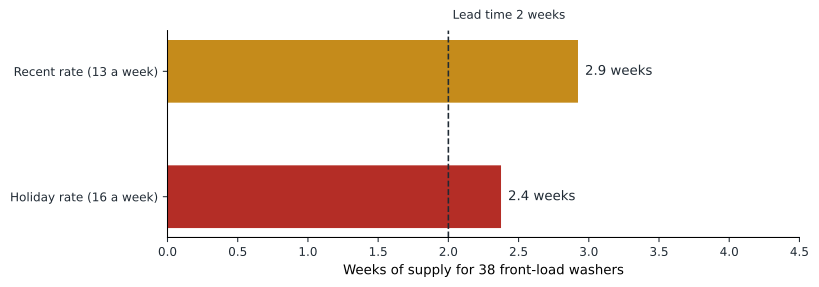
On October 19, Juniper & Pine had 38 front-load washers in stock. It had sold 52 in the previous four weeks. Marcus expects sales to rise to about 16 a week from mid-November, and new orders take two weeks to arrive. How many weeks of supply does the store have at the recent rate and at the holiday rate?
Show solution
- Recent rate = 52 ÷ 4 = 13 a week.
- Weeks of supply at the recent rate = 38 ÷ 13 ≈ 2.9 weeks.
- Weeks of supply at the holiday rate = 38 ÷ 16 ≈ 2.4 weeks.
Answer: The store has about three weeks of washers at the current rate and less than two and a half at the holiday rate. With a two-week lead time, Marcus should order now, sized to cover the holiday weeks plus a small safety stock.
Worked problem
Mattresses: too much or too little?
Juniper & Pine has 46 queen mattresses of its best-selling store-label model. It expects to sell 6 a week and aims to hold 6 weeks of supply on its core mattresses. Is it over or under its target?
Show solution
- Weeks of supply = 46 ÷ 6 ≈ 7.7 weeks.
- Target stock = 6 weeks × 6 a week = 36 mattresses.
- Excess = 46 − 36 = 10 mattresses.
Answer: The store holds about 7.7 weeks of supply, about 10 mattresses more than its target. Marcus can skip the next reorder rather than adding more.
| Weeks of supply | What it usually means | Typical response |
|---|---|---|
| Less than the reorder lead time | The item will run out before new stock arrives | Order immediately; consider expediting or substituting |
| About the target | Stock is in balance with sales | Reorder on the normal schedule |
| Well above the target | Too much stock for the expected sales | Pause reorders; check display and price |
| Longer than the remaining season | The item will not sell through at the current rate | Plan a markdown or promotion; do not reorder |
Space, turn and the warehouse
Marcus's warehouse problem was partly a turn problem. The dining sets that had been in the back since spring were tying up three bays that could hold sixty appliances. Bev and Marcus agreed on a simple rule for the holidays: any item with more than 26 weeks of supply would be reviewed for a markdown or a return to the supplier, and the space released would go to fast-turning appliances and the sectional reorders. "The cheapest warehouse space," Bev said, "is the space taken up by things we shouldn't have bought."
Ordering more often in smaller amounts is the usual way to raise turn, but it has costs of its own. Each order takes time to place and receive, smaller shipments can cost more in freight per unit, and some suppliers give better prices for larger orders. Buyers weigh those costs against the carrying cost saved, which is why a store's ordering pattern differs by department: Juniper & Pine reorders appliances weekly from a distributor but places furniture orders a few times a season.
Common mistakes
MistakeDividing cost of goods sold by inventory at retail, or sales by inventory at cost.
InsteadUse cost with cost and retail with retail.
MistakeUsing a single year-end count as the average inventory.
InsteadAverage the opening inventory and the end of each month or quarter.
MistakeAssuming faster turn is always better.
InsteadBalance carrying cost against lost sales and higher buying costs.
MistakeCalculating weeks of supply at today's rate before a seasonal peak.
InsteadUse a forecast of the coming weeks' sales.
MistakeIgnoring lead time when reading weeks of supply.
InsteadCompare weeks of supply with the time it takes new stock to arrive.
Summary and key terms
- Stock turn is the number of times a store sells and replaces its average inventory in a year: cost of goods sold over average inventory at cost, or net sales over average inventory at retail.
- Average inventory should be the average of the opening figure and the end of each month or quarter.
- Days of inventory is 365 divided by turn.
- Juniper & Pine's 2025 turns ranged from about 4.2 for appliances to about 1.9 for décor, with the store at about 2.8.
- Cost turn and retail turn differ and must not be mixed.
- Faster turn frees cash and cuts carrying costs, often estimated at 20 to 30 in 100 of inventory value a year, but turn that is too fast loses sales.
- Weeks of supply is stock on hand divided by expected weekly sales; compare it with lead time and the remaining season to decide what to reorder or mark down.
- Stock turn
- The number of times average inventory is sold and replaced in a year.
- Average inventory
- The average of the inventory at the start of a year and at the end of each period in it.
- Days of inventory
- The average number of days an item spends in stock: 365 divided by annual turn.
- Inventory carrying cost
- The yearly cost of holding inventory, including financing, space, insurance, damage and obsolescence.
- Weeks of supply
- Stock on hand divided by expected weekly sales.
- Lead time
- The time between placing an order and receiving the goods.
Practice problems
Work each problem on paper first, then reveal the answer to check.
A department has cost of goods sold of 900,000 dollars and an average inventory at cost of 300,000 dollars. What is its turn and its days of inventory?
Show answer
Turn = 3.0; days of inventory = 365 ÷ 3 ≈ 122.
A store has 20 recliners and sells about 2.5 a week. How many weeks of supply does it hold?
Show answer
20 ÷ 2.5 = 8 weeks.
A department's inventory was 100, 120, 140, 110 and 130 thousand dollars at the start of the year and the end of each quarter. What is its average inventory?
Show answer
(100 + 120 + 140 + 110 + 130) ÷ 5 = 600 ÷ 5 = 120 thousand dollars.
Lesson quiz · 5 questions
Score 60% or more to complete this lesson.
Create a free account to save your progress, take quizzes and earn a certificate.