
SLS-252 · Lesson 8 of 12 · 23 min
Payments and cash handling
▶ Video coming soon A video version of this lesson is on the way.
At the November 3 back-room session, Marcus set a cash drawer on the table in the cash office, closed the door and handed Aiden a counting sheet. The drawer had come off register 2 after Saturday's close. It had started the day with a 200-dollar float, the Z report said it should now hold 1,846.35 dollars in cash, and Aiden was to count it twice and see whether it balanced. His first count came to 1,841.35 dollars. His second matched it. "Five dollars short," Marcus said. "Inside our tolerance, but we still write it down, because five dollars every Saturday is 260 dollars a year, and a pattern is worth knowing about."
How customers pay
A home furnishings store takes more kinds of payment than most retailers, because its sales are large and often spread over time. At Juniper & Pine, about 70 in 100 of sales by value are paid by credit card, about 15 in 100 by debit, about 10 in 100 through the store's financing partner, and about 5 in 100 in cash.
| Payment type | How it works | Main points for the store |
|---|---|---|
| Credit card | The customer's card issuer pays the store and bills the customer | Fees are higher than debit; risk of chargebacks |
| Debit card | Funds come directly from the customer's bank account, in Canada usually through the Interac network | Low fees; chip and PIN or tap |
| Mobile wallet | A phone or watch taps the terminal using a stored card | Treated like the card behind it; secure because the real card number is not shared |
| Financing | A partner lender approves the customer and pays the store | Store pays a fee; disclosure rules apply to the lender's terms |
| Cash | Paper money and coins | No fee, but must be counted, stored, deposited and protected |
| Gift card or store credit | Value issued by the store earlier | A liability until it is used |
| Card not present | Phone or online orders paid with a secure payment link | Higher fraud risk; card details must never be written down |
Each payment type has a cost. Card networks and the store's payment processor charge a fee on every card transaction, usually a share of the sale plus a small fixed amount, and credit card fees are usually higher than debit. Financing partners charge the store a fee, which is higher on promotional no-interest offers. Cash has no fee but costs staff time, armoured car or deposit trips, and the risk of loss and theft.
Worked problem
Comparing payment costs
A customer buys a dining set for 3,200 dollars. If the store's blended credit card fee is 2.3 in 100 of the sale, and a 12-month no-interest financing promotion costs the store 6 in 100, what does each cost the store?
Show solution
- Credit card fee = 0.023 × 3,200 = 73.60 dollars.
- Financing fee = 0.06 × 3,200 = 192.00 dollars.
- Difference = 192.00 − 73.60 = 118.40 dollars.
Answer: The card would cost the store about 73.60 dollars and the financing promotion about 192 dollars. Financing promotions are worth it when they make sales that would not otherwise happen or that are larger, which is why the store reviews them by results, not by fees alone.
Taking card payments safely
Card payments are protected by technology and by rules. Modern payment terminals read the chip on a card or accept a contactless tap from a card or phone; both create a one-time code for each transaction, which makes stolen data much less useful than the magnetic stripe it replaced. Tap payments above a set limit, which the card issuer controls, ask for a PIN or other verification.
Any business that accepts cards must follow the Payment Card Industry Data Security Standard (PCI DSS), set by the PCI Security Standards Council, an organization founded by the major card brands. The current version, PCI DSS v4.0.1, replaced version 4.0, which was retired at the end of 2024. A group of newer requirements that had been treated as best practices became mandatory after March 31, 2025. The standard is enforced through the store's payment processor and card brands, not by government, but a store that does not comply can face fines, higher fees and liability for fraud losses after a data breach.
For a store like Juniper & Pine, most of the work is handled by using a payment processor and terminals that keep card data out of the store's own systems. What staff must do is straightforward:
- Never write down a card number, expiry date or security code, on paper or in a note in the POS, and never ask a customer to email or text one.
- Take phone orders with a secure payment link sent by the system, so the customer enters their own card details.
- Check terminals for tampering. At opening, compare each payment terminal against its photo and serial number and look for added parts or loose casing. Criminals sometimes fit skimming devices to terminals.
- Protect logins. Never share POS or payment logins, and use multi-factor authentication where the system requires it.
- Report suspicious requests, such as a caller claiming to be from the processor and asking for terminal codes.
Every year the store also completes a PCI self-assessment questionnaire for its processor, confirming the controls it has in place. Marcus completes it with help from the POS provider.
Chargebacks
A chargeback happens when a cardholder disputes a charge with their card issuer and the issuer takes the money back from the store. Customers can dispute charges for fraud, for goods not received, or for goods not as described. Chargebacks are costly because the store loses the sale, pays a fee, and may also have delivered the goods. Furniture stores see chargebacks most often on delayed deliveries and on disputed condition.
The best defence is good records: signed delivery receipts, photos of the item at delivery, clear written terms on returns and special orders, and quick responses to the processor's requests for evidence. Juniper & Pine's delivery redesign added a photo of every delivered item in place, taken by the crew, which Marcus expects to help with condition disputes.
Handling cash
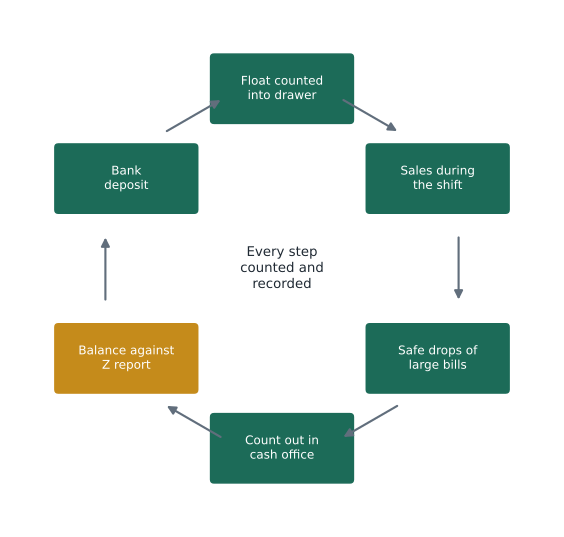
Cash needs careful handling because it is easy to lose, miscount or steal, and because it cannot be traced. Every store uses some version of the same cycle.
- Float. Each drawer starts the day with a fixed amount of change, the float, counted by two people. Juniper & Pine's float is 200 dollars per drawer in set denominations.
- One person per drawer. Only the assigned cashier works a drawer during a shift, so any difference can be traced. A change of cashier means a count and a handover.
- Safe drops. When a drawer holds more than a set amount, 800 dollars at Juniper & Pine, the cashier removes large bills and drops them into the safe in a sealed, recorded envelope. Less cash in drawers means less to lose in a robbery.
- Counting out. At the end of the shift, the drawer is counted in the cash office, not on the sales floor, by the cashier and a second person.
- Balancing. The counted cash, less the float, plus the safe drops, is compared with the cash sales on the Z report. The difference is the drawer's over or short.
- Deposit. The day's cash is prepared for the bank, recorded, and either taken by two people or collected by an armoured car service.
Worked problem
Balancing register 2
Register 2 started Saturday with a 200-dollar float. During the day the cashier made two safe drops of 600 dollars each. The Z report shows cash sales of 2,846.35 dollars. At close, Aiden counted 1,841.35 dollars in the drawer. Is the drawer over or short, and how much cash goes to the bank deposit?
Show solution
- Expected cash in the drawer = float + cash sales − safe drops = 200 + 2,846.35 − 1,200 = 1,846.35 dollars.
- Over or short = counted − expected = 1,841.35 − 1,846.35 = −5.00 dollars.
- Deposit = cash in the drawer − float + safe drops = 1,841.35 − 200 + 1,200 = 2,841.35 dollars.
- Check: the deposit equals cash sales minus the shortage, 2,846.35 − 5.00 = 2,841.35 dollars.
Answer: The drawer is 5.00 dollars short, within Juniper & Pine's 5-dollar tolerance, and the deposit is 2,841.35 dollars. The 200-dollar float stays in the store for Monday.
An over is as much a warning sign as a short. A drawer that is over has usually been given too little change or had a sale rung up for less than was collected, and a pattern of overs followed by shorts can mean someone is building up a cushion to take later. Juniper & Pine records every over and short by drawer and cashier, investigates any difference above 5 dollars, and looks at patterns over a month. Cashiers are never asked to make up a shortage from their own pay, which is restricted or prohibited by employment standards law in many places and would encourage hiding errors.
Counterfeit money
Counterfeit bills are uncommon but not rare, and the store takes the loss when it accepts one. Bank of Canada polymer notes have security features that can be checked in a few seconds: the large transparent window with a metallic portrait and building, raised ink on the large number and shoulders, and fine details that match on both sides. The Bank of Canada advises cashiers to feel the note and look at it, rather than relying only on counterfeit-detector pens, which do not work on polymer. If a note seems fake, the cashier politely refuses it, asks for another payment, and tells the manager, who may contact police; staff should never put themselves at risk.
Rounding cash totals
Canada stopped distributing the one-cent coin in 2013. Since then, cash totals are rounded to the nearest five cents: totals ending in 1 or 2 cents round down to 0, 3 or 4 round up to 5, 6 or 7 round down to 5, and 8 or 9 round up to the next 10. Rounding applies only to the final total of a cash payment, after taxes; card and other electronic payments are still charged to the exact cent, and the store reports tax on the exact amount, not the rounded one.
Worked problem
Rounding a cash sale
A customer pays cash for a lamp and shade totalling 112.47 dollars after tax. What does the customer pay, and what tax does the store record?
Show solution
- The total ends in 7 cents, which rounds down to 5.
- Cash paid = 112.45 dollars.
Answer: The customer pays 112.45 dollars in cash. The store records the sale and the tax on the exact amount of 112.47 dollars; the 2-cent difference is a rounding adjustment, not a change in the price or the tax.
Does a store have to accept cash?
In Canada, no general law requires a retailer to accept cash, although bank notes are legal tender. A store may set its own payment policy, as long as it tells customers before the sale, and some businesses have gone cashless. The Currency Act also limits how many coins of each denomination count as legal tender in a single payment, so a store does not have to accept a large debt paid in coins. Juniper & Pine accepts cash because many customers, including older shoppers and people without cards, prefer it.
Gift cards and store credit
When a store sells a gift card or issues store credit for a return, it receives or keeps value that it owes the customer later. That value is a liability until the card is used. Gift cards are also a target for fraud: thieves steal card numbers from display racks, use stolen credit cards to buy them, or trick victims into paying scammers with them. Retailers in the 2025 surveys reported rising gift card fraud. Juniper & Pine keeps blank gift cards behind the counter, activates them only at the till, and does not sell gift cards over the phone.
Gift card rules are set by each province. In Saskatchewan, The Consumer Protection and Business Practices Act and its regulations generally prohibit expiry dates and most fees on gift cards, with some exceptions.
Common mistakes
MistakeWriting down a card number to process a phone order later.
InsteadSend a secure payment link; never record card numbers.
MistakeLetting two cashiers share a drawer.
InsteadOne cashier per drawer, with a count at every handover.
MistakeIgnoring a drawer that is over.
InsteadRecord overs and shorts alike and investigate patterns.
MistakeAsking cashiers to repay shortages.
InsteadInvestigate shortages; deductions from pay are restricted or prohibited in many places and encourage hiding errors.
MistakeRounding card payments to the nearest five cents.
InsteadRound only cash totals, after tax; card payments are charged to the exact cent.
Summary and key terms
- Customers pay by credit and debit card, mobile wallet, financing, cash, gift card and card-not-present links, and every method has a cost to the store.
- Chip and contactless payments create a one-time code for each transaction.
- Every card-accepting business must follow PCI DSS, now version 4.0.1, whose newer requirements became mandatory after March 31, 2025; staff never write down card data, use secure payment links for phone orders, check terminals for tampering and protect logins.
- Chargebacks are best defended with good records such as signed delivery receipts and photos.
- Cash is handled in a cycle of float, one cashier per drawer, safe drops, counting out, balancing against the Z report and deposit, with overs and shorts recorded and investigated.
- Cashiers check notes for security features and refuse suspected counterfeits safely.
- Cash totals are rounded to the nearest five cents where pennies are not available, after tax, without changing the tax owed.
- Gift cards and store credit are liabilities and a fraud target.
- Float
- The fixed amount of change a cash drawer starts with.
- Safe drop
- Removing large bills from a drawer to the safe during a shift.
- Over and short
- The difference between cash counted and cash expected from the sales record.
- PCI DSS
- The Payment Card Industry Data Security Standard, which every card-accepting business must follow.
- Contactless payment
- A card or device payment made by tapping the terminal.
- Card not present
- A card payment made without the physical card, such as a phone or online order.
- Chargeback
- A disputed card charge taken back from the store by the card issuer.
- Cash rounding
- Rounding the total of a cash payment to the nearest five cents.
Practice problems
Work each problem on paper first, then reveal the answer to check.
A drawer starts with a 200-dollar float, records cash sales of 1,500 dollars and has one safe drop of 500 dollars. How much should be in the drawer at close?
Show answer
200 + 1,500 − 500 = 1,200 dollars.
A cash total is 57.83 dollars. To what amount is it rounded?
Show answer
It ends in 3 cents, so it rounds up to 57.85 dollars.
Why should cashiers never write down a customer's card number?
Show answer
Stored card data can be stolen and used for fraud, and recording it breaks PCI DSS rules.
Lesson quiz · 5 questions
Score 60% or more to complete this lesson.
Create a free account to save your progress, take quizzes and earn a certificate.