
SLS-211 · Lesson 4 of 12 · 16 min
Finding the problem behind the request
▶ Video coming soon A video version of this lesson is on the way.
In late October 2026, Janet Morrow, the office manager at Northfield Family Clinic, emailed Maya with what looked like an easy order. The clinic was taking over the unit next door, and she wanted a quote for "six desks and six chairs, same as the ones we have." Northfield had signed a managed print contract with Ridgeline earlier in the month, so Maya already knew Janet and the clinic. She could have priced six desks in ten minutes.
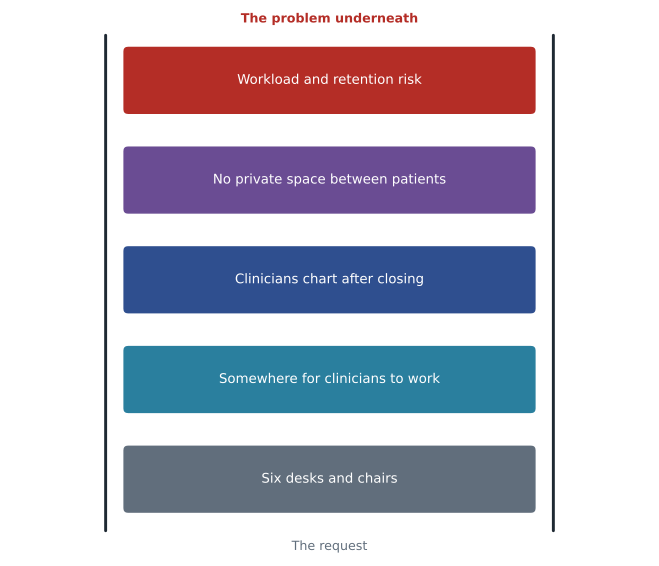
Instead, she asked Janet for a short call, and on Wednesday, November 4, they spent half an hour on it. What Maya learned changed the deal. The six desks were Janet's solution to a problem she had not yet described: the clinic's eight physicians and two nurse practitioners had nowhere to finish their charting between patients, so most of them stayed after the clinic closed to catch up, and two had told Dr. Ravi Anand, the managing physician, that they were tired of it. The expansion was meant to fix that. Whether six desks would fix it was another question.
This lesson is about the gap between what customers ask for and what they need. Lesson 3 gave Maya questions to explore problems. This lesson gives her ways to notice when the customer has already jumped to a solution, and ways to work back to the problem underneath without being annoying.
Requests are solutions, not problems
When a customer asks for something specific, they have usually already done some diagnosis of their own. They noticed a problem, thought about it, and arrived at what they believe will fix it. The request is the end of their thinking, not the beginning. That is natural, and often the customer is right. But customers are experts in their own business, not in the seller's field, and their diagnosis may be incomplete.
| What the customer asked for | What turned out to be underneath | Customer |
|---|---|---|
| Six desks and chairs | Clinicians with nowhere to chart between patients, staying late | Northfield |
| A cheaper printer lease | Monday-morning print volume too big for the machines, causing jams and Sunday-night printing at home | Eastgate Physiotherapy |
| A screen outside the boardroom | Double-booked dealer visits embarrassing Keystone in front of a key dealer group | Keystone Grain |
| Faster toner delivery | Fourteen schools ordering from four suppliers with no central view | Prairie Valley School Division |
Consultants sometimes call the stated request the presenting problem, a term borrowed from medicine and counselling, where it means the complaint a patient first brings to the appointment. The underlying problem is the cause that explains it. A good doctor treats the presenting complaint seriously, but does not prescribe until they understand what is causing it. The same applies to selling.
Why it matters commercially
Selling exactly what was asked for, when it does not solve the problem, causes trouble later. The customer buys six desks, the clinicians still have nowhere quiet to chart, and three months later Janet is unhappy with a purchase she chose herself. The seller has made a small sale and damaged an account. Conversely, finding the underlying problem often makes a deal larger, because the real problem usually affects more people and costs more than the request suggests. But it can also make the deal smaller, and a consultative seller should be ready for that: sometimes the right answer is less than the customer asked for.
There is a competitive reason too. If the customer has already defined the solution precisely, they can compare suppliers on price alone. A seller who helps redefine the problem, and the solution with it, competes on understanding rather than price. Maya knew that two other office-furniture dealers in Regina could quote six desks. None of them knew why the clinic wanted them.
Asking "why now?"
One of the most useful discovery questions is some version of "What made this a priority now?" Problems usually exist for a long time before anyone acts on them. Something triggers the decision to act: a complaint, a new leader, a lease ending, a growth plan, an embarrassing incident, a competitor's move. Sellers call this a trigger event or compelling event. Knowing it tells the seller what really matters to the customer, and often how urgent the decision is.
| Customer | Trigger event | What it revealed |
|---|---|---|
| Northfield | Two physicians complained to Dr. Anand about after-hours charting | The real problem is clinician workload and retention, not furniture |
| Eastgate | The print lease ends January 31, 2027 | A firm deadline; but the jams were the reason Carla wanted to change |
| Keystone | A dealer visit held in the lunchroom in September | A revenue risk tied to the grain dryer launch |
| Prairie Valley | The school board asked for savings across all supply contracts | Cost is a priority, and so is evidence of savings |
Maya's question to Janet was simple: "You've had the same space for a while. What made the expansion happen now?" Janet told her about the physicians' complaints. That one answer reframed the whole conversation.
Working back from the request
Several techniques help a seller move from the request to the problem underneath. They overlap, and good sellers mix them naturally.
| Technique | How it works | Example |
|---|---|---|
| Ask about the purpose | Ask what the requested item is for and what will be different once it is in place | "Once the six desks are in, what will be different for the team?" |
| Ask why now | Find the trigger event | "What made this a priority this fall?" |
| Repeated why | Ask why, gently and in varied words, until a root cause appears | "Why do they end up staying late?" … "What stops them finishing between patients?" |
| Ask about the people affected | Find who feels the problem and how | "Who notices most when charting falls behind?" |
| Ask what has been tried | Learn what the customer already attempted and why it fell short | "Have you tried anything so far to give them time to chart?" |
| Test the request against the problem | Ask whether the requested solution fully solves the problem as described | "If the six desks are in an open area, will the physicians be able to chart there with patient information on screen?" |
The five whys technique comes from manufacturing. It is associated with Sakichi Toyoda and the Toyota Production System, where engineers investigating a defect asked why it happened, then why that cause happened, and so on, roughly five times, until they reached a root cause that could be fixed. In a sales conversation, asking "why?" five times in a row would feel like an interrogation. The useful idea is the persistence, not the word. Maya varied the wording: "What causes that?", "What stops them…?", "Where does that come from?"
The Northfield conversation
The table shows part of Maya's call with Janet, with Darnell's annotations from the following lab.
| Speaker | What was said | Darnell's note |
|---|---|---|
| Maya | "Once the six desks are in, what will be different for the team?" | Purpose question: asks about the future state, not the furniture |
| Janet | "The doctors will have somewhere to do their notes instead of staying till seven." | The real goal appears: time and workload |
| Maya | "What stops them finishing notes between patients now?" | Varied "why": looking for the cause |
| Janet | "There's nowhere to sit. The exam rooms are booked back to back and the back office is the front desk's space." | Cause: no available space during the day |
| Maya | "Where were you picturing the six desks going?" | Tests the request against the problem |
| Janet | "In the open area in the new unit. Why?" | Janet is curious, not defensive: a good sign |
| Maya | "Just thinking about the charting. Would the physicians be comfortable with patient records on screen in an open area?" | Raises a problem with the requested solution without lecturing |
| Janet | "Oh. Probably not. Dr. Anand is strict about that." | The request alone would not solve the problem |
Maya did not tell Janet that her idea was wrong. She asked questions that let Janet test it herself. That distinction matters: customers resist being told their diagnosis is mistaken, but they readily notice a flaw when a question leads them to it. By the end of the call, Janet was describing what she now wanted: quiet, semi-enclosed charting stations, with screens that could not be read from the corridor, near the exam rooms, plus a bookable small room for phone consultations.
Respecting the customer's diagnosis
Working back from a request can go wrong. Customers who are busy, or who have thought hard about their request, may find too many questions patronizing. A procurement officer running a formal tender may not be allowed to discuss anything beyond the written specification. And sometimes the customer is simply right: they need exactly what they asked for.
| Situation | Sensible approach |
|---|---|
| The customer has clearly thought it through and has a sound reason | Confirm the purpose briefly, then quote what they asked for; offer to discuss alternatives only if useful |
| The customer is short of time | Ask one purpose question and one why-now question, then offer a follow-up |
| A formal tender or RFP limits contact | Use the official clarification process to ask about purpose; follow the rules exactly |
| The customer becomes defensive | Stop probing, acknowledge their reasoning, and ask permission before raising a concern |
| The underlying problem is outside your offering | Say so, and suggest who could help; it builds trust for future business |
For Prairie Valley School Division, which issued a formal request for proposals on September 14, 2026, Maya could not call the schools to ask about their printing problems once the RFP was out; questions had to go through Colleen Sawatzky, the procurement officer, and answers were shared with every bidder. Lesson 7 covers how discovery works inside formal procurement. The underlying idea still applied: Ridgeline's written response explained the problem behind the division's request for faster toner delivery, a fragmented supply chain, and showed how a single managed service would fix it.
Confirming the problem
Once the underlying problem is clear, the seller should confirm it with the customer in plain words before moving on. A problem statement is a short summary, in the customer's language, of what is wrong, why it matters and what a good outcome would be. Maya's version for Northfield was: "So the real issue is that the physicians have nowhere private to chart during the day, so they stay late, and two of them are frustrated enough to have raised it with Dr. Anand. The new unit is the chance to fix that. Is that a fair summary?" Janet corrected one detail, that it was all ten clinicians, not just the physicians, and then agreed.
That confirmation turned a ten-minute furniture quote into a design conversation about the clinicians' working day, which lesson 9 follows. It also gave Maya a reason to meet Dr. Anand, the person who approved spending over 5,000 dollars and who cared most about the result.
A last test helps. Before leaving a conversation about a request, ask yourself whether you could explain, in one sentence, what would be different for the customer if the request were met. If the only answer is "they would have six desks", the diagnosis is not finished.
Sellers who make this one-sentence test a habit find that it catches most unfinished diagnoses before they reach a proposal, and that it gives them a natural question to ask the customer in the next conversation.
Common mistakes
MistakeQuoting exactly what was requested without asking what it is for.
InsteadAsk about the purpose and the trigger event before pricing a request.
MistakeTelling the customer their request is wrong.
InsteadAsk questions that let the customer test the request against the problem.
MistakeFiring 'why?' five times in a row.
InsteadKeep the persistence of the five whys but vary the wording and keep the tone curious.
MistakeAssuming the underlying problem always means a bigger sale.
InsteadBe ready for the right answer to be smaller, or outside your offering.
MistakeProbing beyond the rules of a formal tender.
InsteadUse the official clarification process and answer the stated requirement.
Summary and key terms
- A customer's request is usually their own solution to a problem they have already diagnosed.
- The presenting problem is what they first describe; the underlying problem is its cause.
- Finding the underlying problem prevents sales that fail to solve the problem, often enlarges the opportunity, and moves competition away from price, though sometimes the right answer is smaller.
- Asking why now uncovers the trigger event.
- Techniques include asking about purpose, repeated varied why questions, asking who is affected and what has been tried, and testing the request against the problem.
- Questions that let the customer notice a flaw work better than telling them they are wrong.
- Respect sound diagnoses, time limits and tender rules.
- Confirm the underlying problem in a short problem statement before moving on.
- Presenting problem
- The problem or request a customer first describes.
- Underlying problem
- The cause that explains the presenting problem.
- Trigger event
- The event that made the customer decide to act now; also called a compelling event.
- Five whys
- A root-cause technique from the Toyota Production System that asks why repeatedly until a fixable cause appears.
- Problem statement
- A short summary, in the customer's words, of what is wrong, why it matters and what a good outcome would be.
Practice problems
Work each problem on paper first, then reveal the answer to check.
A customer asks for "two more printers for the second floor". Give a purpose question and a why-now question.
Show answer
For example: "Once they are in, what will be different for people on the second floor?" and "What made this come up now?"
Why might asking "why?" five times in a row be a poor idea in a sales call?
Show answer
It feels like an interrogation; vary the wording and keep the tone curious.
When should a seller quote exactly what the customer asked for?
Show answer
When the customer has a sound, clearly explained reason, is short of time, or is bound by tender rules, after briefly confirming the purpose.
Lesson quiz · 5 questions
Score 60% or more to complete this lesson.
Create a free account to save your progress, take quizzes and earn a certificate.