
SLS-211 · Lesson 10 of 12 · 20 min
Avoiding the early pitch
▶ Video coming soon A video version of this lesson is on the way.
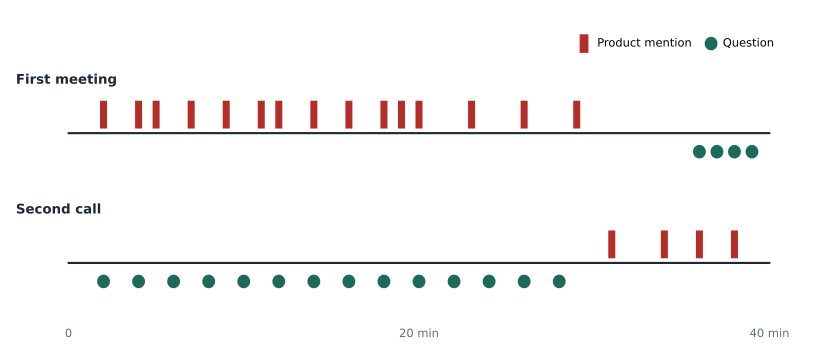
Maya's first meeting at Keystone Grain Equipment, in mid-September 2026, became one of Darnell's favourite teaching cases, with her permission. In forty minutes she had presented Ridgeline's history, shown a short video of a RoomFlow screen, described three sizes of video-meeting kit and quoted an installation time. She had asked four questions, all of them in the last five minutes. Dale Petrie had asked for a brochure and left early.
Her second attempt, the call on September 22 described in lesson 3, went the other way: she asked questions for most of the time, learned that a double-booked boardroom had embarrassed Keystone in front of its largest dealer group, and left with a site visit booked. The product was the same; the outcome was not. This lesson is about why the first meeting went wrong, why so many sellers make the same mistake, and how to avoid it.
What the early pitch is
The early pitch, also called premature pitching or premature presentation, is presenting products, features or solutions before the seller understands the customer's problem well enough to know what will help. Sales trainers have colourful names for it. The point behind all of them is the same: a presentation made before diagnosis is a guess, and customers can usually tell.
| Sign of an early pitch | What it looks like |
|---|---|
| Product talk in the first minutes | Company history, product range or a demo before any questions |
| Features without a confirmed need | "It also has a calendar sync" when nobody has mentioned calendars |
| Answering a problem with a product immediately | "We have exactly the thing for that" the moment a problem appears |
| Seller talks more than the customer | Long explanations; customer gives short answers |
| Questions come at the end | A few questions squeezed in before the meeting closes |
Why sellers pitch too early
Almost every new seller does it, and many experienced ones still do. Understanding why helps in resisting it.
| Cause | Why it happens | What helps |
|---|---|---|
| Nervousness | Talking about the product feels safe; silence feels risky | A planned agenda and prepared questions |
| Product enthusiasm | Sellers who believe in their product want to share it | Remember the customer cares about their problem, not your product |
| Wanting to show value quickly | Sellers fear the customer will lose interest | Show value through good questions and relevant insight |
| The customer asks | "So what do you do?" or "Can you show me a demo?" | Answer briefly, then ask a question that returns to their situation |
| Pressure to hit activity targets | Demos and proposals are counted, discovery is not | Managers who coach and measure discovery quality |
| Recognizing a familiar problem | The seller has solved it before and wants to say so | Confirm it is the same problem before assuming |
The fourth cause deserves care, because the customer is asking. A customer who says "Can you just show me the product?" should not be refused. The seller can give a short, honest answer and then explain why a few questions first will make the demonstration more useful: "Happy to. So I show you the parts that matter to you, can I ask two or three questions about how rooms are booked today?" Most customers agree, because it saves them time.
What the early pitch costs
Pitching early has costs that are easy to miss because they show up later in the sale, or as deals that simply never happen.
| Cost | How it happens |
|---|---|
| The customer anchors on features and price | With no problem defined, products can only be compared by features and cost |
| The diagnosis never happens | Once a product is on the table, the conversation turns to it |
| The proposal misses the real need | The seller proposes what they presented, not what the customer needs |
| Objections multiply | Features presented without a need invite "we don't need that" and "too expensive" |
| The seller loses credibility | The customer sees a vendor, not an adviser |
Neil Rackham's research, described in lesson 3, found a related pattern. He distinguished features, facts about a product; advantages, statements of how a feature can help; and benefits, statements showing how the product meets an explicit need the customer has expressed. In large sales, successful sellers used benefits much more than less successful sellers, while advantages, which are what an early pitch is mostly made of, were not associated with success and tended to provoke objections. Presenting before the customer has stated an explicit need means presenting advantages, not benefits.
| Type | Definition | Keystone example |
|---|---|---|
| Feature | A fact about the product | "RoomFlow screens mount outside each room." |
| Advantage | How a feature can help, in general | "So anyone walking by can see whether a room is free." |
| Benefit | How the product meets an explicit need the customer stated | "You said you need every dealer visit to have a confirmed room; a booking made for the visit shows on the door, so no one else can take it." |
Measuring the problem in Maya's calls
Ridgeline recorded some calls, with the customer's permission, for coaching. Darnell compared Maya's two Keystone conversations using the transcripts.
Worked problem
Comparing talk time
In the first Keystone meeting, 40 minutes long, Maya talked for about 26 minutes. In the second call, also 40 minutes, she talked for about 13 minutes. What share of each call did she talk, and how did the customer's share change?
Show solution
- First meeting: 26 ÷ 40 = 0.65, so Maya talked 65 in 100 of the time and the customer 35 in 100.
- Second call: 13 ÷ 40 = 0.325, so Maya talked about 33 in 100 and the customer about 67 in 100.
- Customer talk time rose from 40 − 26 = 14 minutes to 40 − 13 = 27 minutes, nearly double.
Answer: In the second call the customer spoke for about two-thirds of the time, and Maya learned the facts that mattered. Talk time is a rough guide, not a target; what matters is what the customer said.
Darnell also counted product mentions. In the first meeting, Maya mentioned RoomFlow or a product feature 23 times, 15 of them in the first twenty minutes. In the second call she mentioned a product 4 times, all in the last ten minutes, and each time in response to something Dale or Linda had said. That pattern, product mentions late and tied to the customer's words, is what a well-timed presentation looks like.
Earning the right to present
Darnell's phrase for the alternative was earning the right to present. A seller earns it when they understand the problem well enough that the presentation will be about the customer, not the product. He used a readiness check before any demonstration or proposal.
| Readiness question | Keystone after the second call |
|---|---|
| Has the customer described the problem in their own words? | Yes: dealer visits double booked |
| Has the customer stated an explicit need? | Yes: "We need every dealer visit to have a confirmed room" |
| Do we know the impact, roughly? | Yes: staff time and a revenue risk with the dealer group |
| Do we know the decision criteria and who decides? | Partly: Dale decides; the IT contractor must approve software |
| Do we know the timeline and constraints? | Partly: no installation during harvest; dealer visits resume in January |
| Have we confirmed all this with the customer? | Yes, in a summary email after the call |
Worked problem
Scoring readiness
Darnell scored each readiness question 2 for yes, 1 for partly and 0 for no, and asked sellers to aim for at least 10 of 12 before a full proposal. What did Keystone score after the second call?
Show solution
- Yes answers: problem described, explicit need, impact, confirmation = 4 × 2 = 8 points.
- Partly answers: criteria and decider, timeline = 2 × 1 = 2 points.
- Total: 8 + 2 = 10 of 12.
Answer: Keystone scored 10 of 12: ready for a focused demonstration, with two gaps, the IT contractor's approval and the harvest schedule, to close before the proposal.
When a short presentation early is right
Avoiding the early pitch does not mean never mentioning the product until the final meeting. A brief description of what the seller's company does is often needed at the start, so the customer knows why they are talking. Some customers have done their research and arrive with a clear, well-diagnosed need; making them sit through a long discovery wastes their time. And sometimes a short, relevant example helps the customer think: "Another manufacturer we work with had dealer visits in a shared room. Is that similar to what you have?" That is a question disguised as an example, and it moves discovery forward.
The skill is proportion and timing. A thirty-second description of the company is fine; a twenty-minute presentation is not. A relevant example tied to something the customer just said is fine; a list of features is not. Darnell's rule of thumb was that in a first discovery call, the seller should spend no more than about one minute in ten talking about the product, and only in response to something the customer said.
Handling "just send me pricing"
Customers often ask for a price before discovery. Refusing is rude, but quoting a firm price without understanding the need is risky: it is likely to be wrong, and it turns the conversation into a price comparison. A good response gives an honest range, explains what the price depends on, and asks for the information needed to be precise.
| Speaker | What was said | Why it works |
|---|---|---|
| Dale | "Just give me a ballpark. What does this cost?" | A fair question |
| Maya | "Fair question. For a company your size, room systems usually run from about four to eight thousand dollars a room installed, plus a monthly subscription for the booking software." | An honest range, given straight away |
| Maya | "Where you land depends on how many rooms really need video and whether the boardroom needs a bigger screen. Can I ask a couple of questions so I can narrow that down?" | Explains what the price depends on and returns to discovery |
| Dale | "Go ahead." | Permission to continue |
Coaching yourself out of the habit
Darnell suggested three self-checks for sellers trying to break the early-pitch habit. First, before each important call, write down the one moment when you are most likely to start pitching, usually when the customer describes a problem you recognize, and plan the question you will ask instead. Second, after each call, note the minute at which you first mentioned a product and whether the customer had stated an explicit need by then. Third, once a week, listen to a few minutes of one recorded call, with the customer's permission, and count questions against statements.
Maya kept a sticky note on her monitor that said simply "One more question." When she felt the urge to describe RoomFlow, she asked one more question first: what else does it affect, where else does it happen, or what would it mean if it stopped. Most of the time, that one question produced something she would otherwise have missed.
The habit takes time to change. Maya reckoned it took her about six weeks of conscious effort before asking one more question felt natural rather than forced, and she still caught herself starting to pitch now and then, as the role-play in lesson 12 shows. That is normal. The aim is not perfection but a steadily later and better-timed first product mention.
Common mistakes
MistakeOpening a first meeting with a presentation or demo.
InsteadOpen with the customer's situation and a planned agenda.
MistakeAnswering every problem with a product the moment it appears.
InsteadAsk about the problem's causes and impact before mentioning a product.
MistakeRefusing a customer's request for a demo or price.
InsteadAnswer briefly and honestly, then ask permission to ask a few questions.
MistakePresenting advantages before the customer states a need.
InsteadWait for an explicit need, then present benefits tied to it.
MistakeNever mentioning the product at all.
InsteadGive a short description of what you do and use relevant examples in proportion.
Summary and key terms
- The early pitch is presenting products or solutions before understanding the customer's problem.
- Sellers do it out of nervousness, enthusiasm, a desire to show value, customer requests, activity targets or recognizing a familiar problem.
- It anchors the customer on features and price, stops the diagnosis, produces proposals that miss the need, multiplies objections and costs credibility.
- Rackham found that in large sales benefits, which meet an explicit need, were linked to success while advantages were not.
- Talk time and the timing of product mentions show whether a call was diagnostic.
- A readiness check confirms the problem, explicit need, impact, criteria, decider, timeline and customer confirmation before presenting.
- Short descriptions and relevant examples are fine in proportion.
- Answer early price requests with an honest range and a reason to keep asking.
- Early pitch
- Presenting products or solutions before understanding the customer's problem.
- Feature
- A fact about a product.
- Advantage
- A statement of how a feature can help, in general.
- Benefit
- A statement of how a product meets an explicit need the customer has expressed.
- Earning the right
- Understanding the problem well enough that a presentation will be about the customer, not the product.
- Talk time
- The share of a conversation in which each person is speaking.
Practice problems
Work each problem on paper first, then reveal the answer to check.
In a 30-minute call the seller talked for 18 minutes. What share did the customer talk?
Show answer
30 − 18 = 12 minutes; 12 ÷ 30 = 0.4, or 40 in 100.
Classify: "Because you told me after-hours charting is driving physicians away, the private stations let them finish notes between patients."
Show answer
A benefit: it ties the product to an explicit need the customer stated.
A customer asks for a demo in the first minute. What is a good response?
Show answer
Agree, then ask permission for two or three questions so the demo covers what matters to them.
Lesson quiz · 5 questions
Score 60% or more to complete this lesson.
Create a free account to save your progress, take quizzes and earn a certificate.