
SLS-210 · Lesson 6 of 12 · 20 min
Cold email
▶ Video coming soon A video version of this lesson is on the way.
Maya's first batch of prospecting emails went out on September 24, 2026. She had written one message, about 220 words long, describing Ridgeline's four product lines, and sent it to 40 tier B contacts with their first names merged into the greeting. Two weeks later she had one reply, from an office manager asking to be removed from the list. At the Thursday session, Owen Pelletier, who leads the inside sales team, read the email aloud and then read one of his team's best-performing messages, which was 74 words long and mentioned the recipient's office move in the first line. "Yours is a brochure," he said, kindly. "Ours is a note from one person to another."
A cold email is a commercial email sent to someone who has not recently been in touch with the sender. It is cheap to send, easy to scale and easy to get wrong. Done well, it reaches busy people at a time that suits them and gives them a quick way to say yes or no. Done badly, it is spam: irrelevant, impersonal and, in some cases, unlawful. This lesson covers how to write cold emails that get read, how to follow up, how to keep messages out of spam folders and what the law requires in Canada, where the rules are among the strictest in the world.
The law comes first
In Canada, the law shapes cold email more than any writing technique. Canada's Anti-Spam Legislation (CASL) covers commercial electronic messages (CEMs), which include emails, texts and direct messages on social platforms that encourage participation in commercial activity. A CEM may be sent only with the recipient's consent, unless an exemption applies, and an email asking for consent is itself a CEM. That means the American habit of emailing strangers to ask for a meeting is not generally lawful in Canada. Consent can be express (the person agreed, for example by signing up) or implied. Implied consent arises from an existing business relationship, such as a purchase within the past two years or an inquiry within the past six months. It also arises through conspicuous publication: a business email address the person has published, for example on the firm's website, may be used if it was not published with a statement refusing commercial messages and the message relates to their business role. Two exemptions matter for sellers. A message between organizations that have a relationship, about the recipient organization's activities, is exempt. And one message may be sent following a referral by someone who has a relationship with both sender and recipient, if it names the referrer. Every CEM must identify the sender, give contact information and include an unsubscribe mechanism, and unsubscribe requests must take effect within 10 business days. Organizations can face penalties of up to 10 million dollars per violation, and individuals up to 1 million
At Ridgeline, this means Maya's cold emails go only to people who have published their business address in their work role without a "no commercial messages" statement, who have an existing business relationship with Ridgeline, or who were referred to her. Grace's CRM records the consent basis and its date for every contact, and emails go out only through the company's sales engagement platform, which adds the unsubscribe link automatically and blocks contacts whose consent has expired. SLS-150 covers electronic marketing law in more detail.
Anatomy of a cold email
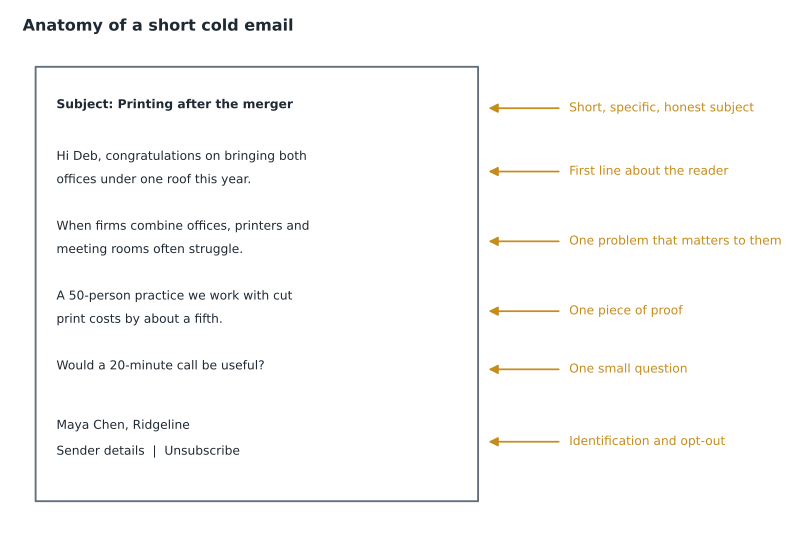
A cold email has to survive three quick decisions by the reader: whether to open it, whether to read past the first line and whether to reply. Each part of the email serves one of these.
| Part | Purpose | Guidance |
|---|---|---|
| Subject line | Get the email opened | Short, specific and honest; often looks like an internal email ("Printers after the merger") |
| First line | Show it is about them | Mention their situation or trigger, not your company |
| Reason and relevance | Explain why you are writing to them | One or two sentences linking their situation to a problem you help with |
| Proof | Make it credible | A short, specific example from a similar customer, with permission |
| Ask | Make replying easy | One small question or request, such as "Worth a 20-minute call?" |
| Signature | Identify the sender | Name, role, company, phone; required identification and unsubscribe information |
Most effective cold emails are short, often under 120 words, because they are read on phones between other tasks. They are written in plain language, without marketing phrases such as "industry-leading" or "best-in-class", and they ask one question. They do not attach files, which spam filters distrust and readers rarely open, and they use few or no links.
| Element | Text |
|---|---|
| Subject | Printing after the merger |
| Opening | Hi Deb, congratulations on bringing both Sandstone offices under one roof this year. |
| Relevance | When firms combine offices, the printers and meeting rooms often struggle: two print fleets, two booking habits and a lot more confidential paper. |
| Proof | A 50-person practice we work with cut its print costs by about a fifth and stopped double-booking rooms after a similar move. |
| Ask | Would a 20-minute call to compare notes be useful? If not, no problem at all. |
| Signature | Maya Chen, Account Executive, Ridgeline Workplace Solutions, with phone number and the required sender details and unsubscribe link |
Compare this with Maya's first attempt. The new email is about Sandstone, not Ridgeline. It names one problem, gives one example and makes one small request. It is honest: the proof refers to a real customer result that the customer has agreed Ridgeline may describe without naming them. And it gives Deb an easy way out, which tends to make people more willing to reply.
Personalization
Personalization means tailoring a message to the recipient. It ranges from a merged first name, which almost nobody notices, to a message that could only have been written to one person. Research by email-platform vendors generally finds that more relevant messages get more replies, although the size of the effect varies and the studies are not independent. The practical question is how much effort each message deserves. Ridgeline uses three levels, matched to account tiers.
| Level | What changes | Used for | Time per email |
|---|---|---|---|
| Segment | The message is written for a type of organization, such as clinics that have expanded | Tier C and some tier B | Under 1 minute |
| Trigger | The first line names the recipient's own trigger, such as a merger or move | Tier B | 3 to 5 minutes |
| Individual | The whole email reflects research on this person and organization | Tier A | 10 to 15 minutes |
Worked problem
Is individual personalization worth the time?
Owen's team measured two approaches over the summer of 2026. Segment-level emails took about 1 minute each and got a positive reply (agreeing to talk) from 2 in every 100 recipients. Individually personalized emails took about 12 minutes each and got a positive reply from 9 in every 100. How many positive replies does each approach produce per hour of the seller's time?
Show solution
- Segment emails per hour: 60 ÷ 1 = 60 emails; positive replies: 60 × 0.02 = 1.2.
- Individual emails per hour: 60 ÷ 12 = 5 emails; positive replies: 5 × 0.09 = 0.45.
- Segment emails produce more replies per hour, about 1.2 against 0.45.
Answer: For raw volume, segment emails win. But the individual emails go to tier A accounts, which are worth far more and more likely to buy, and segment emails sent to the wrong people risk complaints and damage to the company's email reputation. That is why Ridgeline matches the level of effort to the tier rather than choosing one approach for everything.
Following up
Most replies to cold emails come after the first message, not in response to it, because busy people miss or postpone emails. A follow-up is a later message in the same thread that adds something new, such as another example, a useful resource or a different angle, rather than simply asking "Did you see my last email?". Ridgeline's standard email sequence has three or four messages spread over about two to three weeks, combined with calls, as lesson 11 shows. The last message, sometimes called a breakup email, says politely that the seller will stop writing and leaves the door open: "I'll stop writing for now. If printing or room bookings become a priority, I'm easy to find."
Follow-ups must stop as soon as the person replies, opts out or asks not to be contacted, and every follow-up is a separate commercial message subject to the same legal rules. Sequences that keep sending after a reply, because the seller forgot to update the CRM, are one of the most common causes of complaints. Sales engagement platforms usually stop a sequence automatically when a reply arrives, but they can miss replies sent to a different address.
Deliverability
Deliverability is the ability of emails to reach the inbox rather than the spam folder. Email providers decide based on technical signals and on how recipients behave. On the technical side, the sending domain should be set up with standard authentication records (known as SPF, DKIM and DMARC), which prove that messages really come from the company. Large email providers such as Google and Yahoo have required these for bulk senders since 2024, along with a one-click unsubscribe and a low spam-complaint rate; Google's guidance asks senders to keep reported spam below 0.3 in every 100 messages. A sales team that sends large volumes of poorly targeted email can harm deliverability for the whole company, including customer invoices and support emails.
Behaviour matters too. Messages that many recipients delete unread or mark as spam make future messages more likely to be filtered. Messages that get replies help. This is one more reason why targeting and relevance matter more than volume. Practical habits include sending from a real person's address, keeping volumes steady rather than sudden, removing addresses that bounce, avoiding misleading subject lines and checking that lists are accurate before sending.
Using AI to draft emails
AI writing tools can draft cold emails quickly, and many sales platforms now include them. They help with first drafts, alternative subject lines and shortening long messages. They also have weaknesses. Drafts tend to sound generic, can include claims the company cannot support and may invent facts about the recipient. Prospects increasingly recognize machine-written messages and ignore them. Ridgeline's policy is that AI may suggest wording, but the seller must check every fact, remove any claim that is not approved and make sure the message sounds like a person. Maya found the tools most useful for cutting her drafts, which still tended to run long.
Measuring cold email
Cold email produces a lot of data, and some of it is misleading. Open rates were once the main measure, but many email apps now load images automatically or block tracking pixels, so an "open" may mean that a privacy feature opened the message rather than that a person read it. Ridgeline therefore pays more attention to reply rates, positive reply rates (replies that agree to a conversation or ask a real question), meetings booked, opt-outs and bounces. A message with a high open rate and almost no replies is a message people glance at and ignore.
Owen's team tests one change at a time, such as a shorter subject line or a different customer example, sending each version to similar groups of contacts and comparing positive replies over two or three weeks. Because the numbers are small, a difference of one or two replies means little; they look for consistent differences over several tests before changing the standard template. They also read every negative reply. "Please take me off your list" is information about targeting, and "We just signed with someone else in August" is information about timing that belongs in the CRM, with a reminder to check back before that contract ends.
Finally, the team watches what happens after the reply. An email that produces many replies but few meetings may be attracting curiosity rather than real need. The best cold email is not the one with the most replies; it is the one that starts the most conversations with organizations that fit.
Common mistakes
MistakeWriting about your company and products in the first lines.
InsteadOpen with the reader's situation and keep the whole email about them.
MistakeSending long emails with attachments and many links.
InsteadKeep it short, plain and link-light, with one question.
MistakeFollowing up with "Just checking you saw my email".
InsteadAdd something new in each follow-up, and stop when the person replies or opts out.
MistakeIgnoring the consent and identification rules.
InsteadEmail only with express or implied consent or under an exemption, and include identification and an unsubscribe link.
MistakeSending high volumes of poorly targeted email.
InsteadTarget carefully to protect replies, reputation and the company's deliverability.
Summary and key terms
- A cold email is a commercial email to someone who has not recently been in touch with the sender.
- CASL requires consent, express or implied, or an exemption before sending a commercial electronic message, and every message needs identification and an unsubscribe mechanism.
- Effective cold emails are short, plain and about the reader, with one piece of proof and one small ask.
- Personalization effort should match the account tier: segment, trigger or individual.
- Follow-ups should add something new and stop when the person replies or opts out.
- Deliverability depends on email authentication, low complaint rates and relevant messages.
- AI drafts must be checked for facts, approved claims and a human voice.
- Cold email
- A commercial email sent to someone who has not recently been in touch with the sender.
- Commercial electronic message (CEM)
- Under CASL, an electronic message that encourages participation in commercial activity.
- Implied consent
- Consent inferred from an existing business relationship or from conspicuous publication of a business address.
- Personalization
- Tailoring a message to its recipient, from segment level to individual level.
- Deliverability
- The ability of emails to reach the inbox rather than the spam folder.
- Breakup email
- A final, polite message saying the seller will stop writing for now.
Practice problems
Work each problem on paper first, then reveal the answer to check.
Trigger-level emails take 4 minutes each and get positive replies from 5 in every 100. How many positive replies per hour is that?
Show answer
15 emails an hour × 0.05 = 0.75 positive replies.
Rewrite this opening to be about the reader: "Ridgeline is a leading provider of workplace solutions."
Show answer
For example: "Congratulations on opening your second clinic this fall."
Name three things every commercial email must include in your country.
Show answer
Identification of the sender, contact information and an unsubscribe mechanism.
Why should follow-ups stop immediately when someone replies?
Show answer
Continuing is irritating, damages the relationship, causes complaints and may break the law if they opted out.
Lesson quiz · 5 questions
Score 60% or more to complete this lesson.
Create a free account to save your progress, take quizzes and earn a certificate.