
SLS-210 · Lesson 4 of 12 · 20 min
Referrals and networking
▶ Video coming soon A video version of this lesson is on the way.
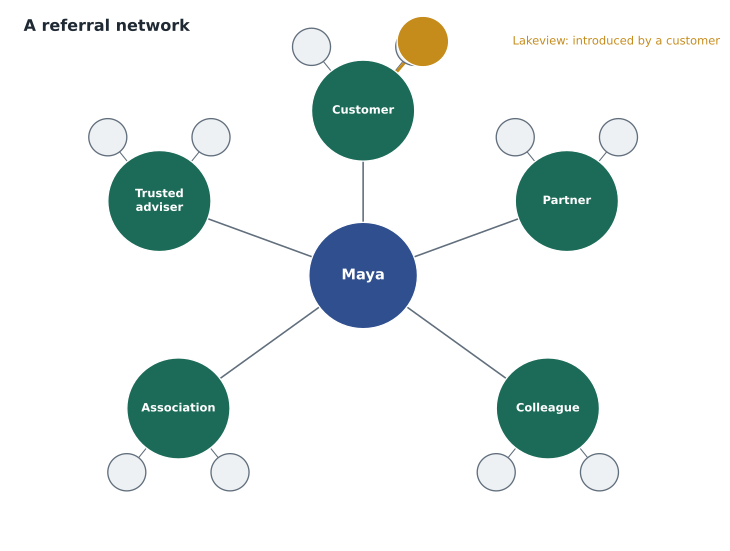
On October 20, 2026, a week after Northfield Family Clinic's new printers were installed, Maya phoned Dr. Ravi Anand, the clinic's managing physician, to check that everything was working. He was pleased: the reception printer had not jammed once, and the staff liked booking rooms on the screens outside each door. Near the end of the call, Maya asked whether he knew anyone else who might be dealing with the same problems Northfield had faced. He thought for a moment, then said that his friend Dr. Erin Shaw, who owned Lakeview Veterinary Hospital, had complained about her printers at a dinner the month before. He offered to send an email introducing them. Two days later, Maya had a meeting booked with Lakeview's practice manager, Sandra Kim, who opened the conversation by saying, "Ravi says you actually listen."
That sentence explains why referrals are the most valuable prospecting source most sellers have. A referral lends the seller some of the trust the buyer already has in the person who referred them. The buyer is more willing to take the meeting, more open in the conversation and more likely to believe what the seller says. Many sales organizations report that referred prospects convert to customers at much higher rates than cold ones, although the exact figures vary widely and much of the evidence comes from surveys by sales-training firms. This lesson covers how to earn, ask for and handle referrals, and how to build a professional network that produces them over time.
Why referrals work
Several ideas from SLS-110 explain the power of referrals. Buying from a new supplier carries risk, and buyers look for ways to reduce it; a recommendation from someone they trust is one of the most effective. Social proof makes an option seem safer when people like us have chosen it. And the referrer's reputation is at stake, so buyers assume that the referrer would not recommend a seller who wastes people's time. This last point cuts both ways. A seller who mishandles a referral damages two relationships at once: the one with the new prospect and the one with the person who referred them.
Referrals also tend to come with better information. Dr. Anand did not just give Maya a name; he told her that Dr. Shaw had complained about printers, that Lakeview had grown and that Sandra Kim ran the office day to day. A cold prospect has to be researched from scratch. A referred prospect often arrives with the trigger and the right contact already known.
Sources of referrals
| Source | Example at Ridgeline | What makes it work |
|---|---|---|
| Satisfied customers | Dr. Anand at Northfield Family Clinic | Delivering real value before asking |
| Partners | The leasing company that finances laptops; the electricians who wire meeting rooms | Clear understanding of the ICP and a reason for the partner to care |
| Centres of influence | An accountant who advises many small clinics; an office-landlord's property manager | Trust built over time; giving as well as receiving |
| Colleagues | Service technicians who notice old printers at other sites | An easy way to pass on leads and credit when they do |
| Former customers who moved jobs | An office manager who left a customer to join a new firm | Keeping in touch after people move |
| Professional networks | Industry associations and business groups | Showing up regularly and being useful |
A centre of influence is a person who is trusted by many people in your target market and who can introduce you to them. For Ridgeline, examples include accountants who serve many small professional practices, commercial real-estate agents who help offices move and the people who run associations for clinic managers. These relationships take time and must be two-way: a centre of influence will not keep recommending a seller who never sends anything back. Maya started sending Ridgeline's office-move checklist to the two commercial agents in her territory, and mentioned them to customers who were thinking about moving.
Colleagues are an underused source. Ridgeline's service technicians visit dozens of offices a week to fix printers, and they see old equipment, crowded rooms and frustrated office managers at sites that are not yet customers. In 2025 Grace set up a simple form in the CRM for technicians to pass on these observations; the account executive who books a meeting from one gives the technician credit in the monthly team meeting, and the leads go to the right territory automatically.
Earning the right to ask
The best time to ask for a referral is when the customer has just experienced value: a successful installation, a problem solved, a good result reported at a review. Asking during the sale, before anything has been delivered, rarely works and can feel pushy. Asking months later, after the warm feeling has faded, works less well. Maya's call to Dr. Anand came a week after installation, when he had seen the result and still remembered the old problems.
Not every customer is ready to refer. If something went wrong during the installation and has not been fixed, the seller should fix it first. Asking an unhappy customer for referrals makes them unhappier. A good habit is to ask a satisfaction question first, such as "How has the first week been?", and only move to a referral request if the answer is clearly positive.
How to ask
A vague request such as "Let me know if you know anyone who might need us" almost never produces anything, because it asks the customer to do all the thinking. A good referral request is specific, easy and low pressure. It describes the kind of organization or situation the seller is looking for, often using the ICP in plain words, and it gives the customer an easy way to help. It also makes it fine to say no.
| Vague | Specific and easy |
|---|---|
| "Do you know anyone who needs printers?" | "We do our best work with clinics and professional offices of 20 or more people who are fed up with jammed printers or double-booked rooms. Does anyone come to mind, maybe someone you've heard complain about the same things you used to?" |
| "Pass my name along." | "If someone does come to mind, would you be comfortable sending a short email introducing us? I can draft it for you, and you can change it however you like." |
| "Any referrals would be great." | "No pressure at all if nobody comes to mind. I'd rather you only introduce someone you think would actually benefit." |
Offering to draft the introduction is one of the most effective techniques, because it removes the work. Maya sent Dr. Anand a three-sentence draft that described Northfield's problems before Ridgeline, what had changed and a suggestion that Dr. Shaw and Maya talk. He changed one word and sent it.
The introduction email
Many professionals use a double opt-in introduction: before introducing two people, the introducer checks that both are willing. In practice, a customer often checks with the prospect informally ("I have a sales rep who helped us; would you like an intro?") and then sends an email to both. When the introduction arrives, the seller should reply quickly, thank the introducer, move the introducer to the blind copy line so they are not flooded with scheduling messages, and propose a next step to the prospect.
| Part | Text |
|---|---|
| To and copy | To Dr. Erin Shaw and Sandra Kim; Dr. Anand moved to blind copy |
| Thanks | Ravi, thank you for the introduction (moving you to blind copy to spare your inbox). |
| Connection | Erin and Sandra, Ravi mentioned that Lakeview has had trouble with its printers since you added the second surgery suite. |
| Offer | I'd be glad to hear how things work at Lakeview and share what changed for Northfield, with no obligation either way. |
| Next step | Would 20 minutes on Thursday, October 22, or Monday, October 26, suit either of you? I can come by or call, whichever is easier. |
Two things should follow every referral. First, the seller should tell the referrer what happened, briefly and without sharing anything confidential: "Thank you again for the introduction to Lakeview; I met with Sandra on Thursday and we're looking at options." People who refer like to know their help mattered, and they are more likely to refer again. Second, the seller should treat a referred prospect at least as carefully as any other, including being honest if the fit turns out to be poor. Telling Sandra that a product was not right for Lakeview would protect Maya's relationship with Dr. Anand far better than overselling.
Referral programs and incentives
Some companies run formal referral programs that thank customers or partners for introductions with discounts, gift cards or fees. These can work, but they need care. Incentives can make referrals feel less genuine, and some customers find them awkward. More seriously, paying an individual employee of a customer for steering business can be unlawful. In Canada, the Criminal Code's secret commissions offence (section 426) makes it an offence to give an agent or employee a benefit, without their employer's knowledge, for doing something related to their employer's business. Ridgeline's program avoids this by offering a service credit to the customer organization, never a personal payment to an employee, and by disclosing it openly. SLS-150 covers gifts and bribery in detail.
Worked problem
Is a referral program worth it?
Grace compares two sources of first meetings for Ridgeline in 2025. Outbound prospecting cost about 260 dollars of seller and SDR time per first meeting, and 18 in every 100 outbound first meetings became customers. Referred first meetings cost about 90 dollars in seller time plus a 150-dollar service credit to the referring customer, and 45 in every 100 became customers. Which source had the lower cost per new customer?
Show solution
- Outbound: 260 ÷ 0.18 ≈ 1,444 dollars per new customer.
- Referral cost per meeting: 90 + 150 = 240 dollars.
- Referral: 240 ÷ 0.45 ≈ 533 dollars per new customer.
- Difference: 1,444 − 533 ≈ 911 dollars per new customer.
Answer: Referred meetings cost less per meeting and converted far more often, so each new customer from a referral cost about 911 dollars less. The catch is volume: Ridgeline only received about 120 referrals in 2025, so outbound prospecting is still needed.
Networking
Networking is building professional relationships with people who may become customers, refer customers or help in other ways. Common settings include the Regina & District Chamber of Commerce and other business associations, industry associations such as those for clinic and office managers, structured referral groups that meet weekly, alumni networks, community volunteering and online professional communities. Each has a different feel. Structured referral groups explicitly exchange leads; industry associations are more about learning; community involvement builds goodwill slowly.
Good networking is mostly about giving. The people who get the most from a network are usually those who share useful information, make introductions for others and follow through on small promises. Darnell's advice to Maya before her first chamber breakfast was to go with three goals: learn something about three people's work, find one way to help someone, and book no more than one follow-up conversation. "Don't sell at the breakfast," he said. "Nobody wants to be pitched over eggs."
At a networking event, the conversation skills from SLS-120 apply: open questions, active listening and a short, clear description of what you do. Many sellers prepare an introduction, sometimes called an elevator pitch, but a stiff recited speech puts people off. Maya's version was conversational: "I work with clinics and professional offices on their printers and meeting rooms, mostly the ones that are growing or moving. What about you?" It was short, it used the ICP and it handed the conversation back.
Following up and staying in touch
Networking produces value only if the seller follows up. A good rule is to follow up within two business days, while the conversation is fresh, with something useful: an article that was mentioned, an introduction promised or simply a note saying it was good to meet. Business cards collected and never used are wasted. Maya entered each new contact in the CRM the same afternoon, with a note on how they met and what they talked about, and set a reminder to get in touch again in about three months.
Long-term relationships need occasional light contact. Many sellers keep a list of their best referral sources and centres of influence and contact each one every few months with something relevant, such as an invitation to an event, a useful article or a referral back. These contacts should be genuine and relevant, not automated spam, and commercial email to them must still follow CASL.
Common mistakes
MistakeAsking for referrals before the customer has seen any value.
InsteadAsk after a clear success, and check satisfaction first.
MistakeMaking a vague request such as "let me know if you know anyone".
InsteadDescribe the kind of organization you help and offer to draft the introduction.
MistakeLeaving the introducer copied on every scheduling email.
InsteadThank them, move them to blind copy and report back briefly later.
MistakePaying a customer's employee personally for referrals.
InsteadUse openly disclosed incentives to the organization, if any, and follow the law on secret commissions and commercial bribery.
MistakePitching at networking events.
InsteadLearn, help and follow up; save the sales conversation for later.
Summary and key terms
- Referrals lend the seller the trust a buyer already has in the referrer, and often arrive with the trigger and contact already known.
- Referrals come from customers, partners, centres of influence, colleagues, former customers and professional networks.
- Ask after the customer has experienced value, and check satisfaction first.
- Good requests are specific, easy and low pressure; offering to draft the introduction removes the work.
- Reply quickly to introductions, move the introducer to blind copy and report back to them.
- Referral incentives must be open and must not be personal payments to a customer's employees.
- Networking works through giving, listening and prompt, useful follow-up.
- Referral
- An introduction to a prospect from someone who knows both parties.
- Centre of influence
- A person trusted by many people in a target market who can make introductions.
- Double opt-in introduction
- An introduction made after both people have agreed to it.
- Social proof
- The tendency to see an option as safer when similar people have chosen it.
- Networking
- Building professional relationships that may lead to customers, referrals or other help.
Practice problems
Work each problem on paper first, then reveal the answer to check.
Outbound meetings cost 300 dollars each and convert at 20 in 100. What is the cost per new customer?
Show answer
300 ÷ 0.20 = 1,500 dollars.
Rewrite "Let me know if you know anyone" as a specific referral request for Ridgeline.
Show answer
For example: "We do our best work with clinics of 20 or more people who struggle with printers or room bookings. Does anyone come to mind?"
What two things should a seller do after receiving a referral?
Show answer
Report back to the referrer and treat the prospect carefully and honestly, even if the fit is poor.
Why does Ridgeline give service credits to organizations rather than payments to individuals?
Show answer
Personal benefits to a customer's employee given without the employer's knowledge can be unlawful as secret commissions or commercial bribery.
Lesson quiz · 5 questions
Score 60% or more to complete this lesson.
Create a free account to save your progress, take quizzes and earn a certificate.