
SLS-150 · Lesson 12 of 12 · 18 min
Case study: an ethics problem in the field
▶ Video coming soon A video version of this lesson is on the way.
Ridgeline's fiscal year ends on November 30. On Monday, November 9, 2026, Rob Kowalski stopped by Maya's desk with a printout of the sales forecast. Keystone Grain Equipment was listed as a likely January deal: video equipment and RoomFlow for six more meeting rooms at its new dealer training centre, worth 48,000 dollars. "If we close that this month instead of January, the region makes its number," Rob said. "Dale says the budget won't be approved until mid-January. So get him to sign now, and send him an email saying they can cancel without penalty before January 15 if the budget doesn't come through. We book it this year, and if they cancel, we deal with it then."
This final lesson brings the course together through a case. It walks through the situation step by step, using the method from lesson 1 and the law from the lessons in between, and then looks at a second, shorter case from the retail side. The goal is to practise the skill that matters most in the field: recognizing a problem while there is still time to handle it well, and handling it in a way that protects the customer, the company and the seller.
The facts
Maya started by writing down what she knew, separating facts from assumptions.
| Facts | Assumptions to check |
|---|---|
| Dale Petrie, Keystone's operations director, wants the equipment | That Dale has authority to sign without the budget approval |
| Keystone's budget for the training centre is not approved until mid-January | That approval is likely |
| Ridgeline's standard contract has an entire agreement clause and no free cancellation right | That a side email would be enforceable or would stay side |
| Ridgeline's fiscal year ends November 30 | That booking the deal this year is allowed if it may be cancelled |
| Last week Dale mentioned that his team "would love to see a game this winter" | Whether that was a hint, and whether it matters now |
The issues
Next, Maya listed the legal and ethical issues, using the lessons in this course as a checklist.
| Issue | Course lesson | Why it matters |
|---|---|---|
| A side promise that contradicts the written contract | Lesson 2: contracts | It creates confusion about what was agreed, and the entire agreement clause may not protect Ridgeline from its own promise |
| Recording a sale that is really conditional | Lessons 1 and 11: ethics and codes | Booking revenue that may not exist misleads Ridgeline's own management, lenders and owners, and may breach accounting rules |
| Asking Dale to sign before his budget is approved | Lessons 2 and 10: authority and honesty | Dale may lack authority, and he could be breaching his own company's purchasing rules |
| Hockey tickets during a live negotiation | Lesson 9: gifts | Ridgeline's policy bans gifts to buyers during an active negotiation |
| Pressure from a manager | Lessons 1 and 11 | The sales code commits Ridgeline to recommending what fits and speaking up |
The accounting issue was the one Maya had not considered at first. Leah later explained it. Accounting standards in both countries require revenue to be recognized when the company has a genuine contract and transfers goods or services, not when a document is signed that the customer can freely walk away from. A contract with a side agreement allowing free cancellation may not count as a contract for revenue purposes at all. Booking it as a sale, and hiding the side email, would make Ridgeline's year-end results look better than they were. In public companies, that kind of practice has led to securities fraud charges. In a private company like Ridgeline, it still misleads the owners and the bank that lends to the company based on its financial statements.
The stakeholders
| Stakeholder | Interest |
|---|---|
| Keystone and Dale | Getting the right equipment, at a fair price, without breaching their own approval rules |
| Ridgeline's owners and lenders | Accurate financial results |
| Rob and the region | Making the annual number |
| Maya | Keeping her integrity, her customer's trust and her relationship with her manager |
| Ridgeline's other customers and sellers | A company culture where results are real |
The options
Maya then listed her options and tested each one against the quick tests from lesson 1.
| Option | Disclosure test | Record test | Likely result |
|---|---|---|---|
| Do what Rob asked | Fails: Ridgeline's owners would not be told about the side email | Fails: the side email contradicts the CRM record | Short-term number met; risk of cancellation, clawback and a broken relationship |
| Refuse and say nothing more | Passes | Passes | No sale this year; tension with Rob; no alternative offered |
| Explain the problem to Rob and propose a legitimate alternative | Passes | Passes | A real deal in January, possibly better; a harder conversation now |
| Go over Rob's head to the owners | Passes | Passes | Possibly needed if Rob insists, but premature as a first step |
Worked problem
Putting numbers on the options
If Maya follows Rob's plan, she earns 5 per cent commission on 48,000 dollars in December, which Ridgeline claws back if Keystone cancels. Ridgeline's manufacturer has announced a 4 per cent price increase on January 1. As an alternative, Maya could offer Keystone a written price hold: today's prices for orders signed by January 31. What does each option mean in numbers?
Show solution
- Commission under Rob's plan: 5 per cent of 48,000 is 2,400 dollars, paid in December but clawed back if Keystone cancels in January.
- Value of the price hold to Keystone: 4 per cent of 48,000 is 1,920 dollars saved by ordering by January 31.
- Cost of the price hold to Ridgeline: Ridgeline would absorb the 1,920 dollar increase from the manufacturer, if the manufacturer will not extend its own price protection.
- Commission under the price hold: 2,400 dollars, paid when the real contract is signed in January.
Answer: Maya earns the same 2,400 dollars either way. The difference is that the price hold gives Keystone a real reason to sign in January and gives Ridgeline a real sale, while Rob's plan risks a reversed sale and clawed-back commission.
The conversation with Rob
Disagreeing with a manager is hard, especially for a new seller. Maya prepared for the conversation the way she prepares for a sales call: she planned her opening, her key points and the next step she wanted.
| Part | What Maya said |
|---|---|
| Shared goal | "I want to help the region make its number, and I want Keystone as a long-term customer." |
| The concern, stated as facts | "If we book it with a side email letting them cancel for free, it isn't really a sale yet, and the contract and the CRM would say something different from what we promised." |
| The customer's view | "Dale can't approve this before his budget is approved. Asking him to sign early could get him in trouble with his own company." |
| The alternative | "I'd like to offer a written price hold until January 31. They save about 1,900 dollars by ordering, and we get a real contract." |
| The ask | "Can we check with Leah on the price hold today, so I can call Dale tomorrow?" |
Rob was quiet for a moment. Then he said, "Fine. Check with Leah." Leah confirmed that the manufacturer would extend price protection for confirmed orders by January 31, so the price hold would cost Ridgeline nothing. She also explained to Rob, privately, why the side email was a problem. Rob moved the Keystone deal to January in the forecast. The region missed its annual number by a small margin. In the next sales meeting, Rob told the team that a forecast is only useful if it is real, and added a line about side agreements to the sales code: none, ever.
Maya handled the hockey tickets separately. When Dale mentioned them again, she said: "I'd love to host your team at a game, and I'll check with Darnell once the training centre project is signed. While we're working on the deal, our policy doesn't let me." Dale laughed and said his company had the same rule.
A retail case: the Black Friday doorbuster
Juniper & Pine's Black Friday sale is on Friday, November 27. At the planning meeting on November 12, Tessa proposed a doorbuster: a queen mattress, regularly 899 dollars, advertised at 499. The supplier could provide only four units at that price. One associate suggested an approach he had seen elsewhere: advertise the 499 mattress without mentioning quantities, and when it sells out in the first hour, steer customers to a 799 model.
Bev recognized the pattern. Under the Competition Act, advertising a product at a bargain price that the seller does not supply in reasonable quantities, given the nature of the market and the advertising, is bait and switch, unless the ad discloses that supplies are limited or the seller offers a rain check. Using the ad to steer customers to a more expensive model makes the problem worse. Juniper & Pine's plan became: the ad would state "limited to four units, while quantities last", associates would not disparage the doorbuster to sell up, and customers who missed it would be offered the 799 model honestly, as a different product at a different price, with no pressure.
Bev also checked the "regularly 899" claim against lesson 6. The mattress had sold at 899 for nine of the last twelve months, and most units had sold at that price, so the reference price was genuine.
A method you can reuse
The two cases followed the same pattern, which you can use for any ethics problem in the field.
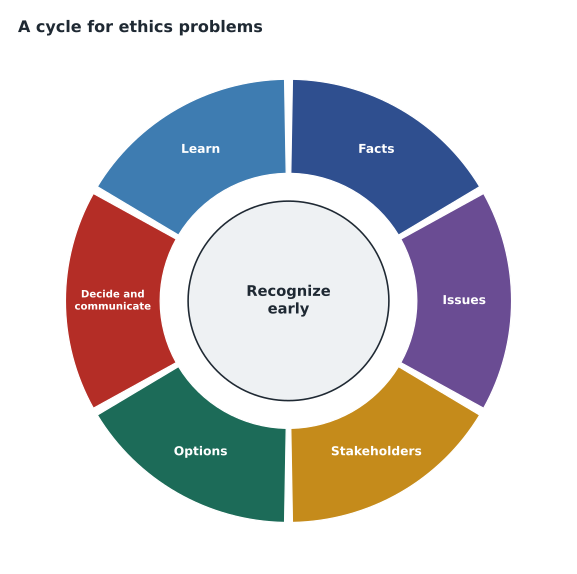
| Step | Questions to answer |
|---|---|
| Facts | What do I know? What am I assuming? |
| Issues | Which laws, policies and ethical principles are involved? |
| Stakeholders | Who is affected, and what do they each need? |
| Options | What could I do? How does each option test? |
| Decide and communicate | What will I do, and how will I explain it to each person involved? |
| Learn | What should change so this is easier next time? |
The last step is often skipped. In both cases, the people involved changed something lasting: a line in the sales code about side agreements, and a standard for doorbuster ads. Good organizations turn individual ethical problems into better systems, so the next person faces less pressure.
Taking the course into the field
The cases in this course were resolved well because someone noticed a problem early and raised it, and because the people around them responded with facts rather than blame. Neither is guaranteed. In your first year in sales, you will face pressure you did not expect, from targets, from customers and sometimes from managers. A short checklist, drawn from the whole course, can help you prepare.
| Before you sell | While you sell | After you sell |
|---|---|---|
| Read your company's code, gifts policy and approval matrix | Quote only approved, substantiated claims | Confirm what was agreed in writing |
| Learn the consumer protection rules for your products | Never discuss prices or bids with competitors | Record conflicts, gifts and special prices |
| Check consent before any email, text or call campaign | Disclose conflicts as soon as they arise | Correct mistakes quickly |
| Know who your legal and privacy contacts are | Slow down for customers who seem confused | Raise concerns with facts, early |
Sales careers are built on reputations, and reputations are built one conversation at a time. The rules in this course protect customers and companies, but they also protect sellers: from lawsuits, from discipline and from becoming someone they did not set out to be.
Above all, the course has argued that the honest path and the successful path are usually the same path over any reasonable length of time. When they seem to diverge, that is the moment to slow down, use the method and ask for help.
Common mistakes
MistakeIf my manager asks, it must be acceptable.
InsteadManagers can be wrong under pressure; raise the concern with facts and propose an alternative.
MistakeA side email is a harmless way to close faster.
InsteadSide agreements contradict the contract, distort revenue and can mislead owners and lenders.
MistakeRefusing is enough.
InsteadOffer a legitimate alternative that meets the real goal where you can.
MistakeLimited-quantity deals are bait and switch.
InsteadThey are legitimate when quantities are disclosed and customers are not steered dishonestly.
MistakeOnce the problem is solved, the case is closed.
InsteadChange the system, such as the code or ad standards, so the problem is less likely next time.
Summary and key terms
- Real ethics problems often combine several issues at once, such as contracts, accounting, gifts and honesty.
- Separate facts from assumptions, list the issues, identify stakeholders and test the options.
- Revenue should reflect real contracts; side agreements that allow free cancellation distort results.
- When disagreeing with a manager, start from the shared goal, state the concern as facts and propose a legitimate alternative.
- Limited-quantity promotions must disclose limits and must not be used to switch customers dishonestly.
- End every case by improving the system so the next person faces less pressure.
- Side agreement
- A promise outside the written contract that changes its terms, such as a free cancellation right.
- Revenue recognition
- The accounting rules for when a sale can be recorded as revenue.
- Price hold
- A written commitment to keep prices for orders placed by a stated date.
- Bait and switch
- Advertising a bargain not available in reasonable quantities in order to sell something more expensive.
Practice problems
Work each problem on paper first, then reveal the answer to check.
Why might Keystone's contract with a free cancellation side email not count as a sale for revenue purposes?
Show answer
Because the customer can walk away freely, so there may be no genuine, enforceable contract yet.
What alternative did Maya offer, and what was it worth to Keystone?
Show answer
A written price hold until January 31, worth about 1,920 dollars, 4 per cent of 48,000.
What two changes made the doorbuster ad acceptable?
Show answer
Disclosing the limited quantity and not steering customers dishonestly to a more expensive model.
Lesson quiz · 5 questions
Score 60% or more to complete this lesson.
Create a free account to save your progress, take quizzes and earn a certificate.