
SLS-140 · Lesson 4 of 12 · 19 min
Pipelines and stages
▶ Video coming soon A video version of this lesson is on the way.
At the start of October, Darnell Brooks sat down with Maya for her first full pipeline review. Her pipeline view in the CRM showed eleven open opportunities spread across five columns, with a total value of a little over 240,000 dollars. Darnell did not start with the total. He started with the oldest card in the Propose column: a printer and furniture package for Halverson Law that had been sitting there for seven weeks. 'What has to happen for this to move to Negotiate?' he asked. Maya explained that Ruth Halverson liked the proposal but Tom Ostrowski, the finance manager, had not yet seen the lease terms. 'Then the next step isn't "follow up",' Darnell said. 'It's "send Tom the lease terms and book fifteen minutes with him". Put that in, with a date.'
A pipeline is the set of a seller's or team's open opportunities, organized by the stage each has reached in the sales process. Pipelines are the most-viewed screen in most business CRMs, and the most misunderstood. This lesson explains what stages are, how to define them so they mean something, how deals move between them, and how to keep a pipeline honest. The numbers that managers build from pipelines, such as conversion rates, sales velocity and weighted forecasts, are the subject of SLS-214 Sales Analytics and Forecasting; this lesson stays with the pipeline as a working tool for the seller.
Stages describe the buyer's progress
A stage is a named step in the sales process. Each opportunity is in exactly one stage at a time. The stages a company uses should reflect its own sales process, and that process should follow how its customers actually buy. SLS-101 described the buyer's journey and the sales process; a CRM pipeline is the place where that process is made concrete.
The most useful stage definitions describe what the buyer has done or agreed to, not what the seller has done. "Proposal sent" tells you the seller did something. "Buyer has reviewed the proposal with the decision maker" tells you the deal has actually progressed. The difference matters because sellers can always do more activity, but a deal only moves when the buyer moves.
| Stage | Exit criteria: what must be true to move on | Typical seller work in this stage |
|---|---|---|
| Qualify | A real need is confirmed, the decision maker is known, and there is a rough budget and timeframe | First conversation, basic research, qualifying questions |
| Discover | The buyer has described the problem and its impact, and agreed to see a recommendation | Discovery meeting, site visit, stakeholder mapping |
| Propose | The decision maker has reviewed the proposal and price, and raised any concerns | Proposal, presentation or demonstration, quote |
| Negotiate | Terms are agreed in principle and the buyer has started their approval or paperwork | Answering questions, adjusting terms, working with procurement or finance |
| Closed Won | The contract or order is signed | Handover to account management and installation |
| Closed Lost | The buyer has chosen another option or decided not to buy | Record the reason; agree whether and when to check back |
Each stage has exit criteria: conditions that must be met before an opportunity moves to the next stage. Exit criteria make stages comparable across sellers. When Maya and another account executive both have a deal in Propose, Darnell knows both buyers have actually reviewed a proposal, not just that a document was emailed.
Most CRMs let companies attach a default probability to each stage, such as 10 in 100 for Qualify or 75 in 100 for Negotiate, and use it to weight the pipeline. These figures are rough averages at best, and SLS-214 explains why many sales teams treat them with caution. For now, the important point is that stages are a description of progress, and the description is only useful if it is true.
Views of the pipeline
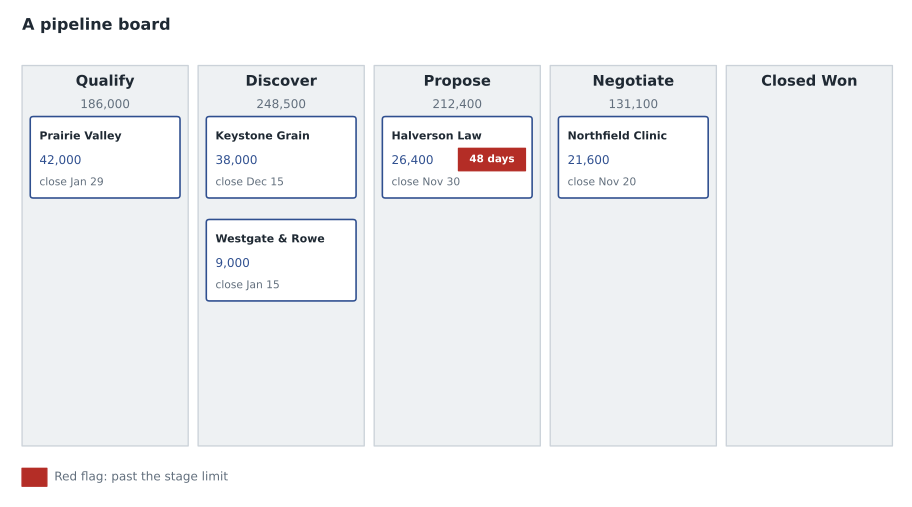
CRMs show the pipeline in several ways. A board or kanban view shows each stage as a column with opportunities as cards, which a seller can drag from one column to the next. A list view shows opportunities as rows with columns for amount, close date, stage and next step, which is better for sorting and editing many records quickly. A chart view shows totals by stage, owner or month. Sellers usually work from the board or list; managers often start from the chart and then open individual deals.
Whatever the view, a seller should be able to answer four questions about every opportunity at a glance: what stage it is in, what it is worth, when it is expected to close and what the next step is. If any of those is missing or out of date, the pipeline is not telling the truth.
Moving deals forward, and backward
An opportunity should move forward when its exit criteria are met, and not before. A common temptation is to move a deal forward because the seller feels optimistic, or because the end of the month is near and the manager wants to see more in the later stages. Darnell's answer to "Can I move this to Negotiate?" is always the same question: "What did the buyer do?"
Deals can also move backward. If Ridgeline sends a proposal and the decision maker then asks to revisit the requirements because the clinic's plans have changed, the honest stage is Discover again. Moving a deal backward feels like failure, but it is accurate, and it prompts the right next step. A pipeline in which deals only ever move forward is usually a pipeline where stages are not being taken seriously.
When a deal is lost, the seller should close it as lost promptly and record why. Ridgeline uses a picklist of loss reasons (price, chose a competitor, no decision or chose to do nothing, timing, product fit, relationship, other) plus a short note. Loss reasons are one of the most useful sources of insight in the whole CRM, but only if sellers record them honestly. "No decision" is common in business sales: many deals are lost not to a competitor but to the buyer deciding to keep things as they are.
Stale deals and pipeline hygiene
A stale deal is an opportunity that has stopped moving: it has been in the same stage much longer than usual, its close date has passed, or nobody has had contact with the buyer for weeks. Stale deals make the pipeline look bigger than it is, hide real problems and distract sellers from deals that can be won.
Ridgeline sets a stage limit for each stage based on how long deals usually spend there: 21 days in Qualify, 30 in Discover, 30 in Propose and 21 in Negotiate. The CRM flags any deal past its limit. A flag does not mean the deal is dead; large projects legitimately take longer. It means the seller needs to look at it and decide: update the next step and close date, move the stage back, or close the deal as lost.
Worked problem
Cleaning up a pipeline
On October 1, Maya's pipeline has 11 open opportunities worth a total of 243,600 dollars. Darnell's review finds: 2 deals whose close dates passed in August with no contact since (worth 18,200 and 9,800 dollars), which Maya agrees to close as lost; and 1 deal worth 31,500 dollars in Propose where the buyer has asked to revisit requirements, which moves back to Discover. What is the open pipeline after the clean-up, and how much value sits in Propose and later stages, if before the review those stages held 132,900 dollars including the deal that moved back?
Show solution
- Value closed as lost: 18,200 plus 9,800.
- \[18200 + 9800 = 28000\]
- Open pipeline after closing those deals.
- \[243600 - 28000 = 215600\]
- The deal moving back does not change the total, only where it sits.
- Propose and later stages before the review held 132,900 dollars, including the 31,500-dollar deal that moved back to Discover. The two lost deals were in Qualify and Discover, so they do not affect this figure.
- \[132900 - 31500 = 101400\]
Answer: Maya's open pipeline is 215,600 dollars in 9 opportunities, with 101,400 dollars in Propose or later. It is smaller than before, and much more believable.
Darnell was pleased with the smaller number. 'I'd rather plan from 215,000 we believe than 243,000 we don't,' he said. Pipeline hygiene, the habit of keeping stages, amounts, dates and next steps current, is easiest as a weekly routine. Many sellers set aside half an hour at the end of each week to go through every open opportunity. Lesson 12 builds this routine into the lab.
Close dates and amounts
Two fields cause most pipeline problems: the close date and the amount. Close dates drift because sellers enter optimistic dates and then push them back a month at a time. Some CRMs record every change to the close date, and a deal whose close date has been pushed four times is telling a story. Amounts drift because the first estimate is a guess and the final quote is different. Ridgeline asks sellers to update the amount whenever a quote changes, and to record the total contract value before tax so that a 36-month lease and a one-time furniture purchase can be compared fairly. Some companies also record monthly or annual recurring revenue for subscription products such as Ridgeline's RoomFlow booking software; which measure to use is a decision for sales operations, and the important thing is consistency.
Pipelines for different kinds of sales
One pipeline rarely fits every kind of deal. A company that sells both quick transactional sales and long projects often keeps separate pipelines, each with its own stages. Ridgeline has two: a project pipeline for deals like the Keystone room project, with the stages shown above, and a renewal pipeline for lease renewals and subscription renewals, with stages such as Renewal identified, Customer reviewed, Terms agreed and Renewed. Renewals start in the CRM automatically 180 days before a lease end date, using the installed-equipment records from lesson 3.
Juniper & Pine does not use a pipeline for everyday floor sales, which usually close the same day. It does use something similar for large special orders and for interior design consultations: Consultation booked, Design presented, Deposit taken, Order placed and Delivered. Aiden's best sale of the summer, a living room and dining room package for a couple renovating their house, moved through all five stages over six weeks, and the clienteling app reminded him at each step.
The pipeline as a conversation tool
A good pipeline review is a coaching conversation, not an inspection. Darnell's reviews follow a pattern that many sales managers use: look first at the deals that matter most (largest, closest to closing or most at risk), ask what the buyer has done and what the next step is, check that the stage matches the evidence, and agree on specific help. In Maya's October review, the help was concrete: Darnell offered to join the call with Tom Ostrowski at Halverson Law, because he had worked with the firm's finance team on a previous lease.
For the seller, the pipeline is also a planning tool. Sorting open opportunities by next-step date shows what needs attention this week. Looking at how much is in each stage shows whether there is enough early-stage work to replace the deals that will close or be lost next month. A seller with a full Propose column and an empty Qualify column has a problem that will arrive in about two months.
Common mistakes
MistakeStages describe what the seller has done.
InsteadGood stages describe what the buyer has done or agreed to.
MistakeA deal should move forward when the seller feels confident.
InsteadMove a deal forward only when the stage's exit criteria are met.
MistakeMoving a deal backward is a failure that should be avoided.
InsteadMoving a deal back when the situation changes keeps the pipeline honest and prompts the right next step.
MistakeOld deals should be kept open in case they come back.
InsteadClose stale deals as lost with a reason and, if useful, a task to check back later.
MistakeA bigger pipeline is always better.
InsteadA smaller, accurate pipeline is more useful than a large one full of stale deals.
Summary and key terms
- A pipeline is the set of open opportunities organized by stage.
- Stages should describe the buyer's progress and have clear exit criteria.
- Every opportunity should show its stage, amount, close date and next step.
- Deals move forward when exit criteria are met, move backward when the situation changes, and are closed as lost with an honest reason.
- Stage limits help sellers spot stale deals; weekly pipeline hygiene keeps the pipeline believable.
- Different kinds of sales may need separate pipelines, and pipeline reviews work best as coaching conversations.
- Pipeline
- The set of open opportunities, organized by the stage each has reached.
- Stage
- A named step in the sales process; each opportunity is in one stage at a time.
- Exit criteria
- The conditions that must be true before an opportunity moves to the next stage.
- Stale deal
- An opportunity that has stopped moving.
- Stage limit
- The number of days after which a deal in a stage is flagged for review.
- Pipeline hygiene
- The routine of keeping stages, amounts, close dates and next steps current.
- Loss reason
- The recorded reason a deal was lost, such as price, competitor or no decision.
Practice problems
Work each problem on paper first, then reveal the answer to check.
Rewrite the stage "Demo given" so that it describes the buyer's progress.
Show answer
For example: "Decision maker has seen a demonstration and confirmed it addresses the problem."
A pipeline of 180,000 dollars has 3 stale deals worth 12,000, 7,500 and 20,500 dollars closed as lost. What remains?
Show answer
180,000 minus 40,000 is 140,000 dollars.
Why does Ridgeline keep a separate renewal pipeline?
Show answer
Renewals follow different steps from new projects, and they start automatically from lease end dates.
What does a full Propose column with an empty Qualify column warn the seller about?
Show answer
There will soon be too few deals to replace the ones that close or are lost; the seller needs to prospect now.
Lesson quiz · 5 questions
Score 60% or more to complete this lesson.
Create a free account to save your progress, take quizzes and earn a certificate.